Exercise 1
Consider a light beam incident from air to a glass slab at Brewster's angle as shown in Fig. 10.1.
A polaroid is placed in the path of the emergent ray at point P and rotated about an axis passing through the centre and perpendicular to the plane of the polaroid.
(a)
For a particular orientation there shall be darkness as observed through the polaoid.
(b)
The intensity of light as seen through the polaroid shall be independent of the rotation.
(c)
The intensity of light as seen through the Polaroid shall go through a minimum but not zero for two orientations of the polaroid.
(d)
The intensity of light as seen through the polaroid shall go through a minimum for four orientations of the polaroid.

NCERT’s answer
(c)
(c) Only the reflected ray is fully polarised; the emergent ray is partially polarised, so the minimum is non-zero, twice per turn.\[\tan\theta_B=n \]\[I(\varphi)=I_\parallel\cos^2\varphi+I_\perp\sin^2\varphi,\qquad I_\parallel>I_\perp>0 \]\[I_{\max}=I_\parallel\ \ (\varphi=0^\circ,\,180^\circ),\qquad I_{\min}=I_\perp\neq0\ \ (\varphi=90^\circ,\,270^\circ) \]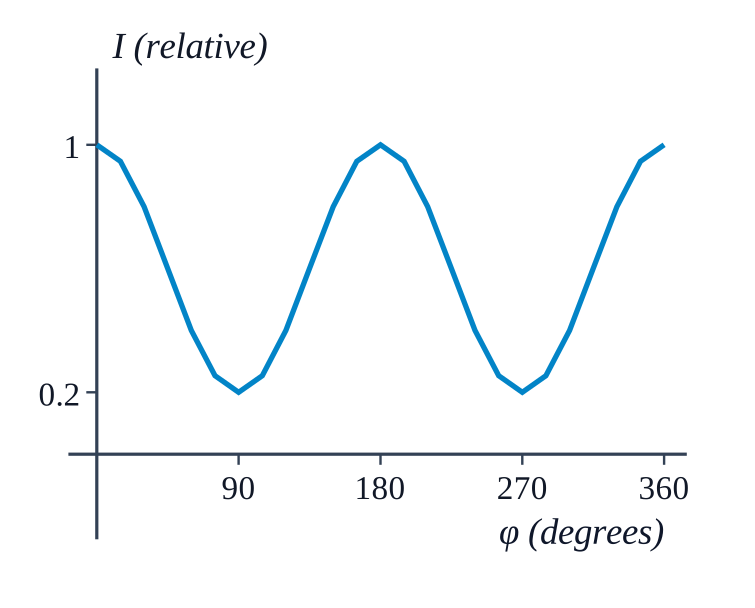 \(\displaystyle \varphi\): polaroid axis from the plane of incidence; \(\displaystyle I_\perp<I_\parallel\) as reflection removes only \(\displaystyle E_\perp\).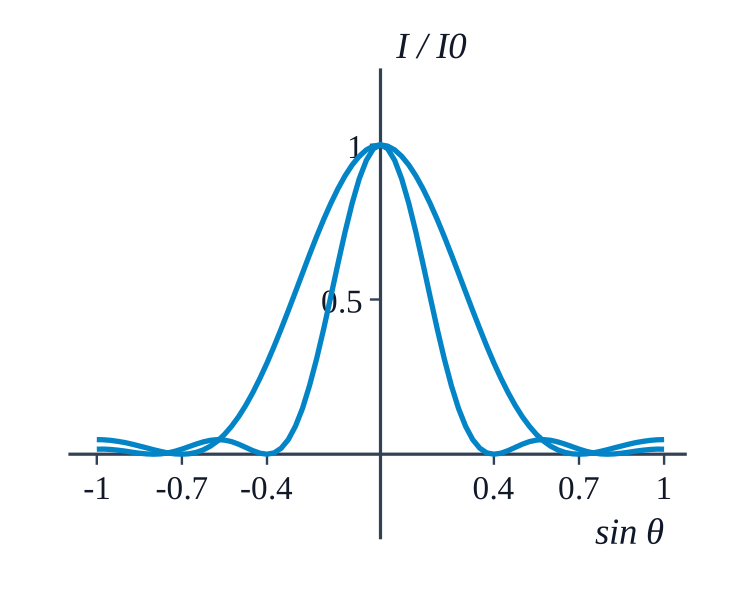
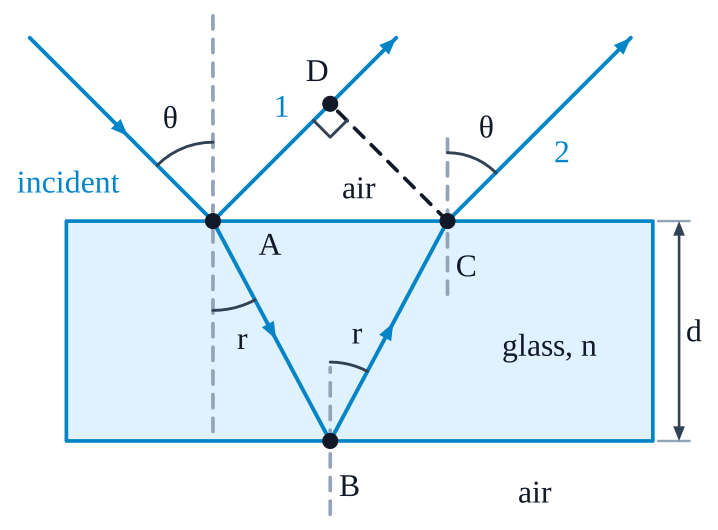 \[\sin\theta=n\sin r\ \Rightarrow\ \cos r=\left(1-\frac{1}{n^2}\sin^2\theta\right)^{1/2} \]\[n\,(AB+BC)-AD=\frac{2nd}{\cos r}-2d\tan r\,\sin\theta=2nd\cos r \]\[\delta=\frac{2\pi}{\lambda_0}\,(2nd\cos r)+\pi=\frac{4\pi d}{\lambda}\left(1-\frac{1}{n^2}\sin^2\theta\right)^{1/2}+\pi,\qquad \lambda=\frac{\lambda_0}{n} \]
