SolveIt is under development
SolveItClass 12 · Exemplar

NCERT Exemplar · Class 12 Physics Wave Optics

23 questions

Multiple Choice Questions (Type II) 6–9 (part 2 of 5)

  1. Exercise 6

    Two source S1\displaystyle \mathrm{S}_1 and S2\displaystyle \mathrm{S}_2 of intensity I1\displaystyle I_1 and I2\displaystyle I_2 are placed in front of a screen [Fig. 10.3\displaystyle 10.3 (a)]. The patteren of intensity distribution seen in the central portion is given by Fig. 10.3\displaystyle 10.3 (b).
    In this case which of the following statements are true.
    (a)
    S1\displaystyle \mathrm{S}_1 and S2\displaystyle \mathrm{S}_2 have the same intensities.
    (b)
    S1\displaystyle \mathrm{S}_1 and S2\displaystyle \mathrm{S}_2 have a constant phase difference.
    (c)
    S1\displaystyle \mathrm{S}_1 and S2\displaystyle \mathrm{S}_2 have the same phase.
    (d)
    S1\displaystyle \mathrm{S}_1 and S2\displaystyle \mathrm{S}_2 have the same wavelength.
    NCERT_Question_Class12_Physics_Exemplar_Ch10_Q6
    NCERT_Question_Class12_Physics_Exemplar_Ch10_Q6_2
    (a), (b), (c), (d)Dark fringes reach zero, the pattern is steady, and the central bright fringe sits at \(\displaystyle x=0\), equidistant from both sources.\[I = I_1 + I_2 + 2\sqrt{I_1 I_2}\,\cos\phi \]\[I_{\min} = \left(\sqrt{I_1}-\sqrt{I_2}\right)^2 = 0 \;\Rightarrow\; I_1 = I_2 \]\[\text{steady fringes} \Rightarrow \phi\ \text{constant in time} \Rightarrow \text{same frequency, same } \lambda \]\[x=0:\ \text{path difference}=0,\ I=I_{\max} \;\Rightarrow\; \cos\phi = 1 \;\Rightarrow\; \text{sources in phase} \]
  2. Exercise 7

    Consider sunlight incident on a pinhole of width 103A\displaystyle 10^3 \mathrm{A}. The image of the pinhole seen on a screen shall be
    (a)
    a sharp white ring.
    (b)
    different from a geometrical image.
    (c)
    a diffused central spot, white in colour.
    (d)
    diffused coloured region around a sharp central white spot.
    NCERT’s answer
    (b), (d)
    (b), (d)The hole is smaller than the wavelength, so diffraction replaces the geometrical image.\[a = 10^{3}\,\mathrm{\AA} = 10^{-7}\,\mathrm{m} \;<\; \lambda_{\text{visible}} \approx (4\text{--}7)\times10^{-7}\,\mathrm{m} \]\[\theta = 0:\ \text{path difference}=0\ \text{for every } \lambda \;\Rightarrow\; \text{white centre} \]\[\theta \neq 0:\ \text{position depends on } \lambda \;\Rightarrow\; \text{coloured region around it} \]
  3. Exercise 8

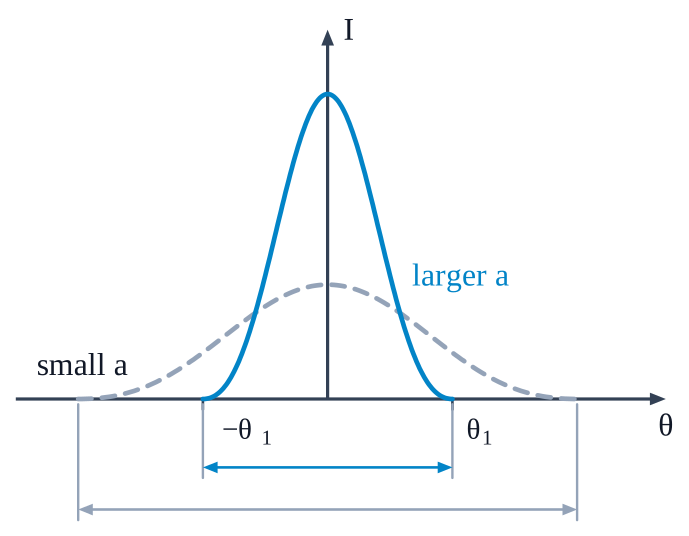
    Consider the diffraction patern for a small pinhole. As the size of the hole is increased
    (a)
    the size decreases.
    (b)
    the intensity increases.
    (c)
    the size increases.
    (d)
    the intensity decreases.
    NCERT’s answer
    (a), (b)
    (a), (b)A bigger hole narrows the central maximum and passes more light into it.\[\theta_1 \approx \frac{1.22\,\lambda}{a},\qquad a\uparrow \;\Rightarrow\; \theta_1\downarrow \;\Rightarrow\; \text{size}\downarrow \]\[P = I_0\,\frac{\pi a^{2}}{4},\qquad a\uparrow \;\Rightarrow\; P\uparrow \text{ into a smaller spot} \;\Rightarrow\; I\uparrow \]NCERT_Solution_Class12_Physics_Exemplar_Ch10_Q8
  4. Exercise 9

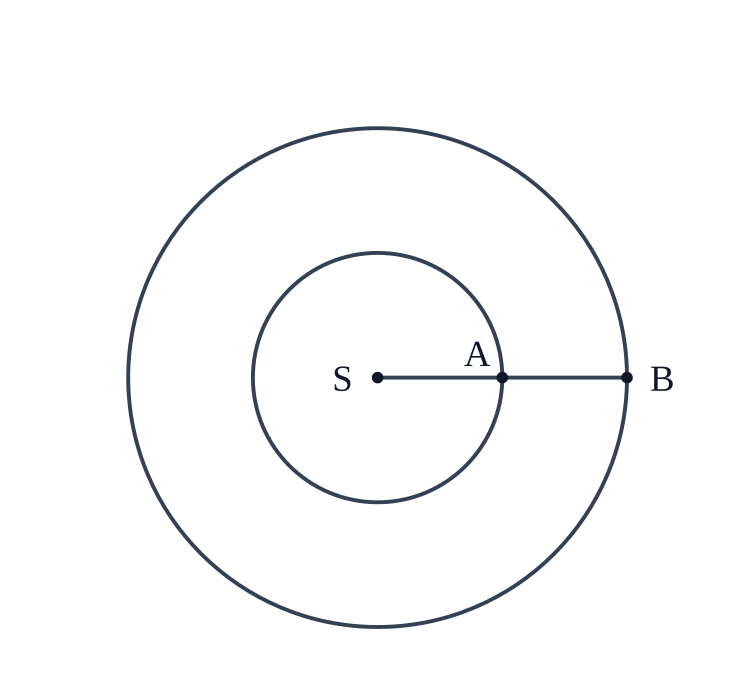
    For light diverging from a point source
    (a)
    the wavefront is spherical.
    (b)
    the intensity decreases in proportion to the distance squared.
    (c)
    the wavefront is parabolic.
    (d)
    the intensity at the wavefront does not depend on the distance.
    NCERT’s answer
    (a), (b)
    (a), (b)Wavefronts from a point source are spheres centred on it; intensity falls with the inverse square of distance, so (c) and (d) fail.NCERT_Solution_Class12_Physics_Exemplar_Ch10_Q9\[I = \frac{P}{4\pi r^{2}} \;\Rightarrow\; r\to 2r:\ \ I \to \frac{I}{4} \]