SolveIt is under development
SolveItClass 12 · Exemplar

NCERT Exemplar · Class 12 Physics Wave Optics

23 questions

Short Answer Questions 16–19 (part 4 of 5)

  1. Exercise 16

    Can reflection result in plane polarised light if the light is incident on the interface from the side with higher refractive index?
    NCERT’s answer
    Polarisation by reflection occurs when the angle of incidence is the Brewster's angle i.e. \(\displaystyle \tan \theta_B=\frac{n_2}{n_1}\) where \(\displaystyle n_2<n_1\). When light travels in such a medium the critical angle is \(\displaystyle \sin \theta_c=\frac{n_2}{n_1}\) where \(\displaystyle n_2<n_1\). As \(\displaystyle \left|\tan \theta_{\mathrm{B}}\right|>\left|\sin \theta_{\mathrm{c}}\right|\) for large angles, \(\displaystyle \theta_{\mathrm{B}}<\theta_{\mathrm{C}}\). Thus, polarisation by reflection shall definitely occur.
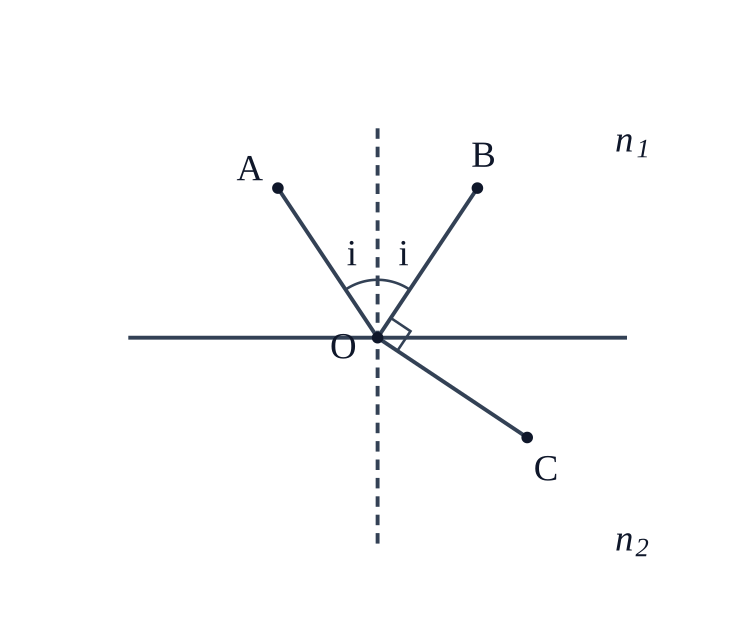
    Yes. At the Brewster angle the reflected ray is plane polarised, vibrating perpendicular to the plane of incidence, even when the light travels from the denser to the rarer medium.\[\tan i_B=\frac{n_2}{n_1},\qquad n_1>n_2 \]NCERT_Solution_Class12_Physics_Exemplar_Ch10_Q16\[i_B+r=90^\circ \quad\text{(reflected} \perp \text{refracted)} \]Refraction must still occur, so \(\displaystyle i_B\) must stay below the critical angle:\[\sin\theta_c=\frac{n_2}{n_1}=\tan i_B \;\Rightarrow\; \sin i_B<\sin\theta_c \;\Rightarrow\; i_B<\theta_c \]Glass to air (\(\displaystyle n_1=1.5,\ n_2=1\)):\[i_B=\tan^{-1}\!\left(\frac{1}{1.5}\right)=33.7^\circ<\theta_c=\sin^{-1}\!\left(\frac{1}{1.5}\right)=41.8^\circ \]Answer: Yes, at \(\displaystyle i_B=\tan^{-1}(n_2/n_1)\), which is less than the critical angle, the reflected light is completely plane polarised.
  2. Exercise 17

    For the same objective, find the ratio of the least separation between two points to be distinguished by a microscope for light of 5000A˚\displaystyle 5000 \AA and electrons accelerated through 100V used as the illuminating substance.
    NCERT’s answer
    \(\displaystyle d_{\text {min }}=\frac{1.22 \lambda}{2 \sin \beta}\) where \(\displaystyle \beta\) is the angle subtended by the objective at the object. For light of \(\displaystyle 5500 \AA\) \[d_{\min }=\frac{1.22 \times 5.5 \times 10^{-7}}{2 \sin \beta} \mathrm{~m} \] For electrons accelerated through 100V the deBroglie wavelength is \[\begin{aligned} & \lambda=\frac{h}{p}=\frac{1.227}{\sqrt{100}}=0.13 \mathrm{~nm}=0.13 \times 10^{-9} \mathrm{~m} \\ & \therefore d_{\min }^{\prime}=\frac{1.22 \times 1.3 \times 10^{-10}}{2 \sin \beta} \end{aligned} \] \[\begin{aligned} & \therefore d_{\min }^{\prime}=\frac{1.22 \times 1.3 \times 10^{-10}}{2 \sin \beta} \\ & \frac{d_{\min }^{\prime}}{d_{\min }}=\frac{1.3 \times 10^{-10}}{5.5 \times 10^{-7}} \sim 0.2 \times 10^{-3} \end{aligned} \]
    \[d_{\min}=\frac{1.22\,\lambda}{2\mu\sin\beta} \]The same objective (same \(\displaystyle \mu\sin\beta\)) leaves only \(\displaystyle \lambda\) changing:\[\frac{d_{\text{light}}}{d_{\text{electron}}}=\frac{\lambda_{\text{light}}}{\lambda_e} \]\[\lambda_e=\frac{h}{\sqrt{2meV}}=\frac{6.63\times10^{-34}}{\sqrt{2\,(9.11\times10^{-31})(1.6\times10^{-19})(100)}}\ \mathrm{m}=1.23\times10^{-10}\ \mathrm{m} \]\[\frac{d_{\text{light}}}{d_{\text{electron}}}=\frac{5000\times10^{-10}\ \mathrm{m}}{1.23\times10^{-10}\ \mathrm{m}}\approx 4.1\times10^{3} \]Answer: \(\displaystyle d_{\text{light}} : d_{\text{electron}} \approx 4\times10^{3}\), so the electron microscope resolves about four thousand times finer detail.
  3. Exercise 18

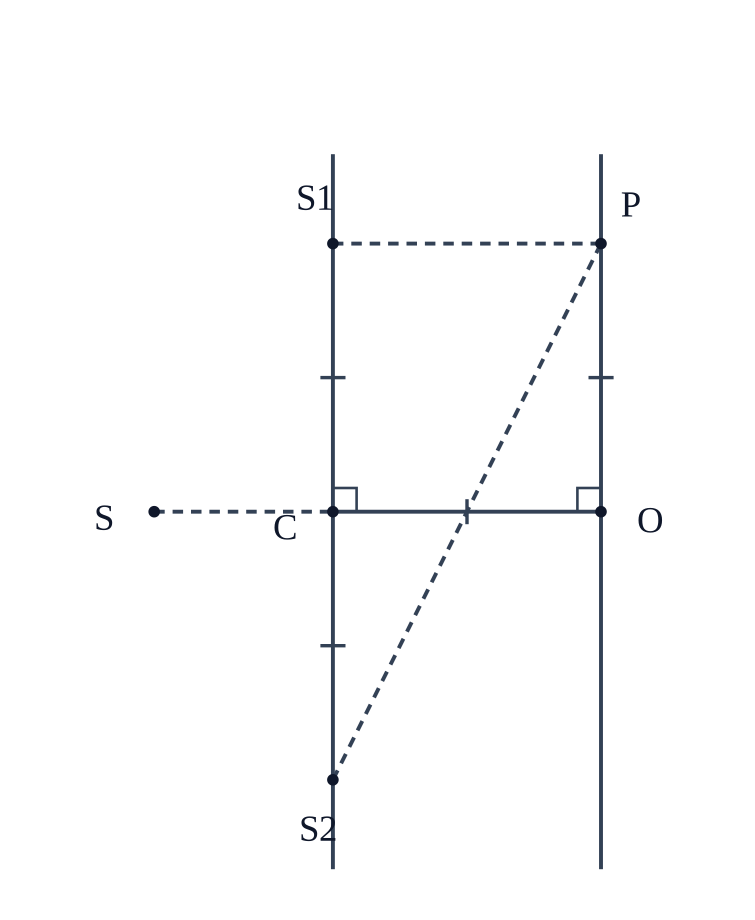
    Consider a two slit interference arrangements (Fig. 10.4\displaystyle 10.4) such that the distance of the screen from the slits is half the distance between the slits. Obtain the value of D\displaystyle D in terms of λ\displaystyle \lambda such that the first minima on the screen falls at a distance D\displaystyle D from the centre O. NCERT_Question_Class12_Physics_Exemplar_Ch10_Q18
    Slits at \(\displaystyle \pm D\) from the axis, screen at distance \(\displaystyle D\), first minimum at \(\displaystyle P\) with \(\displaystyle OP=D\).NCERT_Solution_Class12_Physics_Exemplar_Ch10_Q18\[S_1P=\sqrt{D^2+(D-D)^2}=D \]\[S_2P=\sqrt{D^2+(D+D)^2}=\sqrt5\,D \]\[\Delta=S_2P-S_1P=(\sqrt5-1)\,D \]Caution: the slit separation \(\displaystyle 2D\) is not small compared with the screen distance \(\displaystyle D\), so \(\displaystyle \Delta=\dfrac{dx}{D_{\text{screen}}}\) fails. Use the exact path lengths.First minimum, \(\displaystyle \Delta=\dfrac{\lambda}{2}\):\[(\sqrt5-1)\,D=\frac{\lambda}{2} \;\Rightarrow\; D=\frac{\lambda}{2(\sqrt5-1)}=\frac{(\sqrt5+1)\,\lambda}{8} \]Answer: \(\displaystyle D=\dfrac{\lambda}{2(\sqrt5-1)}\approx 0.40\,\lambda\)
  4. Exercise 19

    Figure 10.5\displaystyle 10.5 shown a two slit arrangement with a source which emits unpolarised light. P is a polariser with axis whose direction is not given. If I0\displaystyle I_0 is the intensity of the principal maxima when no polariser is present, calculate in the present case, the intensity of the principal maxima as well as of the first minima. NCERT_Question_Class12_Physics_Exemplar_Ch10_Q19
    NCERT’s answer
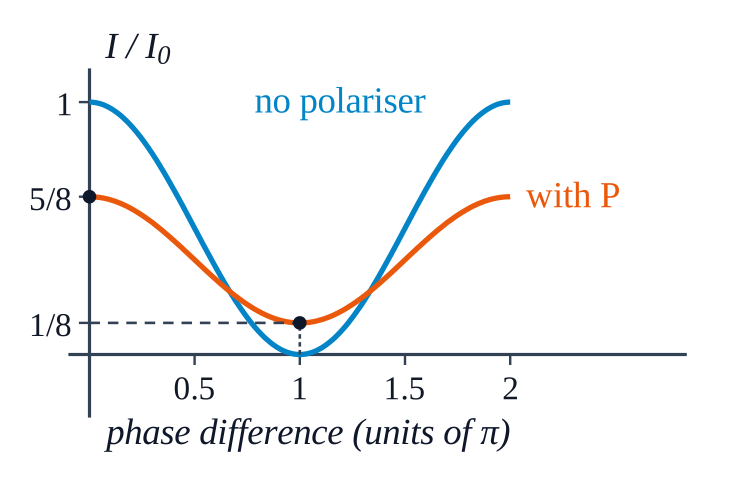
    Without P: \[\begin{aligned} & A=A_{\perp}+A_{11} \\ & A_{\perp}=A_{\perp}^1+A_{\perp}^2=A_{\perp}^0 \sin (k x-\omega t)+A_{\perp}^0 \sin (k x-\omega t+\phi) \\ & A_{11}=A_{11}^{(1)}+A_{11}^{(2)} \\ & A_{11}=A_{11}^0[\sin (k x-w t)+\sin (k x-\omega t+\phi] \end{aligned} \] where \(\displaystyle \mathrm{A}_{\perp}^0, \mathrm{~A}_{11}^0\) are the amplitudes of either of the beam in \(\displaystyle \perp\) and $\displaystyle 11$ polarizations. \[\begin{aligned} & \therefore \text { Intensity }= \\ & =\left\{\left|A_{\perp}^0\right|^2+\left|A_{11}^0\right|^2\right\}\left[\sin ^2(k x-w t)\left(1+\cos ^2 \phi+2 \sin \phi\right)+\sin ^2(k x-\omega t) \sin ^2 \phi\right]_{\text {average }} \\ & =\left\{\left|A_{\perp}^0\right|^2+\left|A_{11}^0\right|^2\right\}\left(\frac{1}{2}\right) . 2(1+\cos \phi) \end{aligned} \] \[=2\left|\mathrm{~A}_{\perp}^0\right|^2 .(1+\cos \phi) \text { since }\left|\mathrm{A}_{\perp}^0\right|_{\text {average }}=\left|\mathrm{A}_{11}^0\right|_{\text {average }} \] With P: Assume \(\displaystyle \mathrm{A}_{\perp}^2\) is blocked: \[\begin{aligned} & \text { Intensity }=\left(A_{11}^1+A_{11}^2\right)^2+\left(A_{\perp}^1\right)^2 \\ & =\left|A_{\perp}^0\right|^2(1+\cos \phi)+\left|A_{\perp}^0\right|^2 . \frac{1}{2} \end{aligned} \] Given: \(\displaystyle I_0=4\left|\mathrm{~A}_{\perp}^0\right|^2=\) Intensity without polariser at principal maxima. Intensity at principal maxima with polariser \[\begin{aligned} & =\left|\mathrm{A}_{\perp}^0\right|^2\left(2+\frac{1}{2}\right) \\ & =\frac{5}{8} \mathrm{I}_0 \end{aligned} \] Intensity at first minima with polariser \[\begin{aligned} & =\left|\mathrm{A}_{\perp}^0\right|^2(1-1)+\frac{\left|\mathrm{A}_{\perp}^0\right|^2}{2} \\ & =\frac{I_0}{8} . \end{aligned} \]
    Unpolarised light is two independent, perpendicular components. Beam $\displaystyle 2$ passes only the component along the axis of P, so only that one interferes. Let \(\displaystyle \delta\) be the phase difference.One slit alone gives \(\displaystyle I_s\); without P:\[I_0=4I_s \;\Rightarrow\; I_s=\frac{I_0}{4} \]Component along the axis, \(\displaystyle I_s/2\) in each beam:\[I_{\parallel}=2\left(\frac{I_s}{2}\right)\left(1+\cos\delta\right)=2I_s\cos^2\frac{\delta}{2} \]Perpendicular component, beam $\displaystyle 1$ only, so no interference:\[I_{\perp}=\frac{I_s}{2} \]\[I=2I_s\cos^2\frac{\delta}{2}+\frac{I_s}{2} \]NCERT_Solution_Class12_Physics_Exemplar_Ch10_Q19Principal maximum, \(\displaystyle \delta=0\):\[I=2I_s+\frac{I_s}{2}=\frac52 I_s=\frac58 I_0 \]First minimum, \(\displaystyle \delta=\pi\):\[I=0+\frac{I_s}{2}=\frac18 I_0 \]Answer: Principal maximum \(\displaystyle \dfrac58 I_0\); first minimum \(\displaystyle \dfrac18 I_0\), not zero.