SolveIt is under development
SolveItClass 12 · Exemplar

NCERT Exemplar · Class 12 Physics Semiconductor Electronics: Materials, Devices and Simple Circuits

40 questions

Very Short Answer Questions 17–22 (part 3 of 5)

  1. Exercise 17

    Why are elemental dopants for Silicon or Germanium usually chosen from group XIII or group XV?
    NCERT’s answer
    The size of dopant atoms should be such as not to distort the pure semiconductor lattice structure and yet easily contribute a charge carrier on forming co-valent bonds with Si or Ge.
    Similar size, so they replace Si/Ge atoms without distorting the lattice.\[\text{Group XV: } 5\,e^- \to 4\ \text{bonds} + 1\ \text{free } e^- \Rightarrow \text{n-type (donor)} \]\[\text{Group XIII: } 3\,e^- \to 3\ \text{bonds} + 1\ \text{hole} \Rightarrow \text{p-type (acceptor)} \]Answer: Similar atomic size, and one valence electron more (XV) or fewer (XIII) than four, giving a free electron or a hole.
  2. Exercise 18

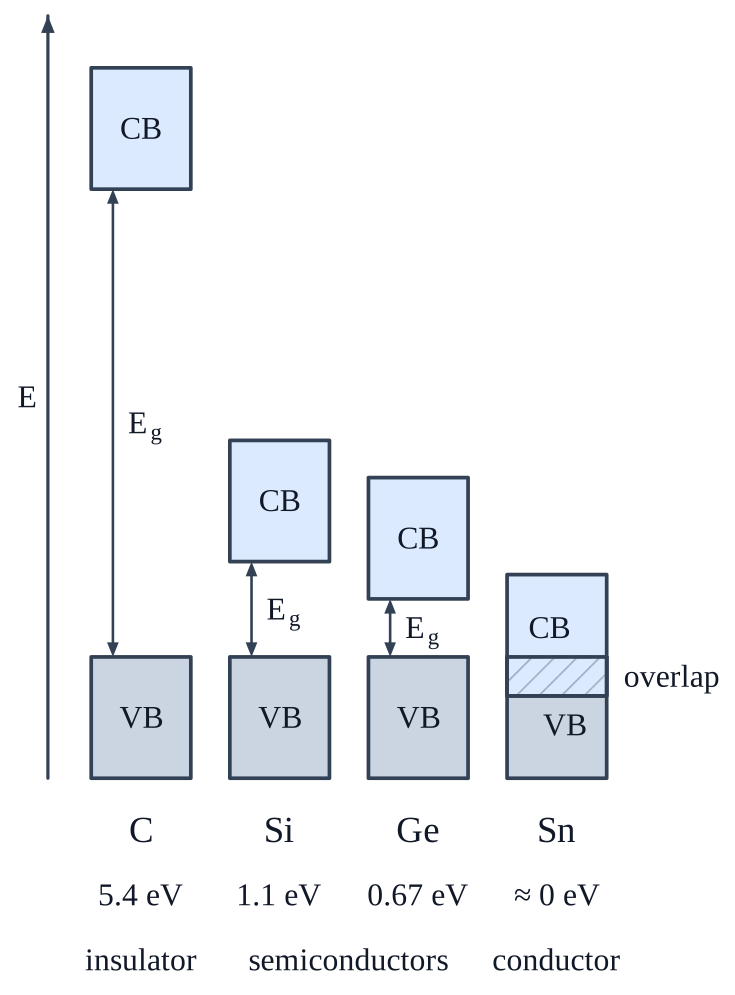
    Sn, C, and Si, Ge are all group XIV elements. Yet, Sn is a conductor, C is an insulator while Si and Ge are semiconductors. Why?
    NCERT’s answer
    The energy gap for Sn is $\displaystyle 0$ eV, for C is $\displaystyle 5.4$ eV, for Si is $\displaystyle 1.1$ eV and for Ge is 0.7eV, related to their atomic size.
    Down the group, atoms grow larger and outer electrons bind less tightly, so the gap shrinks.\[\mathrm{C}:\ E_g \approx 5.4\ \mathrm{eV} \gg k_BT \approx 0.026\ \mathrm{eV} \Rightarrow \text{no free carriers: insulator} \]\[\mathrm{Si,\ Ge}:\ E_g \approx 1.1\ \mathrm{eV},\ 0.67\ \mathrm{eV} \Rightarrow \text{some thermally excited carriers: semiconductor} \]\[\mathrm{Sn}:\ E_g \approx 0 \Rightarrow \text{bands overlap: conductor} \]NCERT_Solution_Class12_Physics_Exemplar_Ch14_Q18Answer: Band gap falls from large (C) to small (Si, Ge) to about zero (Sn).
  3. Exercise 19

    Can the potential barrier across a p-n junction be measured by simply connecting a voltmeter across the junction?
    NCERT’s answer
    No, because the voltmeter must have a resistance very high compared to the junction resistance, the latter being nearly infinite.
    Contact potentials at the voltmeter leads' metal-semiconductor contacts cancel the barrier.\[V_{\text{lead-}p} + V_{0}(p\text{-}n) + V_{n\text{-lead}} = 0 \Rightarrow \text{reading} = 0\ \mathrm{V} \]Answer: No; the barrier is internal, not an emf, and the voltmeter reads zero.
  4. Exercise 20

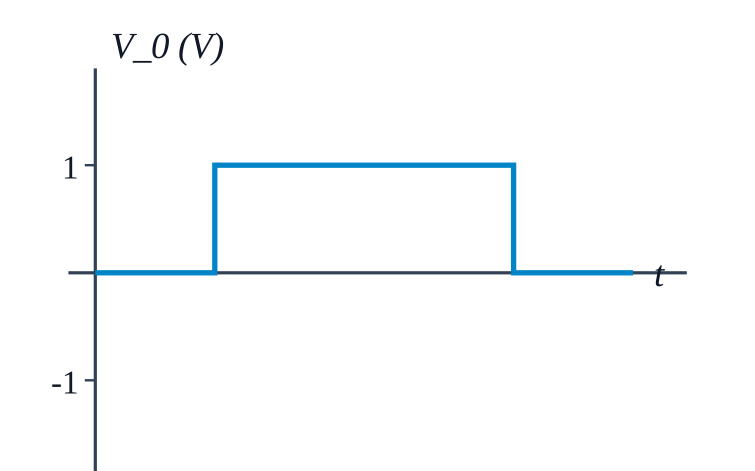
    Draw the output waveform across the resistor (Fig.14.8). NCERT_Question_Class12_Physics_Exemplar_Ch14_Q20
    NCERT’s answer
    NCERT_Solution_Class12_Physics_Exemplar_Ch14_Q20_ncert
    Ideal diode: it conducts only while A is positive.\[V_A = +1\ \mathrm{V}:\ \text{forward biased} \Rightarrow V_0 \approx +1\ \mathrm{V} \]\[V_A = -1\ \mathrm{V}:\ \text{reverse biased} \Rightarrow I \approx 0 \Rightarrow V_0 = IR \approx 0\ \mathrm{V} \]NCERT_Solution_Class12_Physics_Exemplar_Ch14_Q20Answer: Half-wave rectified output: +$\displaystyle 1$ V while the input is +$\displaystyle 1$ V, $\displaystyle 0$ V otherwise.
  5. Exercise 21

    The amplifiers X, Y and Z are connected in series. If the voltage gains of X, Y and Z are 10\displaystyle 10, 20\displaystyle 20 and 30\displaystyle 30, respectively and the input signal is 1\displaystyle 1 mV peak value, then what is the output signal voltage (peak value)
    (i)
    if dc supply voltage is 10V?
    (ii)
    if dc supply voltage is 5V?
    NCERT’s answer
    (i)
    \(\displaystyle 10 \times 20 \times 30 \times 10^{-3}=6 \mathrm{~V}\)
    (ii)
    If dc supply voltage is 5V, the output peak will not exceed \(\displaystyle \mathrm{V}_{\mathrm{cc}}=5 \mathrm{~V}\). Hence, \(\displaystyle \mathrm{V}_0=5 \mathrm{~V}\).
    \[1\ \mathrm{mV} \xrightarrow{\times 10} 10\ \mathrm{mV} \xrightarrow{\times 20} 200\ \mathrm{mV} \xrightarrow{\times 30} 6000\ \mathrm{mV} = 6\ \mathrm{V} \]\[\text{(i) } V_{CC} = 10\ \mathrm{V}:\ 6\ \mathrm{V} < 10\ \mathrm{V} \Rightarrow V_o = 6\ \mathrm{V} \]\[\text{(ii) } V_{CC} = 5\ \mathrm{V}:\ 6\ \mathrm{V} > 5\ \mathrm{V} \Rightarrow V_o \approx 5\ \mathrm{V}\ \text{(clipped)} \]Output can never exceed the dc supply.Answer: (i) $\displaystyle 6$ V; (ii) about $\displaystyle 5$ V, clipped at the supply voltage.
  6. Exercise 22

    In a CE transistor amplifier there is a current and voltage gain associated with the circuit. In other words there is a power gain. Considering power a measure of energy, does the circuit voilate conservation of energy?
    NCERT’s answer
    No, the extra power required for amplified output is obtained from the DC source.
    The extra power comes from the dc supply; the signal only controls it.\[P_{dc} + P_{in} = P_{out} + P_{loss} \Rightarrow P_{out} - P_{in} = P_{dc} - P_{loss} \]Answer: No; energy is conserved because the dc supply provides the gain power.