SolveIt is under development
SolveItClass 12 · Exemplar

NCERT Exemplar · Class 12 Physics Semiconductor Electronics: Materials, Devices and Simple Circuits

40 questions

Short Answer Questions 23–31 (part 4 of 5)

  1. Exercise 23

    (i)
    Name the type of a diode whose characteristics are shown in Fig. 14.9\displaystyle 14.9 (A) and Fig. 14.9\displaystyle 14.9(B).
    (ii)
    What does the point P in Fig. (A) represent?
    (iii)
    What does the points P and Q in Fig. (B) represent?
    NCERT_Question_Class12_Physics_Exemplar_Ch14_Q23
    NCERT’s answer
    (i)
    ZENER junction diode and solar cell.
    (ii)
    Zener breakdown voltage
    (iii)
    Q- short circuit current
    P- open circuit voltage.
    (i) Fig. (a): reverse current shoots up at one reverse voltage \(\displaystyle \Rightarrow\) Zener diode. Fig. (b): curve in the fourth quadrant, current opposite to the applied voltage \(\displaystyle \Rightarrow\) solar cell.(ii) \[\text{P in (a):}\quad V=-V_{Z} \] Reverse breakdown (Zener) voltage: beyond it \(\displaystyle I\) rises steeply at almost constant \(\displaystyle V\).(iii) \[\text{P in (b):}\quad I=0,\quad V=V_{\mathrm{oc}} \] \[\text{Q in (b):}\quad V=0,\quad |I|=I_{\mathrm{sc}} \] Answer: (i) (a) Zener diode, (b) solar cell. (ii) Zener breakdown voltage. (iii) P is the open-circuit voltage, Q is the short-circuit current.
  2. Exercise 24

    Three photo diodes D1, D2 and D3 are made of semiconductors having band gaps of 2.5eV,2eV\displaystyle 2.5 \mathrm{eV}, 2 \mathrm{eV} and 3\displaystyle 3 eV, respectively. Which ones will be able to detect light of wavelength 6000A˚\displaystyle 6000 \AA ?
    NCERT’s answer
    Energy of incident light photon \[h v=\frac{6.6 \times 10^{-34} \times 3 \times 10^8}{6 \times 10^{-7} \times 1.6 \times 10^{-19}}=2.06 \mathrm{eV} \] For the incident radiation to be detected by the photodiode, energy of incident radiation photon should be greater than the band gap. This is true only for D2. Therefore, only D2 will detect this radiation.
    \[\lambda = 6000\ \mathrm{\AA} = 600\ \mathrm{nm} \] \[E = \frac{hc}{\lambda} = \frac{1240\ \mathrm{eV\,nm}}{600\ \mathrm{nm}} \approx 2.07\ \mathrm{eV} \] Detection needs \(\displaystyle E \ge E_g\). \[D_1:\ 2.07\ \mathrm{eV} < 2.5\ \mathrm{eV}\ \Rightarrow\ \text{no} \] \[D_2:\ 2.07\ \mathrm{eV} > 2\ \mathrm{eV}\ \Rightarrow\ \text{yes} \] \[D_3:\ 2.07\ \mathrm{eV} < 3\ \mathrm{eV}\ \Rightarrow\ \text{no} \] Answer: Only \(\displaystyle D_2\) detects this light.
  3. Exercise 25

    If the resistance R1\displaystyle R_1 is increased (Fig.14.10), how will the readings of the ammeter and voltmeter change? NCERT_Question_Class12_Physics_Exemplar_Ch14_Q25
    NCERT’s answer
    \(\displaystyle I_B=\frac{V_{B B}-V_{B E}}{R_1}\). If \(\displaystyle R_1\) is increased, \(\displaystyle I_B\) will decrease. Since \(\displaystyle I_c=\beta I_b\), it will result in decrease in \(\displaystyle I_C\) i.e decrease in ammeter and voltmeter readings.
    The transistor is \(\displaystyle p\)-\(\displaystyle n\)-\(\displaystyle p\) in common-emitter mode: the ammeter reads \(\displaystyle I_C\) and the voltmeter reads the drop across \(\displaystyle R_2\). \[I_B = \frac{V_{BB}-V_{BE}}{R_1} \] \[I_C = \beta I_B \] \[V = I_C R_2 \] \[R_1\uparrow \Rightarrow I_B\downarrow \Rightarrow I_C\downarrow \Rightarrow V\downarrow \] Valid while the transistor stays in its active region.Answer: Both the ammeter reading and the voltmeter reading decrease.
  4. Exercise 26

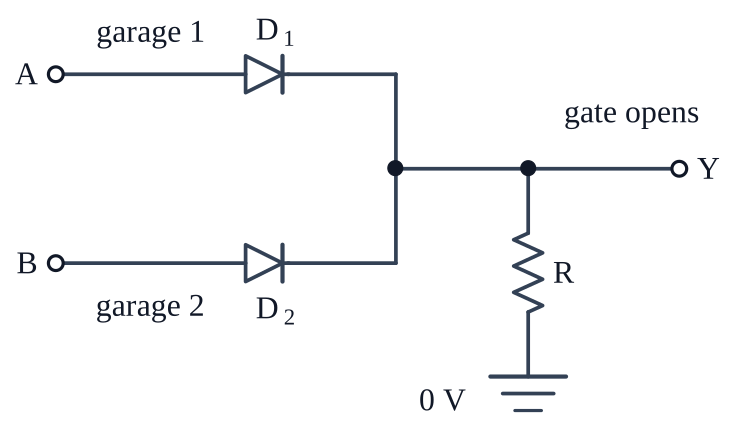
    Two car garages have a common gate which needs to open automatically when a car enters either of the garages or cars enter both. Devise a circuit that resembles this situation using diodes for this situation.
    NCERT’s answer
    OR gate gives output according to the truth table.
    ABC
    $\displaystyle 0$$\displaystyle 0$$\displaystyle 0$
    $\displaystyle 0$$\displaystyle 1$$\displaystyle 1$
    $\displaystyle 1$$\displaystyle 0$$\displaystyle 1$
    $\displaystyle 1$$\displaystyle 1$$\displaystyle 1$
    NCERT_Solution_Class12_Physics_Exemplar_Ch14_Q26_ncert
    Gate must open for A alone, B alone, or both: an OR operation. Let \(\displaystyle A,B=1\) when a car is in garage $\displaystyle 1$, garage $\displaystyle 2$, and \(\displaystyle Y=1\) when the gate opens. \[Y = A + B \] NCERT_Solution_Class12_Physics_Exemplar_Ch14_Q26 \[\begin{array}{cc|c} A & B & Y\\ \hline 0&0&0\\ 0&1&1\\ 1&0&1\\ 1&1&1 \end{array} \] \[A=1\ \text{or}\ B=1:\ D_1\ \text{or}\ D_2\ \text{conducts} \Rightarrow V_Y \approx V_{\mathrm{high}} \] \[A=B=0:\ I=0 \Rightarrow V_Y=0 \] Answer: Two diodes with joined cathodes and a resistor to ground form an OR gate.
  5. Exercise 27

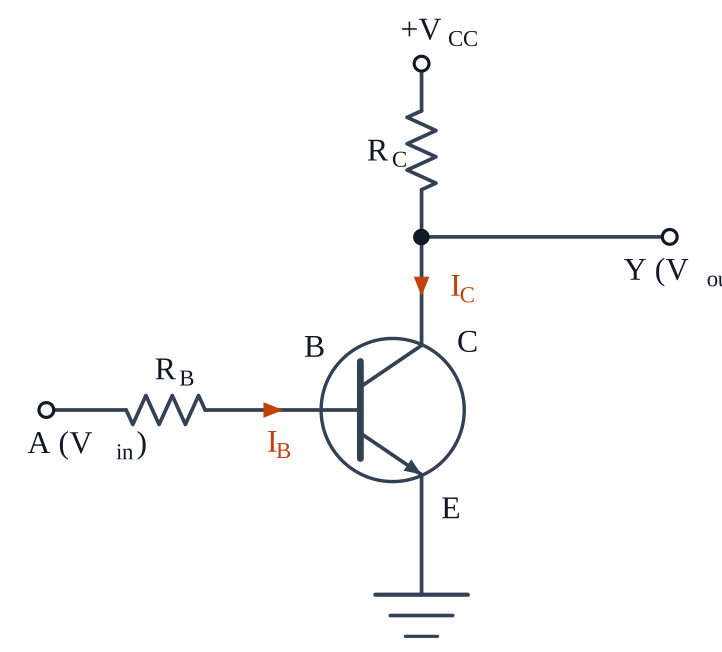
    How would you set up a circuit to obtain NOT gate using a transistor?
    NCERT’s answer
    InputOutput
    AA
    $\displaystyle 0$$\displaystyle 1$
    $\displaystyle 1$$\displaystyle 0$
    NCERT_Solution_Class12_Physics_Exemplar_Ch14_Q27_ncert
    Use an \(\displaystyle n\)-\(\displaystyle p\)-\(\displaystyle n\) transistor in common-emitter mode: input to the base through \(\displaystyle R_B\), emitter grounded, output from the collector, which is joined to \(\displaystyle V_{CC}\) through \(\displaystyle R_C\). NCERT_Solution_Class12_Physics_Exemplar_Ch14_Q27 \[V_{\mathrm{out}} = V_{CC} - I_C R_C \] \[V_{\mathrm{in}}\ \text{low}:\ I_B=0 \Rightarrow I_C=0 \Rightarrow V_{\mathrm{out}}=V_{CC}\ (\text{high}) \] \[V_{\mathrm{in}}\ \text{high}:\ I_B=\frac{V_{\mathrm{in}}-0.7\ \mathrm{V}}{R_B},\ \text{saturation} \Rightarrow V_{\mathrm{out}}=V_{CE(\mathrm{sat})}\approx 0.2\ \mathrm{V}\ (\text{low}) \] Keep \(\displaystyle R_B\) in the base lead: it limits \(\displaystyle I_B\).Answer: \(\displaystyle Y=\bar{A}\): the output is high for low input and low for high input.
  6. Exercise 28

    Explain why elemental semiconductor cannot be used to make visible LEDs.
    NCERT’s answer
    Elemental semiconductor's band-gap is such that emissions are in IR region.
    \[E_{photon}=h\nu=\frac{hc}{\lambda}\approx\frac{1240\ \mathrm{eV\,nm}}{\lambda} \] \[\lambda=400\text{--}700\ \mathrm{nm}\ \Rightarrow\ E_{photon}\approx 3.1\text{--}1.8\ \mathrm{eV} \] \[\mathrm{Si}:\ E_g=1.1\ \mathrm{eV}\ \Rightarrow\ \lambda\approx\frac{1240}{1.1}\ \mathrm{nm}\approx 1.1\times10^{3}\ \mathrm{nm}\ \text{(infrared)} \] \[\mathrm{Ge}:\ E_g=0.67\ \mathrm{eV}\ \Rightarrow\ \lambda\approx\frac{1240}{0.67}\ \mathrm{nm}\approx 1.9\times10^{3}\ \mathrm{nm}\ \text{(infrared)} \] Si and Ge are also indirect-gap, so recombination gives lattice heat rather than photons. Wide-gap compound semiconductors such as GaAsP are used instead.Answer: \(\displaystyle E_g\) of Si and Ge is below the visible photon energy, so they emit infrared or heat, not visible light.
  7. Exercise 29

    Write the truth table for the circuit shown in Fig.14.11. Name the gate that the circuit resembles. NCERT_Question_Class12_Physics_Exemplar_Ch14_Q29
    NCERT’s answer
    Truth table
    ABY
    $\displaystyle 0$$\displaystyle 0$$\displaystyle 0$
    $\displaystyle 0$$\displaystyle 1$$\displaystyle 0$
    $\displaystyle 1$$\displaystyle 0$$\displaystyle 0$
    $\displaystyle 1$$\displaystyle 1$$\displaystyle 1$
    AND Gate
    Cathodes face the inputs, so a low input forward-biases its diode (ideal diodes; logic $\displaystyle 0$ = $\displaystyle 0$ V, logic $\displaystyle 1$ = $\displaystyle 5$ V). \[A=0\ \text{or}\ B=0:\ \text{that diode conducts}\ \Rightarrow\ V_0\approx 0 \] \[A=B=5\ \mathrm{V}:\ \Delta V_{\text{diode}}=0\ \Rightarrow\ I=0\ \Rightarrow\ V_0=+5\ \mathrm{V} \] \[\begin{array}{|c|c|c|}\hline A & B & V_0\\ \hline 0&0&0\\ 0&1&0\\ 1&0&0\\ 1&1&1\\ \hline\end{array} \] \[V_0=A\cdot B \]Answer: AND gate.
  8. Exercise 30

    A Zener of power rating 1\displaystyle 1 W is to be used as a voltage regulator. If zener has a breakdown of 5V and it has to regulate voltage which fluctuated between 3V and 7V, what should be the value of Rs\displaystyle Rs for safe operation (Fig.14.12)? NCERT_Question_Class12_Physics_Exemplar_Ch14_Q30
    NCERT’s answer
    \(\displaystyle I_{Z \text { max }}=\frac{P}{V_Z}=0.2 \mathrm{~A}=200 \mathrm{~mA}\) \[R_S=\frac{V_s-V_Z}{I_{Z \max }}=\frac{2}{0.2}=10 \Omega . \]
    \[I_{Z,\max}=\frac{P}{V_Z}=\frac{1\ \mathrm{W}}{5\ \mathrm{V}}=0.2\ \mathrm{A} \] The zener current is largest at the highest input, $\displaystyle 7$ V, so that case fixes \(\displaystyle R_s\). \[V_{R_s}=V_{in,\max}-V_Z=7\ \mathrm{V}-5\ \mathrm{V}=2\ \mathrm{V} \] \[R_s=\frac{V_{R_s}}{I_{Z,\max}}=\frac{2\ \mathrm{V}}{0.2\ \mathrm{A}}=10\ \Omega \] A smaller \(\displaystyle R_s\) lets more than \(\displaystyle 0.2\ \mathrm{A}\) flow at $\displaystyle 7$ V and overheats the zener. (At $\displaystyle 3$ V the zener is below breakdown and does not conduct.)Answer: \(\displaystyle R_s=10\ \Omega\) (minimum value for safe operation).
  9. Exercise 31

    If each diode in Fig. 14.13\displaystyle 14.13 has a forward bias resistance of 25Ω\displaystyle 25 \Omega and infinite resistance in reverse bias, what will be the values of the current I1,I2,I3\displaystyle I_1, I_2, I_3 and I4\displaystyle I_4? NCERT_Question_Class12_Physics_Exemplar_Ch14_Q31
    NCERT’s answer
    \(\displaystyle I_3\) is zero as the diode in that branch is reverse bised. Resistance in the branch AB and EF are each \(\displaystyle (125+25) \Omega=150 \Omega\). As AB and EF are identical parallel branches, their effective resistance is \(\displaystyle \frac{150}{2}=75 \Omega\) ∴ Net resistance in the circuit \(\displaystyle =(75+25) \Omega=100 \Omega\). ∴ Current \(\displaystyle I_1=\frac{5}{100}=0.05 \mathrm{~A}\). As resistances of AB and EF are equal, and \(\displaystyle I_1=I_2+I_3+I_4, I_3=0\) \[\therefore I_2=I_4=\frac{0.05}{2}=0.025 \mathrm{~A} \]
    The cell's + plate is at G, so current runs G \(\displaystyle \to\) E. The diode in CD points against it: reverse biased, infinite resistance, branch open. \[I_3=0 \]Branches AB and EF each carry a forward diode (\(\displaystyle 25\ \Omega\)) and \(\displaystyle 125\ \Omega\): \[R_{AB}=R_{EF}=25\ \Omega+125\ \Omega=150\ \Omega \] \[R_{\parallel}=\frac{150\times150}{150+150}\ \Omega=75\ \Omega \] \[R_{total}=75\ \Omega+25\ \Omega=100\ \Omega \] \[I_1=\frac{5\ \mathrm{V}}{100\ \Omega}=0.05\ \mathrm{A} \] \[I_2=I_4=\frac{I_1}{2}=\frac{0.05\ \mathrm{A}}{2}=0.025\ \mathrm{A} \] \[I_1=I_2+I_3+I_4=0.025+0+0.025=0.05\ \mathrm{A}\ \checkmark \]Answer: \(\displaystyle I_1=0.05\ \mathrm{A}\), \(\displaystyle I_2=I_4=0.025\ \mathrm{A}\), \(\displaystyle I_3=0\).