SolveIt is under development
SolveItClass 12 · Exemplar

NCERT Exemplar · Class 12 Physics Ray Optics and Optical Instruments

32 questions

Very Short Answer Questions 17–21 (part 3 of 5)

  1. Exercise 17

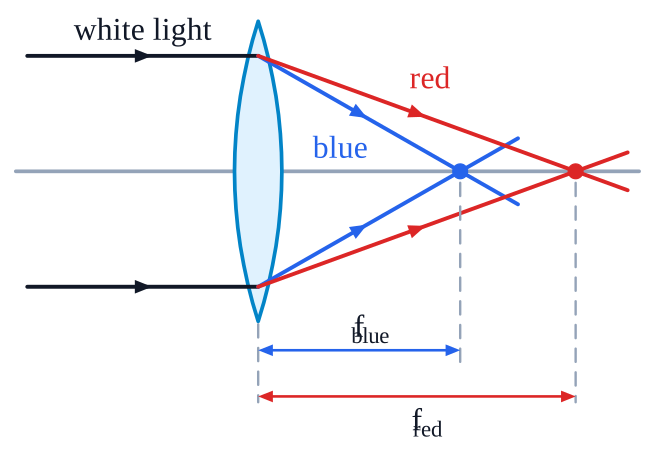
    Will the focal length of a lens for red light be more, same or less than that for blue light?
    NCERT’s answer
    As the refractive index for red is less than that for blue, parallel beams of light incident on a lens will be bent more towards the axis for blue light compared to red. Thus the focal length for blue light will be smaller than that for red.
    Blue light bends more, so it focuses nearer.\[\frac1f=(\mu-1)\left(\frac1{R_1}-\frac1{R_2}\right) \]\[\mu_{\text{blue}}>\mu_{\text{red}}\ \Rightarrow\ \frac1{f_{\text{blue}}}>\frac1{f_{\text{red}}}\ \Rightarrow\ f_{\text{red}}>f_{\text{blue}} \]NCERT_Solution_Class12_Physics_Exemplar_Ch9_Q17Answer: More.
  2. Exercise 18

    The near vision of an average person is 25cm. To view an object with an angular magnification of 10\displaystyle 10, what should be the power of the microscope?
    NCERT’s answer
    The near vision of an average person is 25cm. To view an object with magnification $\displaystyle 10$, \[m=\frac{D}{f} \Rightarrow f=\frac{D}{m}=\frac{25}{10}=2.5=0.025 \mathrm{~m} \] \[P=\frac{1}{0.025}=40 \text { diopters. } \]
    Final image at infinity (relaxed eye):\[M=\frac{D}{f}=10,\qquad D=25\ \mathrm{cm} \]\[f=\frac{25\ \mathrm{cm}}{10}=2.5\ \mathrm{cm}=0.025\ \mathrm{m} \]\[P=\frac1f=\frac{1}{0.025\ \mathrm{m}}=40\ \mathrm{D} \]If the final image is at the near point instead:\[M=1+\frac Df=10\ \Rightarrow\ f=\frac{25}{9}\ \mathrm{cm}\ \Rightarrow\ P=36\ \mathrm{D} \]Answer: \(\displaystyle P=40\ \mathrm{D}\) (image at infinity); \(\displaystyle 36\ \mathrm{D}\) if the image is at $\displaystyle 25$ cm.
  3. Exercise 19

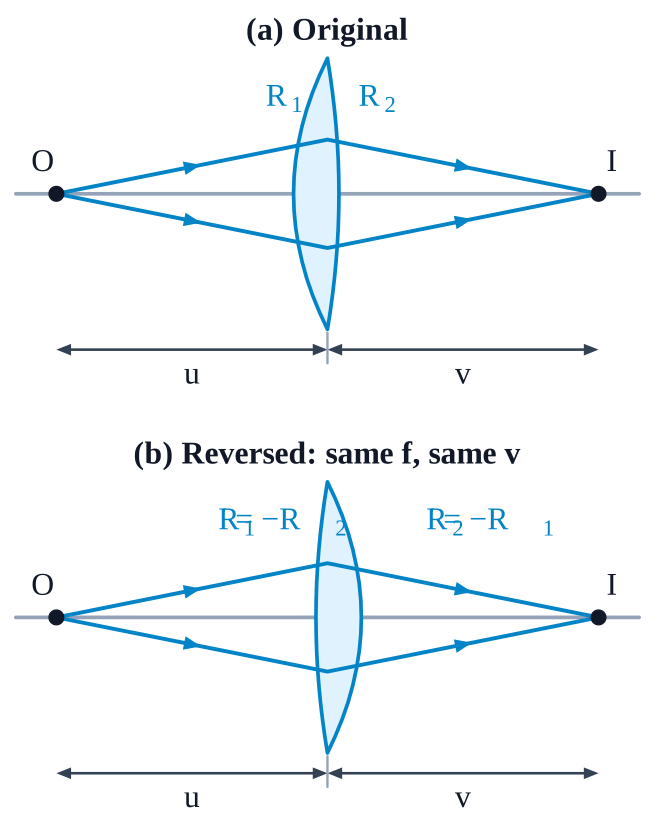
    An unsymmetrical double convex thin lens forms the image of a point object on its axis. Will the position of the image change if the lens is reversed?
    NCERT’s answer
    No. The reversibility of the lens makes equation.
    No. Reversing the lens swaps the two radii and flips their signs, so \(\displaystyle f\) is unchanged.\[\frac1f=(\mu-1)\left(\frac1{R_1}-\frac1{R_2}\right) \]\[R_1\to-R_2,\quad R_2\to-R_1:\qquad \frac1{f'}=(\mu-1)\left(-\frac1{R_2}+\frac1{R_1}\right)=\frac1f \]\[\frac1v-\frac1u=\frac1f\ \Rightarrow\ v\ \text{is the same for the same}\ u \]NCERT_Solution_Class12_Physics_Exemplar_Ch9_Q19Answer: No, the image position does not change.
  4. Exercise 20

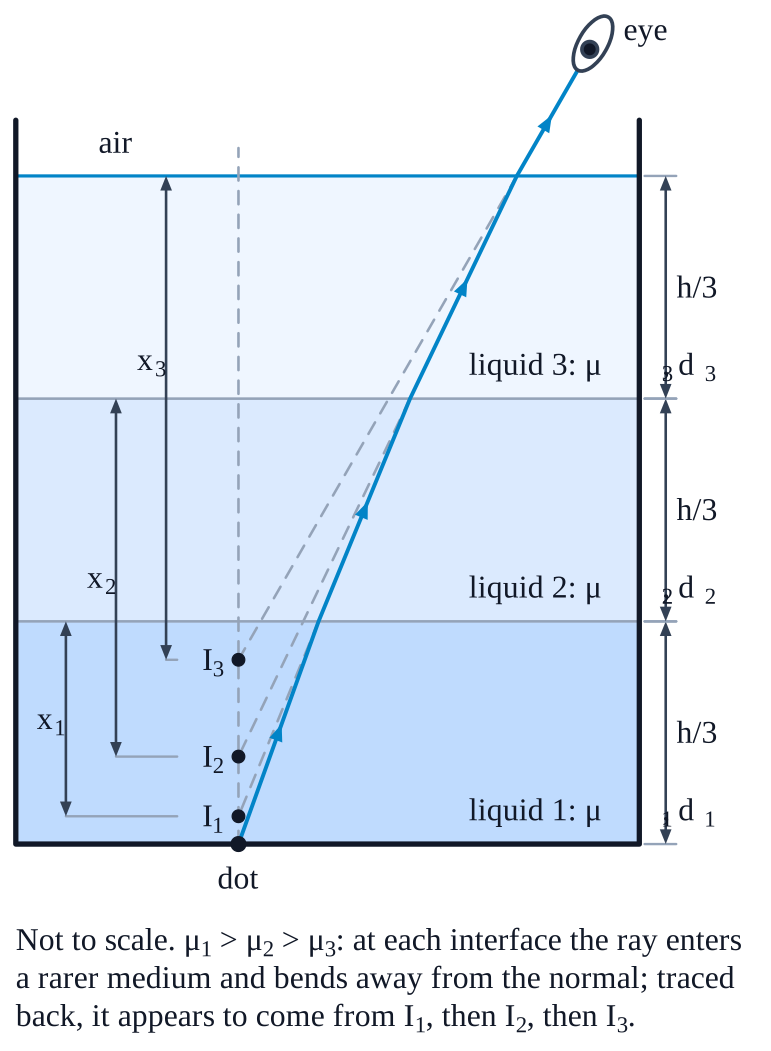
    Three immiscible liquids of densities d1>d2>d3\displaystyle d_1>d_2>d_3 and refractive indices μ1>μ2>μ3\displaystyle \mu_1>\mu_2>\mu_3 are put in a beaker. The height of each liquid column is h3\displaystyle \frac{h}{3}. A dot is made at the bottom of the beaker. For near normal vision, find the apparent depth of the dot.
    NCERT’s answer
    Let the apparent depth be \(\displaystyle \mathrm{O}_1\) for the object seen from \(\displaystyle \mu_2\) then \[\mathrm{O}_1=\frac{\mu_2}{\mu_1} \frac{h}{3} \] If seen from \(\displaystyle \mu_3\) the apparent depth is \(\displaystyle \mathrm{O}_2\). \[\mathrm{O}_2=\frac{\mu_3}{\mu_2}\left(\frac{h}{3}+\mathrm{O}_1\right)=\frac{\mu_3}{\mu_2}\left(\frac{h}{3}+\frac{\mu_2}{\mu_1} \frac{h}{3}\right)=\frac{h}{3}\left(\frac{\mu_3}{\mu_2}+\frac{\mu_3}{\mu_1}\right) \] Seen from outside, the apparent height is \[\begin{aligned} & \mathrm{O}_3=\frac{1}{\mu_3}\left(\frac{\mathrm{~h}}{3}+\mathrm{O}_2\right)=\frac{1}{\mu_3}\left[\frac{h}{3}+\frac{h}{3}\left(\frac{\mu_3}{\mu_2}+\frac{\mu_3}{\mu_1}\right)\right] \\ & =\frac{h}{3}\left(\frac{1}{\mu_1}+\frac{1}{\mu_2}+\frac{1}{\mu_3}\right) \end{aligned} \] NCERT_Solution_Class12_Physics_Exemplar_Ch9_Q20_ncert
    Liquid $\displaystyle 1$ (densest) is lowest; densities do not enter. Apparent depth \(\displaystyle x\), real depth \(\displaystyle t\), at each interface:\[x=t\,\frac{\mu_{\mathrm{upper}}}{\mu_{\mathrm{lower}}} \]\(\displaystyle x_1,\ x_2,\ x_3\) are depths below interface $\displaystyle 1$|$\displaystyle 2$, interface $\displaystyle 2$|$\displaystyle 3$ and the top surface.\[x_1=\frac h3\cdot\frac{\mu_2}{\mu_1}\qquad(I_1) \]\[x_2=\frac{\mu_3}{\mu_2}\left(\frac h3+x_1\right)=\frac h3\left(\frac{\mu_3}{\mu_2}+\frac{\mu_3}{\mu_1}\right)\qquad(I_2) \]\[x_3=\frac{1}{\mu_3}\left(\frac h3+x_2\right)=\frac h3\left(\frac1{\mu_1}+\frac1{\mu_2}+\frac1{\mu_3}\right)\qquad(I_3) \]NCERT_Solution_Class12_Physics_Exemplar_Ch9_Q20Answer: \(\displaystyle \dfrac h3\left(\dfrac1{\mu_1}+\dfrac1{\mu_2}+\dfrac1{\mu_3}\right)\) below the top surface.
  5. Exercise 21

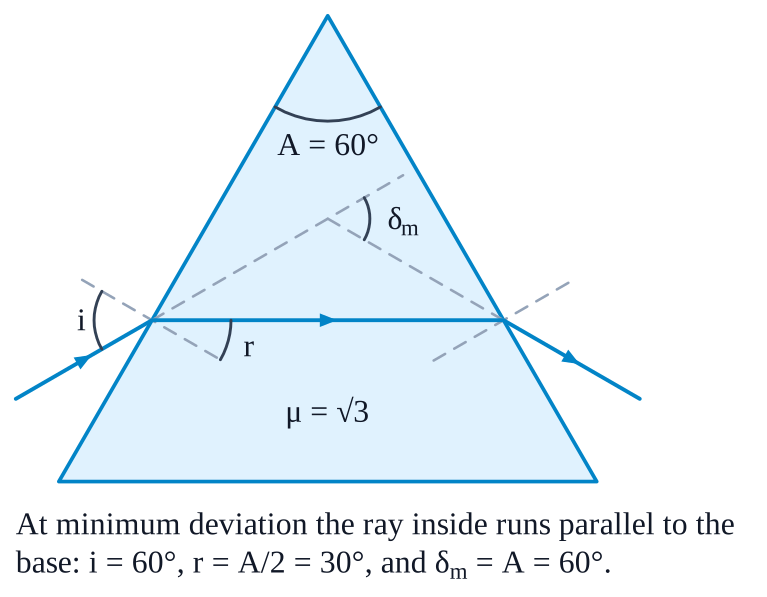
    For a glass prism (μ=3)\displaystyle (\mu=\sqrt{3}) the angle of minimum deviation is equal to the angle of the prism. Find the angle of the prism.
    NCERT’s answer
    At minimum deviation \[\mu=\frac{\sin \left[\dfrac{\left(A+D_m\right)}{2}\right]}{\sin \left(\dfrac{A}{2}\right)} \] ∴Given \(\displaystyle D_m=A\) \[\begin{aligned} & \therefore \mu=\frac{\sin A}{\sin \dfrac{A}{2}}=\frac{2 \sin \dfrac{A}{2} \cos \dfrac{A}{2}}{\sin \dfrac{A}{2}}=2 \cos \frac{A}{2} \\ & \therefore \cos \frac{A}{2}=\frac{\sqrt{3}}{2} \text { or } \frac{A}{2}=30^{\circ} \therefore A=60^{\circ} \end{aligned} \]
    \[\mu=\frac{\sin\dfrac{A+\delta_m}{2}}{\sin\frac A2},\qquad \delta_m=A \]\[\sqrt3=\frac{\sin A}{\sin\frac A2}=2\cos\frac A2 \]\[\cos\frac A2=\frac{\sqrt3}{2}\ \Rightarrow\ \frac A2=30^\circ\ \Rightarrow\ A=60^\circ \]NCERT_Solution_Class12_Physics_Exemplar_Ch9_Q21Answer: \(\displaystyle A=60^\circ\).