SolveIt is under development
SolveItClass 12 · Exemplar

NCERT Exemplar · Class 12 Physics Ray Optics and Optical Instruments

32 questions

Multiple Choice Questions (Type I) 1–11 (part 1 of 5)

  1. Exercise 1

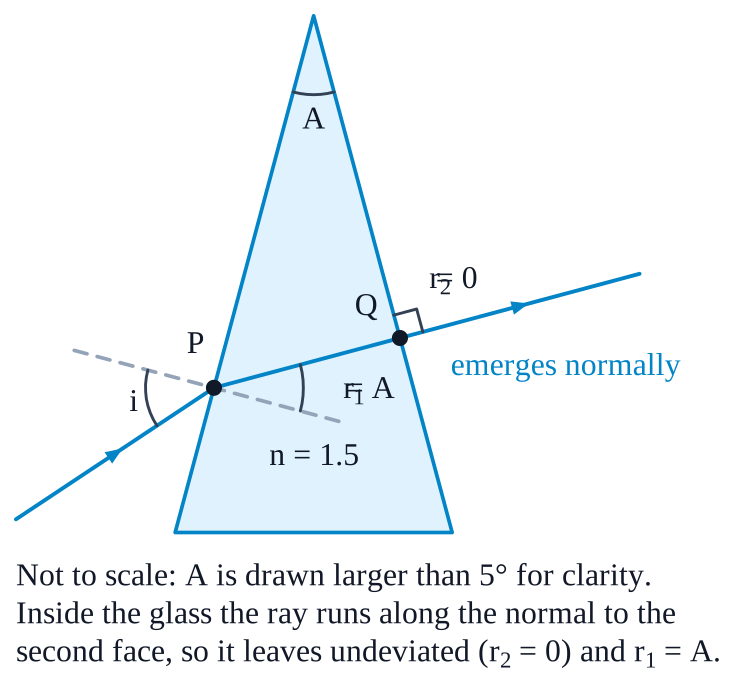
    A ray of light incident at an angle θ\displaystyle \theta on a refracting face of a prism emerges from the other face normally. If the angle of the prism is 5\displaystyle 5° and the prism is made of a material of refractive index 1.5\displaystyle 1.5, the angle of incidence is
    (a)
    7.5\displaystyle 5°.
    (b)
    5\displaystyle 5°. (c) 15\displaystyle 15°.
    (d)
    2.5\displaystyle 5°.
    NCERT’s answer
    (a)
    (a) $\displaystyle 7.5$°. Normal emergence gives \(\displaystyle r_2=0\), so \(\displaystyle r_1=A\). \[r_1+r_2=A \;\Rightarrow\; r_1=5^\circ \] \[\sin i=n\sin r_1=1.5\times\sin 5^\circ=1.5\times 0.0872=0.131 \] \[i=\sin^{-1}(0.131)\approx 7.5^\circ \] NCERT_Solution_Class12_Physics_Exemplar_Ch9_Q1
  2. Exercise 2

    A short pulse of white light is incident from air to a glass slab at normal incidence. After travelling through the slab, the first colour to emerge is
    (a)
    blue.
    (b)
    green.
    (c)
    violet.
    (d)
    red.
    NCERT’s answer
    (d)
    (d) Red. Normal incidence means no bending, so every colour crosses the same thickness \(\displaystyle d\); the colour with the smallest \(\displaystyle n\) is fastest. \[v=\frac{c}{n},\qquad t=\frac{d}{v}=\frac{nd}{c} \] \[n_{\mathrm{red}}<n_{\mathrm{green}}<n_{\mathrm{blue}}<n_{\mathrm{violet}} \;\Rightarrow\; t_{\mathrm{red}}<t_{\mathrm{green}}<t_{\mathrm{blue}}<t_{\mathrm{violet}} \]
  3. Exercise 3

    An object approaches a convergent lens from the left of the lens with a uniform speed 5\displaystyle 5 m/s and stops at the focus. The image
    (a)
    moves away from the lens with an uniform speed 5\displaystyle 5 m/s.
    (b)
    moves away from the lens with an uniform accleration.
    (c)
    moves away from the lens with a non-uniform acceleration.
    (d)
    moves towards the lens with a non-uniform acceleration.
    NCERT’s answer
    (c)
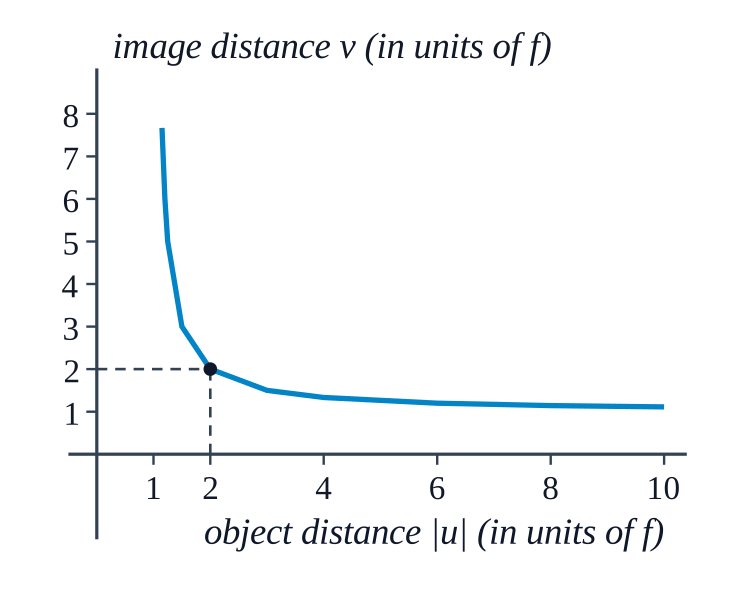
    (c) The image moves away from the lens with non-uniform acceleration. Let the object distance be \(\displaystyle x=|u|>f\) (\(\displaystyle f\), \(\displaystyle x\) in m), \(\displaystyle u=-x\). \[\frac{1}{v}-\frac{1}{u}=\frac{1}{f}\;\Rightarrow\; \frac{1}{v}+\frac{1}{x}=\frac{1}{f}\;\Rightarrow\; v=\frac{xf}{x-f} \] \[v_I=\frac{dv}{dt}=-\frac{f^{2}}{(x-f)^{2}}\frac{dx}{dt},\qquad \frac{dx}{dt}=-5\ \mathrm{m\,s^{-1}} \] \[v_I=\frac{5f^{2}}{(x-f)^{2}}\ \mathrm{m\,s^{-1}}\ (>0),\qquad x\downarrow\Rightarrow v_I\uparrow \] \[a_I=\frac{dv_I}{dt}=\frac{50f^{2}}{(x-f)^{3}}\ \mathrm{m\,s^{-2}}>0,\ \text{not constant} \] NCERT_Solution_Class12_Physics_Exemplar_Ch9_Q3
  4. Exercise 4

    A passenger in an aeroplane shall
    (a)
    never see a rainbow.
    (b)
    may see a primary and a secondary rainbow as concentric circles.
    (c)
    may see a primary and a secondary rainbow as concentric arcs.
    (d)
    shall never see a secondary rainbow.
    NCERT’s answer
    (b)
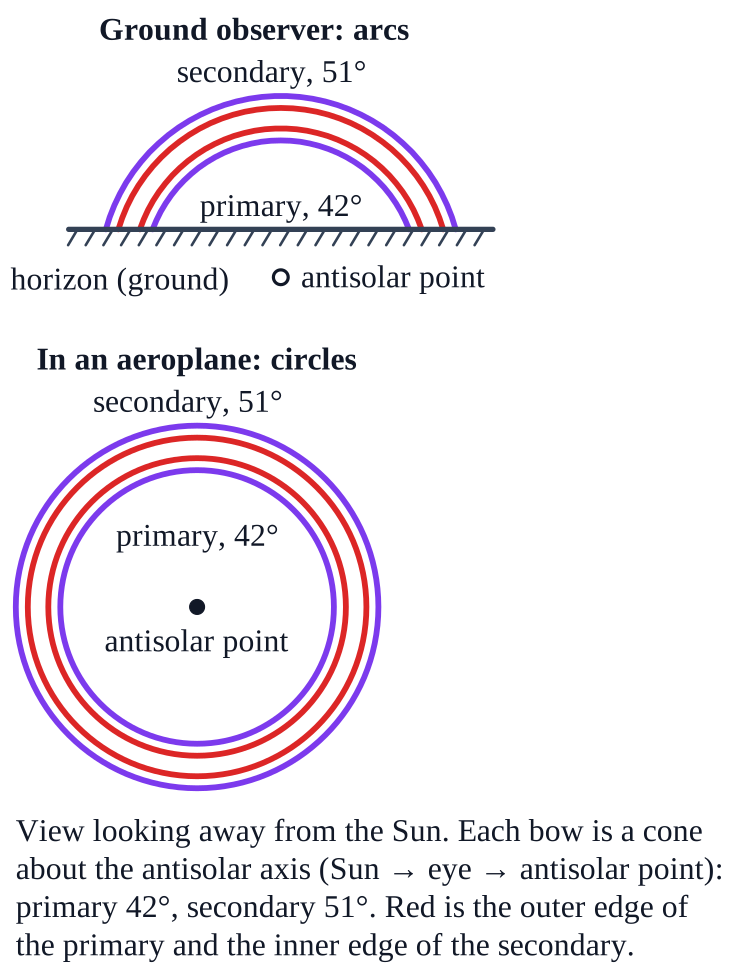
    (b) Both bows are cones about the antisolar axis, at about \(\displaystyle 42^\circ\) (primary) and \(\displaystyle 51^\circ\) (secondary). \[\theta_{\mathrm{primary}}\approx 42^\circ,\qquad \theta_{\mathrm{secondary}}\approx 51^\circ \] Ground observer: horizon cuts the cone \(\displaystyle \Rightarrow\) arcs. Aeroplane: nothing cuts it \(\displaystyle \Rightarrow\) full concentric circles. NCERT_Solution_Class12_Physics_Exemplar_Ch9_Q4
  5. Exercise 5

    You are given four sources of light each one providing a light of a single colour – red, blue, green and yellow. Suppose the angle of refraction for a beam of yellow light corresponding to a particular angle of incidence at the interface of two media is 90\displaystyle 90°. Which of the following statements is correct if the source of yellow light is replaced with that of other lights without changing the angle of incidence?
    (a)
    The beam of red light would undergo total internal reflection.
    (b)
    The beam of red light would bend towards normal while it gets refracted through the second medium.
    (c)
    The beam of blue light would undergo total internal reflection.
    (d)
    The beam of green light would bend away from the normal as it gets refracted through the second medium.
    NCERT’s answer
    (c)
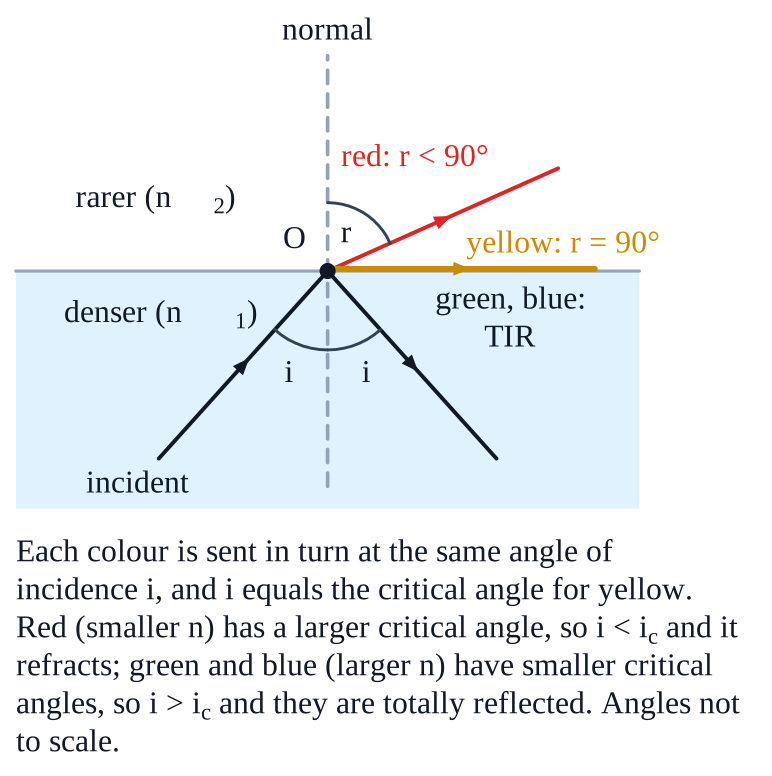
    (c) Yellow is at the critical angle, so a colour of larger \(\displaystyle n\) has a smaller critical angle and is totally reflected. Red refracts away from the normal; green also reflects totally. \[\sin i_c=\frac{1}{n},\quad n=\frac{n_{\mathrm{denser}}}{n_{\mathrm{rarer}}},\quad \sin i=\sin i_c(\text{yellow})=\frac{1}{n_{\mathrm{yellow}}} \] \[n_{\mathrm{red}}<n_{\mathrm{yellow}}<n_{\mathrm{green}}<n_{\mathrm{blue}} \] \[\text{red: } i_c\uparrow\Rightarrow i<i_c\Rightarrow \text{refracts},\ r>i \] \[\text{green, blue: } i_c\downarrow\Rightarrow i>i_c\Rightarrow \text{total internal reflection} \] NCERT_Solution_Class12_Physics_Exemplar_Ch9_Q5
  6. Exercise 6

    The radius of curvature of the curved surface of a plano-convex lens is 20\displaystyle 20 cm. If the refractive index of the material of the lens be 1.5\displaystyle 1.5, it will
    (a)
    act as a convex lens only for the objects that lie on its curved side.
    (b)
    act as a concave lens for the objects that lie on its curved side.
    (c)
    act as a convex lens irrespective of the side on which the object lies.
    (d)
    act as a concave lens irrespective of side on which the object lies.
    NCERT’s answer
    (c)
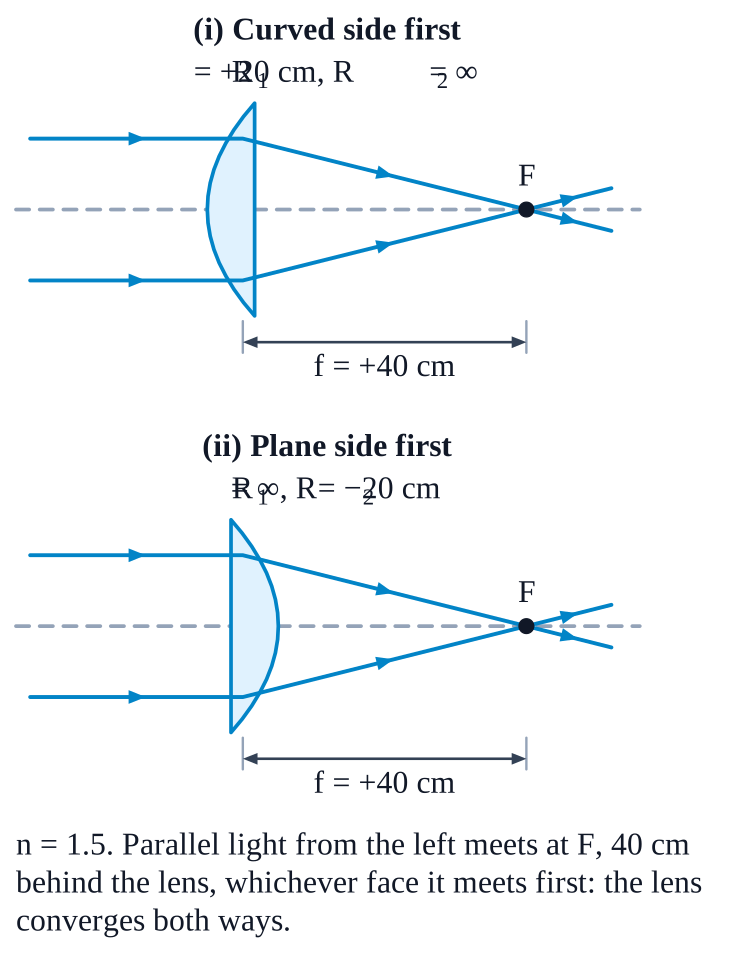
    (c) Convex either way: \(\displaystyle f\) is positive and the same for both orientations. \[\frac{1}{f}=(n-1)\left(\frac{1}{R_1}-\frac{1}{R_2}\right) \] Curved side first, \(\displaystyle R_1=+20\ \mathrm{cm}\), \(\displaystyle R_2=\infty\): \[\frac{1}{f}=(1.5-1)\left(\frac{1}{20}-0\right)=\frac{1}{40}\ \mathrm{cm^{-1}}\;\Rightarrow\; f=+40\ \mathrm{cm} \] Plane side first, \(\displaystyle R_1=\infty\), \(\displaystyle R_2=-20\ \mathrm{cm}\): \[\frac{1}{f}=0.5\left(0-\frac{1}{-20}\right)=\frac{1}{40}\ \mathrm{cm^{-1}}\;\Rightarrow\; f=+40\ \mathrm{cm} \] NCERT_Solution_Class12_Physics_Exemplar_Ch9_Q6
  7. Exercise 7

    The phenomena involved in the reflection of radiowaves by ionosphere is similar to
    (a)
    reflection of light by a plane mirror.
    (b)
    total internal reflection of light in air during a mirage.
    (c)
    dispersion of light by water molecules during the formation of a rainbow.
    (d)
    scattering of light by the particles of air.
    NCERT’s answer
    (b)
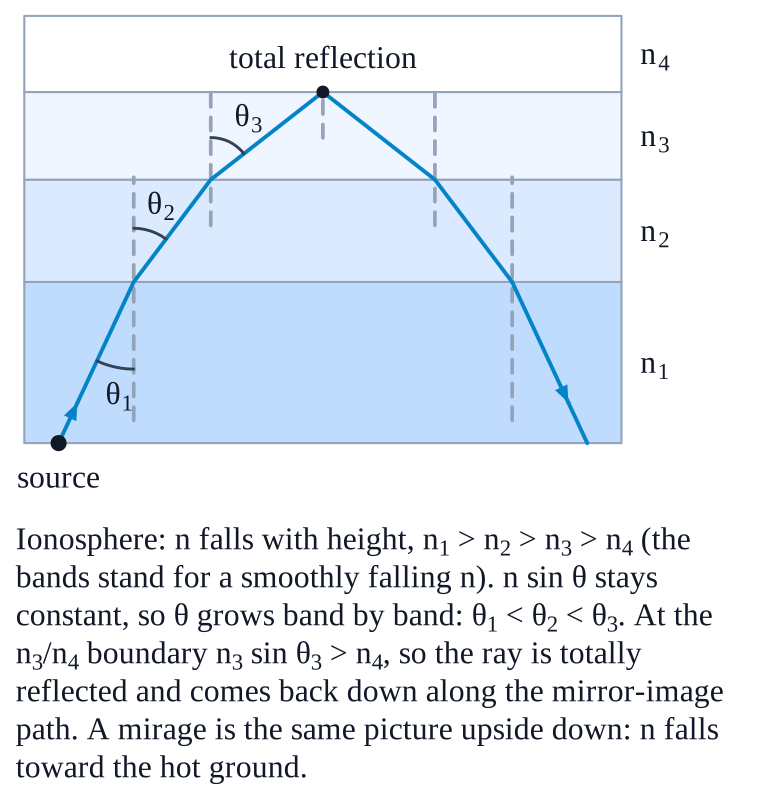
    (b) In both, the refractive index falls along the path, so the ray bends away from the normal until it is totally reflected.\[n\sin\theta=\text{constant along the ray} \] \[n\downarrow\ \Rightarrow\ \sin\theta\uparrow\ \Rightarrow\ \theta\to90^\circ\ \Rightarrow\ \text{ray turns back} \]NCERT_Solution_Class12_Physics_Exemplar_Ch9_Q7Ionosphere: \(\displaystyle n\) falls with height. Mirage: \(\displaystyle n\) falls toward the hot ground.
  8. Exercise 8

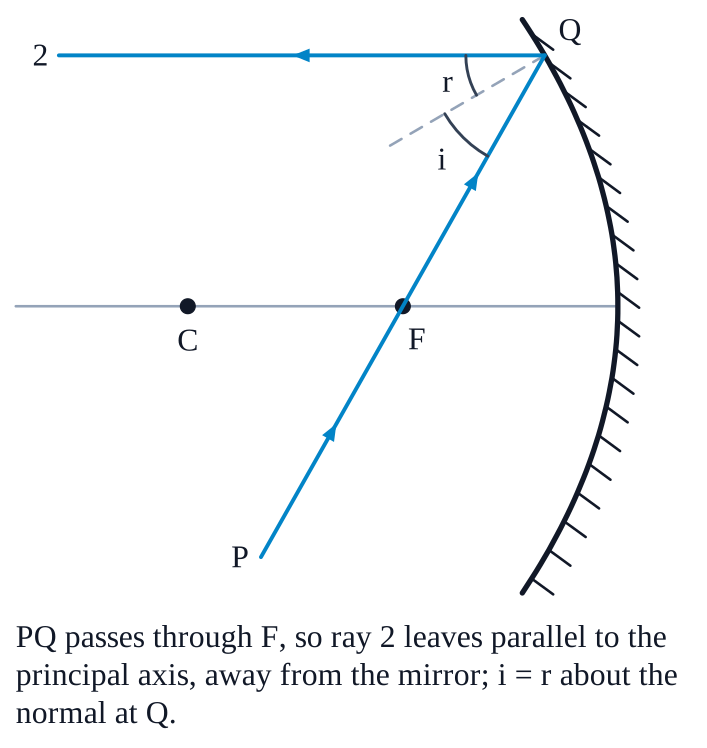
    The direction of ray of light incident on a concave mirror is shown by PQ while directions in which the ray would travel after reflection is shown by four rays marked 1\displaystyle 1, 2\displaystyle 2, 3\displaystyle 3 and 4\displaystyle 4 (Fig 9.1\displaystyle 9.1). Which of the four rays correctly shows the direction of reflected ray?
    (a)
    1\displaystyle 1 (b) 2\displaystyle 2 (c) 3\displaystyle 3 (d) 4\displaystyle 4 NCERT_Question_Class12_Physics_Exemplar_Ch9_Q8
    NCERT’s answer
    (b)
    (b) Ray 2. The incident ray passes through the focus, so it reflects parallel to the principal axis, away from the mirror (ray $\displaystyle 4$ runs into it).Source at \(\displaystyle F\): \(\displaystyle u=f\) \[\frac1v=\frac1f-\frac1u=\frac1f-\frac1f=0\ \Rightarrow\ v=\infty \]NCERT_Solution_Class12_Physics_Exemplar_Ch9_Q8
  9. Exercise 9

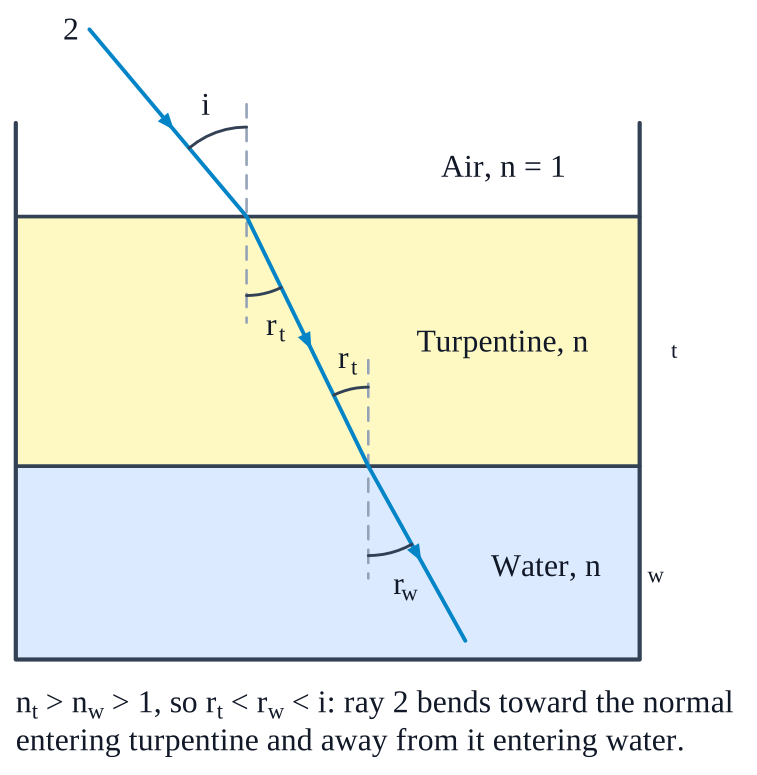
    The optical density of turpentine is higher than that of water while its mass density is lower. Fig 9.2. shows a layer of turpentine floating over water in a container. For which one of the four rays incident on turpentine in Fig 9.2\displaystyle 9.2, the path shown is correct?
    (a)
    1\displaystyle 1 (b) 2\displaystyle 2 (c) 3\displaystyle 3 (d) 4\displaystyle 4 NCERT_Question_Class12_Physics_Exemplar_Ch9_Q9
    NCERT’s answer
    (b)
    (b) Ray $\displaystyle 2$ bends toward the normal entering turpentine, then away from it into water. Ray $\displaystyle 1$ crosses the normal, ray $\displaystyle 3$ is undeviated, ray $\displaystyle 4$ bends away on entering turpentine.\[\sin i=n_t\sin r_t=n_w\sin r_w,\qquad n_t>n_w>1 \] \[\Rightarrow\ r_t<r_w<i \]NCERT_Solution_Class12_Physics_Exemplar_Ch9_Q9
  10. Exercise 10

    A car is moving with at a constant speed of 60 km h−1\displaystyle 60 \mathrm{~km} \mathrm{~h}^{-1} on a straight road. Looking at the rear view mirror, the driver finds that the car following him is at a distance of 100\displaystyle 100 m and is approaching with a speed of 5 km h−1\displaystyle 5 \mathrm{~km} \mathrm{~h}^{-1}. In order to keep track of the car in the rear, the driver begins to glance alternatively at the rear and side mirror of his car after every 2\displaystyle 2 s till the other car overtakes. If the two cars were maintaining their speeds, which of the following statement (s) is/are correct?
    (a)
    The speed of the car in the rear is 65 km h−1\displaystyle 65 \mathrm{~km} \mathrm{~h}^{-1}.
    (b)
    In the side mirror the car in the rear would appear to approach with a speed of 5 km h−1\displaystyle 5 \mathrm{~km} \mathrm{~h}^{-1} to the driver of the leading car.
    (c)
    In the rear view mirror the speed of the approaching car would appear to decrease as the distance between the cars decreases.
    (d)
    In the side mirror, the speed of the approaching car would appear to increase as the distance between the cars decreases.
    (a), (d) The rear-view mirror is plane, the side mirror convex.
    \[v_\text{rear}=60+5=65\ \mathrm{km\,h^{-1}} \]
    Plane mirror, image speed:
    \[v_\text{image}=v_\text{rel}=5\ \mathrm{km\,h^{-1}}\ \text{(constant)} \]
    Convex mirror:
    \[\frac1v+\frac1u=\frac1f\ \Rightarrow\ \left|\frac{dv}{dt}\right|=\frac{v^2}{u^2}\left|\frac{du}{dt}\right|=m^2\,(5\ \mathrm{km\,h^{-1}}),\qquad m=\frac{f}{f+|u|}<1 \]
    \[|u|\downarrow\ \Rightarrow\ m\uparrow\ \Rightarrow\ v_\text{image}\uparrow \]
    (c)
    fails: the plane-mirror speed is constant. (b) fails: \(\displaystyle m<1\).
  11. Exercise 11

    There are certain material developed in laboratories which have a negative refractive index (Fig. 9.3\displaystyle 9.3). A ray incident from air (medium 1\displaystyle 1) into such a medium (medium 2\displaystyle 2) shall follow a path given by NCERT_Question_Class12_Physics_Exemplar_Ch9_Q11 NCERT_Question_Class12_Physics_Exemplar_Ch9_Q11_2 NCERT_Question_Class12_Physics_Exemplar_Ch9_Q11_3 NCERT_Question_Class12_Physics_Exemplar_Ch9_Q11_4
    NCERT’s answer
    (a)
    (a) The refracted ray lies on the same side of the normal as the incident ray.\[n_1\sin i=n_2\sin r,\qquad n_1=1,\ n_2<0 \] \[\sin r=\frac{\sin i}{n_2}<0\ \Rightarrow\ r<0 \]