SolveIt is under development
SolveItClass 12 · Exemplar

NCERT Exemplar · Class 12 Physics Ray Optics and Optical Instruments

32 questions

Long Answer Questions 28–32 (part 5 of 5)

  1. Exercise 28

    Show that for a material with refractive index μ≥2\displaystyle \mu \geq \sqrt{2}, light incident at any angle shall be guided along a length perpendicular to the incident face.
    NCERT’s answer
    Any ray entering at an angle \(\displaystyle i\) shall be guided along AC if the angle the ray makes with the face AC \(\displaystyle (\phi)\) is greater than the critical angle. \[\begin{aligned} & \Rightarrow \sin \geq \frac{1}{\mu} \\ & \Rightarrow \cos r \geq \frac{1}{\mu} \end{aligned} \] Or, \(\displaystyle 1-\cos ^2 r \leq 1-\frac{1}{\mu^2}\) i.e. \(\displaystyle \sin ^2 r \leq 1-\frac{1}{\mu^2}\) Since \(\displaystyle \sin i=\mu \sin r\) \[\frac{1}{\mu^2} \sin ^2 i \leq 1-\frac{1}{\mu^2} \] Or, \(\displaystyle \sin ^2 i \leq \mu^2-1\) The smallest angle \(\displaystyle \phi\) shall be when \(\displaystyle i=\frac{\pi}{2}\). If that is greater than the critical angle then all other angles of incidence shall be more than the critical angle. Thus \(\displaystyle 1 \leq \mu^2-1\) Or, \(\displaystyle \mu^2 \geq 2\) \[\Rightarrow \mu \geq \sqrt{2} \] NCERT_Solution_Class12_Physics_Exemplar_Ch9_Q28_ncert
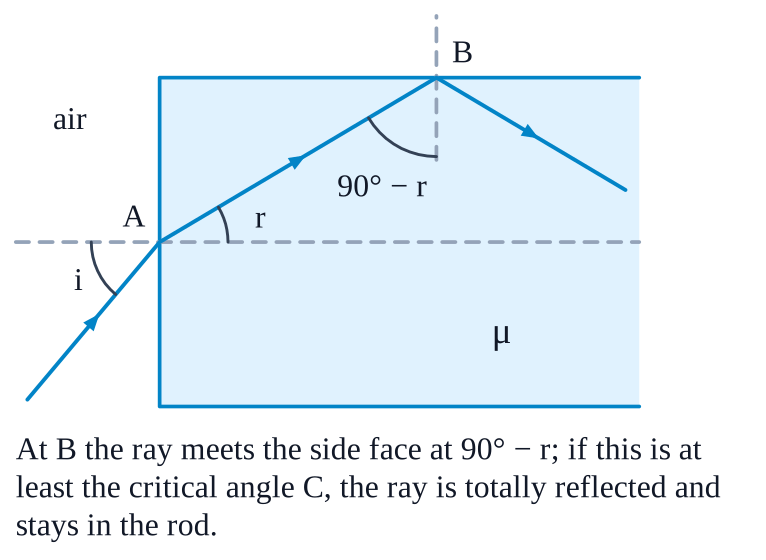
    A ray enters the end face at incidence angle \(\displaystyle i\), refracts to \(\displaystyle r\), and meets the side face at angle \(\displaystyle 90^\circ-r\).NCERT_Solution_Class12_Physics_Exemplar_Ch9_Q28\[\sin i=\mu\sin r \] \[\text{Total internal reflection at the side face: }\ \sin(90^\circ-r)=\cos r\ \ge\ \sin C=\frac{1}{\mu} \] \[\cos r=\sqrt{1-\sin^2 r}=\sqrt{1-\frac{\sin^2 i}{\mu^2}} \]Worst case is grazing entry, \(\displaystyle i=90^\circ\), which gives the largest \(\displaystyle r\) and the smallest angle at the side face:\[\sqrt{1-\frac{1}{\mu^2}}\ \ge\ \frac{1}{\mu}\ \Rightarrow\ 1-\frac{1}{\mu^2}\ \ge\ \frac{1}{\mu^2}\ \Rightarrow\ \mu^2\ge 2 \] \[\mu\ \ge\ \sqrt{2} \]Any smaller \(\displaystyle i\) gives a smaller \(\displaystyle r\) and a larger \(\displaystyle \cos r\), so the condition still holds.Answer: For \(\displaystyle \mu\ge\sqrt{2}\), a ray entering at any angle is totally reflected at the side faces and is guided along the length of the rod.
  2. Exercise 29

    The mixture a pure liquid and a solution in a long vertical column (i.e, horizontal dimensions << vertical dimensions) produces diffusion of solute particles and hence a refractive index gradient along the vertical dimension. A ray of light entering the column at right angles to the vertical is deviated from its original path. Find the deviation in travelling a horizontal distance d≪h\displaystyle d \ll h, the height of the column.
    NCERT’s answer
    Consider a portion of a ray between \(\displaystyle x\) and \(\displaystyle x+d x\) inside the liquid. Let the angle of incidence at \(\displaystyle x\) be \(\displaystyle \theta\) and let it enter the thin column at height \(\displaystyle y\). Because of the bending it shall emerge at \(\displaystyle x+d x\) with an angle \(\displaystyle \theta+d \theta\) and at a height \(\displaystyle y+d y\). From Snell's law \[\mu(y) \sin \theta=\mu(y+d y) \sin (\theta+d \theta) \] \[\text { or } \mu(y) \sin \theta \simeq\left(\mu(y)+\frac{d \mu}{d y} d y\right)(\sin \theta \cos d \theta+\cos \theta \sin d \theta) \] \[\simeq \mu(y) \sin \theta+\mu(y) \cos \theta d \theta+\frac{d \mu}{d y} d y \sin \theta \] or \(\displaystyle \mu(y) \cos \theta d \theta \simeq \frac{-d \mu}{d y} d y \sin \theta\) \[d \theta \simeq \frac{-1}{\mu} \frac{d \mu}{d y} d y \tan \theta \] But \(\displaystyle \tan \theta=\frac{d x}{d y}\) (from the fig.) \[\therefore d \theta=\frac{-1}{\mu} \frac{d \mu}{d y} d x \] \[\therefore \theta=\frac{-1}{\mu} \frac{d \mu}{d y} \int_o^d d x=\frac{-1}{\mu} \frac{d \mu}{d y} d \] NCERT_Solution_Class12_Physics_Exemplar_Ch9_Q29_ncert
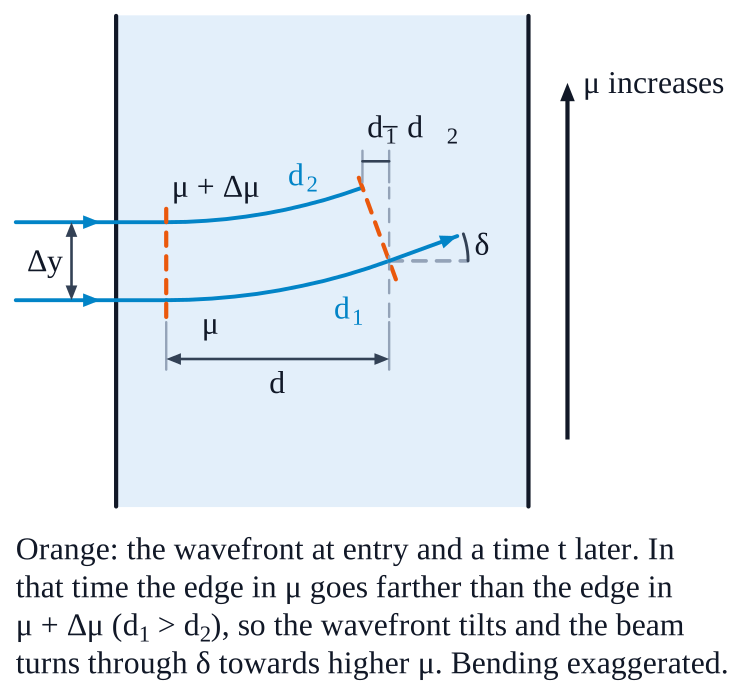
    Take a narrow horizontal beam of width \(\displaystyle \Delta y\); its lower edge sees index \(\displaystyle \mu\), its upper edge \(\displaystyle \mu+\Delta\mu\).NCERT_Solution_Class12_Physics_Exemplar_Ch9_Q29In the same time \(\displaystyle t\) the two edges of the wavefront advance\[d_1=\frac{ct}{\mu}\quad(\text{lower-index edge}),\qquad d_2=\frac{ct}{\mu+\Delta\mu}\quad(\text{higher-index edge}) \] \[d_1-d_2=\frac{ct\,\Delta\mu}{\mu(\mu+\Delta\mu)}\approx d\,\frac{\Delta\mu}{\mu},\qquad d_1\approx d \]The wavefront tilts, so the ray turns through\[\delta\approx\frac{d_1-d_2}{\Delta y}=\frac{d}{\mu}\,\frac{\Delta\mu}{\Delta y} \] \[\delta=\frac{d}{\mu}\,\frac{d\mu}{dy}\ \ \text{(radian)} \]Answer: \(\displaystyle \delta=\dfrac{d}{\mu}\dfrac{d\mu}{dy}\), the ray bending towards the region of higher refractive index.
  3. Exercise 30

    If light passes near a massive object, the gravitational interaction causes a bending of the ray. This can be thought of as happening due to a change in the effective refrative index of the medium given by n(r)=1+2GM/rc2n(r)=1+2 G M / r c^2 where r\displaystyle r is the distance of the point of consideration from the centre of the mass of the massive body, G\displaystyle G is the universal gravitational constant, M\displaystyle M the mass of the body and c the speed of light in vacuum. Considering a spherical object find the deviation of the ray from the original path as it grazes the object.
    NCERT’s answer
    Consider two planes at \(\displaystyle r\) and \(\displaystyle r+d r\). Let the light be incident at an angle \(\displaystyle \theta\) at the plane at \(\displaystyle r\) and leave \(\displaystyle r+d r\) at an angle \(\displaystyle \theta+\mathrm{d} \theta\) Then from Snell's law \[n(r) \sin \theta=n(r+d r) \sin (\theta+d \theta) \] \[\begin{gathered} \Rightarrow n(r) \sin \theta \simeq\left(n(r)+\frac{d n}{d r} d r\right)(\sin \theta \cos \mathrm{d} \theta+\cos \theta \sin d \theta) \\ \simeq\left(n(r)+\frac{d n}{d r} d r\right)(\sin \theta+\cos \theta d \theta) \end{gathered} \] Neglecting products of differentials \[n(r) \sin \theta \simeq n(r) \sin \theta+\frac{d n}{d r} d r \sin \theta+n(r) \cos \theta d \theta \] \[\Rightarrow-\frac{d n}{d r} \tan \theta=n(r) \frac{d \theta}{d r} \] \[\begin{aligned} & \Rightarrow \frac{2 G M}{r^2 c^2} \tan \theta=\left(1+\frac{2 G M}{r c^2}\right) \frac{d \theta}{d r} \approx \frac{d \theta}{d r} \\ & \therefore \int_0^{\theta o} d \theta=\frac{2 \mathrm{GM}}{c^2} \int_{\infty}^{\infty} \frac{\tan \theta d r}{r^2} \end{aligned} \] Now \(\displaystyle r^2=x^2+R^2\) and \(\displaystyle \tan \theta=\frac{R}{x}\) \[\begin{aligned} & 2 r d r=2 x d x \\ & \int_0^{\theta o} d \theta=\frac{2 \mathrm{GM}}{c^2} \int_{-\infty}^{\infty} \frac{R}{x} \frac{x d x}{\left(x^2+R^2\right)^{\frac{3}{2}}} \end{aligned} \] Put \(\displaystyle x=R \tan \phi\) \[d x=R \operatorname{Sec}^2 \phi d \phi \] \[\begin{aligned} \therefore \quad \theta_0 & =\frac{2 \mathrm{GMR}}{\mathrm{c}^2} \int_{-\pi / 2}^{\pi / 2} \frac{R \sec ^2 \phi d \phi}{R^3 \sec ^3 \phi} \\ & =\frac{2 G M}{R c^2} \int_{-\pi / 2}^{\pi / 2} \cos \phi d \phi=\frac{4 G M}{R c^2} \end{aligned} \] NCERT_Solution_Class12_Physics_Exemplar_Ch9_Q30_ncert
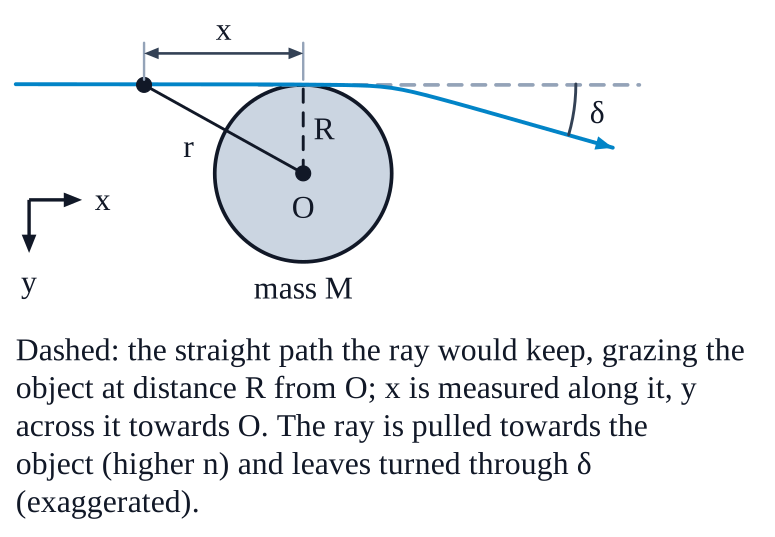
    The bending is tiny, so take the straight path grazing the surface at distance \(\displaystyle R\) (radius of the object) from the centre \(\displaystyle O\); \(\displaystyle x\) is measured along the path from the closest point, so \(\displaystyle r^2=R^2+x^2\).NCERT_Solution_Class12_Physics_Exemplar_Ch9_Q30\[n=1+\frac{2GM}{rc^2}\approx 1,\qquad \frac{dn}{dr}=-\frac{2GM}{c^2r^2} \]Only the gradient across the path bends the ray: radial gradient times \(\displaystyle R/r\):\[\frac{\partial n}{\partial y}=\frac{2GM}{c^2r^2}\cdot\frac{R}{r}=\frac{2GMR}{c^2\,(R^2+x^2)^{3/2}} \]Each element \(\displaystyle dx\) turns the ray, towards higher \(\displaystyle n\), by \(\displaystyle d\delta=\dfrac{1}{n}\dfrac{\partial n}{\partial y}\,dx\):\[\delta=\int_{-\infty}^{\infty}\frac{2GMR\,dx}{c^2\,(R^2+x^2)^{3/2}}=\frac{2GMR}{c^2}\cdot\frac{2}{R^2} \] \[\delta=\frac{4GM}{Rc^2} \]Answer: The ray is deviated by \(\displaystyle \dfrac{4GM}{Rc^2}\) towards the object.
  4. Exercise 31

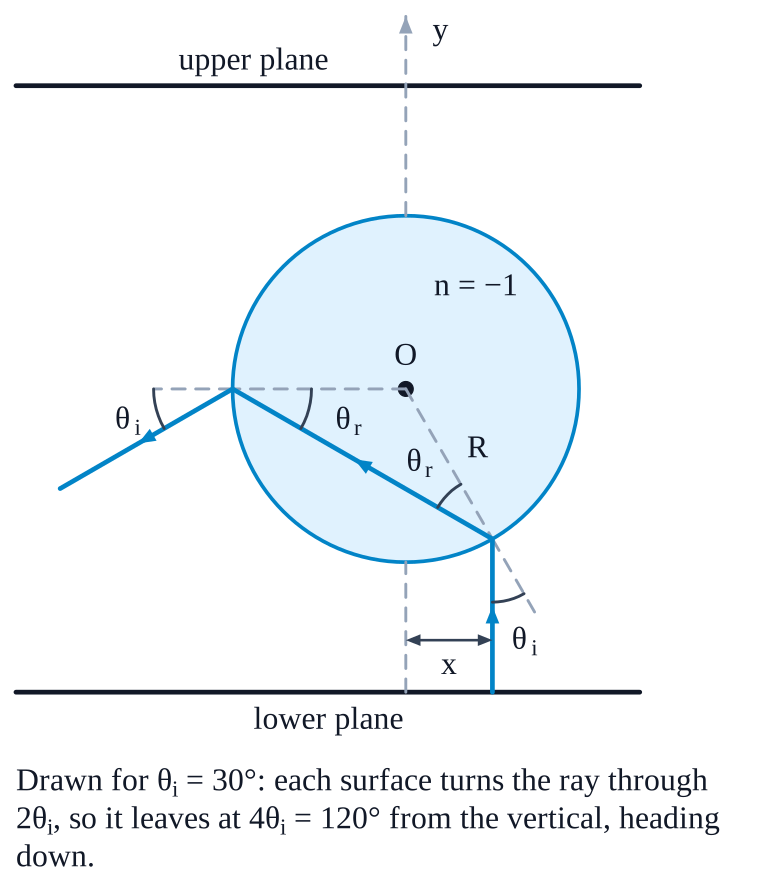
    An infinitely long cylinder of radius R\displaystyle R is made of an unusual exotic material with refractive index −1\displaystyle -1 (Fig. 9.7\displaystyle 9.7). The cylinder is placed between two planes whose normals are along the y\displaystyle y direction. The center of the cylinder O lies along the y\displaystyle y-axis. A narrow laser beam is directed along the y\displaystyle y direction from the lower plate. The laser source is at a horizontal distance x\displaystyle x from the diameter in the y\displaystyle y direction. Find the range of x\displaystyle x such that light emitted from the lower plane does not reach the upper plane. NCERT_Question_Class12_Physics_Exemplar_Ch9_Q31
    NCERT_Solution_Class12_Physics_Exemplar_Ch9_Q31The beam meets the cylinder at \(\displaystyle \theta_i\):\[\sin\theta_i=\frac{x}{R} \]For \(\displaystyle n=-1\) the refracted ray lies on the same side of the normal as the incident ray:\[\sin\theta_r=\frac{\sin\theta_i}{-1}\ \Rightarrow\ \theta_r=-\theta_i \] \[\text{turn at one surface}=\theta_i-\theta_r=2\theta_i \]The chord meets the far surface at the same angle \(\displaystyle \theta_i\) and turns the ray another \(\displaystyle 2\theta_i\) the same way:\[\text{total turn}=4\theta_i \]The emerging ray has no upward component when\[90^\circ\le 4\theta_i\le 270^\circ\ \Rightarrow\ 22.5^\circ\le\theta_i\le 67.5^\circ \] \[R\sin22.5^\circ\ \le\ x\ \le\ R\sin67.5^\circ \] \[0.38\,R\ \le\ x\ \le\ 0.92\,R \]Beyond \(\displaystyle 67.5^\circ\) the total turn exceeds \(\displaystyle 270^\circ\), so the beam heads upward again. The same range holds for \(\displaystyle |x|\) on the other side.Answer: \(\displaystyle R\sin22.5^\circ\le x\le R\sin67.5^\circ\), i.e. \(\displaystyle 0.38R\le x\le 0.92R\).
  5. Exercise 32

    (i)
    Consider a thin lens placed between a source (S) and an observer (O) (Fig. 9.8\displaystyle 9.8). Let the thickness of the lens vary as w(b)=w0−b2α\displaystyle w(b)=w_0-\frac{b^2}{\alpha}, where b\displaystyle b is the verticle distance from the pole. w0\displaystyle w_0 is a constant. Using Fermat's principle i.e. the time of transit for a ray between the source and observer is an extremum, find the condition that all paraxial rays starting from the source will converge at a point O on the axis. Find the focal length.
    (ii)
    A gravitational lens may be assumed to have a varying width of the form
    w(b)=k1ln⁡(k2b)bmin⁡<b<bmax⁡=k1ln⁡(k2bmin⁡)b<bmin⁡\begin{aligned} w(b) & =k_1 \ln \left(\frac{k_2}{b}\right) & & b_{\min }<b<b_{\max } \\ & =k_1 \ln \left(\frac{k_2}{b_{\min }}\right) & & b<b_{\min } \end{aligned}
    Show that an observer will see an image of a point object as a ring about the center of the lens with an angular radius
    β=(n−1)k1uvu+v.\beta=\sqrt{\frac{(n-1) k_1 \dfrac{u}{v}}{u+v}} .
    NCERT_Question_Class12_Physics_Exemplar_Ch9_Q32
    NCERT’s answer
    (i)
    The time required to travel from S to \(\displaystyle \mathrm{P}_1\) is
    \[t_1=\frac{S P_1}{c}=\frac{\sqrt{u^2+b^2}}{c} \simeq \frac{u}{c}\left(1+\frac{1}{2} \frac{b^2}{u^2}\right) \text { assuming } b \ll u_0 \]
    The time required to travel from \(\displaystyle \mathrm{P}_1\) to O is
    \[t_2=\frac{P_1 O}{c}=\frac{\sqrt{v^2+b^2}}{c} \simeq \frac{v}{c}\left(1+\frac{1}{2} \frac{b^2}{v^2}\right) \]
    The time required to travel through the lens is \(\displaystyle t_l=\frac{(n-1) w(b)}{c}\) where \(\displaystyle n\) is the refractive index.
    Thus the total time is
    \[t=\frac{1}{c}\left[u+v+\frac{1}{2} b^2\left(\frac{1}{u}+\frac{1}{v}\right)+(n-1) w(b)\right] . \text { Put } \frac{1}{D}=\frac{1}{u}+\frac{1}{v} \]
    Then \(\displaystyle t=\frac{1}{c}\left(u+v+\frac{1}{2} \frac{b^2}{D}+(n-1)\left(w_0+\frac{b^2}{\alpha}\right)\right)\) Fermet's principle gives
    \[\begin{aligned} & \frac{d t}{d b}=0=\frac{b}{C D}-\frac{2(n-1) b}{c \alpha} \\ & \alpha=2(n-1) D \end{aligned} \]
    Thus a convergent lens is formed if \(\displaystyle \alpha=2(n-1) D\). This is independant of b and hence all paraxial rays from S will converge at O (i.e. for rays \(\displaystyle b \ll n\) and \(\displaystyle b \ll v\) ).
    Since \(\displaystyle \frac{1}{D}=\frac{1}{u}+\frac{1}{v}\), the focal length is D.
    (ii)
    In this case
    \[t=\frac{1}{c}\left(u+v+\frac{1}{2} \frac{b^2}{\mathrm{D}}+(n-1) k_1 \ln \left(\frac{k_2}{b}\right)\right) \]
    \[\frac{d t}{d b}=0=\frac{b}{D}-(n-1) \frac{k_1}{b} \]
    \[\begin{aligned} & \Rightarrow \mathrm{b}^2=(n-1) k_1 D \\ & \therefore \mathrm{~b}=\sqrt{(n-1) k_1 D} \end{aligned} \]
    Thus all rays passing at a height \(\displaystyle b\) shall contribute to the image. The ray paths make an angle
    \[\beta \simeq \frac{b}{v}=\frac{\sqrt{(n-1) k_1 D}}{v^2}=\sqrt{\frac{(n-1) k_1 u v}{v^2(u+v)}}=\sqrt{\frac{(n-1) k_1 u}{(u+v) v}} . \]
    NCERT_Solution_Class12_Physics_Exemplar_Ch9_Q32_ncert
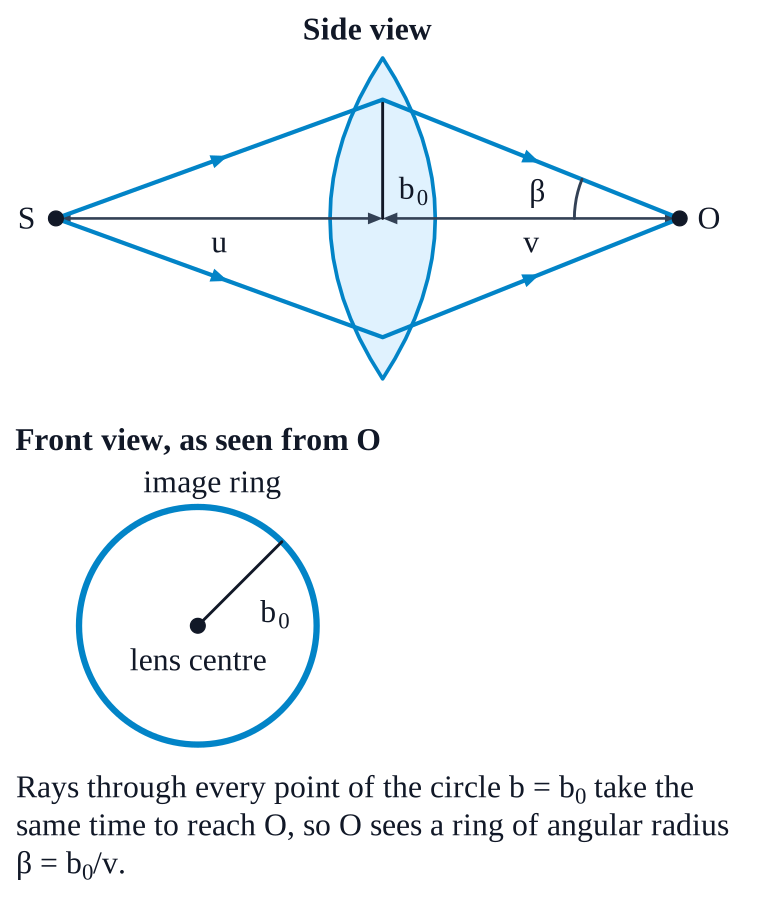
    (i) A ray through the lens at height \(\displaystyle b\ (\ll u,v)\) has optical path, with glass of thickness \(\displaystyle w(b)\) replacing air:\[L(b)=\sqrt{u^2+b^2}+\sqrt{v^2+b^2}+(n-1)\,w(b) \] \[L(b)\approx u+v+\frac{b^2}{2}\Big(\frac1u+\frac1v\Big)+(n-1)\Big(w_0-\frac{b^2}{\alpha}\Big) \] \[L(b)=u+v+(n-1)w_0+b^2\left[\frac12\Big(\frac1u+\frac1v\Big)-\frac{n-1}{\alpha}\right] \]All paraxial rays take the same time, so \(\displaystyle L\) must not depend on \(\displaystyle b\):\[\frac1u+\frac1v=\frac{2(n-1)}{\alpha} \] \[u\to\infty,\ v=f:\qquad f=\frac{\alpha}{2(n-1)} \](ii) With \(\displaystyle w=k_1\ln(k_2/b)\):\[L(b)=\text{const}+\frac{b^2}{2}\,\frac{u+v}{uv}-(n-1)k_1\ln b \] \[\frac{dL}{db}=b\,\frac{u+v}{uv}-\frac{(n-1)k_1}{b}=0\ \Rightarrow\ b_0^2=\frac{(n-1)k_1\,uv}{u+v} \]Every point of the circle \(\displaystyle b=b_0\) (with \(\displaystyle b_{\min}<b_0<b_{\max}\)) has the same extremal transit time, so rays from all sides reach O: a ring.NCERT_Solution_Class12_Physics_Exemplar_Ch9_Q32\[\beta=\frac{b_0}{v}=\sqrt{\frac{(n-1)k_1\,uv}{(u+v)\,v^2}}=\sqrt{\frac{(n-1)k_1\,\dfrac{u}{v}}{u+v}} \]Answer: (i) \(\displaystyle \dfrac1u+\dfrac1v=\dfrac{2(n-1)}{\alpha}\), \(\displaystyle f=\dfrac{\alpha}{2(n-1)}\); (ii) a ring of angular radius \(\displaystyle \beta=\sqrt{\dfrac{(n-1)k_1\,u/v}{u+v}}\).