SolveIt is under development
SolveItClass 12 · Exemplar

NCERT Exemplar · Class 12 Physics Ray Optics and Optical Instruments

32 questions

Short Answer Questions 22–27 (part 4 of 5)

  1. Exercise 22

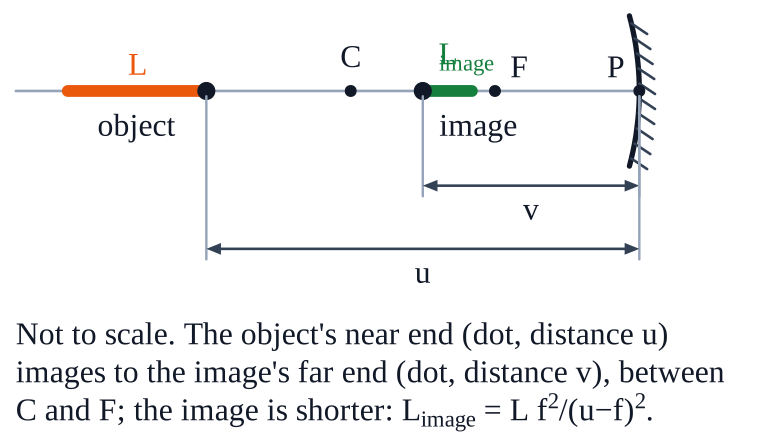
    A short object of length L\displaystyle L is placed along the principal axis of a concave mirror away from focus. The object distance is u\displaystyle u. If the mirror has a focal length f\displaystyle f, what will be the length of the image? You may take L≪∣v−f∣\displaystyle L \ll|v-f|.
    NCERT’s answer
    Let the two ends of the object be at distance \(\displaystyle u_1=u-L / 2\) and \(\displaystyle u_2=u+L / 2\), respectively, so that \(\displaystyle \left|u_1-u_2\right|=L\). Let the image of the two ends be formed at \(\displaystyle v_1\) and \(\displaystyle v_2\), so that the image length would be \(\displaystyle L^{\prime}=\left|v_1-v_2\right|\). Since \(\displaystyle \frac{1}{u}+\frac{1}{v}=\frac{1}{f}\) or \(\displaystyle v=\frac{f u}{u-f}\) the image of the two ends will be at \(\displaystyle v_1=\frac{f(u-L / 2)}{u-f-L / 2}, v_2=\frac{f(u+L / 2)}{u-f+L / 2}\) Hence \[L^{\prime}=\left|v_1-v_2\right|=\frac{f^2 L}{(u-f)^2 \times L^2 / 4} \] Since the object is short and kept away from focus, we have \[L^2 / 4 \ll(u-f)^2 \] Hence finally \[L^{\prime}=\frac{f^2}{(u-f)^2} L . \]
    Differentiate the mirror formula; with \(\displaystyle |du|=L\), the image length is \(\displaystyle |dv|\) (signed \(\displaystyle u,\,v,\,f\)). \[\frac{1}{v}+\frac{1}{u}=\frac{1}{f}\;\Rightarrow\;-\frac{dv}{v^{2}}-\frac{du}{u^{2}}=0\;\Rightarrow\;|dv|=\left(\frac{v}{u}\right)^{2}L \] \[v=\frac{uf}{u-f}\;\Rightarrow\;\frac{v}{u}=\frac{f}{u-f} \] \[L_{\text{image}}=L\left(\frac{f}{u-f}\right)^{2} \] NCERT_Solution_Class12_Physics_Exemplar_Ch9_Q22 \[(v-f)(u-f)=f^{2}\;\Rightarrow\;L_{\text{image}}=L\left(\frac{v-f}{f}\right)^{2} \] Answer: \(\displaystyle L_{\text{image}}=L\,\dfrac{f^{2}}{(u-f)^{2}}=L\left(\dfrac{v-f}{f}\right)^{2}\)
  2. Exercise 23

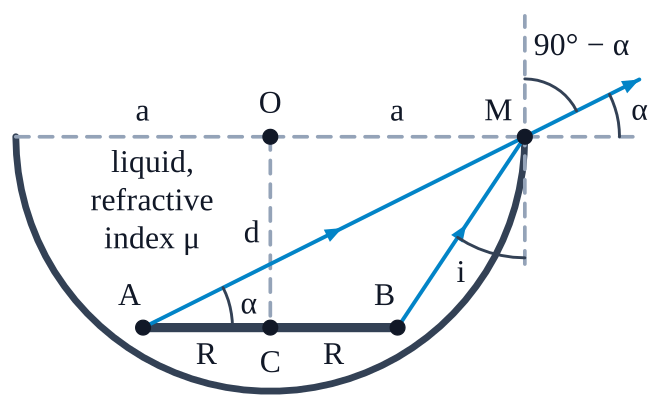
    A circular disc of radius 'R\displaystyle R' is placed co-axially and horizontally inside an opaque hemispherical bowl of radius 'a\displaystyle a' (Fig. 9.5\displaystyle 9.5). The far edge of the disc is just visible when viewed from the edge of the bowl. The bowl is filled with transparent liquid of refractive index μ\displaystyle \mu and the near edge of the disc becomes just visible. How far below the top of the bowl is the disc placed? NCERT_Question_Class12_Physics_Exemplar_Ch9_Q23
    Empty bowl: the far edge \(\displaystyle A\) is just visible along \(\displaystyle AM\). \[\tan\alpha=\frac{d}{a+R}\;\Rightarrow\;\cos\alpha=\frac{a+R}{\sqrt{(a+R)^{2}+d^{2}}} \] NCERT_Solution_Class12_Physics_Exemplar_Ch9_Q23 Liquid filled: the ray from the near edge \(\displaystyle B\) must leave at \(\displaystyle M\) along the same direction, which is \(\displaystyle 90^\circ-\alpha\) from the vertical normal. \[\sin i=\frac{a-R}{\sqrt{(a-R)^{2}+d^{2}}} \] \[\mu\sin i=\sin(90^\circ-\alpha)=\cos\alpha \] \[\frac{\mu\,(a-R)}{\sqrt{(a-R)^{2}+d^{2}}}=\frac{a+R}{\sqrt{(a+R)^{2}+d^{2}}} \] Squaring and collecting \(\displaystyle d^{2}\): \[(\mu^{2}-1)(a^{2}-R^{2})^{2}=d^{2}\left[(a+R)^{2}-\mu^{2}(a-R)^{2}\right] \] Answer: \(\displaystyle d=(a^{2}-R^{2})\sqrt{\dfrac{\mu^{2}-1}{(a+R)^{2}-\mu^{2}(a-R)^{2}}}\)
  3. Exercise 24

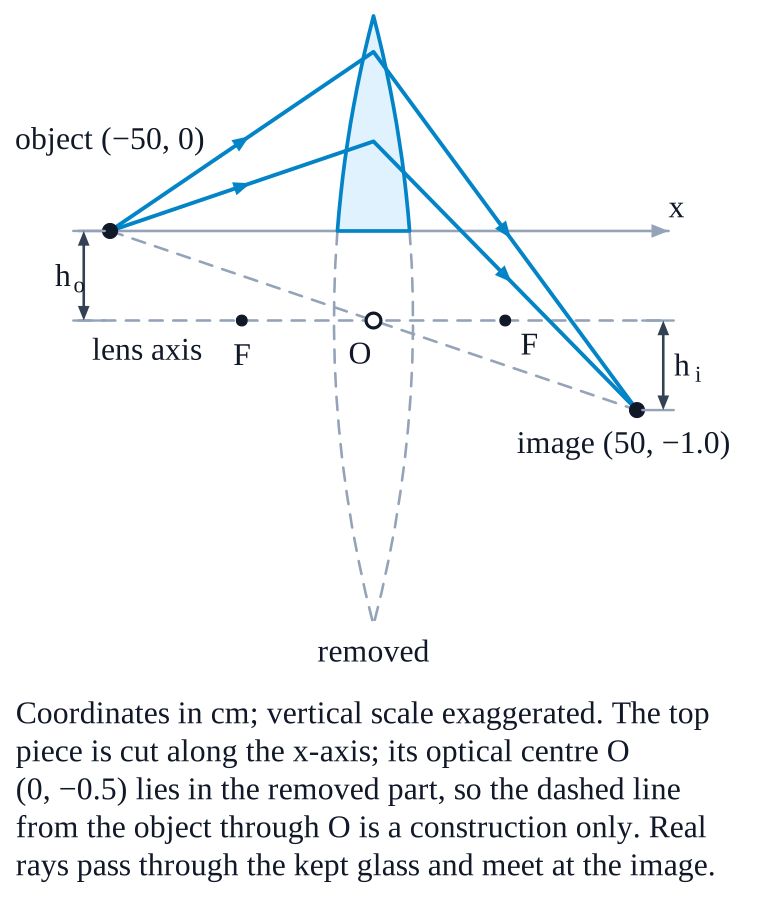
    A thin convex lens of focal length 25\displaystyle 25 cm is cut into two pieces 0.5\displaystyle 0.5 cm above the principal axis. The top part is placed at (0,0)\displaystyle (0,0) and an object placed at (-50\displaystyle 50 cm, 0\displaystyle 0). Find the coordinates of the image.
    NCERT’s answer
    If there was no cut then the object would have been at a height of $\displaystyle 0.5$ cm from the principal axis $\displaystyle 00$′. Consider the image for this case. \[\begin{aligned} & \frac{1}{v}-\frac{1}{u}=\frac{1}{f} \\ & \therefore \frac{1}{v}=\frac{1}{u}+\frac{1}{f}=\frac{1}{-50}+\frac{1}{25}=\frac{1}{50} \\ & \therefore v=50 \mathrm{~cm} . \end{aligned} \] Magnification is \(\displaystyle \mathrm{m}=\frac{v}{u}=-\frac{50}{50}=-1\). Thus the image would have been formed at $\displaystyle 50$ cm from the pole and $\displaystyle 0.5$ cm below the principal axis. Hence with respect to the X axis passing through the edge of the cut lens, the co-ordinates of the image are \[(50 \mathrm{~cm},-1 \mathrm{~cm}) \] NCERT_Solution_Class12_Physics_Exemplar_Ch9_Q24_ncert
    With the cut edge at the origin, the piece's optical centre is at \(\displaystyle (0,\,-0.5\ \mathrm{cm})\); the object lies \(\displaystyle h_o=+0.5\ \mathrm{cm}\) above the piece's own axis. \[\frac{1}{v}-\frac{1}{u}=\frac{1}{f}\;\Rightarrow\;\frac{1}{v}=\frac{1}{25}-\frac{1}{50}=\frac{1}{50}\ \mathrm{cm^{-1}}\;\Rightarrow\;v=+50\ \mathrm{cm} \] \[m=\frac{v}{u}=\frac{50}{-50}=-1\;\Rightarrow\;h_i=m\,h_o=-0.5\ \mathrm{cm} \] NCERT_Solution_Class12_Physics_Exemplar_Ch9_Q24 \[y_{\text{image}}=-0.5\ \mathrm{cm}+(-0.5\ \mathrm{cm})=-1.0\ \mathrm{cm} \] Answer: Image at \(\displaystyle (50\ \mathrm{cm},\,-1.0\ \mathrm{cm})\), real and inverted.
  4. Exercise 25

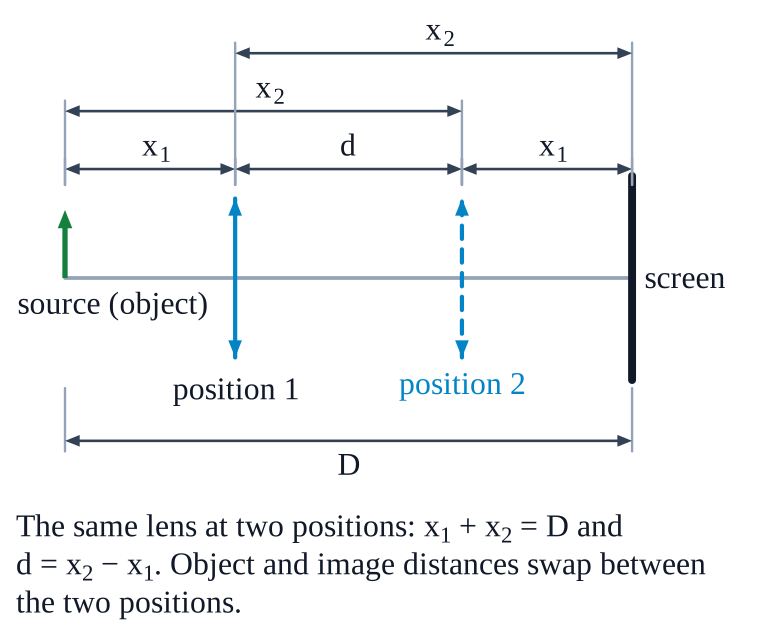
    In many experimental set-ups the source and screen are fixed at a distance say D\displaystyle D and the lens is movable. Show that there are two positions for the lens for which an image is formed on the screen. Find the distance between these points and the ratio of the image sizes for these two points.
    NCERT’s answer
    From the reversibility of \(\displaystyle u\) and \(\displaystyle v\), as seen from the formula for lens, \[\frac{1}{f}=\frac{1}{v}-\frac{1}{u} \] It is clear that there are two positions for which there shall be an image on the screen. Let the first position be when the lens is at O. Given \(\displaystyle -u+v=D\) \[\Rightarrow u=-(D-v) \] Placing it in the lens formula \[\frac{1}{D-v}+\frac{1}{v}=\frac{1}{f} \] \[\begin{aligned} & \Rightarrow \frac{v+D-v}{(D-v) v}=\frac{1}{f} \\ & \Rightarrow v^2-D v+\mathrm{D} f=0 \\ & \Rightarrow v=\frac{D}{2} \pm \frac{\sqrt{\mathrm{D}^2-4 D f}}{2} \end{aligned} \] \[u=-(D-v)=-\left(\frac{D}{2} \pm \frac{\sqrt{D^2-4 D f}}{2}\right) \] Thus, if the object distance is \(\displaystyle \frac{D}{2}-\frac{\sqrt{D^2-4 D f}}{2}\) then the image is at \[\frac{D}{2}+\frac{\sqrt{D^2-4 D f}}{2} \] If the object distance is \(\displaystyle \frac{D}{2}+\frac{\sqrt{D^2-4 D f}}{2}\), then the image is at \[\frac{D}{2}-\frac{\sqrt{D^2-4 D f}}{2} . \] The distance between the poles for these two object distances is \[\frac{D}{2}+\frac{\sqrt{D^2-4 D f}}{2}-\left(\frac{D}{2}-\frac{\sqrt{D^2-4 \mathrm{D} f}}{2}\right)=\sqrt{D^2-4 D f} \] Let \(\displaystyle d=\sqrt{D^2-4 D f}\) If \(\displaystyle u=\frac{D}{2}+\frac{d}{2}\) then the image is at \(\displaystyle v=\frac{D}{2}-\frac{d}{2}\). ∴ The magnification \(\displaystyle m_1=\frac{\mathrm{D}-d}{D+d}\) If \(\displaystyle u=\frac{\mathrm{D}-d}{2}\) then \(\displaystyle v=\frac{\mathrm{D}+d}{2}\) ∴ The magnification \(\displaystyle m_2=\frac{\mathrm{D}+d}{\mathrm{D}-d}\) - Thus \(\displaystyle \frac{m_2}{m_1}=\left(\frac{\mathrm{D}+d}{\mathrm{D}-d}\right)^2\). NCERT_Solution_Class12_Physics_Exemplar_Ch9_Q25_ncert
    Let the lens be \(\displaystyle x\) from the source, so the screen is \(\displaystyle D-x\) from it (distances as magnitudes, real image). \[\frac{1}{x}+\frac{1}{D-x}=\frac{1}{f}\;\Rightarrow\;x^{2}-Dx+Df=0 \] \[x=\frac{D\pm\sqrt{D^{2}-4Df}}{2} \] Two real positions \(\displaystyle x_1<x_2\) exist when \(\displaystyle D>4f\). NCERT_Solution_Class12_Physics_Exemplar_Ch9_Q25 \[d=x_2-x_1=\sqrt{D(D-4f)} \] At \(\displaystyle x_1\): \(\displaystyle u=x_1,\ v=x_2\). At \(\displaystyle x_2\): \(\displaystyle u=x_2,\ v=x_1\). \[m_1=\frac{x_2}{x_1},\quad m_2=\frac{x_1}{x_2}\;\Rightarrow\;\frac{I_1}{I_2}=\frac{m_1}{m_2}=\left(\frac{x_2}{x_1}\right)^{2}=\left(\frac{D+d}{D-d}\right)^{2} \] Answer: \(\displaystyle d=\sqrt{D(D-4f)}\); \(\displaystyle \dfrac{I_1}{I_2}=\left(\dfrac{D+\sqrt{D(D-4f)}}{D-\sqrt{D(D-4f)}}\right)^{2}\), the larger image when the lens is nearer the source.
  5. Exercise 26

    A jar of height h\displaystyle h is filled with a transparent liquid of refractive index μ\displaystyle \mu (Fig. 9.6\displaystyle 9.6). At the centre of the jar on the bottom surface is a dot. Find the minimum diameter of a disc, such that when placed on the top surface symmetrically about the centre, the dot is invisible. NCERT_Question_Class12_Physics_Exemplar_Ch9_Q26
    NCERT’s answer
    Let \(\displaystyle d\) be the diameter of the disc. The spot shall be invisible if the incident rays from the dot at O to the surface at \(\displaystyle \frac{d}{2}\) are at the critical angle. Let \(\displaystyle i\) be the angle of incidence. Then \(\displaystyle \sin i=\frac{1}{\mu}\) Now, \(\displaystyle \frac{d / 2}{h}=\tan i\) \[\begin{aligned} & \Rightarrow \frac{d}{2}=h \tan i=h\left[\sqrt{\mu^2-1}\right]^{-1} \\ & \therefore d=\frac{2 h}{\sqrt{\mu^2-1}} . \end{aligned} \]
    The dot is hidden when the disc stops every ray that could leave the top surface; the limiting ray meets the surface at the critical angle \(\displaystyle \theta_c\). Rays beyond the disc edge have \(\displaystyle i>\theta_c\) and are totally reflected. \[\sin\theta_c=\frac{1}{\mu}\;\Rightarrow\;\tan\theta_c=\frac{1}{\sqrt{\mu^{2}-1}} \] NCERT_Solution_Class12_Physics_Exemplar_Ch9_Q26 \[\frac{d}{2}=h\tan\theta_c=\frac{h}{\sqrt{\mu^{2}-1}} \] Answer: \(\displaystyle d_{\min}=\dfrac{2h}{\sqrt{\mu^{2}-1}}\)
  6. Exercise 27

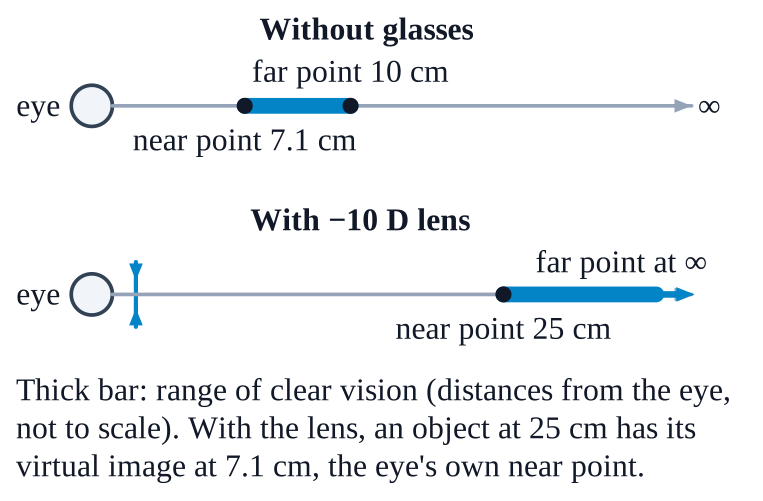
    A myopic adult has a far point at 0.1\displaystyle 0.1 m. His power of accomodation is 4\displaystyle 4 diopters.
    (i)
    What power lenses are required to see distant objects?
    (ii)
    What is his near point without glasses?
    (iii)
    What is his near point with glasses? (Take the image distance from the lens of the eye to the retina to be 2\displaystyle 2 cm.)
    NCERT’s answer
    (i)
    Let the power at the far point be \(\displaystyle \mathrm{P}_f\) for the normal relaxed eye.
    Then \(\displaystyle \mathrm{P}_f=\frac{1}{f}=\frac{1}{0.1}+\frac{1}{0.02}=60 \mathrm{D}\)
    With the corrective lens the object distance at the far point is \(\displaystyle \infty\). The power required is
    \[P_f^{\prime}=\frac{1}{f^{\prime}}=\frac{1}{\infty}+\frac{1}{0.02}=50 \mathrm{D} \]
    The effective power of the relaxed eye with glasses is the sum of the eye and that of the glasses \(\displaystyle P_g\).
    \[\begin{aligned} & \therefore P_f^{\prime}=\mathrm{P}_{\mathrm{f}}+P_g \\ & \therefore \mathrm{P}_{\mathrm{g}}=-10 \mathrm{D} . \end{aligned} \]
    (ii)
    His power of accomadation is $\displaystyle 4$ diopters for the normal eye. Let the power of the normal eye for near vision be \(\displaystyle P_n\).
    Then \(\displaystyle 4=P_n-P_f\) or \(\displaystyle P_n=64 \mathrm{D}\).
    Let his near point be \(\displaystyle x_{\mathrm{n}}\), then
    \[\begin{aligned} & \frac{1}{x_n}+\frac{1}{0.02}=64 \text { or } \frac{1}{x_n}+50=64 \\ & \frac{1}{x_n}=14, \\ & \therefore x_{\mathrm{n}}=\frac{1}{14} \simeq 0.07 \mathrm{~m} \end{aligned} \]
    (iii)
    With glasses \(\displaystyle P_n^{\prime}=P_f^{\prime}+4=54\)
    \[\begin{aligned} & 54=\frac{1}{x_n^{\prime}}+\frac{1}{0.02}=\frac{1}{x_n^{\prime}}+50 \\ & \frac{1}{x_n^{\prime}}=4, \\ & \therefore x_n^{\prime}=\frac{1}{4}=0.25 \mathrm{~m} . \end{aligned} \]
    (i) Distant objects must be imaged at the far point (glasses close to the eye): \[u=-\infty,\ v=-0.1\ \mathrm{m}\;\Rightarrow\;P=\frac{1}{v}-\frac{1}{u}=-10\ \mathrm{D} \] (ii) Eye-lens power at the far point, then \(\displaystyle +4\ \mathrm{D}\) of accommodation: \[P_{F}=\frac{1}{0.02}+\frac{1}{0.1}=60\ \mathrm{D},\qquad P_{N}=60+4=64\ \mathrm{D} \] \[\frac{1}{d_N}=64-\frac{1}{0.02}=14\ \mathrm{m^{-1}}\;\Rightarrow\;d_N=\frac{1}{14}\ \mathrm{m}\approx 7.1\ \mathrm{cm} \] (iii) The \(\displaystyle -10\ \mathrm{D}\) lens must form a virtual image at \(\displaystyle 7.1\ \mathrm{cm}\): \[\frac{1}{u}=\frac{1}{v}-P=-14-(-10)=-4\ \mathrm{m^{-1}}\;\Rightarrow\;u=-0.25\ \mathrm{m} \] NCERT_Solution_Class12_Physics_Exemplar_Ch9_Q27 Answer: (i) \(\displaystyle -10\ \mathrm{D}\) (concave); (ii) \(\displaystyle \approx 7.1\ \mathrm{cm}\); (iii) \(\displaystyle 25\ \mathrm{cm}\).