SolveIt is under development
SolveItClass 12 · Exemplar

NCERT Exemplar · Class 12 Physics Ray Optics and Optical Instruments

32 questions

Multiple Choice Questions (Type II) 12–16 (part 2 of 5)

  1. Exercise 12

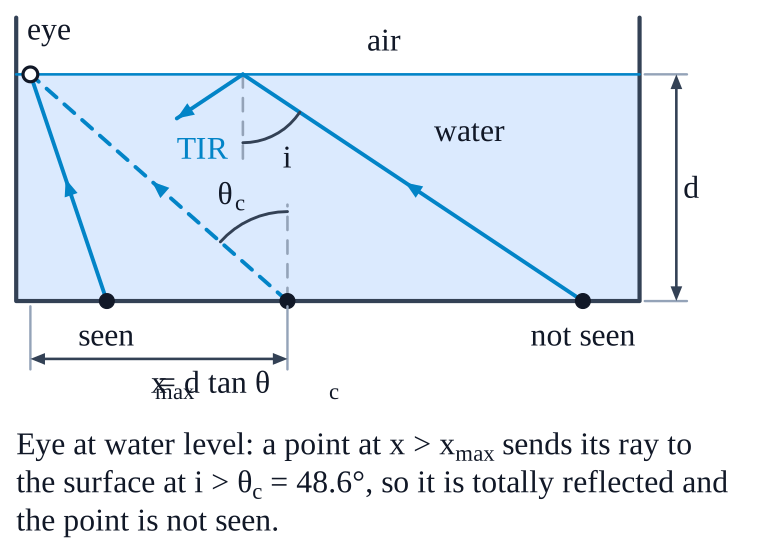
    Consider an extended object immersed in water contained in a plane trough. When seen from close to the edge of the trough the object looks distorted because
    (a)
    the apparent depth of the points close to the edge are nearer the surface of the water compared to the points away from the edge.
    (b)
    the angle subtended by the image of the object at the eye is smaller than the actual angle subtended by the object in air.
    (c)
    some of the points of the object far away from the edge may not be visible because of total internal reflection.
    (d)
    water in a trough acts as a lens and magnifies the object.
    NCERT’s answer
    (a), (b), (c)
    (a), (b), (c) Apparent depth depends on the viewing angle, so points are lifted unequally and the image is squashed. For an eye at water level, far points are totally reflected.\[d_{app}=\frac{d}{n_w}=\frac{3}{4}\,d<d\quad(\text{near-normal view}) \]\[\sin\theta_c=\frac{1}{n_w}=0.75\ \Rightarrow\ \theta_c=48.6^\circ \]NCERT_Solution_Class12_Physics_Exemplar_Ch9_Q12\[x_{max}=d\tan\theta_c=1.13\,d\ \Rightarrow\ x>x_{max}:\ i>\theta_c,\ \text{TIR, point hidden} \]
  2. Exercise 13

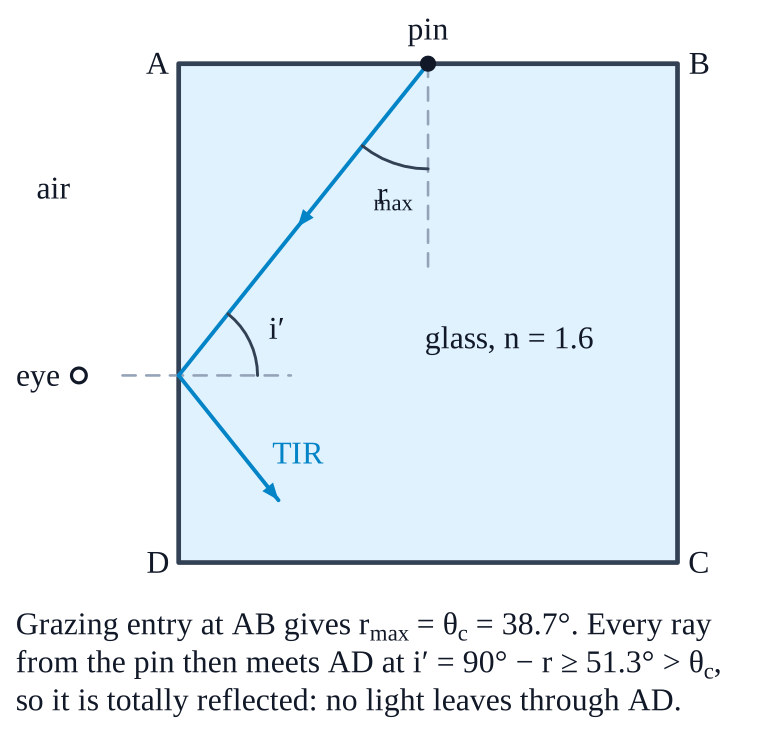
    A rectangular block of glass ABCD has a refractive index 1.6. A pin is placed midway on the face AB (Fig. 9.4\displaystyle 9.4). When observed from the face AD, the pin shall
    (a)
    appear to be near A.
    (b)
    appear to be near D.
    (c)
    appear to be at the centre of AD.
    (d)
    not be seen at all.
    NCERT_Question_Class12_Physics_Exemplar_Ch9_Q13
    NCERT’s answer
    (d)
    (d) Light entering through AB stays within \(\displaystyle \theta_c\) of its normal, so it meets AD beyond \(\displaystyle \theta_c\) and is totally reflected. The pin is not seen from AD.\[\sin\theta_c=\frac{1}{1.6}=0.625\ \Rightarrow\ \theta_c=38.7^\circ \]\[\text{At AB, grazing entry:}\quad \sin 90^\circ=1.6\,\sin r_{max}\ \Rightarrow\ r_{max}=38.7^\circ \]NCERT_Solution_Class12_Physics_Exemplar_Ch9_Q13\[\text{At AD:}\quad i'=90^\circ-r\ \ge\ 90^\circ-38.7^\circ=51.3^\circ>\theta_c\ \Rightarrow\ \text{total internal reflection} \]
  3. Exercise 14

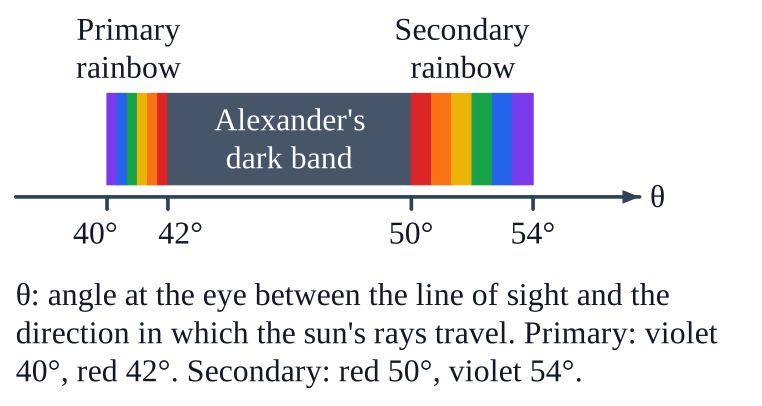
    Between the primary and secondary rainbows, there is a dark band known as Alexandar's dark band. This is because
    (a)
    light scattered into this region interfere destructively.
    (b)
    there is no light scattered into this region.
    (c)
    light is absorbed in this region.
    (d)
    angle made at the eye by the scattered rays with respect to the incident light of the sun lies between approximately 42\displaystyle 42° and 50\displaystyle 50°.
    NCERT’s answer
    (a), (d)
    (a), (d) The dark band lies where the angle at the eye is between \(\displaystyle 42^\circ\) and \(\displaystyle 50^\circ\); light scattered into it interferes destructively.\[\text{primary (one internal reflection):}\quad \theta\le 42^\circ \]\[\text{secondary (two internal reflections):}\quad \theta\ge 50^\circ \]NCERT_Solution_Class12_Physics_Exemplar_Ch9_Q14\[42^\circ<\theta<50^\circ\ \Rightarrow\ \text{destructive interference, dark band} \]
  4. Exercise 15

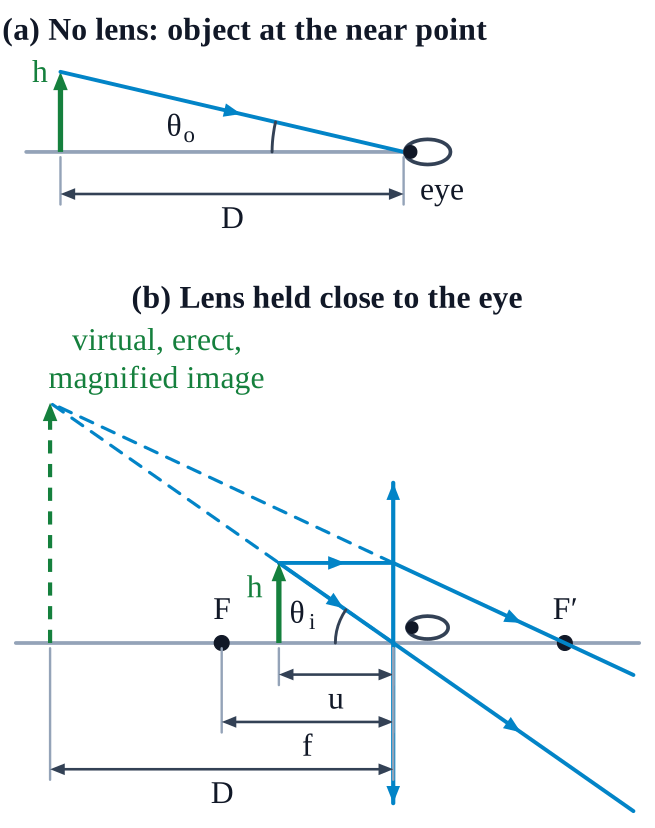
    A magnifying glass is used, as the object to be viewed can be brought closer to the eye than the normal near point. This results in
    (a)
    a larger angle to be subtended by the object at the eye and hence viewed in greater detail.
    (b)
    the formation of a virtual erect image.
    (c)
    increase in the field of view.
    (d)
    infinite magnification at the near point.
    NCERT’s answer
    (a), (b)
    (a), (b) The object lies inside \(\displaystyle f\), so the image is virtual and erect and subtends a larger angle. The magnification stays finite, so (d) fails.NCERT_Solution_Class12_Physics_Exemplar_Ch9_Q15\[\theta_o=\frac{h}{D},\qquad \theta_i=\frac{h}{u},\quad u<D\ \Rightarrow\ \theta_i>\theta_o \]\[m=\frac{\theta_i}{\theta_o}=\frac{D}{u}=1+\frac{D}{f}\quad(\text{finite}) \]
  5. Exercise 16

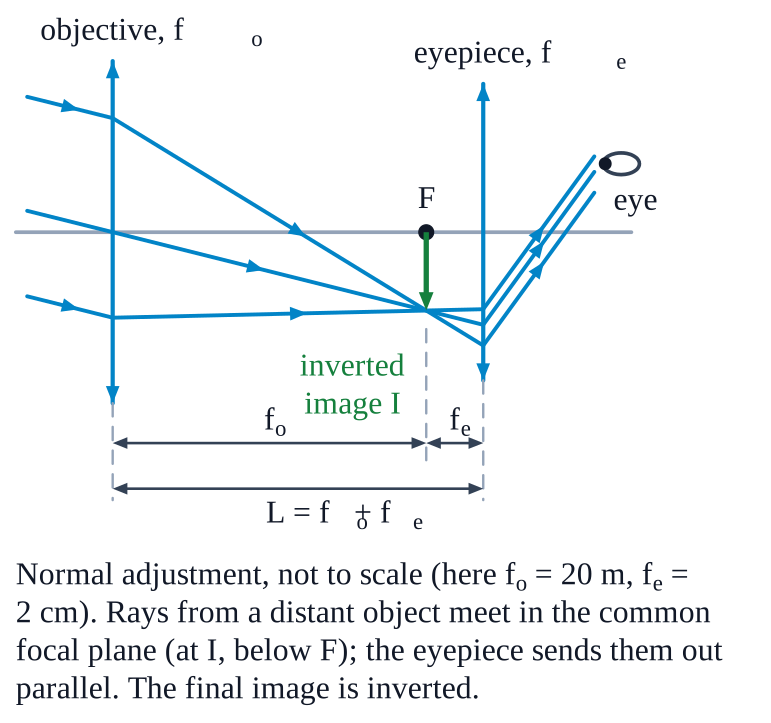
    An astronomical refractive telescope has an objective of focal length 20m and an eyepiece of focal length 2cm.
    (a)
    The length of the telescope tube is 20.02m.
    (b)
    The magnification is 1000.
    (c)
    The image formed is inverted.
    (d)
    An objective of a larger aperture will increase the brightness and reduce chromatic aberration of the image.
    NCERT’s answer
    (a), (b), (c)
    (a), (b), (c) Option (d) fails: a larger aperture brightens the image, but chromatic aberration comes from dispersion in the lens glass and remains.\[f_e=2\ \mathrm{cm}=0.02\ \mathrm{m} \]\[L=f_o+f_e=20\ \mathrm{m}+0.02\ \mathrm{m}=20.02\ \mathrm{m} \]\[m=\frac{f_o}{f_e}=\frac{20\ \mathrm{m}}{0.02\ \mathrm{m}}=1000 \]NCERT_Solution_Class12_Physics_Exemplar_Ch9_Q16