SolveIt is under development
SolveItClass 12 · Exemplar

NCERT Exemplar · Class 12 Physics Moving Charges and Magnetism

29 questions

Very Short Answer Questions 12–16 (part 3 of 5)

  1. Exercise 12

    Verify that the cyclotron frequency ω=eB/m\displaystyle \omega=e B / m has the correct dimensions of [T]−1\displaystyle [\mathrm{T}]^{-1}.
    NCERT’s answer
    For a charge particle moving perpendicular to the magnetic field: \[\begin{aligned} & \frac{m v^2}{R}=q v B \\ & \therefore \frac{q B}{m}=\frac{v}{R}=\omega \\ & \therefore[\omega]=\left[\frac{q B}{m}\right]=\left[\frac{v}{R}\right]=[T]^{-1} . \end{aligned} \]
    For \(\displaystyle \mathbf{v}\perp\mathbf{B}\), with \(\displaystyle \mathrm{Q}\) the dimension of charge and \(\displaystyle \mathrm{T}\) of time: \[F=qvB\;\Rightarrow\;[B]=\frac{[F]}{[q]\,[v]}=\frac{[\mathrm{M\,L\,T^{-2}}]}{[\mathrm{Q}]\,[\mathrm{L\,T^{-1}}]}=[\mathrm{M\,Q^{-1}\,T^{-1}}] \] \[[\omega]=\frac{[e]\,[B]}{[m]}=\frac{[\mathrm{Q}]\,[\mathrm{M\,Q^{-1}\,T^{-1}}]}{[\mathrm{M}]}=[\mathrm{T^{-1}}] \] Answer: \(\displaystyle \omega=eB/m\) has dimensions \(\displaystyle [\mathrm{T}]^{-1}\).
  2. Exercise 13

    Show that a force that does no work must be a velocity dependent force.
    NCERT’s answer
    \(\displaystyle \mathrm{dW}=\mathbf{F} . d \mathbf{l}=0\) \[\begin{aligned} & \Rightarrow \mathbf{F} . \mathbf{v} d t=0 \\ & \Rightarrow \mathbf{F} . \mathbf{v}=0 \end{aligned} \] \(\displaystyle \mathbf{F}\) must be velocity dependent which implies that angle between \(\displaystyle \mathbf{F}\) and \(\displaystyle \mathbf{v}\) is $\displaystyle 90$°. If \(\displaystyle \mathbf{v}\) changes (direction) then (directions) \(\displaystyle \mathbf{F}\) should also change so that above condition is satisfied.
    If \(\displaystyle \mathbf{F}\) did not depend on \(\displaystyle \mathbf{v}\), a particle moving along \(\displaystyle \mathbf{F}\) would have work done on it: \[P=\mathbf{F}\cdot\mathbf{v}=Fv\cos0^\circ\neq0 \] Zero work for every motion needs \[dW=\mathbf{F}\cdot\mathbf{v}\,dt=0\;\Rightarrow\;\mathbf{F}\perp\mathbf{v}\ \text{at every instant} \] \[\text{e.g. }\ \mathbf{F}=q(\mathbf{v}\times\mathbf{B})\;\Rightarrow\;\mathbf{F}\cdot\mathbf{v}=0 \] Answer: \(\displaystyle \mathbf{F}\perp\mathbf{v}\) always, so \(\displaystyle \mathbf{F}\) must change with \(\displaystyle \mathbf{v}\).
  3. Exercise 14

    The magnetic force depends on v\displaystyle \mathbf{v} which depends on the inertial frame of reference. Does then the magnetic force differ from inertial frame to frame? Is it reasonable that the net acceleration has a different value in different frames of reference?
    NCERT’s answer
    Magnetic force is frame dependent. Net acceleraton arising from this is however frame independent (non - relativistic physics)for inertial frames.
    Frame \(\displaystyle S'\) moves at \(\displaystyle \mathbf{u}\) relative to \(\displaystyle S\) (\(\displaystyle u\ll c\)): \[\mathbf{v}'=\mathbf{v}-\mathbf{u},\qquad \mathbf{E}'=\mathbf{E}+\mathbf{u}\times\mathbf{B},\qquad \mathbf{B}'=\mathbf{B} \] \[\mathbf{F}'=q(\mathbf{E}'+\mathbf{v}'\times\mathbf{B}')=q(\mathbf{E}+\mathbf{u}\times\mathbf{B}+\mathbf{v}\times\mathbf{B}-\mathbf{u}\times\mathbf{B})=q(\mathbf{E}+\mathbf{v}\times\mathbf{B})=\mathbf{F} \] \[\mathbf{a}'=\frac{\mathbf{F}'}{m}=\mathbf{a} \] \[\mathbf{v}=\mathbf{0},\ \mathbf{E}=\mathbf{0}:\quad \mathbf{F}'_{\mathrm{mag}}=-q\,\mathbf{u}\times\mathbf{B},\quad \mathbf{F}'_{\mathrm{el}}=+q\,\mathbf{u}\times\mathbf{B}\;\Rightarrow\;\mathbf{F}'=\mathbf{0} \] Answer: Yes, the magnetic force differs, but an electric force appears that compensates; net force and acceleration are the same in every inertial frame.
  4. Exercise 15

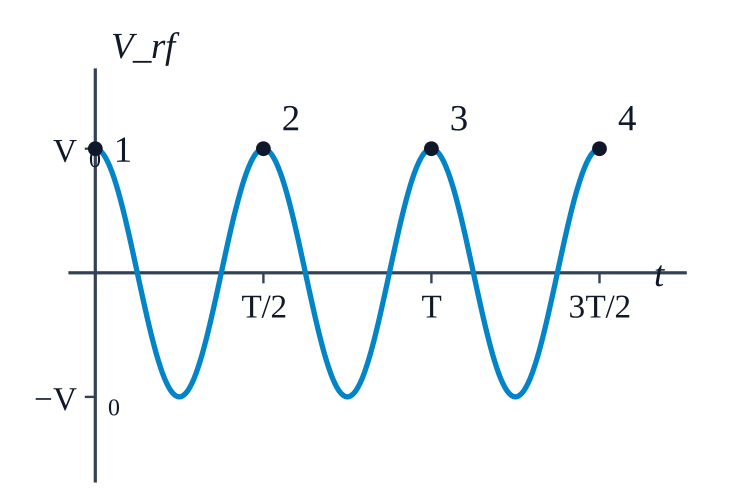
    Describe the motion of a charged particle in a cyclotron if the frequency of the radio frequency (rf) field were doubled.
    NCERT’s answer
    Particle will accelerate and decelerate altenatively. So the radius of path in the Dee's will remain unchanged.
    \[T_c=\frac{2\pi m}{qB}\ \ (\text{independent of speed}),\qquad \nu_{rf}'=2\nu_c\;\Rightarrow\;T_{rf}'=\frac{T_c}{2} \] \[\text{gap crossings at } t=0,\ \frac{T_c}{2},\ T_c,\dots\ \Rightarrow\ \omega_{rf}'\,t=0,\ 2\pi,\ 4\pi,\dots \] NCERT_Solution_Class12_Physics_Exemplar_Ch4_Q15 \[\text{crossing 1: } K\uparrow;\qquad \text{crossing 2: } K\downarrow;\qquad \text{crossing 3: } K\uparrow\ \cdots \] Answer: The particle is alternately accelerated and decelerated, so it gains no net energy.
  5. Exercise 16

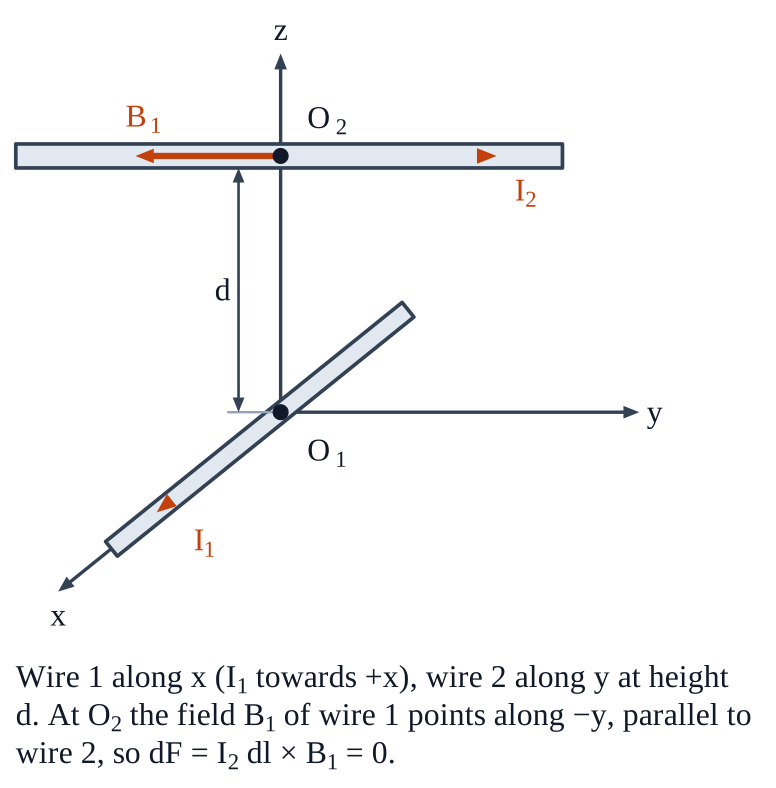
    Two long wires carrying current I1\displaystyle I_1 and I2\displaystyle I_2 are arranged as shown in Fig. 4.1. The one carrying current I1\displaystyle I_1 is along is the x\displaystyle x-axis. The other carrying current I2\displaystyle I_2 is along a line parallel to the y\displaystyle y-axis given by x=0\displaystyle x=0 and z=d\displaystyle z=d. Find the force exerted at O2\displaystyle \mathrm{O}_2 because of the wire along the x\displaystyle x-axis. NCERT_Question_Class12_Physics_Exemplar_Ch4_Q16
    NCERT’s answer
    At \(\displaystyle \mathrm{O}_2\), the magnetic field due to \(\displaystyle I_1\) is along the y-axis. The second wire is along the \(\displaystyle y\)-axis and hence the force is zero.
    Field of wire $\displaystyle 1$ at \(\displaystyle \mathrm{O_2}\) (distance \(\displaystyle d\)), taking \(\displaystyle I_1\) along \(\displaystyle +x\): \[\mathbf{B}_1=\frac{\mu_0 I_1}{2\pi d}\,(\hat{\mathbf{x}}\times\hat{\mathbf{z}})=-\frac{\mu_0 I_1}{2\pi d}\,\hat{\mathbf{y}} \] NCERT_Solution_Class12_Physics_Exemplar_Ch4_Q16 \[d\mathbf{F}=I_2\,d\mathbf{l}\times\mathbf{B}_1=I_2\,dl\,\hat{\mathbf{y}}\times\left(-\frac{\mu_0 I_1}{2\pi d}\,\hat{\mathbf{y}}\right)=\mathbf{0} \] Answer: \(\displaystyle \mathbf{F}=\mathbf{0}\) at \(\displaystyle \mathrm{O_2}\), because \(\displaystyle \mathbf{B}_1\) is parallel to wire 2.