Exercise 23
A turn rectangular coil ABCD (in XY plane) is hung from one arm of a balance (Fig. ). A mass 500g is added to the other arm to balance the weight of the coil. A current A passes through the coil and a constant magnetic field of T acting inward (in plane) is switched on such that only arm CD of length cm lies in the field. How much additional mass '' must be added to regain the balance?

Only arm CD (length \(\displaystyle l = 1\ \mathrm{cm}\)) lies in the field, so only it feels a force.\[F = N I l B = 100 \times 4.9\ \mathrm{A} \times 10^{-2}\ \mathrm{m} \times 0.2\ \mathrm{T} = 0.98\ \mathrm{N} \]Current in CD runs from C to D, \(\displaystyle \mathbf{B}\) is into the page:\[\mathbf{F} = N I\,(\mathbf{l}\times\mathbf{B}) \ \Rightarrow\ \mathbf{F}\ \text{points downward} \]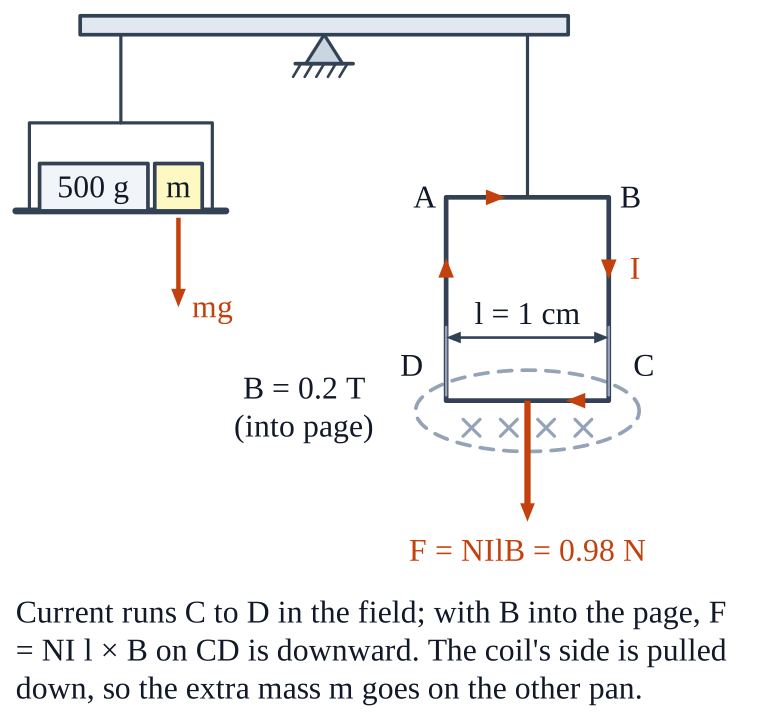 The coil is pulled down, so the extra mass goes on the other arm:\[m g = F \ \Rightarrow\ m = \frac{0.98\ \mathrm{N}}{9.8\ \mathrm{m\,s^{-2}}} = 0.1\ \mathrm{kg} = 100\ \mathrm{g} \]Answer: \(\displaystyle m = 100\ \mathrm{g}\), added on the arm opposite the coil.
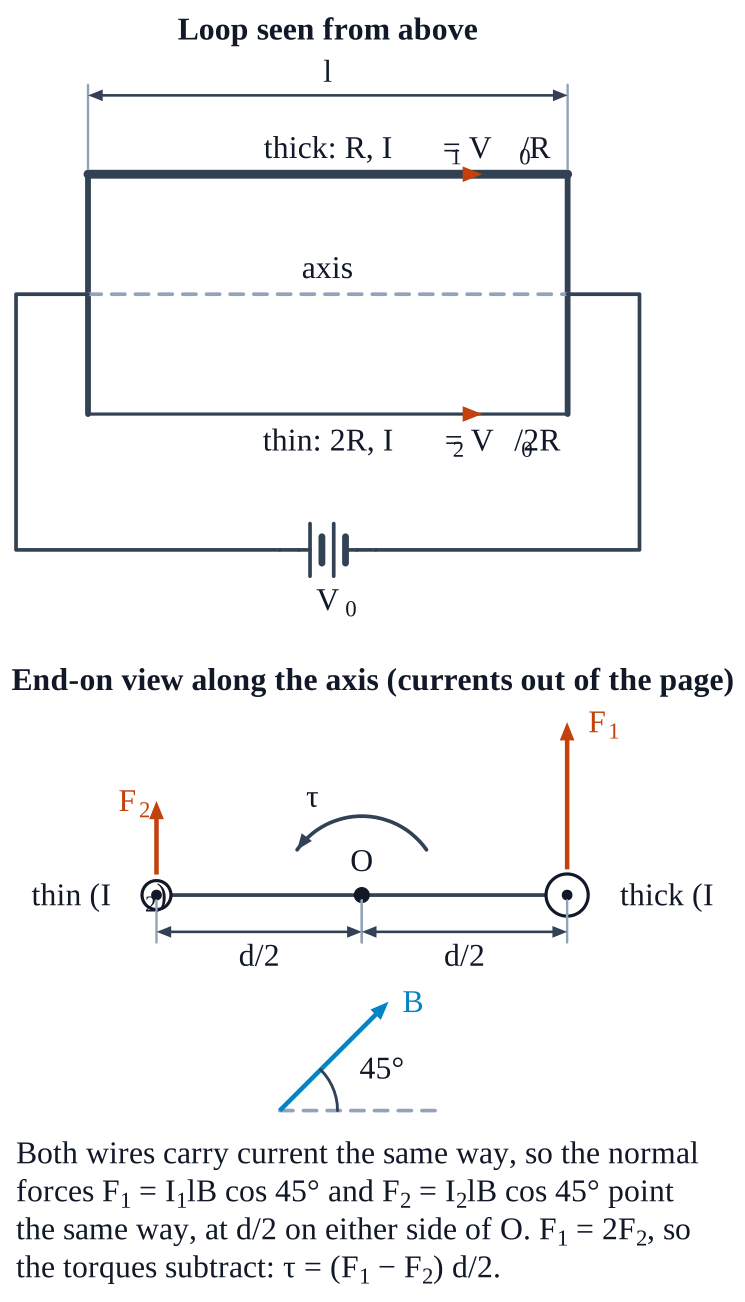 The two forces act the same way, at \(\displaystyle d/2\) on opposite sides of the axis, so the torques subtract:\[\tau = (F_1 - F_2)\,\frac{d}{2} = \frac{(I_1 - I_2)\,l\,d\,B}{2\sqrt{2}} = \frac{V_0}{2R}\cdot\frac{l\,d\,B}{2\sqrt{2}} \]Answer: \(\displaystyle \tau = \dfrac{V_0\,B\,l\,d}{4\sqrt{2}\,R}\)

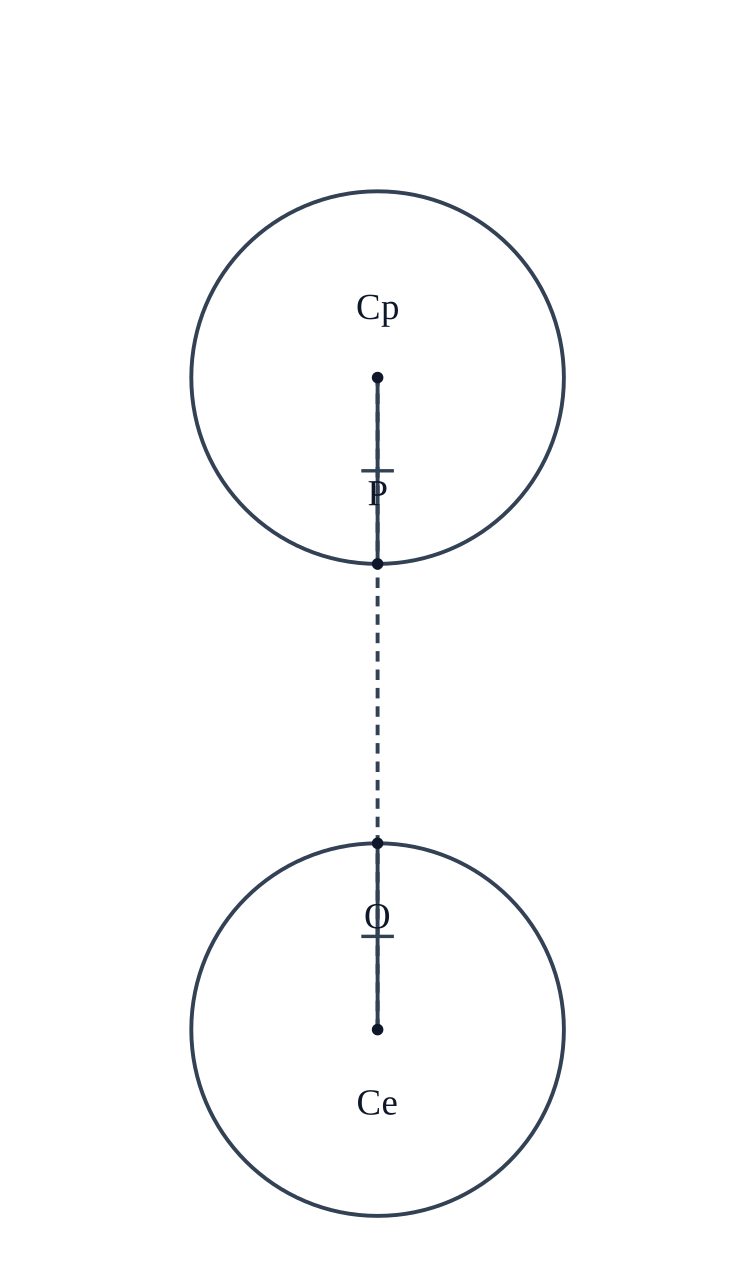 Equal circles in one plane do not meet only if the centres are more than \(\displaystyle 2R\) apart:\[C_eC_p^{2} = R^2\left[4.25 + 2\cos(\alpha - \beta) - 3(\cos\alpha + \cos\beta)\right] > 4R^2 \]\[\Rightarrow\ 2\cos(\alpha - \beta) - 3(\cos\alpha + \cos\beta) + \tfrac{1}{4} > 0 \]For equal directions \(\displaystyle \alpha = \beta\) this reads \(\displaystyle \cos\alpha < \tfrac{3}{8}\); both along \(\displaystyle -y\) gives \(\displaystyle C_eC_p = 3.5R\).Answer: \(\displaystyle p_x = 0\) (momenta in the \(\displaystyle yz\)-plane) and \(\displaystyle 2\cos(\alpha-\beta) - 3(\cos\alpha+\cos\beta) + \tfrac14 > 0\).

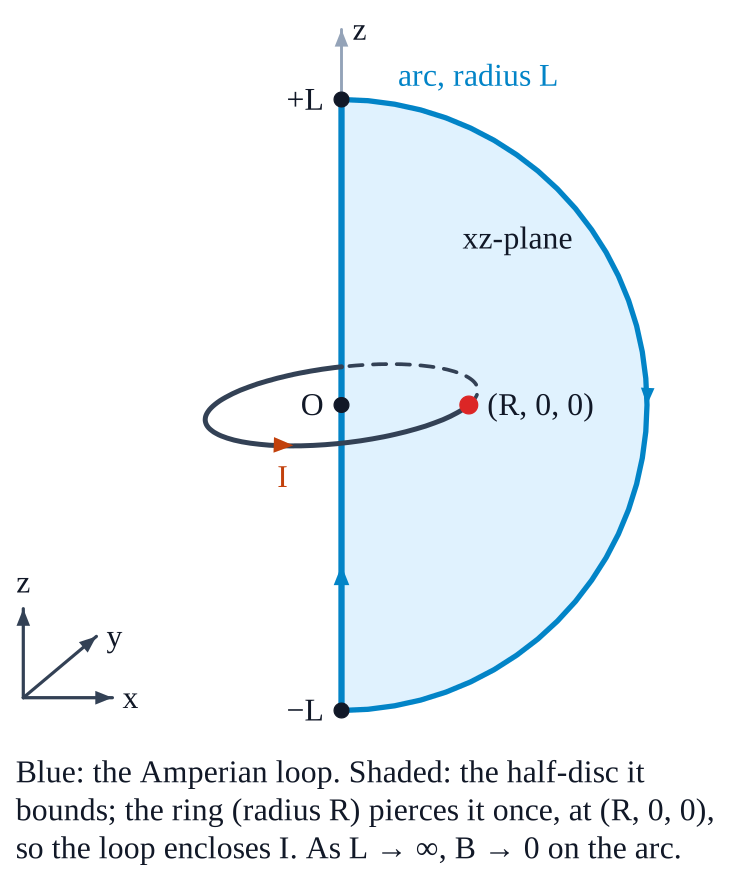 \[\oint \mathbf{B}\cdot d\mathbf{l} = \int_{-L}^{L} B_z\,dz + \int_{\text{arc}} \mathbf{B}\cdot d\mathbf{l} = \mu_0 I \]For \(\displaystyle L \gg R\) the field is a dipole field, \(\displaystyle B \le \dfrac{\mu_0 (I\pi R^2)}{2\pi L^3}\), over arc length \(\displaystyle \pi L\):\[\left|\int_{\text{arc}} \mathbf{B}\cdot d\mathbf{l}\right| \le \pi L\cdot\frac{\mu_0 (I\pi R^2)}{2\pi L^3} = \frac{\pi\mu_0 I R^2}{2L^2} \to 0 \ \Rightarrow\ \mathfrak{I}(\infty) = \mu_0 I \](c) Direct integration:\[\mathfrak{I}(L) = \frac{\mu_0 I R^2}{2}\left[\frac{z}{R^2\sqrt{R^2 + z^2}}\right]_{-L}^{L} = \frac{\mu_0 I\,L}{\sqrt{R^2 + L^2}} \]\[\mathfrak{I}(\infty) = \lim_{L\to\infty}\frac{\mu_0 I}{\sqrt{1 + R^2/L^2}} = \mu_0 I \](d) The loop of (b) never used the coil's shape, so the limit stays. The square lies inside the circle, nearer the centre, so its centre field is larger:\[B_{sq}(0) = \frac{2\sqrt{2}\,\mu_0 I}{\pi R} \approx 0.90\,\frac{\mu_0 I}{R} \ >\ B_{circ}(0) = \frac{\mu_0 I}{2R} \]Integrating the square's axial field \(\displaystyle B_z = \dfrac{\mu_0 I R^2}{2\pi\,(z^2 + R^2/4)\sqrt{z^2 + R^2/2}}\):\[\mathfrak{I}_{sq}(L) = \frac{4\mu_0 I}{\pi}\arctan\frac{L}{\sqrt{L^2 + R^2/2}} \ \to\ \mu_0 I \]\[L = R:\quad \mathfrak{I}_{sq} = 0.87\,\mu_0 I \ >\ \mathfrak{I}_{circ} = 0.71\,\mu_0 I \]Answer: (a) \(\displaystyle d\mathfrak{I}/dL > 0\); (b), (c) \(\displaystyle \mathfrak{I}(\infty) = \mu_0 I\), with \(\displaystyle \mathfrak{I}(L) = \mu_0 I L/\sqrt{R^2 + L^2}\); (d) \(\displaystyle \mathfrak{I}_{sq}(L) > \mathfrak{I}_{circ}(L)\) at every finite \(\displaystyle L\), both \(\displaystyle \to \mu_0 I\).

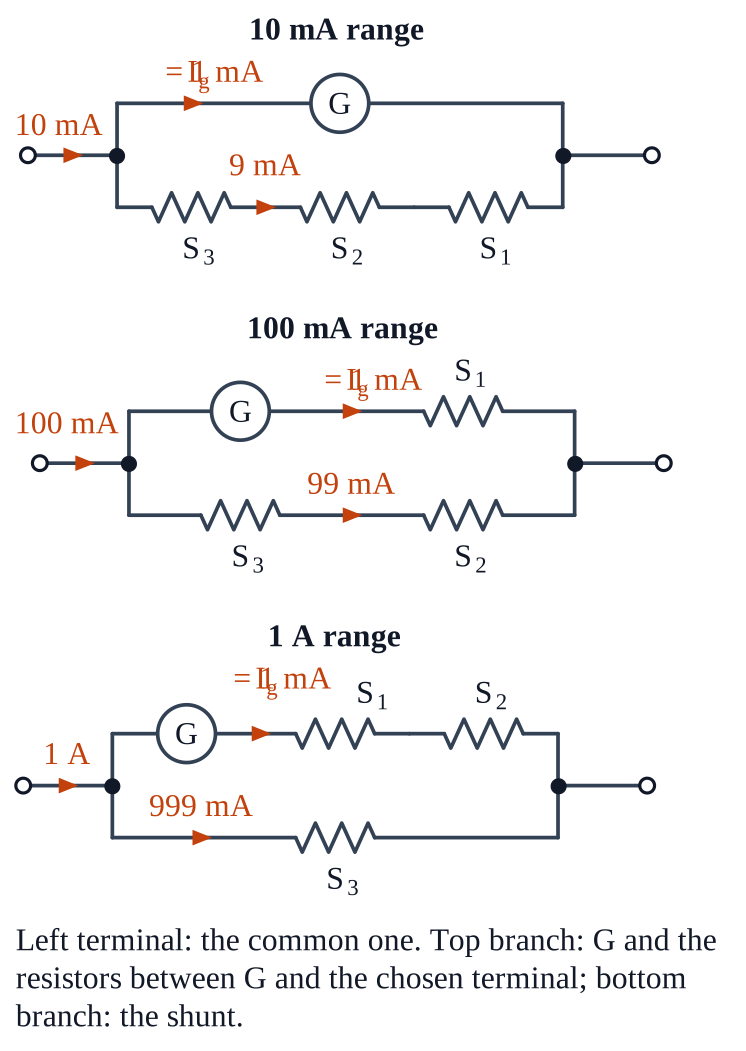 $\displaystyle 10$ mA terminal: \(\displaystyle G\) in parallel with \(\displaystyle S_1+S_2+S_3\):\[I_g G = (10-1)\ \mathrm{mA}\,(S_1+S_2+S_3) \ \Rightarrow\ S_1+S_2+S_3 = \frac{10\ \mathrm{mV}}{9\ \mathrm{mA}} = \frac{10}{9}\ \Omega \]$\displaystyle 100$ mA terminal: \(\displaystyle G+S_1\) in parallel with \(\displaystyle S_2+S_3\):\[I_g\,(G+S_1) = 99\ \mathrm{mA}\,(S_2+S_3) \]\[1\,(10+S_1) = 99\left(\tfrac{10}{9}-S_1\right) \ \Rightarrow\ S_1 = 1\ \Omega, \quad S_2+S_3 = \tfrac{1}{9}\ \Omega \]$\displaystyle 1$ A terminal: \(\displaystyle G+S_1+S_2\) in parallel with \(\displaystyle S_3\):\[I_g\,(G+S_1+S_2) = 999\ \mathrm{mA}\;S_3 \]\[1\left(11+\tfrac{1}{9}-S_3\right) = 999\,S_3 \ \Rightarrow\ S_3 = \tfrac{1}{90}\ \Omega \approx 0.011\ \Omega, \quad S_2 = \tfrac{1}{9}-\tfrac{1}{90} = 0.1\ \Omega \]Answer: \(\displaystyle S_1 = 1\ \Omega\), \(\displaystyle S_2 = 0.1\ \Omega\), \(\displaystyle S_3 = \tfrac{1}{90}\ \Omega \approx 0.011\ \Omega\).

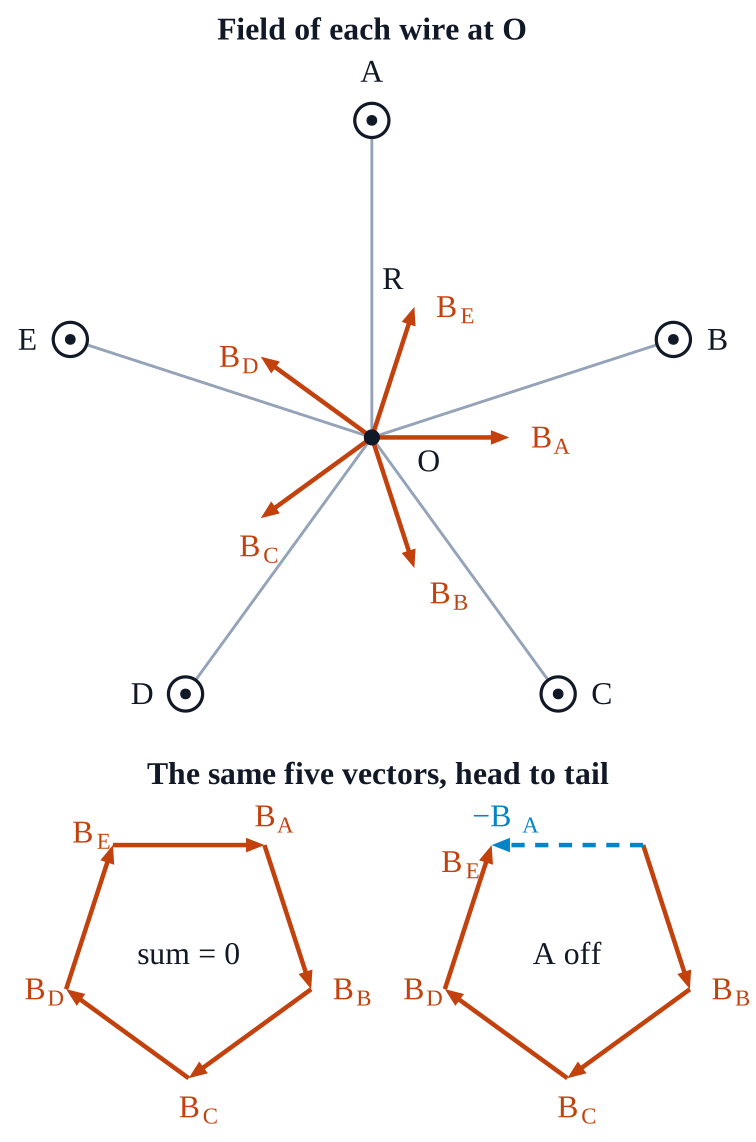 \[\mathbf{B}_A + \mathbf{B}_B + \mathbf{B}_C + \mathbf{B}_D + \mathbf{B}_E = \mathbf{0} \ \Rightarrow\ B_O = 0 \](b) A switched off:\[\mathbf{B}_O = \mathbf{B}_B + \mathbf{B}_C + \mathbf{B}_D + \mathbf{B}_E = -\mathbf{B}_A \ \Rightarrow\ B_O = \frac{\mu_0 I}{2\pi R} \](c) A reversed, \(\displaystyle \mathbf{B}_A \to -\mathbf{B}_A\):\[\mathbf{B}_O = (\mathbf{B}_B + \mathbf{B}_C + \mathbf{B}_D + \mathbf{B}_E) - \mathbf{B}_A = -2\mathbf{B}_A \ \Rightarrow\ B_O = \frac{\mu_0 I}{\pi R} \]At \(\displaystyle O\), \(\displaystyle \mathbf{B}_A\) points to the right (current out of the page, \(\displaystyle O\) below A), so (b) and (c) point left, along EB.Answer: (a) \(\displaystyle 0\); (b) \(\displaystyle \dfrac{\mu_0 I}{2\pi R}\); (c) \(\displaystyle \dfrac{\mu_0 I}{\pi R}\); in (b) and (c) opposite to \(\displaystyle \mathbf{B}_A\).