SolveIt is under development
SolveItClass 12 · Exemplar

NCERT Exemplar · Class 12 Physics Moving Charges and Magnetism

29 questions

Multiple Choice Questions (Type I) 1–6 (part 1 of 5)

  1. Exercise 1

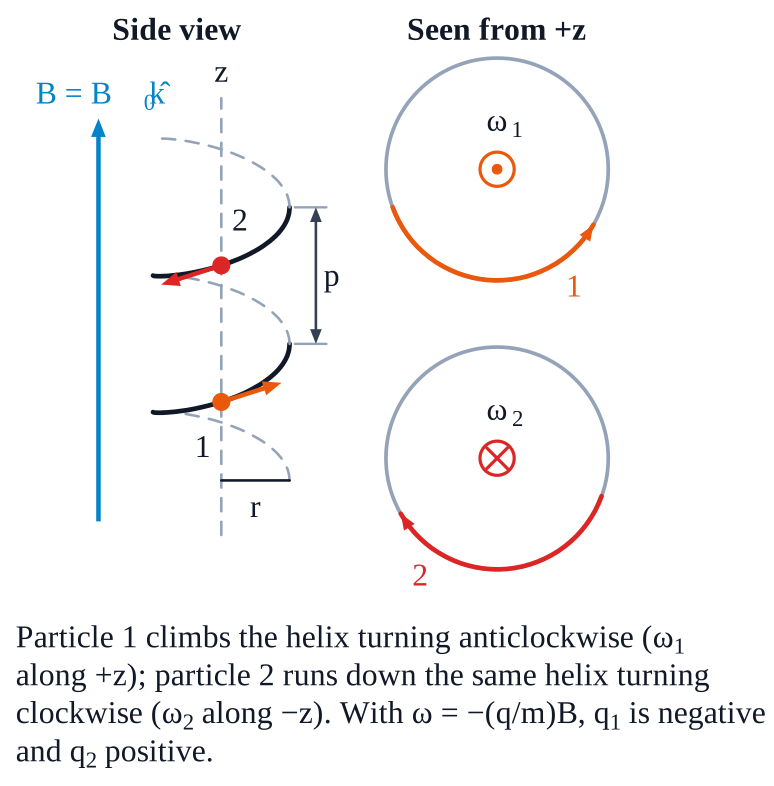
    Two charged particles traverse identical helical paths in a completely opposite sense in a uniform magnetic field B=B0k^\displaystyle \mathbf{B}=\mathrm{B}_0 \hat{\mathbf{k}}.
    (a)
    They have equal z-components of momenta.
    (b)
    They must have equal charges.
    (c)
    They necessarily represent a particle-antiparticle pair.
    (d)
    The charge to mass ratio satisfy: (em)1+(em)2=0\displaystyle \left(\frac{e}{m}\right)_1+\left(\frac{e}{m}\right)_2=0.
    NCERT’s answer
    (d)
    (d)Same helix traversed in opposite senses means equal and opposite angular velocities. Opposite senses need opposite-sign charges, so (b) fails; masses stay free, so (a) and (c) are not forced.\[\boldsymbol{\omega}=-\frac{q}{m}\,\mathbf{B}_0 \] \[\boldsymbol{\omega}_1=-\boldsymbol{\omega}_2\;\Rightarrow\;\frac{q_1}{m_1}\,\mathbf{B}_0=-\frac{q_2}{m_2}\,\mathbf{B}_0 \] \[\left(\frac{e}{m}\right)_1+\left(\frac{e}{m}\right)_2=0 \]NCERT_Solution_Class12_Physics_Exemplar_Ch4_Q1
  2. Exercise 2

    Biot-Savart law indicates that the moving electrons (velocity v\displaystyle \mathbf{v}) produce a magnetic field B\displaystyle \mathbf{B} such that
    (a)
    B⊥v\displaystyle \mathbf{B} \perp \mathbf{v}.
    (b)
    B∥v\displaystyle \mathbf{B} \parallel \mathbf{v}.
    (c)
    it obeys inverse cube law.
    (d)
    it is along the line joining the electron and point of observation.
    NCERT’s answer
    (a)
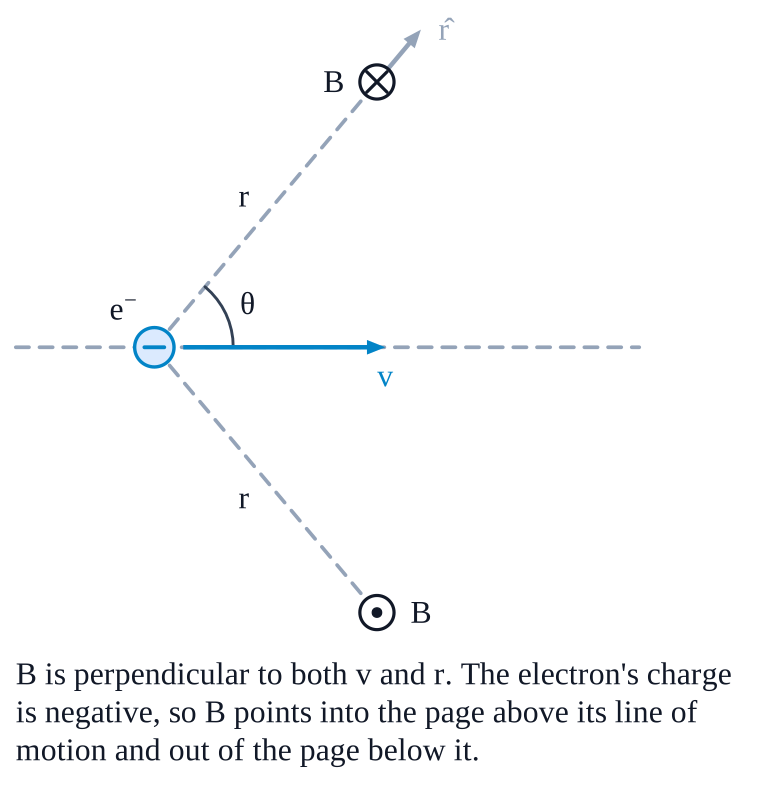
    (a)The cross product makes \(\displaystyle \mathbf{B}\) perpendicular to \(\displaystyle \mathbf{v}\) and to the line from the electron to the point. Distance enters as \(\displaystyle r^{2}\), not \(\displaystyle r^{3}\).\[\mathbf{B}=\frac{\mu_0}{4\pi}\,\frac{q\,\mathbf{v}\times\hat{\mathbf{r}}}{r^{2}},\qquad q=-e \] \[\mathbf{B}\cdot\mathbf{v}=0,\qquad \mathbf{B}\cdot\hat{\mathbf{r}}=0,\qquad B=\frac{\mu_0}{4\pi}\,\frac{e\,v\sin\theta}{r^{2}} \]NCERT_Solution_Class12_Physics_Exemplar_Ch4_Q2
  3. Exercise 3

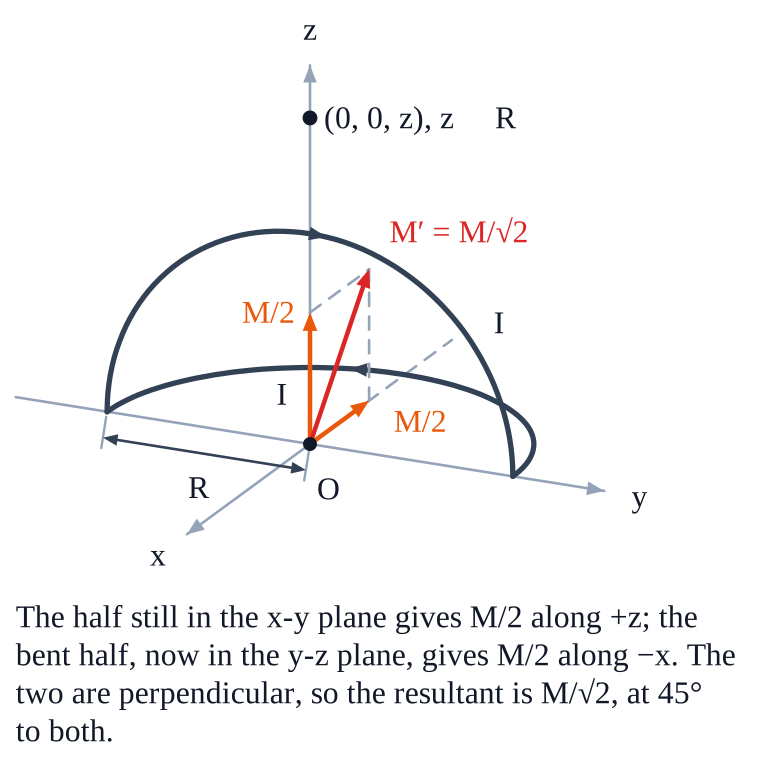
    A current carrying circular loop of radius R\displaystyle R is placed in the x−y\displaystyle x-y plane with centre at the origin. Half of the loop with x>0\displaystyle x>0 is now bent so that it now lies in the y−z\displaystyle y-z plane.
    (a)
    The magnitude of magnetic moment now diminishes.
    (b)
    The magnetic moment does not change.
    (c)
    The magnitude of B\displaystyle \mathbf{B} at (0.0.z), z≫R\displaystyle z \gg R increases.
    (d)
    The magnitude of B\displaystyle \mathbf{B} at (0.0.z), z≫R\displaystyle z \gg R is unchanged.
    NCERT’s answer
    (a)
    (a)The fixed half gives \(\displaystyle M/2\) along \(\displaystyle \hat{\mathbf{k}}\); the bent half gives \(\displaystyle M/2\) along \(\displaystyle -\hat{\mathbf{i}}\), perpendicular to it. The resultant moment is smaller, and so is the far axial field.\[M=I\pi R^{2},\qquad \mathbf{m}'=\frac{M}{2}\left(\hat{\mathbf{k}}-\hat{\mathbf{i}}\right) \] \[M'=\frac{M}{2}\sqrt{1^{2}+1^{2}}=\frac{M}{\sqrt{2}}<M \] \[\mathbf{B}=\frac{\mu_0}{4\pi z^{3}}\left[3(\mathbf{m}\cdot\hat{\mathbf{k}})\,\hat{\mathbf{k}}-\mathbf{m}\right]\quad (z\gg R) \] \[B=\frac{\mu_0}{4\pi}\,\frac{2M}{z^{3}},\qquad B'=\frac{\mu_0}{4\pi z^{3}}\,\frac{M}{2}\left|2\hat{\mathbf{k}}+\hat{\mathbf{i}}\right|=\frac{\mu_0}{4\pi}\,\frac{\sqrt{5}\,M}{2z^{3}} \] \[\frac{B'}{B}=\frac{\sqrt{5}}{4}\approx 0.56<1 \]NCERT_Solution_Class12_Physics_Exemplar_Ch4_Q3
  4. Exercise 4

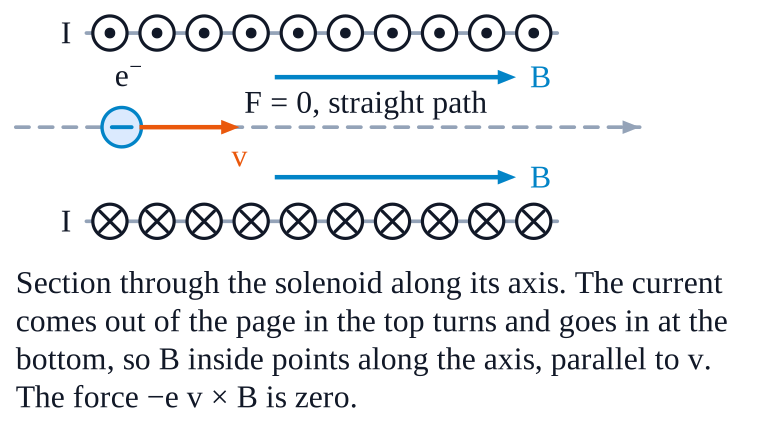
    An electron is projected with uniform velocity along the axis of a current carrying long solenoid. Which of the following is true?
    (a)
    The electron will be accelerated along the axis.
    (b)
    The electron path will be circular about the axis.
    (c)
    The electron will experience a force at 45\displaystyle 45° to the axis and hence execute a helical path.
    (d)
    The electron will continue to move with uniform velocity along the axis of the solenoid.
    NCERT’s answer
    (d)
    (d)Inside a long solenoid \(\displaystyle \mathbf{B}\) lies along the axis, parallel to the electron's velocity, so the magnetic force is zero: no deflection, no speed change.\[\mathbf{F}=-e\,\mathbf{v}\times\mathbf{B} \] \[F=e\,vB\sin 0^{\circ}=0 \] \[\mathbf{a}=\frac{\mathbf{F}}{m}=0\;\Rightarrow\;\mathbf{v}\ \text{unchanged} \]NCERT_Solution_Class12_Physics_Exemplar_Ch4_Q4
  5. Exercise 5

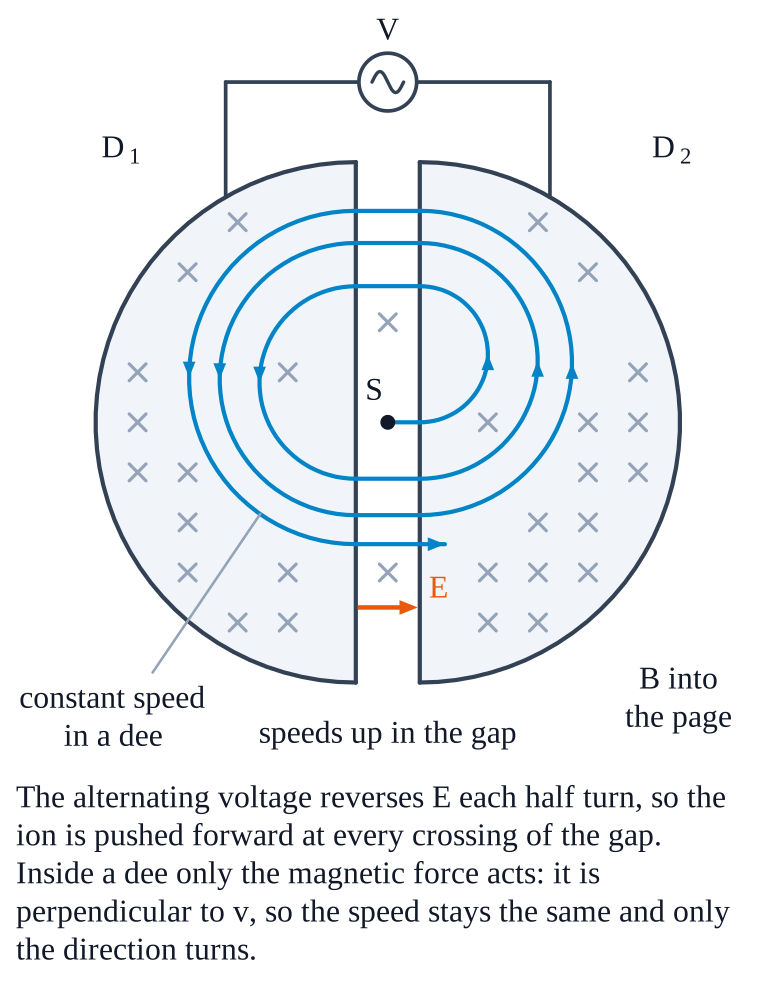
    In a cyclotron, a charged particle
    (a)
    undergoes acceleration all the time.
    (b)
    speeds up between the dees because of the magnetic field.
    (c)
    speeds up in a dee.
    (d)
    slows down within a dee and speeds up between dees.
    NCERT’s answer
    (a)
    (a)Electric field accelerates it between the dees; inside a dee only the magnetic force acts, so speed is constant but direction changes. Acceleration never vanishes, and (b), (c), (d) fail.\[\text{gap:}\quad a=\frac{qE}{m},\qquad \Delta K=qV \] \[\text{dee:}\quad dW=\mathbf{F}_B\cdot\mathbf{v}\,dt=0\;\Rightarrow\;v\ \text{constant} \] \[a=\frac{v^{2}}{r}=\frac{qvB}{m}\neq 0 \]NCERT_Solution_Class12_Physics_Exemplar_Ch4_Q5
  6. Exercise 6

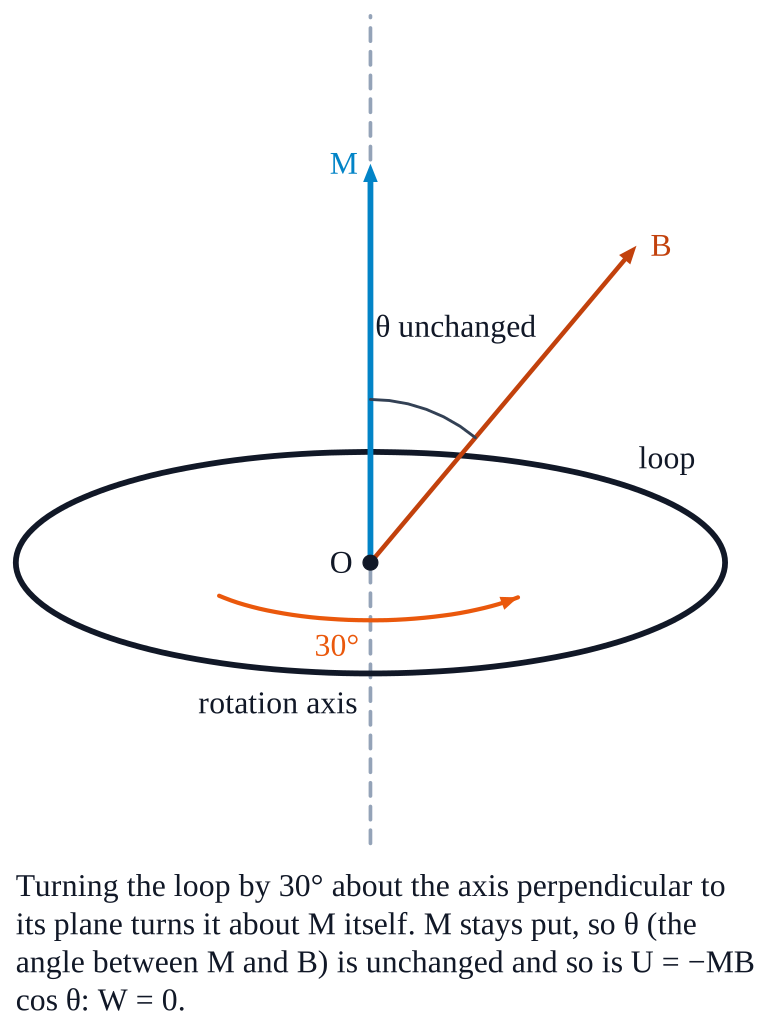
    A circular current loop of magnetic moment M\displaystyle M is in an arbitrary orientation in an external magnetic field B\displaystyle \mathbf{B}. The work done to rotate the loop by 30\displaystyle 30° about an axis perpendicular to its plane is
    (a)
    MB\displaystyle M B.
    (b)
    3MB2\displaystyle \sqrt{3} \frac{M B}{2}.
    (c)
    MB2\displaystyle \frac{M B}{2}.
    (d)
    zero.
    NCERT’s answer
    (d)
    (d)Turning the loop about the axis perpendicular to its plane turns it about \(\displaystyle \mathbf{M}\) itself. \(\displaystyle \mathbf{M}\) does not move, so its angle with \(\displaystyle \mathbf{B}\) and the energy are unchanged.\[U=-\mathbf{M}\cdot\mathbf{B}=-MB\cos\theta \] \[\theta_f=\theta_i\;\Rightarrow\;W=U_f-U_i=0 \] \[\boldsymbol{\tau}\cdot\hat{\mathbf{M}}=(\mathbf{M}\times\mathbf{B})\cdot\hat{\mathbf{M}}=0 \]NCERT_Solution_Class12_Physics_Exemplar_Ch4_Q6