Exercise 7
The gyro-magnetic ratio of an electron in an H-atom, according to Bohr model, is
(a)
independent of which orbit it is in.
(b)
negative.
(c)
positive.
(d)
increases with the quantum number .
NCERT’s answer
(a), (b)
(a), (b) The electron's charge is negative, so \(\displaystyle \boldsymbol{\mu}\) opposes \(\displaystyle \mathbf{L}\); \(\displaystyle n\) cancels in the ratio.\[I=\frac{e}{T}=\frac{ev}{2\pi r},\qquad \mu=IA=\frac{ev}{2\pi r}\,\pi r^{2}=\frac{evr}{2} \]\[L=mvr\ \Rightarrow\ \frac{\mu}{L}=\frac{e}{2m},\qquad \boldsymbol{\mu}=-\frac{e}{2m}\,\mathbf{L} \]\[L=n\hbar\ \Rightarrow\ \mu_n=-n\,\frac{e\hbar}{2m}\quad(\text{grows with } n),\ \text{but}\ \gamma=\frac{\mu_n}{L}=-\frac{e}{2m} \]\[\gamma=-\frac{1.6\times10^{-19}\ \mathrm{C}}{2\times9.1\times10^{-31}\ \mathrm{kg}}\approx-8.8\times10^{10}\ \mathrm{C\,kg^{-1}} \]Answer: (a), (b)
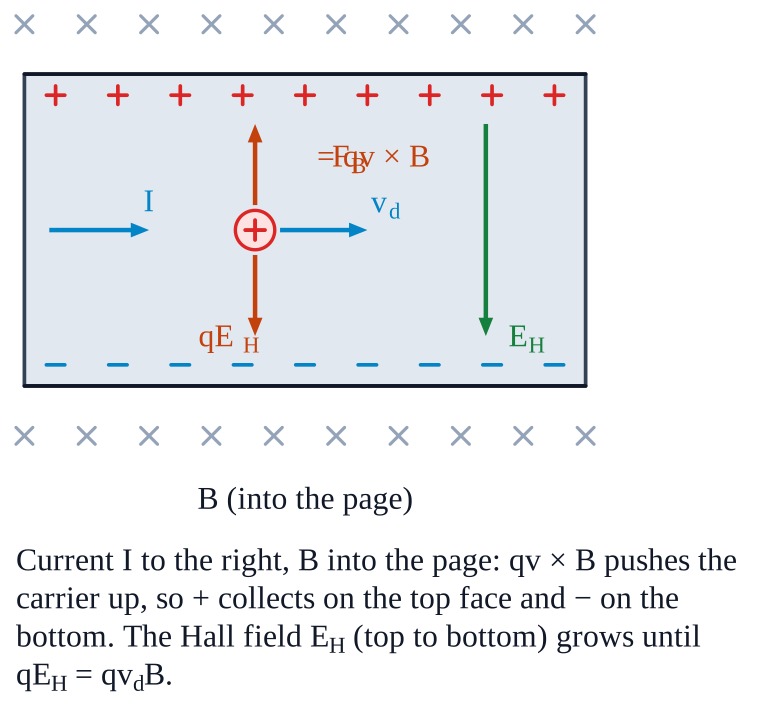 \[qE_H=q\,v_dB\ \Rightarrow\ E_H=v_dB \]\[\text{ion moving with the wire at } \mathbf{u}:\ \mathbf{F}_B=q\,\mathbf{u}\times\mathbf{B}\ \Rightarrow\ \mathbf{F}_B\cdot\mathbf{u}=0\ \Rightarrow\ W=0 \]
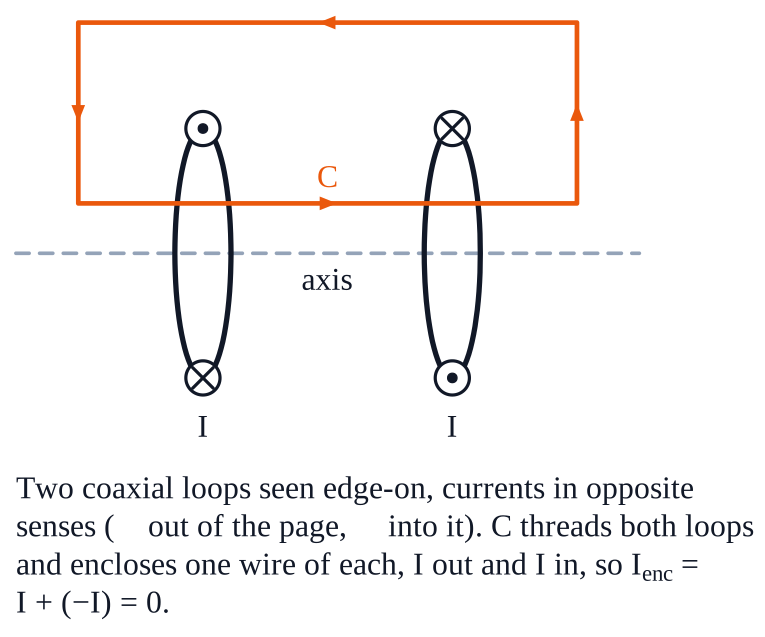 \[I_{enc}=I+(-I)=0 \]\[\oint_C\mathbf{B}\cdot d\mathbf{l}=\mu_0I_{enc}=0\quad(\text{either sense of } C) \]\[\oint_C\mathbf{B}\cdot d\mathbf{l}=0,\ \ \mathbf{B}\neq\mathbf{0}\ \Rightarrow\ B\cos\theta\ \text{changes sign}\ \Rightarrow\ \theta=90^\circ\ \text{at some point} \]Answer: (b), (c)