Exercise 17
A current carrying loop consists of identical quarter circles of radius , lying in the positive quadrants of the and planes with their centres at the origin, joined together. Find the direction and magnitude of at the origin.
NCERT’s answer
\(\displaystyle \mathbf{B}=\frac{1}{4}(\hat{\mathbf{i}}+\hat{\mathbf{j}}+\hat{\mathbf{k}}) \frac{\mu_0 I}{2 R}\)
Current circulates \(\displaystyle x\to y\to z\to x\) along the three arcs.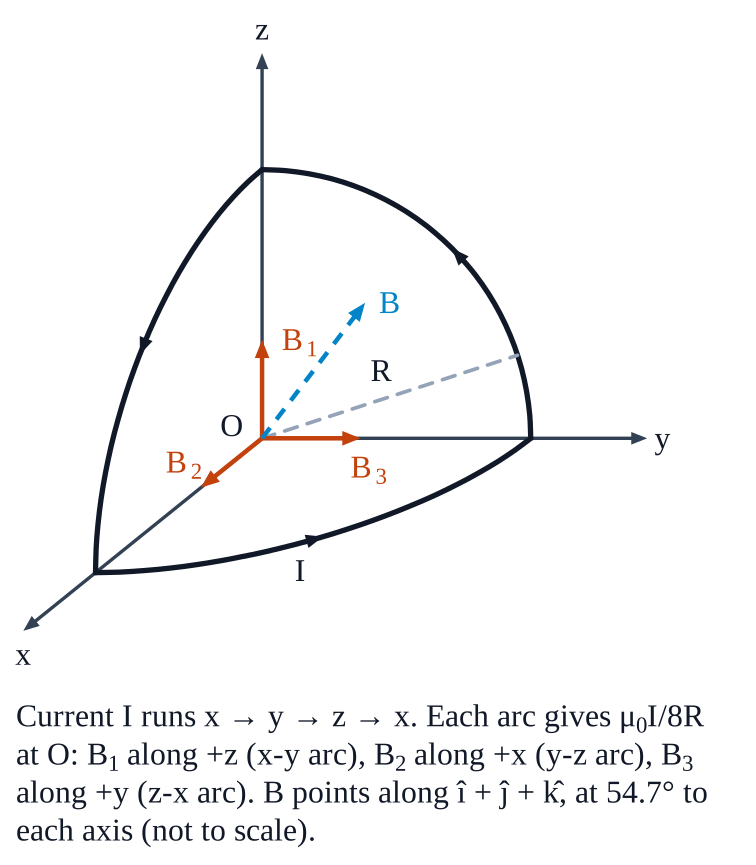 Each arc is a quarter of a circular loop, so at the common centre
\[B_1=\tfrac14\cdot\frac{\mu_0 I}{2R}=\frac{\mu_0 I}{8R} \]
Right-hand rule: the \(\displaystyle x\)-\(\displaystyle y\) arc gives \(\displaystyle +\hat{\mathbf k}\), the \(\displaystyle y\)-\(\displaystyle z\) arc gives \(\displaystyle +\hat{\mathbf i}\), the \(\displaystyle z\)-\(\displaystyle x\) arc gives \(\displaystyle +\hat{\mathbf j}\).
\[\mathbf B=\frac{\mu_0 I}{8R}\left(\hat{\mathbf i}+\hat{\mathbf j}+\hat{\mathbf k}\right) \]
\[|\mathbf B|=\frac{\mu_0 I}{8R}\sqrt{1^2+1^2+1^2}=\frac{\sqrt3\,\mu_0 I}{8R} \]
\[\cos\alpha=\frac{1}{\sqrt3}\;\Rightarrow\;\alpha\approx54.7^\circ\ \text{with each axis} \]
Caution: the three fields are mutually perpendicular, so add them as vectors (\(\displaystyle \sqrt3\), not $\displaystyle 3$). Reversing the current reverses \(\displaystyle \mathbf B\).Answer: \(\displaystyle \mathbf B=\dfrac{\mu_0 I}{8R}(\hat{\mathbf i}+\hat{\mathbf j}+\hat{\mathbf k})\), magnitude \(\displaystyle \dfrac{\sqrt3\,\mu_0 I}{8R}\), along the line from the origin towards \(\displaystyle (1,1,1)\).
Each arc is a quarter of a circular loop, so at the common centre
\[B_1=\tfrac14\cdot\frac{\mu_0 I}{2R}=\frac{\mu_0 I}{8R} \]
Right-hand rule: the \(\displaystyle x\)-\(\displaystyle y\) arc gives \(\displaystyle +\hat{\mathbf k}\), the \(\displaystyle y\)-\(\displaystyle z\) arc gives \(\displaystyle +\hat{\mathbf i}\), the \(\displaystyle z\)-\(\displaystyle x\) arc gives \(\displaystyle +\hat{\mathbf j}\).
\[\mathbf B=\frac{\mu_0 I}{8R}\left(\hat{\mathbf i}+\hat{\mathbf j}+\hat{\mathbf k}\right) \]
\[|\mathbf B|=\frac{\mu_0 I}{8R}\sqrt{1^2+1^2+1^2}=\frac{\sqrt3\,\mu_0 I}{8R} \]
\[\cos\alpha=\frac{1}{\sqrt3}\;\Rightarrow\;\alpha\approx54.7^\circ\ \text{with each axis} \]
Caution: the three fields are mutually perpendicular, so add them as vectors (\(\displaystyle \sqrt3\), not $\displaystyle 3$). Reversing the current reverses \(\displaystyle \mathbf B\).Answer: \(\displaystyle \mathbf B=\dfrac{\mu_0 I}{8R}(\hat{\mathbf i}+\hat{\mathbf j}+\hat{\mathbf k})\), magnitude \(\displaystyle \dfrac{\sqrt3\,\mu_0 I}{8R}\), along the line from the origin towards \(\displaystyle (1,1,1)\).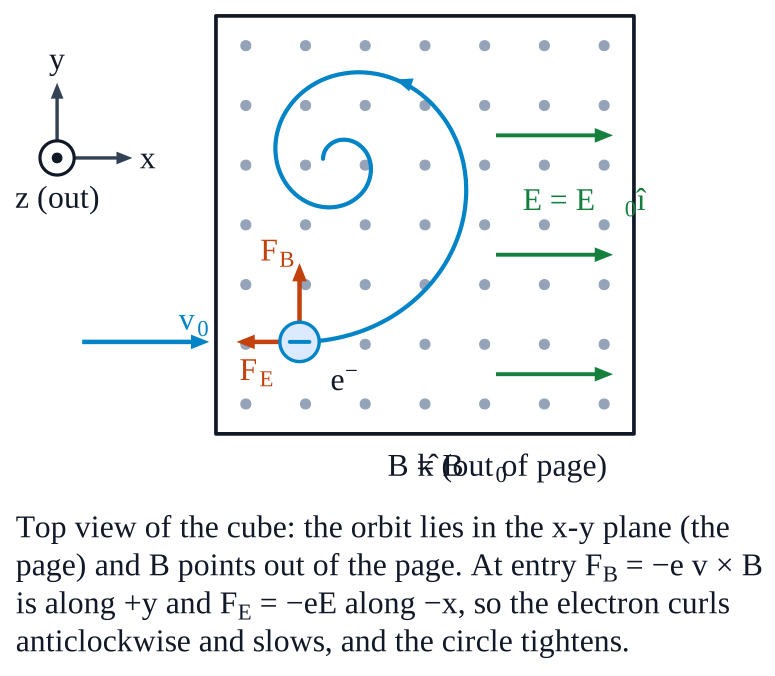 Magnetic force on the electron at entry:
\[\mathbf F_B=-e\,(v_0\hat{\mathbf i})\times(B_0\hat{\mathbf k})=+e\,v_0B_0\,\hat{\mathbf j} \]
In the \(\displaystyle x\)-\(\displaystyle y\) plane and perpendicular to \(\displaystyle \mathbf v\): circular motion,
\[r=\frac{mv}{eB_0} \]
Electric force:
\[\mathbf F_E=-eE_0\,\hat{\mathbf i} \]
It opposes the entry motion, doing negative work: \(\displaystyle v\downarrow\Rightarrow r\downarrow\), the circle tightens.Neither force has a \(\displaystyle z\)-component, so \(\displaystyle v_z=0\) throughout.Caution: \(\displaystyle E_z=0\) and \(\displaystyle B_x=B_y=0\) are essential, else the path becomes a helix.Answer: \(\displaystyle \mathbf B\) along \(\displaystyle z\), \(\displaystyle \mathbf E\) along \(\displaystyle +x\).
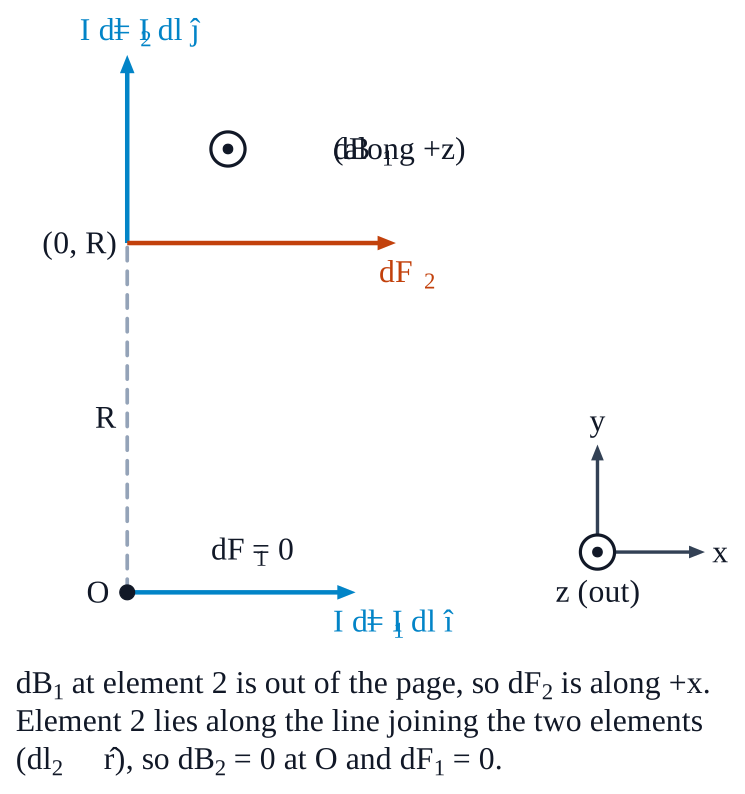 Element $\displaystyle 1$ acting on element $\displaystyle 2$ (\(\displaystyle \hat{\mathbf r}=\hat{\mathbf j}\), \(\displaystyle r=R\)):
\[d\mathbf B_1=\frac{\mu_0 I\,dl}{4\pi R^2}\,(\hat{\mathbf i}\times\hat{\mathbf j})=\frac{\mu_0 I\,dl}{4\pi R^2}\,\hat{\mathbf k} \]
\[d\mathbf F_2=I\,dl\,\hat{\mathbf j}\times d\mathbf B_1=\frac{\mu_0 I^2\,dl^2}{4\pi R^2}\,(\hat{\mathbf j}\times\hat{\mathbf k})=\frac{\mu_0 I^2\,dl^2}{4\pi R^2}\,\hat{\mathbf i} \]
Element $\displaystyle 2$ acting on element $\displaystyle 1$ (\(\displaystyle \hat{\mathbf r}=-\hat{\mathbf j}\)):
\[d\mathbf B_2\propto\hat{\mathbf j}\times(-\hat{\mathbf j})=\mathbf 0\;\Rightarrow\;d\mathbf F_1=\mathbf 0 \]
\[d\mathbf F_1\neq-d\mathbf F_2 \]
The third law holds only for complete closed circuits, not for isolated elements.Answer: No: \(\displaystyle d\mathbf F_1=\mathbf 0\) but \(\displaystyle d\mathbf F_2=\dfrac{\mu_0 I^2\,dl^2}{4\pi R^2}\hat{\mathbf i}\).


