SolveIt is under development
SolveItClass 12 · Exemplar

NCERT Exemplar · Class 12 Physics Magnetism and Matter

25 questions

Very Short Answer Questions 11–15 (part 3 of 5)

  1. Exercise 11

    A proton has spin and magnetic moment just like an electron. Why then its effect is neglected in magnetism of materials?
    NCERT’s answer
    \(\displaystyle \mu_p \approx \frac{e \hbar}{2 m_p}\) and \(\displaystyle \mu_e \approx \frac{e \hbar}{2 m_e}, \hbar=\frac{h}{2 \pi}\) \(\displaystyle \mu_e \gg \mu_p\) because \(\displaystyle m_{\mathrm{p}} \gg m_{\mathrm{e}}\).
    \[\mu_B=\frac{e\hbar}{2m_e},\qquad \mu_N=\frac{e\hbar}{2m_p}\] \[\frac{\mu_N}{\mu_B}=\frac{m_e}{m_p}=\frac{9.11\times10^{-31}\,\mathrm{kg}}{1.673\times10^{-27}\,\mathrm{kg}}\approx5.4\times10^{-4}\approx\frac{1}{1836}\] Answer: The proton is about $\displaystyle 1836$ times heavier, so its magnetic moment is about $\displaystyle 1$/$\displaystyle 1836$ of the electron's and negligible.
  2. Exercise 12

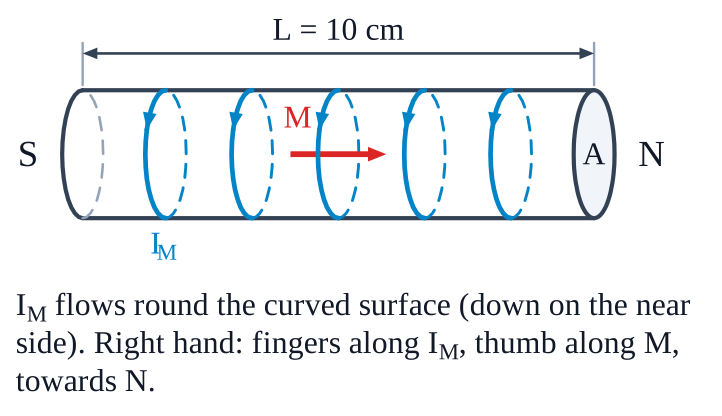
    A permanent magnet in the shape of a thin cylinder of length 10\displaystyle 10 cm has M=106 A/m\displaystyle M=10^6 \mathrm{~A} / \mathrm{m}. Calculate the magnetisation current IM\displaystyle I_M.
    NCERT’s answer
    \(\displaystyle \mathrm{~B} l=\mu_0 M l=\mu_0\left(I+I_{\mathrm{M}}\right)\) and \(\displaystyle H=0=I\) \[\mathrm{M} l=I_{\mathrm{M}}=10^6 \times 0.1=10^5 \mathrm{~A} . \]
    The magnetisation current flows round the curved surface: NCERT_Solution_Class12_Physics_Exemplar_Ch5_Q12 \[M=\frac{m}{V}=\frac{I_M A}{A L}=\frac{I_M}{L}\] \[I_M=ML=\left(10^{6}\,\mathrm{A\,m^{-1}}\right)\left(10\times10^{-2}\,\mathrm{m}\right)=10^{5}\,\mathrm{A}\] Answer: \(\displaystyle I_M=10^{5}\,\mathrm{A}\).
  3. Exercise 13

    Explain quantitatively the order of magnitude difference between the diamagnetic susceptibility of N2(∼5×10⁻⁹)\displaystyle \mathrm{N}_2\left(\sim 5 \times 10^{-9}\right) (at STP) and Cu(∼10−5)\displaystyle \mathrm{Cu}\left(\sim 10^{-5}\right).
    NCERT’s answer
    \(\displaystyle x \alpha\) density \(\displaystyle \rho\). Now \(\displaystyle \frac{\rho_{\mathrm{N}}}{\rho_{\mathrm{Cu}}}=\frac{28 \mathrm{~g} / 22.4 \mathrm{Lt}}{8 \mathrm{~g} / \mathrm{cc}}=\frac{3.5}{22.4} \times 10^{-3}=1.6 \times 10^{-4}\). \[\frac{x_{\mathrm{N}}}{x_{\mathrm{Cu}}}=5 \times 10^{-4} \text { (from given data). } \] Hence major difference is accounted for by density.
    Induced moment per particle is similar, so the susceptibility follows the number density \(\displaystyle n\): \[\chi=\frac{\mu_0 M}{B}=\frac{\mu_0\,n\,m_{ind}}{B}\quad\Rightarrow\quad \frac{m_{ind}}{B}\ \text{similar}\ \Rightarrow\ \chi\propto n\] \[n_{\mathrm{N_2}}=\frac{6.02\times10^{23}\,\mathrm{mol^{-1}}}{22.4\times10^{-3}\,\mathrm{m^{3}\,mol^{-1}}}=2.7\times10^{25}\,\mathrm{m^{-3}}\] \[n_{\mathrm{Cu}}=\frac{\rho N_A}{A}=\frac{\left(8.9\times10^{3}\,\mathrm{kg\,m^{-3}}\right)\left(6.02\times10^{23}\,\mathrm{mol^{-1}}\right)}{63.5\times10^{-3}\,\mathrm{kg\,mol^{-1}}}=8.4\times10^{28}\,\mathrm{m^{-3}}\] \[\frac{n_{\mathrm{Cu}}}{n_{\mathrm{N_2}}}=\frac{8.4\times10^{28}}{2.7\times10^{25}}\approx3\times10^{3},\qquad \frac{\chi_{\mathrm{Cu}}}{\chi_{\mathrm{N_2}}}=\frac{10^{-5}}{5\times10^{-9}}=2\times10^{3}\] Answer: Cu has about \(\displaystyle 10^{3}\) times more particles per unit volume than \(\displaystyle \mathrm{N_2}\) at STP, matching the \(\displaystyle 10^{3}\) ratio of susceptibilities.
  4. Exercise 14

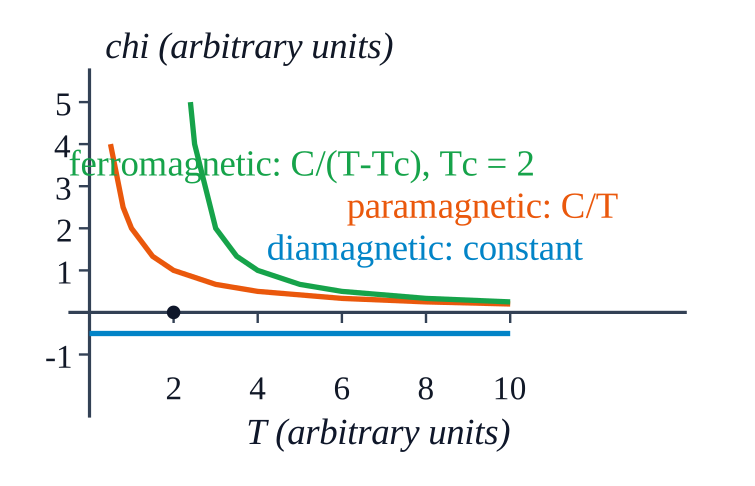
    From molecular view point, discuss the temperature dependence of susceptibility for diamagnetism, paramagnetism and ferromagnetism.
    NCERT’s answer
    Diamagnetism is due to orbital motion of electrons developing magnetic moments opposite to applied field and hence is not much affected by temperature. Paramagnetism and ferromagnetism is due to alignments of atomic magnetic moments in the direction of the applied field. As temperature increases, this aligment is disturbed and hence susceptibilities of both decrease as temperature increases.
    Diamagnetism: induced moments only, so no temperature dependence. \[\chi_{dia}=\text{constant}\ (<0)\] Paramagnetism: heat randomises the field-aligned dipoles. \[T\uparrow\ \Rightarrow\ \text{alignment}\downarrow\ \Rightarrow\ \chi\downarrow,\qquad \chi_{para}=\frac{C}{T}\] Ferromagnetism: domains vanish above the Curie temperature \(\displaystyle T_c\); the substance turns paramagnetic. \[\chi_{ferro}=\frac{C}{T-T_c}\qquad(T>T_c)\] NCERT_Solution_Class12_Physics_Exemplar_Ch5_Q14 Answer: \(\displaystyle \chi_{dia}\) is independent of \(\displaystyle T\); \(\displaystyle \chi_{para}=C/T\); \(\displaystyle \chi_{ferro}=C/(T-T_c)\) above \(\displaystyle T_c\).
  5. Exercise 15

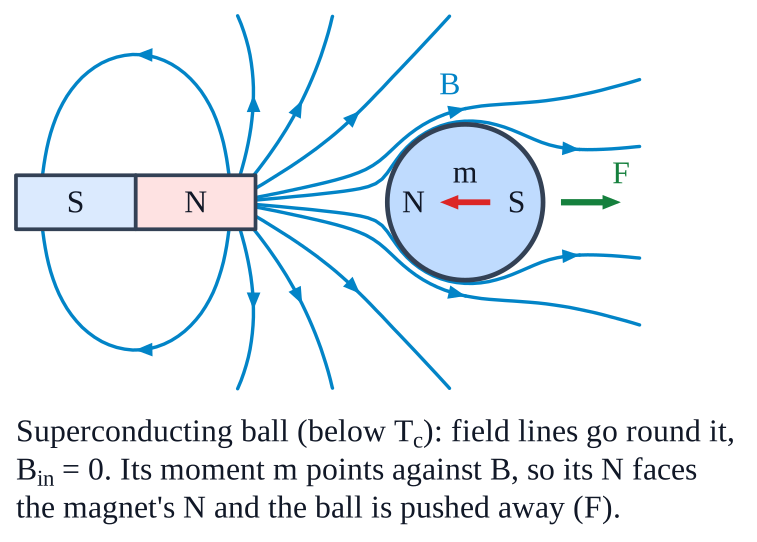
    A ball of superconducting material is dipped in liquid nitrogen and placed near a bar magnet. (i) In which direction will it move? (ii) What will be the direction of it's magnetic moment?
    NCERT’s answer
    (i)
    Away from the magnet.
    (ii)
    Magnetic moment is from left to right
    NCERT_Solution_Class12_Physics_Exemplar_Ch5_Q15_ncert
    Cooled to $\displaystyle 77$ K, below its \(\displaystyle T_c\), the ball is a perfect diamagnet. \[\chi=-1\ \Rightarrow\ \mathbf{M}=\chi\mathbf{H}=-\mathbf{H}\] \[\mathbf{B}_{in}=\mu_0(\mathbf{H}+\mathbf{M})=0\] NCERT_Solution_Class12_Physics_Exemplar_Ch5_Q15 \[\mathbf{m}\ \text{antiparallel to}\ \mathbf{B}\ \Rightarrow\ \text{like poles face}\ \Rightarrow\ \text{repulsion}\] Answer: (i) Away from the magnet (repelled). (ii) Opposite to the magnet's field at the ball.