SolveIt is under development
SolveItClass 12 · Exemplar

NCERT Exemplar · Class 12 Physics Magnetism and Matter

25 questions

Multiple Choice Questions (Type II) 6–10 (part 2 of 5)

  1. Exercise 6

    S\displaystyle S is the surface of a lump of magnetic material.
    (a)
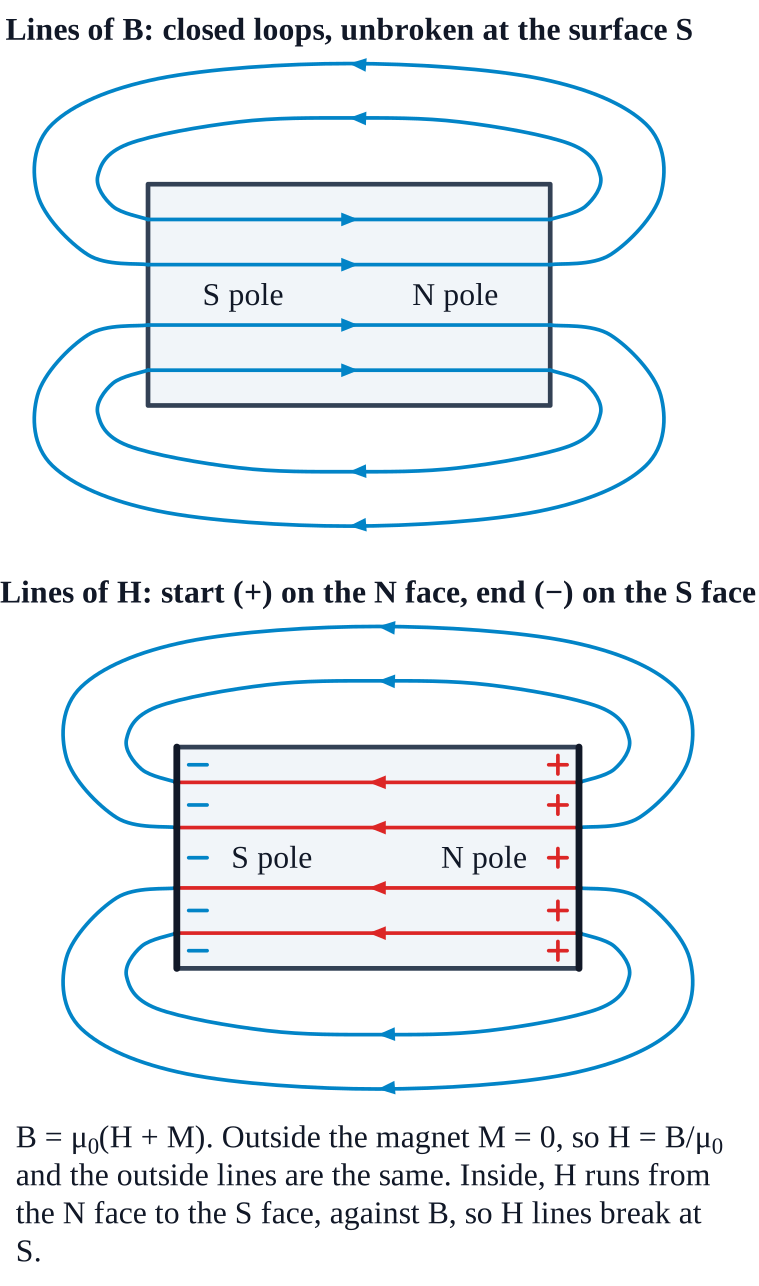
    Lines of B\displaystyle \mathbf{B} are necessarily continuous across S\displaystyle S.
    (b)
    Some lines of B\displaystyle \mathbf{B} must be discontinuous across S\displaystyle S.
    (c)
    Lines of H\displaystyle \mathbf{H} are necessarily continuous across S\displaystyle S.
    (d)
    Lines of H\displaystyle \mathbf{H} cannot all be continuous across S\displaystyle S.
    NCERT’s answer
    (a), (d)
    (a), (d) \(\displaystyle \mathbf{B}\) lines never end, so they are continuous; \(\displaystyle \mathbf{H}\) lines start and stop on the surface poles.NCERT_Solution_Class12_Physics_Exemplar_Ch5_Q6\[\oint \mathbf{B}\cdot d\mathbf{A}=0 \Rightarrow B_n \text{ continuous across } S\] \[\mathbf{B}=\mu_0(\mathbf{H}+\mathbf{M}),\qquad \mathbf{M}_{\text{out}}=0\] \[\mu_0H_n^{\text{out}}=\mu_0\left(H_n^{\text{in}}+M_n\right)\Rightarrow H_n^{\text{out}}-H_n^{\text{in}}=M_n\neq0 \text{ at the poles}\]
  2. Exercise 7

    The primary origin(s) of magnetism lies in
    (a)
    atomic currents.
    (b)
    Pauli exclusion principle.
    (c)
    polar nature of molecules.
    (d)
    intrinsic spin of electron.
    NCERT’s answer
    (a), (d)
    (a), (d) Electron orbital motion (atomic currents) and spin carry the moment; the exclusion principle only sets how spins pair, and polar molecules are electric dipoles.\[\mu_l=IA=\frac{e}{T}\,\pi r^2\] \[\mu_s=g\,\frac{e}{2m_e}\,S,\qquad g\approx2,\ S=\frac{\hbar}{2}\] \[\mu_s=\frac{e\hbar}{2m_e}=9.27\times10^{-24}\ \mathrm{A\,m^2}\]
  3. Exercise 8

    A long solenoid has 1000\displaystyle 1000 turns per metre and carries a current of 1\displaystyle 1 A. It has a soft iron core of μr=1000\displaystyle \mu_r=1000. The core is heated beyond the Curie temperature, Tc\displaystyle T_c.
    (a)
    The H\displaystyle \mathbf{H} field in the solenoid is (nearly) unchanged but the B\displaystyle \mathbf{B} field decreases drastically.
    (b)
    The H\displaystyle \mathbf{H} and B\displaystyle \mathbf{B} fields in the solenoid are nearly unchanged.
    (c)
    The magnetisation in the core reverses direction.
    (d)
    The magnetisation in the core diminishes by a factor of about 108\displaystyle 10^8.
    NCERT’s answer
    (a), (d)
    (a), (d) \(\displaystyle H=nI\) depends only on the current; above \(\displaystyle T_c\) the core is paramagnetic, so \(\displaystyle \mu_r\to1\) and \(\displaystyle M\) collapses.\[H=nI=1000\times1=10^{3}\ \mathrm{A\,m^{-1}}\quad\text{(before and after)}\] \[\text{Before: } B=\mu_0\mu_rH=4\pi\times10^{-7}\times10^{3}\times10^{3}\approx1.3\ \mathrm{T},\qquad M=(\mu_r-1)H\approx10^{6}\ \mathrm{A\,m^{-1}}\] \[\text{After } (\chi\sim10^{-5}): \ B\approx\mu_0H\approx1.3\times10^{-3}\ \mathrm{T},\qquad M=\chi H\approx10^{-5}\times10^{3}=10^{-2}\ \mathrm{A\,m^{-1}}\] \[\frac{M_{\text{before}}}{M_{\text{after}}}\approx\frac{10^{6}}{10^{-2}}=10^{8}\]
  4. Exercise 9

    Essential difference between electrostatic shielding by a conducting shell and magnetostatic shielding is due to
    (a)
    electrostatic field lines can end on charges and conductors have free charges.
    (b)
    lines of B\displaystyle \mathbf{B} can also end but conductors cannot end them.
    (c)
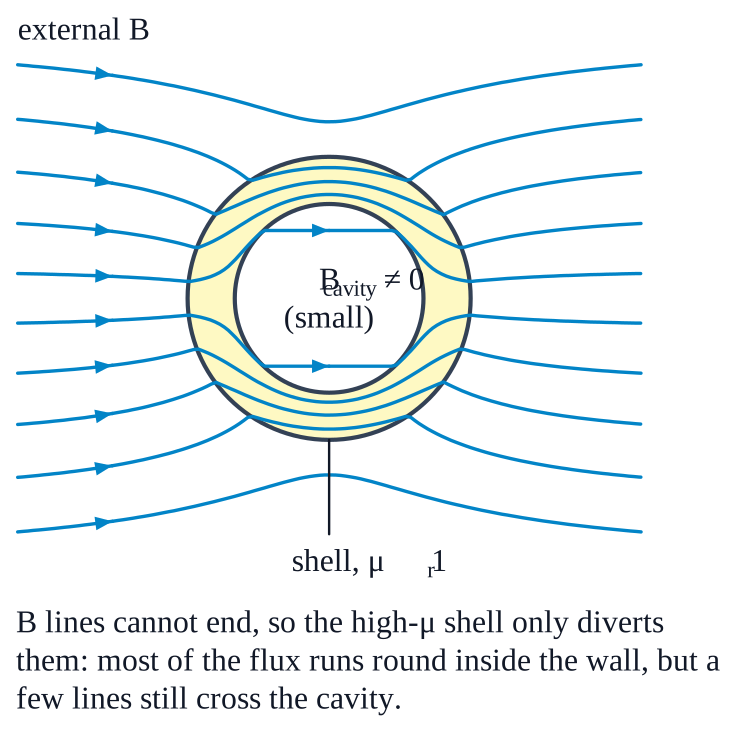
    lines of B\displaystyle \mathbf{B} cannot end on any material and perfect shielding is not possible.
    (d)
    shells of high permeability materials can be used to divert lines of B\displaystyle \mathbf{B} from the interior region.
    NCERT’s answer
    (a), (c), (d)
    (a), (c), (d) \(\displaystyle \mathbf{E}\) lines end on free charges, so a conductor screens fully; \(\displaystyle \mathbf{B}\) lines never end, so a high-\(\displaystyle \mu\) shell can only divert them.NCERT_Solution_Class12_Physics_Exemplar_Ch5_Q9\[\oint \mathbf{E}\cdot d\mathbf{A}=\frac{q}{\varepsilon_0},\qquad \mathbf{E}_{\text{cavity}}=0\] \[\oint \mathbf{B}\cdot d\mathbf{A}=0\] \[\mu_r\gg1\Rightarrow \text{flux runs through the shell wall},\quad B_{\text{cavity}}\neq0\]
  5. Exercise 10

    Let the magnetic field on earth be modelled by that of a point magnetic dipole at the centre of earth. The angle of dip at a point on the geographical equator
    (a)
    is always zero.
    (b)
    can be zero at specific points.
    (c)
    can be positive or negative.
    (d)
    is bounded.
    NCERT’s answer
    (b), (c), (d)
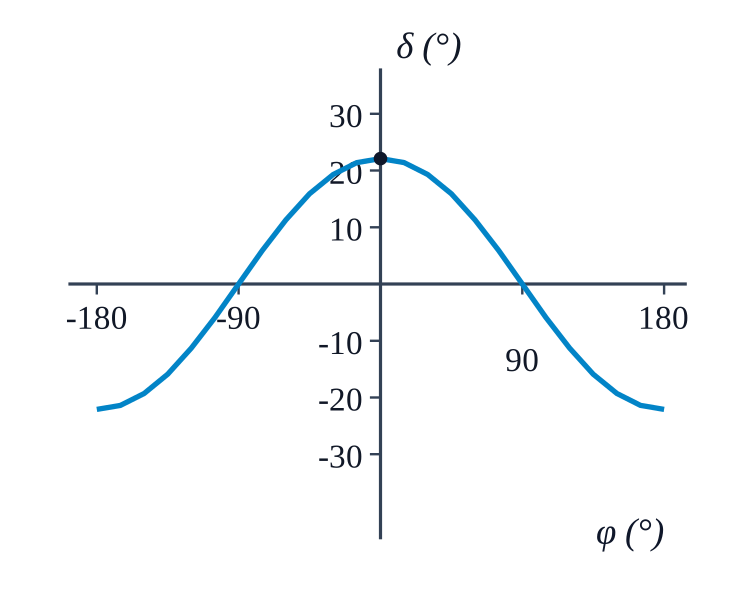
    (b), (c), (d) The dipole axis is tilted from the rotation axis, so the geographic equator meets the magnetic equator at two points (\(\displaystyle \delta=0\)); on either side \(\displaystyle \delta\) has opposite signs, bounded by about \(\displaystyle \pm22^\circ\).\[B_H=\frac{\mu_0m}{4\pi r^3}\cos\lambda,\qquad B_V=\frac{\mu_0m}{4\pi r^3}\,2\sin\lambda\ \Rightarrow\ \tan\delta=\frac{B_V}{B_H}=2\tan\lambda\] \[\sin\lambda=\sin\alpha\,\cos\varphi,\qquad \alpha\approx11.5^\circ\ \text{(axis tilt)}\] \[\varphi=\pm90^\circ:\ \lambda=0\Rightarrow\delta=0\]NCERT_Solution_Class12_Physics_Exemplar_Ch5_Q10\[\delta_{\max}=\tan^{-1}\!\left(2\tan11.5^\circ\right)\approx22^\circ\]