Exercise 16
Verify the Gauss's law for magnetic field of a point dipole of dipole moment at the origin for the surface which is a sphere of radius .
NCERT’s answer
\(\displaystyle \mathbf{B}=\frac{\mu_0}{4 \pi} \frac{3 \mathbf{m} . \hat{\mathbf{r}}}{r^3}, m=m \hat{\mathbf{k}}\)
\[\begin{aligned}
& d \mathbf{s}=\hat{\mathbf{r}} . \mathbf{r}^2 \sin \theta d \theta d \\
& 0 \leq \theta \leq \pi, 0 \leq \phi \leq
\end{aligned}
\]
\[\begin{aligned}
\oint \mathbf{B} . d s & =\frac{\mu_0 m}{4 \pi} \int \frac{3 \cos \theta}{r^3} r^2 \sin \theta d \theta \\
& =0[\text { due to } \theta \text { integral }] .
\end{aligned}
\]

Point dipole \(\displaystyle \mathbf{m}=m\hat{\mathbf{z}}\) at the origin; its field at \(\displaystyle (r,\theta)\):
\[B_r=\frac{\mu_0}{4\pi}\,\frac{2m\cos\theta}{r^{3}},\qquad B_\theta=\frac{\mu_0}{4\pi}\,\frac{m\sin\theta}{r^{3}} \]
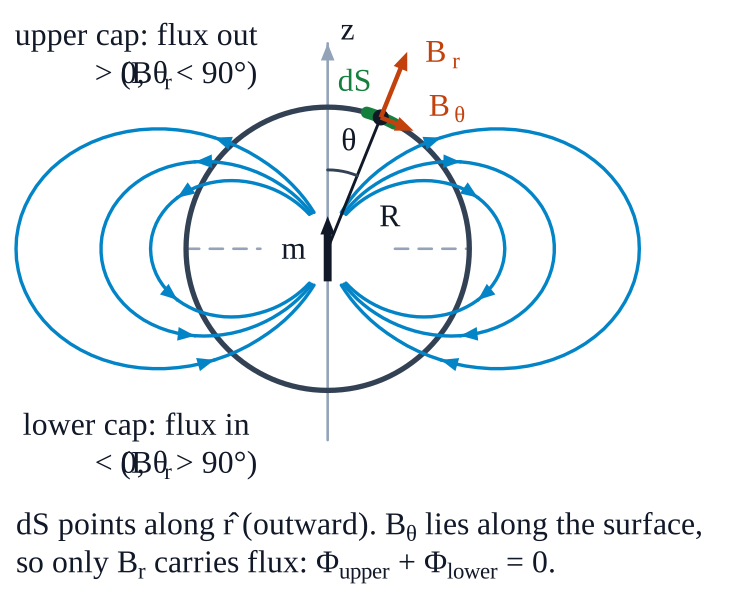 On the sphere \(\displaystyle r=R\), \(\displaystyle d\mathbf{S}=R^{2}\sin\theta\,d\theta\,d\phi\;\hat{\mathbf{r}}\); \(\displaystyle B_\theta\) is tangential, so only \(\displaystyle B_r\) gives flux:
\[\Phi_B=\oint\mathbf{B}\cdot d\mathbf{S}=\frac{\mu_0}{4\pi}\,\frac{2m}{R}\int_0^{2\pi}d\phi\int_0^{\pi}\sin\theta\cos\theta\,d\theta=\frac{\mu_0 m}{R}\left[\frac{\sin^{2}\theta}{2}\right]_0^{\pi}=0 \]
\[\Phi_{\text{upper}}=+\frac{\mu_0 m}{2R},\qquad \Phi_{\text{lower}}=-\frac{\mu_0 m}{2R}\ \Rightarrow\ \Phi_B=0\ \ \text{for every }R \]
Answer: \(\displaystyle \oint\mathbf{B}\cdot d\mathbf{S}=0\) -- equal flux leaves the upper cap and enters the lower cap.
On the sphere \(\displaystyle r=R\), \(\displaystyle d\mathbf{S}=R^{2}\sin\theta\,d\theta\,d\phi\;\hat{\mathbf{r}}\); \(\displaystyle B_\theta\) is tangential, so only \(\displaystyle B_r\) gives flux:
\[\Phi_B=\oint\mathbf{B}\cdot d\mathbf{S}=\frac{\mu_0}{4\pi}\,\frac{2m}{R}\int_0^{2\pi}d\phi\int_0^{\pi}\sin\theta\cos\theta\,d\theta=\frac{\mu_0 m}{R}\left[\frac{\sin^{2}\theta}{2}\right]_0^{\pi}=0 \]
\[\Phi_{\text{upper}}=+\frac{\mu_0 m}{2R},\qquad \Phi_{\text{lower}}=-\frac{\mu_0 m}{2R}\ \Rightarrow\ \Phi_B=0\ \ \text{for every }R \]
Answer: \(\displaystyle \oint\mathbf{B}\cdot d\mathbf{S}=0\) -- equal flux leaves the upper cap and enters the lower cap.

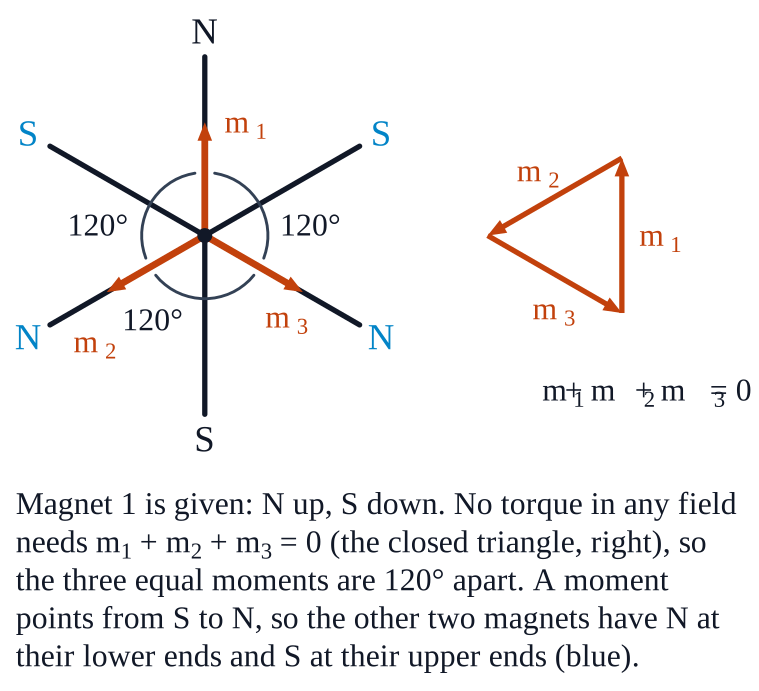 A moment points from S to N, so \(\displaystyle \mathbf{m}_2,\mathbf{m}_3\) (at \(\displaystyle 210^\circ,\,330^\circ\)) put N at the two lower ends.
Answer: N at lower-left and lower-right; S at upper-left and upper-right.

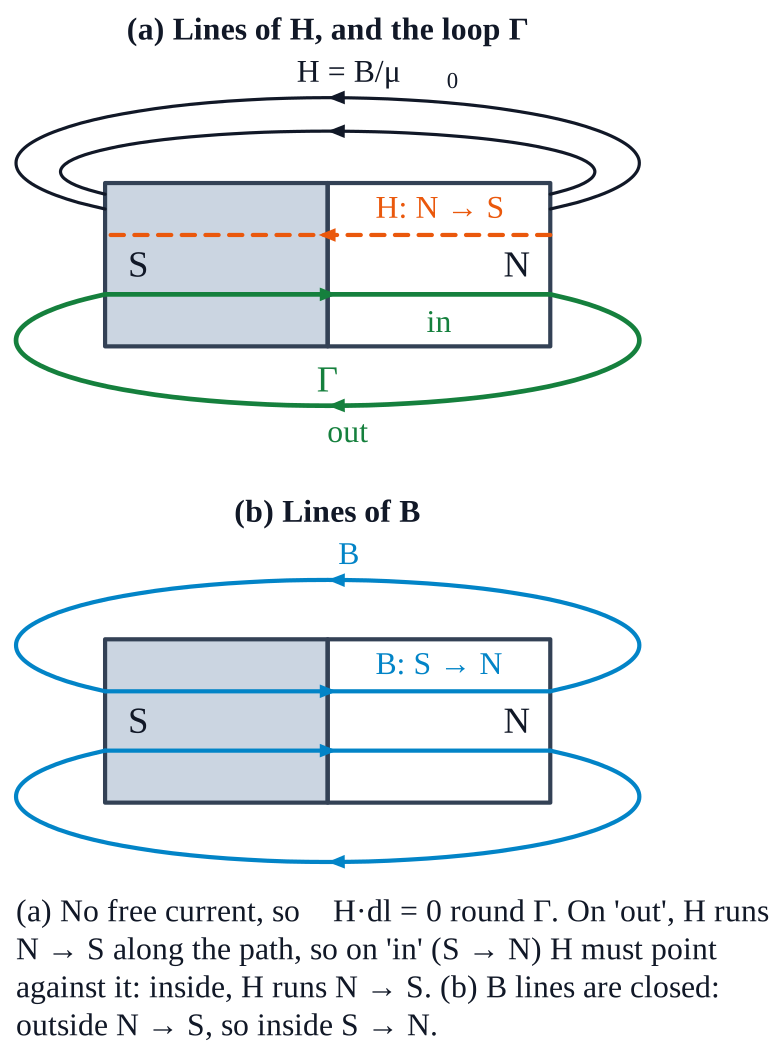 Take \(\displaystyle \Gamma\): outside from \(\displaystyle N\) to \(\displaystyle S\), then back through the magnet from \(\displaystyle S\) to \(\displaystyle N\). Outside, \(\displaystyle \mathbf{H}=\mathbf{B}/\mu_0\) runs \(\displaystyle N\to S\):
\[\int_{out}\mathbf{H}\cdot d\mathbf{l}>0\ \Rightarrow\ \int_{in}\mathbf{H}\cdot d\mathbf{l}=-\int_{out}\mathbf{H}\cdot d\mathbf{l}<0 \]
Inside, \(\displaystyle \mathbf{H}\) opposes the \(\displaystyle S\to N\) path: (a) \(\displaystyle N\to S\).
\[\nabla\cdot\mathbf{B}=0\ \Rightarrow\ \text{lines of }\mathbf{B}\text{ close on themselves} \]
Outside they run \(\displaystyle N\to S\), so inside they must return \(\displaystyle S\to N\): (b).
Answer: inside the magnet, \(\displaystyle \mathbf{H}\) runs \(\displaystyle N\to S\) and \(\displaystyle \mathbf{B}\) runs \(\displaystyle S\to N\).