Exercise 21
Verify the Ampere's law for magnetic field of a point dipole of dipole moment . Take C as the closed curve running clockwise along (i) the -axis from to ; (ii) along the quarter circle of radius and centre at the origin, in the first quadrant of plane; (iii) along the -axis from to , and (iv) along the quarter circle of radius and centre at the origin in the first quadrant of plane.
NCERT’s answer
(i)
Along \(\displaystyle z\) axis
\[\mathbf{B}=\frac{\mu_0}{4 \pi} \frac{2 \mathbf{m}}{r^3}
\]
\[\int_a^R \mathbf{B} \cdot d \mathbf{l}=\frac{\mu_0}{4 \pi} 2 m \int_a^R \frac{d z}{z^3}=\frac{\mu_0 m}{2 \pi}\left(-\frac{1}{2}\right)\left(\frac{1}{R^2}-\frac{1}{a^2}\right)
\]
(ii)
Along the quarter circle of radius \(\displaystyle R\)
\[B_{\emptyset}=\frac{\mu_0}{4 \pi} \frac{-\mathbf{m} \cdot \hat{\boldsymbol{\theta}}}{R^3}=\frac{-\mu_0}{4 \pi} \frac{m}{R^3}(-\sin \theta)
\]
\[\begin{aligned}
& \mathbf{B} \cdot d \boldsymbol{l}=\frac{\mu_0 m}{4 \pi R^2} \sin \theta d \\
& \int_0^{\frac{\pi}{2}} \overrightarrow{\mathrm{~B}} \cdot \overrightarrow{d l}=\frac{\mu_0 m}{4 \pi R^2}
\end{aligned}
\]
(iii)
Along \(\displaystyle x\)-axis
\[\begin{aligned}
& \mathbf{B}=\frac{\mu_0}{4 \pi}\left(\frac{-m}{x^3}\right) \\
& \int \mathbf{B} \cdot d \mathbf{l}=0
\end{aligned}
\]
(iv)
Along the quarter circle of radius \(\displaystyle a\)
\[\mathbf{B} \cdot d \mathbf{l}=\frac{-\mu_0 m}{4 \pi a^2} \sin \theta d \theta, \int \mathbf{B} \cdot d \mathbf{l}=-\frac{-\mu_0 m}{4 \pi a^2} \int_0^{\frac{\pi}{2}} \sin \theta d \theta=\frac{-\mu_0 m}{4 \pi a^2}
\]
Add \(\displaystyle \oint_C \mathbf{B} \cdot d \mathbf{l}=0\)
Dipole field at \(\displaystyle (r,\theta)\), with \(\displaystyle \theta\) measured from the \(\displaystyle z\)-axis:
\[B_r=\frac{\mu_0}{4\pi}\frac{2m\cos\theta}{r^3},\qquad B_\theta=\frac{\mu_0}{4\pi}\frac{m\sin\theta}{r^3} \]
Path: \(\displaystyle A(z=a)\to B(z=R)\to C(x=R)\to D(x=a)\to A\).
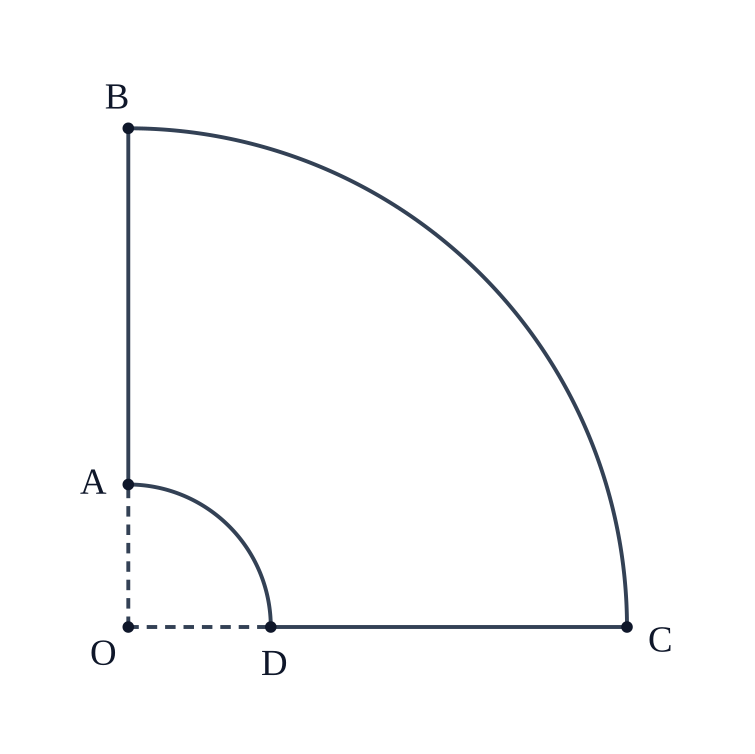 Along \(\displaystyle AB\) (\(\displaystyle \theta=0\), \(\displaystyle d\mathbf{l}=dr\,\hat{\mathbf r}\)):
\[\int_A^B\mathbf{B}\cdot d\mathbf{l}=\int_a^R\frac{\mu_0}{4\pi}\frac{2m}{r^3}\,dr=\frac{\mu_0 m}{4\pi}\left(\frac1{a^2}-\frac1{R^2}\right) \]
Along arc \(\displaystyle BC\) (\(\displaystyle r=R\), \(\displaystyle d\mathbf{l}=R\,d\theta\,\hat{\boldsymbol\theta}\), \(\displaystyle \theta:0\to\pi/2\)):
\[\int_B^C\mathbf{B}\cdot d\mathbf{l}=\int_0^{\pi/2}\frac{\mu_0}{4\pi}\frac{m\sin\theta}{R^3}\,R\,d\theta=\frac{\mu_0 m}{4\pi R^2} \]
Along \(\displaystyle CD\) (\(\displaystyle \theta=\pi/2\)): \(\displaystyle B_r=0\) and \(\displaystyle B_\theta\perp d\mathbf{l}\), so
\[\int_C^D\mathbf{B}\cdot d\mathbf{l}=0 \]
Along arc \(\displaystyle DA\) (\(\displaystyle r=a\), \(\displaystyle \theta:\pi/2\to0\)):
\[\int_D^A\mathbf{B}\cdot d\mathbf{l}=\int_{\pi/2}^{0}\frac{\mu_0}{4\pi}\frac{m\sin\theta}{a^3}\,a\,d\theta=-\frac{\mu_0 m}{4\pi a^2} \]
Sum:
\[\oint\mathbf{B}\cdot d\mathbf{l}=\frac{\mu_0 m}{4\pi}\left[\frac1{a^2}-\frac1{R^2}+\frac1{R^2}+0-\frac1{a^2}\right]=0 \]
No current threads the loop, so \(\displaystyle I_{enc}=0\):
\[\oint\mathbf{B}\cdot d\mathbf{l}=\mu_0 I_{enc}=0 \]
Answer: \(\displaystyle \oint\mathbf{B}\cdot d\mathbf{l}=0=\mu_0 I_{enc}\); Ampere's law holds for the dipole field.
Along \(\displaystyle AB\) (\(\displaystyle \theta=0\), \(\displaystyle d\mathbf{l}=dr\,\hat{\mathbf r}\)):
\[\int_A^B\mathbf{B}\cdot d\mathbf{l}=\int_a^R\frac{\mu_0}{4\pi}\frac{2m}{r^3}\,dr=\frac{\mu_0 m}{4\pi}\left(\frac1{a^2}-\frac1{R^2}\right) \]
Along arc \(\displaystyle BC\) (\(\displaystyle r=R\), \(\displaystyle d\mathbf{l}=R\,d\theta\,\hat{\boldsymbol\theta}\), \(\displaystyle \theta:0\to\pi/2\)):
\[\int_B^C\mathbf{B}\cdot d\mathbf{l}=\int_0^{\pi/2}\frac{\mu_0}{4\pi}\frac{m\sin\theta}{R^3}\,R\,d\theta=\frac{\mu_0 m}{4\pi R^2} \]
Along \(\displaystyle CD\) (\(\displaystyle \theta=\pi/2\)): \(\displaystyle B_r=0\) and \(\displaystyle B_\theta\perp d\mathbf{l}\), so
\[\int_C^D\mathbf{B}\cdot d\mathbf{l}=0 \]
Along arc \(\displaystyle DA\) (\(\displaystyle r=a\), \(\displaystyle \theta:\pi/2\to0\)):
\[\int_D^A\mathbf{B}\cdot d\mathbf{l}=\int_{\pi/2}^{0}\frac{\mu_0}{4\pi}\frac{m\sin\theta}{a^3}\,a\,d\theta=-\frac{\mu_0 m}{4\pi a^2} \]
Sum:
\[\oint\mathbf{B}\cdot d\mathbf{l}=\frac{\mu_0 m}{4\pi}\left[\frac1{a^2}-\frac1{R^2}+\frac1{R^2}+0-\frac1{a^2}\right]=0 \]
No current threads the loop, so \(\displaystyle I_{enc}=0\):
\[\oint\mathbf{B}\cdot d\mathbf{l}=\mu_0 I_{enc}=0 \]
Answer: \(\displaystyle \oint\mathbf{B}\cdot d\mathbf{l}=0=\mu_0 I_{enc}\); Ampere's law holds for the dipole field.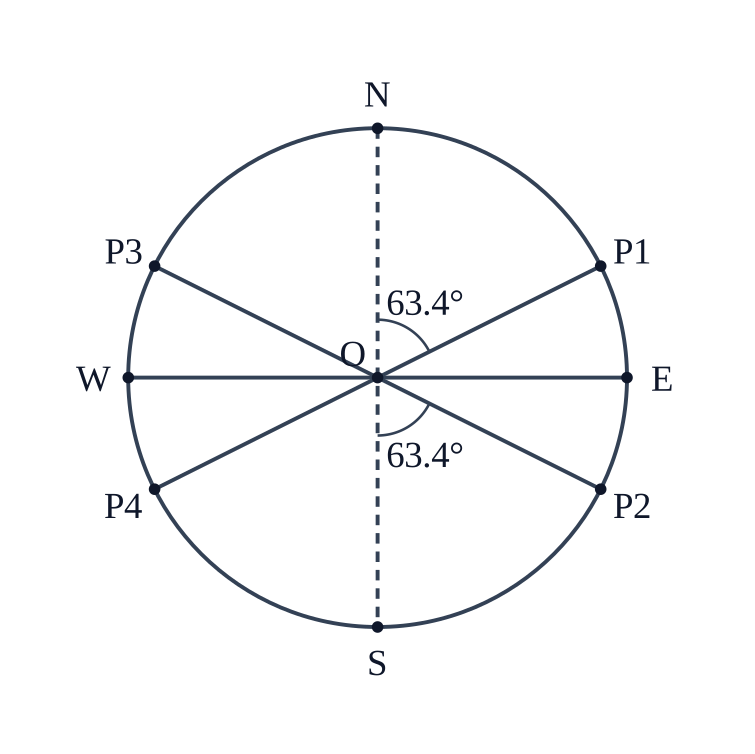 Answer: (i) and (ii) \(\displaystyle \theta=90^\circ\), the magnetic equator; (iii) \(\displaystyle \theta=63.4^\circ\) and \(\displaystyle 116.6^\circ\), the circles of magnetic latitude \(\displaystyle \pm26.6^\circ\).

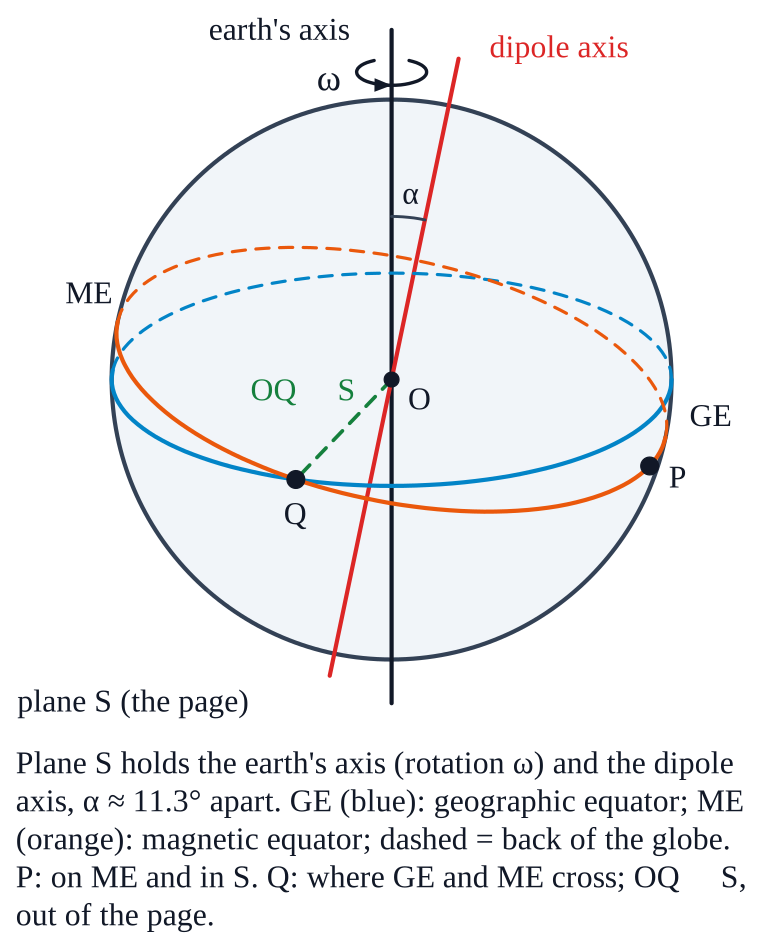 At \(\displaystyle P\) (magnetic equator, in \(\displaystyle S\)): the geographic and the magnetic meridian planes through \(\displaystyle P\) both coincide with \(\displaystyle S\), and the magnetic equator gives zero dip (\(\displaystyle \mathbf{B}\) horizontal):
\[D_P=0^\circ,\qquad I_P=0^\circ \]
At \(\displaystyle Q\) (on both equators): \(\displaystyle OQ\perp S\), so the horizontal plane at \(\displaystyle Q\) is parallel to \(\displaystyle S\). On the magnetic equator \(\displaystyle \mathbf{B}\) is horizontal and parallel to the dipole axis; geographic north is parallel to the earth's axis:
\[I_Q=0^\circ \]
\[D_Q=\angle(\text{dipole axis},\ \text{earth's axis})=\alpha\approx11.3^\circ \]
Answer: \(\displaystyle P\): declination \(\displaystyle D=0^\circ\), dip \(\displaystyle I=0^\circ\). \(\displaystyle Q\): declination \(\displaystyle D=\alpha\approx11.3^\circ\), dip \(\displaystyle I=0^\circ\).