SolveIt is under development
SolveItClass 12 · Exemplar

NCERT Exemplar · Class 12 Physics Magnetism and Matter

25 questions

Multiple Choice Questions (Type I) 1–5 (part 1 of 5)

  1. Exercise 1

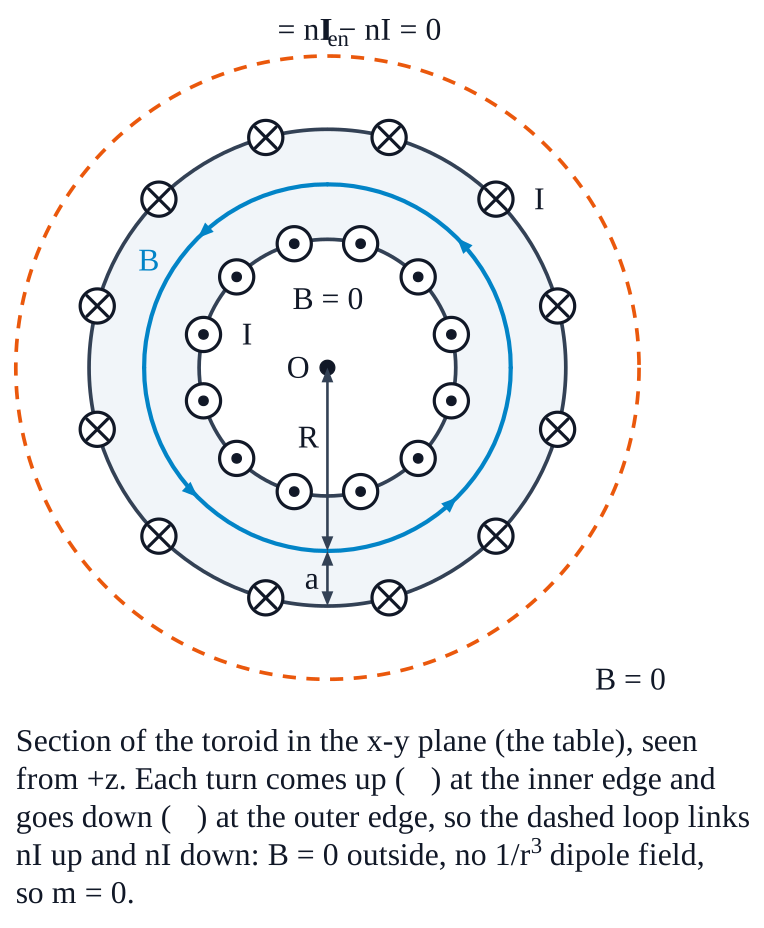
    A toroid of n\displaystyle n turns, mean radius R\displaystyle R and cross-sectional radius a\displaystyle a carries current I\displaystyle I. It is placed on a horizontal table taken as x−y\displaystyle x-y plane. Its magnetic moment m\displaystyle \mathbf{m}
    (a)
    is non-zero and points in the z\displaystyle z-direction by symmetry.
    (b)
    points along the axis of the tortoid (m=mϕ^)\displaystyle (\mathbf{m}=m \hat{\boldsymbol{\phi}}).
    (c)
    is zero, otherwise there would be a field falling as 1r3\displaystyle \frac{1}{r^3} at large distances outside the toroid.
    (d)
    is pointing radially outwards.
    NCERT’s answer
    (c)
    (c) Zero: \(\displaystyle \mathbf{B}=0\) outside the toroid, yet a non-zero \(\displaystyle \mathbf{m}\) would give a dipole field there.NCERT_Solution_Class12_Physics_Exemplar_Ch5_Q1\[\oint \mathbf{B}\cdot d\mathbf{l}=\mu_0 I_{en}=\mu_0\,(nI-nI)=0 \;\Rightarrow\; B_{out}=0 \]\[B_{axis}=\frac{\mu_0}{4\pi}\,\frac{2m}{r^{3}}=0 \;\Rightarrow\; m=0 \]
  2. Exercise 2

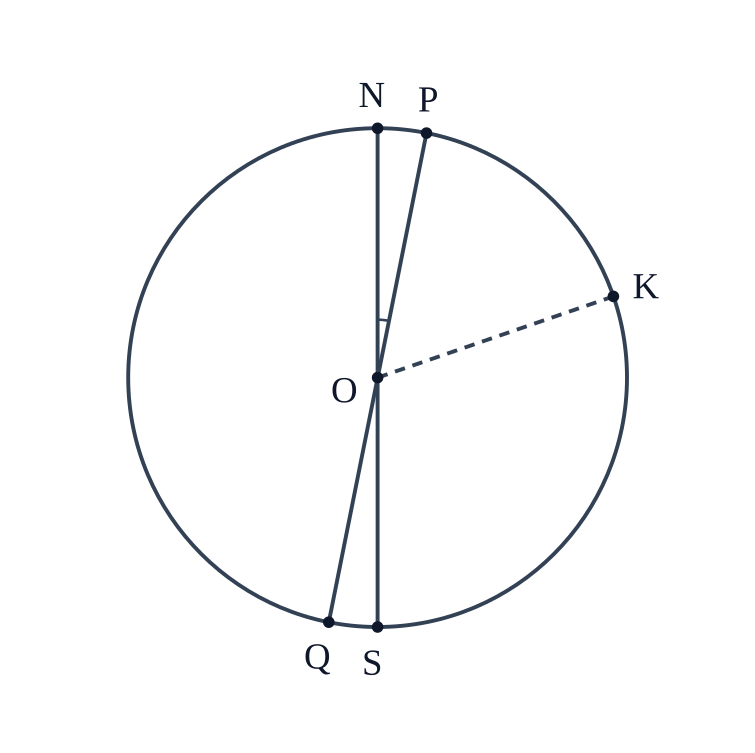
    The magnetic field of Earth can be modelled by that of a point dipole placed at the centre of the Earth. The dipole axis makes an angle of 11.3\displaystyle 11.3° with the axis of Earth. At Mumbai, declination is nearly zero. Then,
    (a)
    the declination varies between 11.3\displaystyle 11.3° W to 11.3\displaystyle 11.3° E.
    (b)
    the least declination is 0\displaystyle 0°.
    (c)
    the plane defined by dipole axis and Earth axis passes through Greenwich.
    (d)
    declination averaged over Earth must be always negative.
    (b) On the plane containing both axes the two meridians coincide, so \(\displaystyle D=0\) there; that plane passes through Mumbai, not Greenwich. Near the poles \(\displaystyle D\) exceeds \(\displaystyle 11.3^\circ\).NCERT_Solution_Class12_Physics_Exemplar_Ch5_Q2\[D_{\text{Mumbai}}\approx 0^\circ \;\Rightarrow\; \text{Mumbai lies in the plane of the two axes} \]\[|D|_{\min}=0^\circ \quad(\text{on that plane}) \]
  3. Exercise 3

    In a permanent magnet at room temperature
    (a)
    magnetic moment of each molecule is zero.
    (b)
    the individual molecules have non-zero magnetic moment which are all perfectly aligned.
    (c)
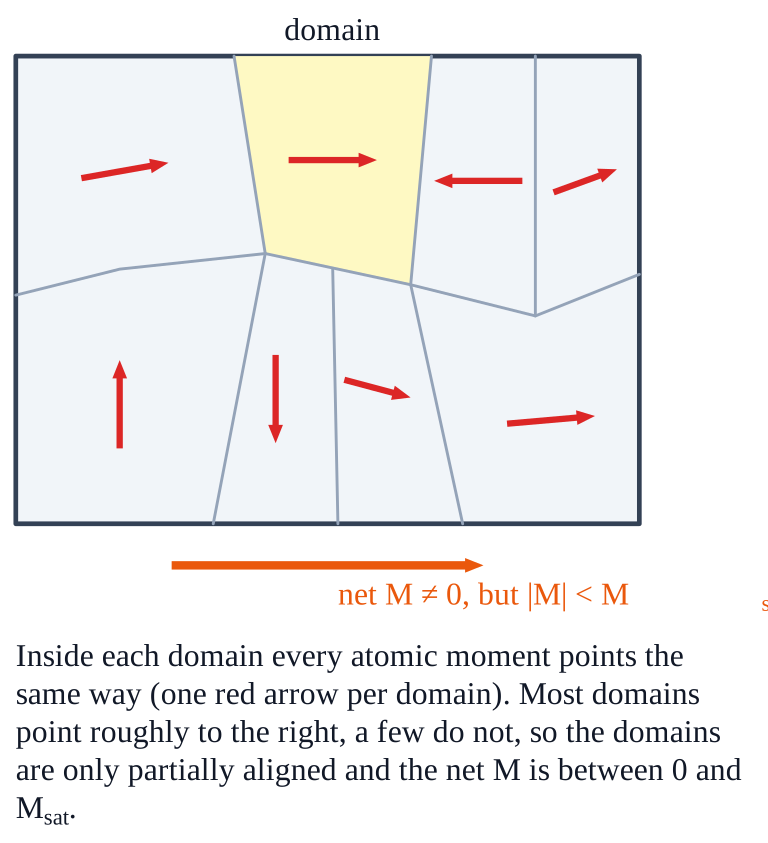
    domains are partially aligned.
    (d)
    domains are all perfectly aligned.
    NCERT’s answer
    (c)
    (c) Each domain is fully magnetised, but the domains are only partly aligned, so a net moment remains.NCERT_Solution_Class12_Physics_Exemplar_Ch5_Q3\[\mathbf{M}=\frac{\sum \mathbf{m}_{domain}}{V}\neq 0,\qquad 0<|\mathbf{M}|<M_{sat} \]
  4. Exercise 4

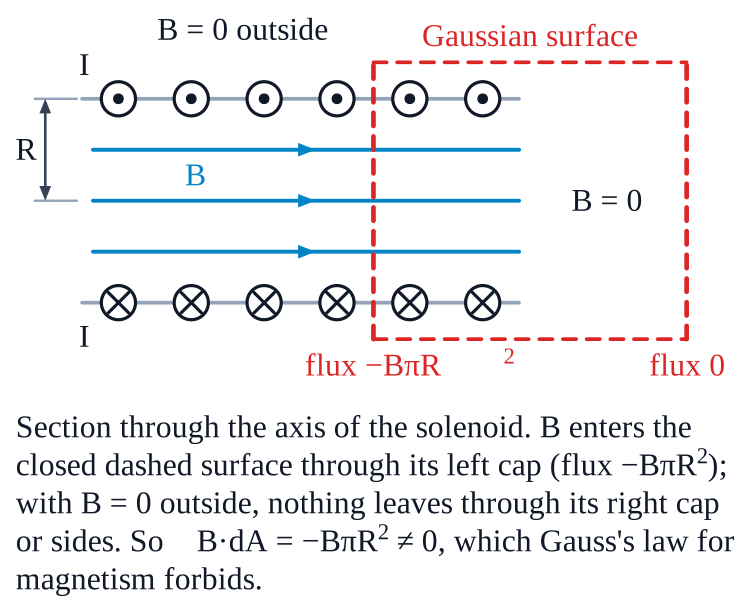
    Consider the two idealized systems: (i) a parallel plate capacitor with large plates and small separation and (ii) a long solenoid of length L≫R\displaystyle L \gg R, radius of cross-section. In (i) E\displaystyle \mathbf{E} is ideally treated as a constant between plates and zero outside. In (ii) magnetic field is constant inside the solenoid and zero outside. These idealised assumptions, however, contradict fundamental laws as below:
    (a)
    case (i) contradicts Gauss's law for electrostatic fields.
    (b)
    case (ii) contradicts Gauss's law for magnetic fields.
    (c)
    case (i) agrees with ∮E.dl=0\displaystyle \oint \mathbf{E} . \mathrm{d} \mathbf{l}=0.
    (d)
    case (ii) contradicts ∮H.dl=Ien\displaystyle \oint \mathbf{H} . \mathrm{d} \mathbf{l}=I_{e n}
    NCERT’s answer
    (b)
    (b) A field that stops abruptly at the end of the solenoid leaves flux with no way out, so Gauss's law for magnetism fails.NCERT_Solution_Class12_Physics_Exemplar_Ch5_Q4\[\oint \mathbf{B}\cdot d\mathbf{A}=-B\pi R^{2}+0\neq 0 \quad(\text{required: } 0) \]\[\text{(d)}\;\; Hl=(nl)\,I=I_{en}\;\;\checkmark \]\[\text{(c)}\;\; \oint \mathbf{E}\cdot d\mathbf{l}=Ed\neq 0 \;\;\text{(loop across plate edge)} \]
  5. Exercise 5

    A paramagnetic sample shows a net magnetisation of 8Am−1\displaystyle 8 \mathrm{Am}^{-1} when placed in an external magnetic field of 0.6T at a temperature of 4\displaystyle 4 K. When the same sample is placed in an external magnetic field of 0.2\displaystyle 0.2 T at a temperature of 16\displaystyle 16 K, the magnetisation will be
    (a)
    323Am−1\displaystyle \frac{32}{3} \mathrm{Am}^{-1}
    (b)
    23Am−1\displaystyle \frac{2}{3} \mathrm{Am}^{-1}
    (c)
    6Am−1\displaystyle 6 \mathrm{Am}^{-1}
    (d)
    2.4Am−1\displaystyle 2.4 \mathrm{Am}^{-1}.
    NCERT’s answer
    (b)
    (b) \(\displaystyle \tfrac{2}{3}\ \mathrm{A\,m^{-1}}\): Curie's law with the same constant, valid below saturation.\[M=\frac{C\,B}{T}\;\Rightarrow\; C=\frac{MT}{B}=\frac{8\times 4}{0.6}=\frac{160}{3}\ \mathrm{A\,m^{-1}\,K\,T^{-1}} \]\[M_2=\frac{C\,B_2}{T_2}=\frac{160}{3}\times\frac{0.2}{16}\ \mathrm{A\,m^{-1}}=\frac{2}{3}\ \mathrm{A\,m^{-1}} \]