SolveIt is under development
SolveItClass 12 · Exemplar

NCERT Exemplar · Class 12 Physics Electromagnetic Waves

32 questions

Very Short Answer Questions 14–20 (part 3 of 5)

  1. Exercise 14

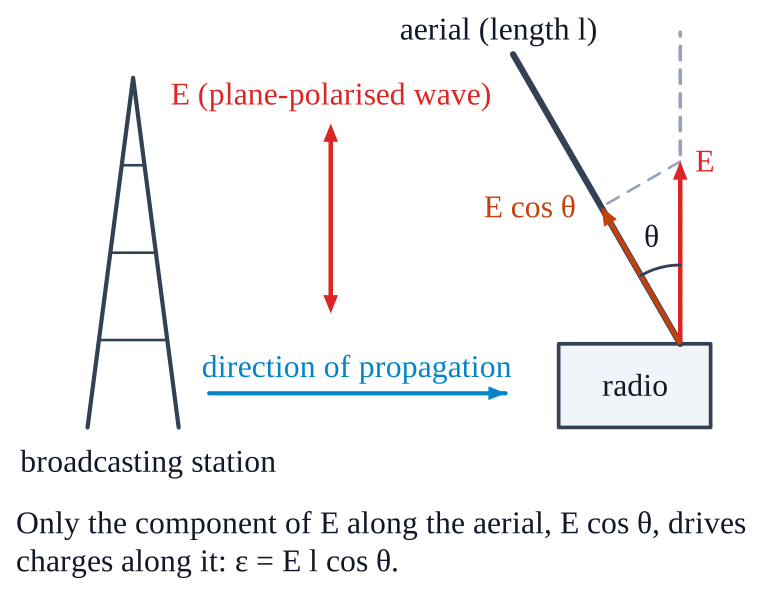
    Why is the orientation of the portable radio with respect to broadcasting station important?
    NCERT’s answer
    As electromagnetic waves are plane polarised, so the receiving antenna should be parallel to electric/magnetic part of the wave.
    Broadcast waves are plane-polarised, so the aerial picks up only the component of \(\displaystyle \mathbf{E}\) along its length.NCERT_Solution_Class12_Physics_Exemplar_Ch8_Q14\[\varepsilon = E\,l\cos\theta,\qquad \theta=\text{angle between aerial and }\mathbf{E} \]Answer: signal is maximum when the aerial is parallel to \(\displaystyle \mathbf{E}\), zero when perpendicular.
  2. Exercise 15

    Why does microwave oven heats up a food item containing water molecules most efficiently?
    NCERT’s answer
    Frequency of the microwave matches the resonant frequency of water molecules.
    Water molecules are polar. Microwave frequency is close to their natural frequency of rotation, so they absorb strongly by resonance.\[f_{\text{microwave}}\approx f_{\text{natural}}(\mathrm{H_2O}) \Rightarrow \text{resonance} \Rightarrow KE_{\text{molecules}}\uparrow \Rightarrow T\uparrow \]Answer: resonant absorption by water molecules turns microwave energy into heat.
  3. Exercise 16

    The charge on a parallel plate capacitor varies as q=q0cos⁡2πνt\displaystyle q=q_0 \cos 2 \pi \nu t. The plates are very large and close together (area =A\displaystyle =A, separation =d\displaystyle =d). Neglecting the edge effects, find the displacement current through the capacitor?
    NCERT’s answer
    \(\displaystyle i_C=i_D=\frac{d q}{d t}=-2 \pi q_0 \nu \sin 2 \pi \nu t\).
    \[E=\frac{q}{\varepsilon_0 A}=\frac{q_0\cos 2\pi\nu t}{\varepsilon_0 A} \]\[I_d=\varepsilon_0\frac{d\Phi_E}{dt}=\varepsilon_0 A\,\frac{dE}{dt}=\frac{dq}{dt} \]\[I_d=\frac{d}{dt}\left(q_0\cos 2\pi\nu t\right)=-2\pi\nu q_0\sin 2\pi\nu t \]Answer: \(\displaystyle I_d=-2\pi\nu q_0\sin 2\pi\nu t\), amplitude \(\displaystyle 2\pi\nu q_0\).
  4. Exercise 17

    A variable frequency a.c source is connected to a capacitor. How will the displacement current change with decrease in frequency?
    NCERT’s answer
    On decreasing the frequency, reactance \(\displaystyle X_c=\frac{1}{\omega C}\) will increase which will lead to decrease in conduction current. In this case \(\displaystyle \mathrm{i}_D=\mathrm{i}_C\); hence displacement current will decrease.
    Displacement current in the gap equals the conduction current in the circuit.\[I_{d,0}=I_0=\frac{V_0}{X_C},\qquad X_C=\frac{1}{2\pi fC} \]\[I_{d,0}=2\pi f\,C\,V_0 \]\[f\downarrow \Rightarrow X_C\uparrow \Rightarrow I_d\downarrow \]Answer: the displacement current decreases, in direct proportion to \(\displaystyle f\).
  5. Exercise 18

    The magnetic field of a beam emerging from a filter facing a floodlight is given by B0=12×10−8sin⁡(1.20×10⁷z−3.60×10¹⁵t)T.B_0=12 \times 10^{-8} \sin \left(1.20 \times 10^7 z-3.60 \times 10^{15} t\right) \mathrm{T} . What is the average intensity of the beam?
    NCERT’s answer
    \(\displaystyle I_{a v}=\frac{1}{2} c \frac{B_0^2}{\mu_0}=\frac{1}{2} \times \frac{3 \times 10^8 \times\left(12 \times 10^{-8}\right)^2}{1.26 \times 10^{-6}}=1.71 \mathrm{~W} / \mathrm{m}^2\).
    Amplitude \(\displaystyle B_0=12\times10^{-8}\ \mathrm{T}\).\[c=\frac{\omega}{k}=\frac{3.60\times10^{15}}{1.20\times10^{7}}=3\times10^{8}\ \mathrm{m\,s^{-1}} \]\[E_0=cB_0=3\times10^{8}\times12\times10^{-8}=36\ \mathrm{V\,m^{-1}} \]\[I=\frac{E_0B_0}{2\mu_0}=\frac{36\times12\times10^{-8}}{2\times4\pi\times10^{-7}}\ \mathrm{W\,m^{-2}} \approx 1.72\ \mathrm{W\,m^{-2}} \]Answer: \(\displaystyle I\approx 1.72\ \mathrm{W\,m^{-2}}\)
  6. Exercise 19

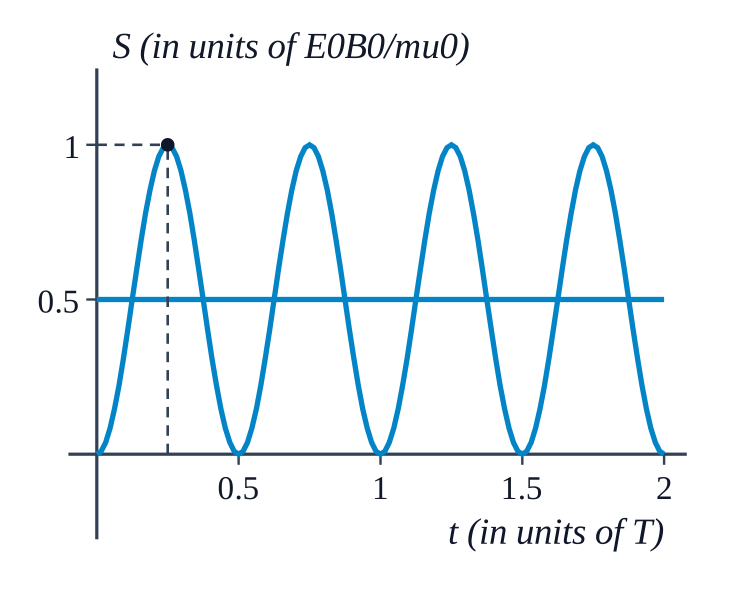
    Poynting vectors S\displaystyle \mathbf{S} is defined as a vector whose magnitude is equal to the wave intensity and whose direction is along the direction of wave propogation. Mathematically, it is given by S=1μ0E×B\displaystyle \mathbf{S}=\frac{1}{\mu_0} \mathbf{E} \times \mathbf{B}. Show the nature of S\displaystyle S vs t\displaystyle t graph.
    NCERT’s answer
    NCERT_Solution_Class12_Physics_Exemplar_Ch8_Q19_ncert
    For a wave along \(\displaystyle +x\), with \(\displaystyle \mathbf{E}\) along \(\displaystyle y\) and \(\displaystyle \mathbf{B}\) along \(\displaystyle z\), \(\displaystyle \mathbf{E}\times\mathbf{B}\) points along \(\displaystyle +x\) and \(\displaystyle E,B\) are in phase.\[S=\frac{EB}{\mu_0}=\frac{E_0B_0}{\mu_0}\sin^2(kx-\omega t) \]\[S=\frac{E_0B_0}{2\mu_0}\left[1-\cos 2(kx-\omega t)\right],\qquad \langle S\rangle=\frac{E_0B_0}{2\mu_0} \]At a fixed point \(\displaystyle S\ge 0\) always, oscillating at twice the wave frequency.NCERT_Solution_Class12_Physics_Exemplar_Ch8_Q19Answer: \(\displaystyle S\)–\(\displaystyle t\) is a \(\displaystyle \sin^2\) curve, never negative, between \(\displaystyle 0\) and \(\displaystyle E_0B_0/\mu_0\), period \(\displaystyle T/2\), mean \(\displaystyle E_0B_0/2\mu_0\).
  7. Exercise 20

    Professor C.V Raman surprised his students by suspending freely a tiny light ball in a transparent vacuum chamber by shining a laser beam on it. Which property of EM waves was he exhibiting? Give one more example of this property.
    NCERT’s answer
    EM waves exert radiation pressure. Tails of comets are due to solar solar radiation.
    EM waves carry momentum, so they exert a force on the ball.\[p=\frac{U}{c},\qquad P_{\text{rad}}=\frac{I}{c}\ \ (\text{absorbing surface}) \]\[F=P_{\text{rad}}A=\frac{IA}{c}\ \text{balances the ball's weight} \]Answer: radiation pressure (momentum of EM waves); e.g. a comet's tail points away from the Sun.