SolveIt is under development
SolveItClass 12 · Exemplar

NCERT Exemplar · Class 12 Physics Electromagnetic Waves

32 questions

Long Answer Questions 28–32 (part 5 of 5)

  1. Exercise 28

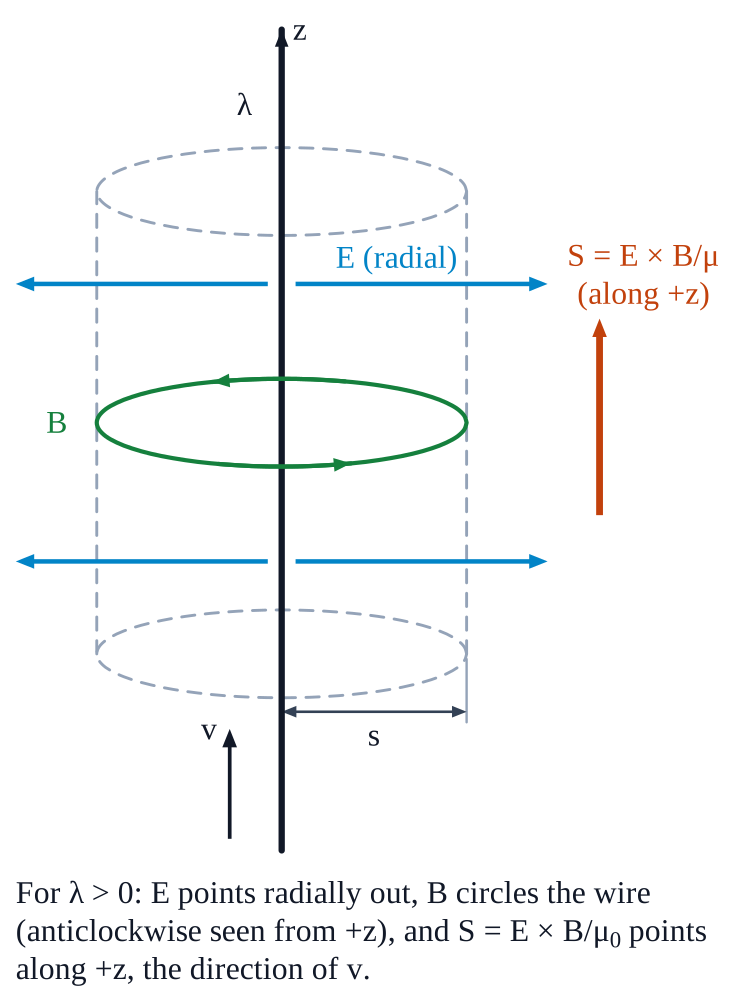
    An infinitely long thin wire carrying a uniform linear static charge density λ\displaystyle \lambda is placed along the z\displaystyle z-axis (Fig. 8.1\displaystyle 8.1). The wire is set into motion along its length with a uniform velocity v=vk^z\displaystyle \mathbf{v}=v \hat{\mathbf{k}}_z. Calculate the poynting vector S=1μo(E×B)\displaystyle \mathbf{S}=\frac{1}{\mu_{\mathrm{o}}}(\mathbf{E} \times \mathbf{B}). NCERT_Question_Class12_Physics_Exemplar_Ch8_Q28
    Gauss's law on a coaxial cylinder of radius \(\displaystyle s\) (on the cylinder of Fig. $\displaystyle 8.1$, \(\displaystyle s=a\)): \[E\,(2\pi s\,l)=\frac{\lambda l}{\varepsilon_0}\;\Rightarrow\;\mathbf{E}=\frac{\lambda}{2\pi\varepsilon_0 s}\,\hat{\mathbf{s}} \] Moving charge is a current along \(\displaystyle z\): \[I=\lambda v \] Ampere's law on a circle of radius \(\displaystyle s\): \[B\,(2\pi s)=\mu_0 I\;\Rightarrow\;\mathbf{B}=\frac{\mu_0\lambda v}{2\pi s}\,\hat{\boldsymbol{\phi}} \] NCERT_Solution_Class12_Physics_Exemplar_Ch8_Q28 With \(\displaystyle \hat{\mathbf{s}}\times\hat{\boldsymbol{\phi}}=\hat{\mathbf{k}}\): \[\mathbf{S}=\frac{1}{\mu_0}\,\mathbf{E}\times\mathbf{B}=\frac{1}{\mu_0}\cdot\frac{\lambda}{2\pi\varepsilon_0 s}\cdot\frac{\mu_0\lambda v}{2\pi s}\,\hat{\mathbf{k}} \] \[\mathbf{S}=\frac{\lambda^{2}v}{4\pi^{2}\varepsilon_0 s^{2}}\,\hat{\mathbf{k}} \] Energy flows along the wire, in the direction of motion, for either sign of \(\displaystyle \lambda\) (only \(\displaystyle \lambda^2\) appears).Answer: \(\displaystyle \mathbf{S}=\dfrac{\lambda^{2}v}{4\pi^{2}\varepsilon_0 s^{2}}\,\hat{\mathbf{k}}\), along \(\displaystyle \mathbf{v}\).
  2. Exercise 29

    Sea water at frequency ν=4×10⁸ Hz\displaystyle \nu=4 \times 10^8 \mathrm{~Hz} has permittivity ε≈80εo\displaystyle \varepsilon \approx 80 \varepsilon_{\mathrm{o}}, permeability μ≈μo\displaystyle \mu \approx \mu_{\mathrm{o}} and resistivity ρ=0.25Ω−m\displaystyle \rho=0.25 \Omega-\mathrm{m}. Imagine a parallel plate capacitor immersed in sea water and driven by an alternating voltage source V(t)=Vosin⁡(2πνt)\displaystyle V(t)=V_o \sin (2 \pi \nu t). What fraction of the conduction current density is the displacement current density?
    NCERT’s answer
    Let the distance between the plates be \(\displaystyle d\). Then the electric field \(\displaystyle E=\frac{V_o}{d} \sin (2 \pi \nu t)\). The conduction current density is given by the Ohm's law \(\displaystyle =E\). \[\begin{aligned} \Rightarrow J^{\mathrm{c}}=\frac{1}{\rho} \frac{\mathrm{~V}_{\mathrm{o}}}{d} \sin (2 \pi \nu t) & =\frac{V_0}{\rho d} \sin (2 \pi \nu t) \\ & =\mathrm{J}_{\mathrm{o}}^{\mathrm{c}} \sin 2 \pi \nu t \end{aligned} \] where \(\displaystyle J_0^c=\frac{V_0}{\rho d}\). The displacement current density is given as \[\begin{gathered} J^d=\varepsilon \frac{\partial E}{\mathrm{~d} t}=\varepsilon \frac{\partial}{\mathrm{dt}}\left\{\frac{\mathrm{~V}_o}{d} \sin (2 \pi \nu t)\right\} \\ =\frac{\varepsilon 2 \pi \nu \mathrm{~V}_{\mathrm{o}}}{d} \cos (2 \pi \nu t) \end{gathered} \] \(\displaystyle =\mathrm{J}_{\mathrm{o}}^{\mathrm{d}} \cos (2 \pi \nu t)\), where \(\displaystyle \mathrm{J}_0^{\mathrm{d}}=\frac{2 \pi \nu \varepsilon V_0}{d}\) \[\begin{aligned} J_{\mathrm{o}}^{\mathrm{d}} / J_{\mathrm{o}}^{\mathrm{c}}= & \frac{2 \pi \nu \varepsilon V_{\mathrm{o}}}{d} \cdot \frac{\rho d}{V_{\mathrm{o}}}=2 \pi \nu \varepsilon \rho=2 \pi \times 80 \varepsilon_{\mathrm{o}} \nu \times 0.25=4 \pi \varepsilon_{\mathrm{o}} \nu \times 10 \\ & =\frac{10 \nu}{9 \times 10^9}=\frac{4}{9} \end{aligned} \]
    Field between the plates: \(\displaystyle E=E_0\sin\omega t\), \(\displaystyle \omega=2\pi\nu\).Conduction current density: \[J_c=\frac{E}{\rho}\;\Rightarrow\;J_{c0}=\frac{E_0}{\rho} \] Displacement current density: \[J_d=\varepsilon\frac{\partial E}{\partial t}=\varepsilon\omega E_0\cos\omega t\;\Rightarrow\;J_{d0}=\varepsilon\omega E_0 \] Ratio of amplitudes: \[\frac{J_{d0}}{J_{c0}}=\varepsilon\,\omega\,\rho=80\,\varepsilon_0\,(2\pi\nu)\,\rho \] \[=80\,(8.85\times10^{-12}\ \mathrm{F\,m^{-1}})\,(2\pi\times4\times10^{8}\ \mathrm{s^{-1}})\,(0.25\ \Omega\,\mathrm{m}) \] \[\approx 0.44 \] \(\displaystyle J_d\) leads \(\displaystyle J_c\) by \(\displaystyle 90^\circ\), so the $\displaystyle 0.44$ compares their amplitudes.Answer: \(\displaystyle J_d/J_c\approx0.44\), about $\displaystyle 44$ %.
  3. Exercise 30

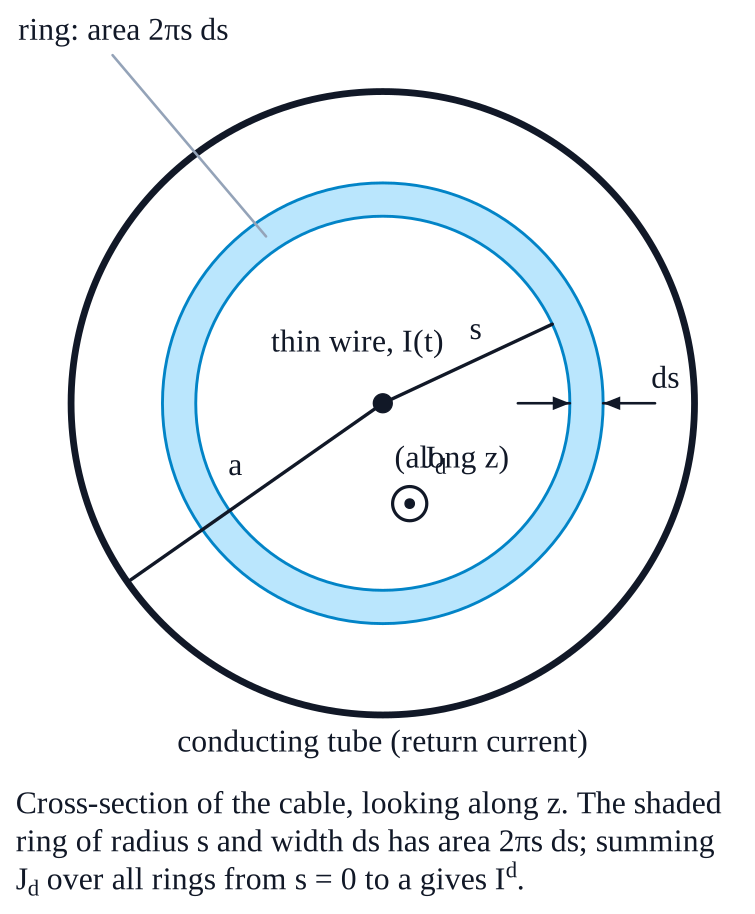
    A long straight cable of length l\displaystyle l is placed symmetrically along z\displaystyle z-axis and has radius a(≪l)\displaystyle a(\ll l). The cable consists of a thin wire and a co-axial conducting tube. An alternating current I(t)=Iosin⁡(2πνt)\displaystyle I(t)=I_o \sin (2 \pi \nu t) flows down the central thin wire and returns along the co-axial conducting tube. The induced electric field at a distance s\displaystyle s from the wire inside the cable is E(s,t)=μoIoνcos⁡(2πνt)In⁡(sa)k^\displaystyle \mathbf{E}(s, t)=\mu_{\mathrm{o}} I_{\mathrm{o}} \nu \cos (2 \pi \nu t) \operatorname{In}\left(\frac{s}{a}\right) \hat{\mathbf{k}}.
    (i)
    Calculate the displacement current density inside the cable.
    (ii)
    Integrate the displacement current density across the cross-section of the cable to find the total displacement current Id\displaystyle I^{\mathrm{d}}.
    (iii)
    Compare the conduction current I0\displaystyle I_0 with the dispalcement current Iod\displaystyle I_{\mathrm{o}}^{\mathrm{d}}.
    NCERT’s answer
    (i)
    Displacement curing density can be found from the relation be \(\displaystyle \mathbf{J}_D=\varepsilon_0 \frac{d \mathbf{E}}{d t}\)
    \[\begin{aligned} & =\varepsilon_0 \mu_0 I_0 \quad \frac{\partial}{\partial t} \cos (2 \pi \nu t) \cdot \ln \left(\frac{s}{a}\right) \hat{\mathbf{k}} \\ & =\frac{1}{c^2} I_0 2 \pi \nu^2(-\sin (2 \pi \nu t)) \ln \left(\frac{s}{a}\right) \hat{\mathbf{k}} \\ & =\left(\frac{\nu}{c}\right)^2 2 \pi I_0 \sin (2 \pi \nu t) \ln \left(\frac{a}{s}\right) \hat{k} \\ & =\frac{2 \pi}{\lambda^2} I_0 \ln \left(\frac{a}{s}\right) \sin (2 \pi \nu t) \hat{\mathbf{k}} \end{aligned} \]
    (ii)
    \(\displaystyle I^d=\int J_D s d s d \theta\)
    \[\begin{aligned} & =\frac{2 \pi}{\lambda^2} I_0 2 \pi \int_{s=0}^a \ln \left(\frac{a}{s}\right) \cdot s d s \sin (2 \pi \nu t) \\ & =\left(\frac{2 \pi}{\lambda}\right)^2 I_0 \int_{s=0}^a \frac{1}{2} d s^2 \ln \left(\frac{a}{s}\right) \cdot \sin (2 \pi \nu t) \\ & =\frac{a^2}{4}\left(\frac{2 \pi}{\lambda}\right)^2 I_0 \int_{s=0}^a d\left(\frac{s}{a}\right)^2 \ln \left(\frac{a}{s}\right)^2 \cdot \sin (2 \pi \nu t) \\ & =-\frac{a^2}{4}\left(\frac{2 \pi}{\lambda}\right)^2 I_0 \int_0^1 \ln \xi d \xi \cdot \sin (2 \pi \nu t) \\ & =+\left(\frac{a}{2}\right)^2\left(\frac{2 \pi}{\lambda}\right)^2 I_0 \sin 2 \pi \nu t \quad(\therefore \text { The integral has value }-1) \end{aligned} \]
    (iii)
    The displacement current
    \[\begin{aligned} & I^d=\left(\frac{a}{2} \cdot \frac{2 \pi}{\lambda}\right)^2 I_0 \sin 2 \pi \nu t=I_0^d \sin 2 \pi \nu t \\ & \frac{I_0^d}{I_0}=\left(\frac{a \pi}{\lambda}\right)^2 . \end{aligned} \]
    (i)
    \[\mathbf{J}_d=\varepsilon_0\frac{\partial\mathbf{E}}{\partial t}=-2\pi\varepsilon_0\mu_0 I_0\nu^{2}\sin(2\pi\nu t)\,\ln\!\Big(\frac{s}{a}\Big)\hat{\mathbf{k}} \]
    (ii)
    Ring of radius \(\displaystyle s\), width \(\displaystyle ds\): area \(\displaystyle 2\pi s\,ds\).
    NCERT_Solution_Class12_Physics_Exemplar_Ch8_Q30
    \[I^d=\int_0^{a}J_d\,(2\pi s\,ds)=-4\pi^{2}\varepsilon_0\mu_0 I_0\nu^{2}\sin(2\pi\nu t)\int_0^{a}s\ln\!\Big(\frac{s}{a}\Big)ds \]
    \[\int_0^{a}s\ln\!\Big(\frac{s}{a}\Big)ds=a^{2}\int_0^{1}u\ln u\,du=-\frac{a^{2}}{4} \]
    \[I^d=\pi^{2}\varepsilon_0\mu_0\nu^{2}a^{2}\,I_0\sin(2\pi\nu t)=\Big(\frac{\pi\nu a}{c}\Big)^{2}I_0\sin(2\pi\nu t) \]
    (iii)
    \[\frac{I^d_0}{I_0}=\Big(\frac{\pi\nu a}{c}\Big)^{2}\ll1\qquad(\nu a\ll c) \]
    Answer: \(\displaystyle I^d=(\pi\nu a/c)^2 I_0\sin(2\pi\nu t)\), so \(\displaystyle I^d_0\ll I_0\): the displacement current is negligible.
  4. Exercise 31

    A plane EM wave travelling in vacuum along z\displaystyle z direction is given by E=E0sin⁡(kz−ωt)i^\displaystyle \mathbf{E}=E_0 \sin (k z-\omega t) \hat{\mathbf{i}} and B=B0sin⁡(kz−ωt)j^\displaystyle \mathbf{B}=B_0 \sin (k z-\omega t) \hat{\mathbf{j}}.
    (i)
    Evaluate ∮E.dl\displaystyle \oint \mathbf{E . d l} over the rectangular loop 1234\displaystyle 1234 shown in Fig 8.2.
    (ii)
    Evaluate ∫B.ds\displaystyle \int \mathbf{B . d s} over the surface bounded by loop 1234.
    (iii)
    Use equation ∮E.dl=−dϕBdt\displaystyle \oint \mathbf{E . d l}=\frac{-\mathrm{d} \phi_{\mathrm{B}}}{\mathrm{d} t} to prove E0B0=c\displaystyle \frac{E_0}{B_0}=\mathrm{c}.
    (iv)
    By using similar process and the equation ∮B.dl=μ0I+ε0 dϕEdt\displaystyle \oint \mathbf{B} . \mathbf{d} \mathbf{l}=\mu_0 I+\varepsilon_0 \frac{\mathrm{~d} \phi_{\mathrm{E}}}{\mathrm{d} t}, prove that c=1μ0ε0\displaystyle \mathrm{c}=\frac{1}{\sqrt{\mu_0 \varepsilon_0}}
    NCERT_Question_Class12_Physics_Exemplar_Ch8_Q31
    NCERT’s answer
    (i)
    \(\displaystyle \oint E . d l=\int_1^2 E . d l+\int_2^3 E . d l+\int_3^4 E . d l+\int_4^1 E . d l\)
    \[\begin{align*} & =\int_1^2 E . d l \cos 90^{\circ}+\int_2^3 E . d l \cos 0+\int_3^4 E . d l \cos 90^{\circ}+\int_4^1 E . d l \cos 180^{\circ} \\ & =\boldsymbol{E}_0 h\left[\sin \left(k z_2-\omega t\right)-\sin \left(k z_1-\omega t\right)\right] \tag{1} \end{align*} \]
    (ii)
    For evaluating \(\displaystyle \int \mathbf{B} . \mathbf{d s}\) let us consider the rectangle $\displaystyle 1234$ to be made of strips of area \(\displaystyle \mathrm{d} s=h d z\) each.
    \[\begin{align*} & \int \boldsymbol{B} \cdot \boldsymbol{d} \boldsymbol{s}=\int B d s \cos 0=\int B d s=\int_{Z_1}^{Z_2} B_0 \sin (k z-\omega t) h d z \\ & =\frac{-B_o h}{k}\left[\cos \left(k z_2-\omega t\right)-\cos \left(k z_1-\omega t\right)\right] \tag{2} \end{align*} \]
    (iii)
    \(\displaystyle \oint \mathbf{E} . \mathbf{d l}=\frac{-d \phi_B}{d t}\)
    Using the relations obtained in Equations ($\displaystyle 1$) and ($\displaystyle 2$) and simplifiying, we get
    \[\begin{aligned} & E_0 h\left[\sin \left(k z_2-\omega t\right)-\sin \left(k z_1-\omega t\right)\right]=\frac{B_o h}{k} \omega\left[\sin \left(k z_2-\omega t\right)-\sin \left(k z_1-\omega t\right)\right] \\ & E_0=B_0 \frac{\omega}{k} \\ & \frac{E_0}{B_0}=c \end{aligned} \]
    (iv)
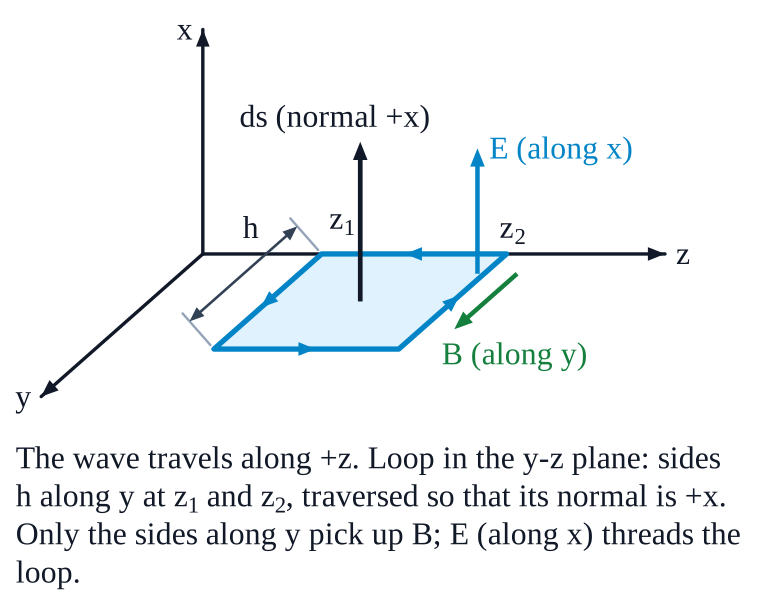
    For evaluating \(\displaystyle \oint \mathbf{B} . \mathbf{d l}\), let us consider the loop $\displaystyle 1234$ in yz plane as shown in Fig.
    \[\begin{align*} & \oint \mathbf{B} \cdot \mathbf{d l}=\int_1^2 \mathbf{B} \cdot \mathbf{d l}+\int_2^3 \mathbf{B} \cdot \mathbf{d l}+\int_3^4 \mathbf{B} \cdot \mathbf{d l}+\int_4^1 \mathbf{B} \cdot \mathbf{d l} \\ & =\int_1^2 B d l \cos 0+\int_2^3 B d l \cos 90^{\circ}+\int_3^4 B d l \cos 180^{\circ}+\int_4^1 B d l \cos 90^{\circ} \\ & =B_0 h\left[\sin \left(k z_1-\omega t\right)-\sin \left(k z_2-\omega t\right)\right] \tag{3} \end{align*} \]
    Now to evaluate \(\displaystyle \phi_E=\int \mathbf{E . d s}\), let us consider the rectangle $\displaystyle 1234$ to be made of strips of area hdz each.
    \[\begin{align*} & \phi_E=\int \mathbf{E} \cdot \mathbf{d s}=\int E d s \cos 0=\int E d s=\int_{Z_1}^{Z_2} E_0 \sin \left(k z_1-\omega t\right) h d z \\ & =\frac{-E_0 h}{k}\left[\cos \left(k z_2-\omega t\right)-\cos \left(k z_1-\right.\right. \\ & \therefore \frac{d \phi_E}{d t}=\frac{E_0 h \omega}{k}\left[\sin \left(k z_1-\omega t\right)-\sin \left(k z_2-\omega t\right)\right] \tag{4} \end{align*} \]
    In \(\displaystyle \oint \mathbf{B} . \mathbf{d l}=\mu_0\left(I+\varepsilon_0 \frac{d \phi_E}{d t}\right), I=\) conduction current
    \(\displaystyle =0\) in vacuum.
    \[\therefore \oint \mathbf{B} \cdot \mathbf{d l}=\mu_0 \varepsilon_0 \frac{d \phi_E}{d t} \]
    Using relations obtained in Equations ($\displaystyle 3$) and ($\displaystyle 4$) and ssimplifying, we get
    \[B_0=E_0 \frac{\omega}{k} \cdot \mu_0 \varepsilon_0 \]
    \(\displaystyle \frac{E_0}{B_0} \frac{\omega}{k}=\frac{1}{\mu_0 \varepsilon_0}\) But \(\displaystyle \mathrm{E}_0 / \mathrm{B}_0=\mathrm{c}\), and \(\displaystyle \omega=c k\)
    or \(\displaystyle c . c=\frac{1}{\mu_0 \varepsilon_0}\) Therefore, \(\displaystyle c=\frac{1}{\sqrt{\mu_0 \varepsilon_0}}\).
    NCERT_Solution_Class12_Physics_Exemplar_Ch8_Q31_ncert
    NCERT_Solution_Class12_Physics_Exemplar_Ch8_Q31_ncert_2
    NCERT_Solution_Class12_Physics_Exemplar_Ch8_Q31_ncert_3
    NCERT_Solution_Class12_Physics_Exemplar_Ch8_Q31_ncert_4
    Side $\displaystyle 1$-$\displaystyle 4$ lies at \(\displaystyle z_1\), side $\displaystyle 2$-$\displaystyle 3$ at \(\displaystyle z_2\); traverse \(\displaystyle 1\to2\to3\to4\to1\). On $\displaystyle 1$-$\displaystyle 2$ and $\displaystyle 3$-$\displaystyle 4$, \(\displaystyle \mathbf{E}\perp d\mathbf{l}\), so only $\displaystyle 2$-$\displaystyle 3$ (\(\displaystyle +x\)) and $\displaystyle 4$-$\displaystyle 1$ (\(\displaystyle -x\)) count.
    (i)
    \[\oint\mathbf{E}\cdot d\mathbf{l}=E_0h\big[\sin(kz_2-\omega t)-\sin(kz_1-\omega t)\big] \]
    (ii)
    Normal of loop $\displaystyle 1234$ is \(\displaystyle +\hat{\mathbf{j}}\); \(\displaystyle d\mathbf{s}=h\,dz\,\hat{\mathbf{j}}\):
    \[\phi_B=B_0h\int_{z_1}^{z_2}\sin(kz-\omega t)\,dz=-\frac{B_0h}{k}\big[\cos(kz_2-\omega t)-\cos(kz_1-\omega t)\big] \]
    (iii)
    \[-\frac{d\phi_B}{dt}=\frac{B_0h\,\omega}{k}\big[\sin(kz_2-\omega t)-\sin(kz_1-\omega t)\big] \]
    \[E_0h=\frac{B_0h\,\omega}{k}\;\Rightarrow\;\frac{E_0}{B_0}=\frac{\omega}{k}=c \]
    (iv)
    Loop in the \(\displaystyle yz\)-plane, side \(\displaystyle h\) along \(\displaystyle y\), normal \(\displaystyle +\hat{\mathbf{i}}\); only the sides along \(\displaystyle y\) count (\(\displaystyle \mathbf{B}\parallel\hat{\mathbf{j}}\)):
    NCERT_Solution_Class12_Physics_Exemplar_Ch8_Q31
    \[\oint\mathbf{B}\cdot d\mathbf{l}=-B_0h\big[\sin(kz_2-\omega t)-\sin(kz_1-\omega t)\big] \]
    \[\phi_E=-\frac{E_0h}{k}\big[\cos(kz_2-\omega t)-\cos(kz_1-\omega t)\big] \]
    \(\displaystyle I=0\) in vacuum:
    \[-B_0h\big[\ldots\big]=\mu_0\varepsilon_0\frac{d\phi_E}{dt}=-\mu_0\varepsilon_0\frac{E_0h\,\omega}{k}\big[\ldots\big]\;\Rightarrow\;B_0=\mu_0\varepsilon_0\,c\,E_0 \]
    With \(\displaystyle E_0=cB_0\):
    \[B_0=\mu_0\varepsilon_0\,c^{2}B_0\;\Rightarrow\;c=\frac{1}{\sqrt{\mu_0\varepsilon_0}} \]
    Answer: \(\displaystyle E_0/B_0=c\) and \(\displaystyle c=1/\sqrt{\mu_0\varepsilon_0}\).
  5. Exercise 32

    A plane EM wave travelling along z\displaystyle z direction is described by E=E0sin⁡(kz−ωt)i^\displaystyle \mathbf{E}=E_0 \sin (k z-\omega t) \hat{\mathbf{i}} and B=B0sin⁡(kz−ωt)j^\displaystyle \mathbf{B}=B_0 \sin (k z-\omega t) \hat{\mathbf{j}}. Show that
    (i)
    The average energy density of the wave is given by
    uav=14ε0E02+14 B02μ0.u_{\mathrm{av}}=\frac{1}{4} \varepsilon_0 E_0^2+\frac{1}{4} \frac{\mathrm{~B}_0^2}{\mu_0} .
    (ii)
    The time averaged intensity of the wave is given by
    Iav=12cε0E02.I_{\mathrm{av}}=\frac{1}{2} \mathrm{c} \varepsilon_0 E_0^2 .
    NCERT’s answer
    (a)
    E - field contribution is \(\displaystyle \mathrm{u}_{\mathrm{E}}=\frac{1}{2} \varepsilon_0 E^2\)
    B - field contribution is \(\displaystyle u_B=\frac{1}{2} \frac{B^2}{\mu_0}\)
    Total energy density \(\displaystyle u=u_E+u_B=\frac{1}{2} \varepsilon_0 E^2+\frac{1}{2} \frac{B^2}{\mu_0}\) ( $\displaystyle 1$)
    The values of \(\displaystyle E^2\) and \(\displaystyle B^2\) vary from point to point and from moment to moment. Hence, the effective values of \(\displaystyle E^2\) and \(\displaystyle B^2\) are their time averages.
    \[\begin{aligned} \left(E^2\right)_{a v} & =E_0^2\left[\sin ^2(k z-\omega t)\right]_{a v} \\ \left(B^2\right)_{a v} & =\left(B^2\right)_{a v}=B_0^2\left[\sin ^2(k z-\omega t)\right]_{a v} \end{aligned} \]
    The graph of \(\displaystyle \sin ^2 \theta\) and \(\displaystyle \cos ^2 \theta\) are identical in shape but shifted by \(\displaystyle \pi / 2\), so the average values of \(\displaystyle \sin ^2 \theta\) and \(\displaystyle \operatorname{Cos}^2 \theta\) are also equal over any integral multiple of \(\displaystyle \pi\).
    and also \(\displaystyle \sin ^2 \theta+\cos ^2 \theta=1\)
    So by symmetry the average of \(\displaystyle \sin ^2 \theta=\) average of \(\displaystyle \cos ^2 \theta=\frac{1}{2}\)
    \[\therefore\left(E^2\right)_{a v}=\frac{1}{2} E_0^2 \text { and }\left(B^2\right)_{a v}=\frac{1}{2} B_0^2 \]
    Substuting in Equation ($\displaystyle 1$),
    \[\begin{equation*} u=\frac{1}{4} \varepsilon_0 E^2+\frac{1}{4} \frac{B_0^2}{\mu} \tag{2} \end{equation*} \]
    (b)
    We know \(\displaystyle \frac{E_0}{B_0}=c\) and \(\displaystyle c=\frac{1}{\sqrt{\mu_0 \varepsilon_0}} \therefore \frac{1}{4} \frac{B_0^2}{\mu_0}=\frac{E_0^2 / c^2}{4 \mu_0}=\frac{E_0^2}{4 \mu_0} \mu_0 \varepsilon_0=\frac{1}{4} \varepsilon_0 E_0^2\).
    Therefore, \(\displaystyle u_{a v}=\frac{1}{4} \varepsilon_0 E_0^2+\frac{1}{4} \varepsilon_0 E_0^2=\frac{1}{2} \varepsilon_0 E_0^2\), and \(\displaystyle I_{a v}=u_{a v} c=\frac{1}{2} \varepsilon_0 E_0^2\).
    NCERT_Solution_Class12_Physics_Exemplar_Ch8_Q32_ncert
    (i)
    \[u_E=\tfrac12\varepsilon_0E^2=\tfrac12\varepsilon_0E_0^2\sin^2(kz-\omega t),\qquad u_B=\frac{B^2}{2\mu_0}=\frac{B_0^2}{2\mu_0}\sin^2(kz-\omega t) \]
    Over a period \(\displaystyle \langle\sin^2(kz-\omega t)\rangle=\tfrac12\):
    \[u_{av}=\langle u_E\rangle+\langle u_B\rangle=\frac14\varepsilon_0E_0^2+\frac14\frac{B_0^2}{\mu_0} \]
    (ii)
    The energy in a slab of thickness \(\displaystyle c\,\Delta t\) crosses unit area in \(\displaystyle \Delta t\):
    \[I_{av}=u_{av}\,c \]
    With \(\displaystyle B_0=E_0/c\) and \(\displaystyle c^2=\dfrac{1}{\mu_0\varepsilon_0}\):
    \[\frac{B_0^2}{\mu_0}=\frac{E_0^2}{\mu_0c^2}=\varepsilon_0E_0^2\;\Rightarrow\;u_{av}=\frac12\varepsilon_0E_0^2 \]
    \[I_{av}=\frac12\,\varepsilon_0E_0^2\,c \]
    Answer: \(\displaystyle u_{av}=\frac14\varepsilon_0E_0^2+\frac14\frac{B_0^2}{\mu_0}\) and \(\displaystyle I_{av}=\frac12 c\,\varepsilon_0E_0^2\).