SolveIt is under development
SolveItClass 12 · Exemplar

NCERT Exemplar · Class 12 Physics Electromagnetic Waves

32 questions

Multiple Choice Questions (Type I) 1–7 (part 1 of 5)

  1. Exercise 1

    One requires 11eV of energy to dissociate a carbon monoxide molecule into carbon and oxygen atoms. The minimum frequency of the appropriate electromagnetic radiation to achieve the dissociation lies in
    (a)
    visible region.
    (b)
    infrared region.
    (c)
    ultraviolet region.
    (d)
    microwave region.
    NCERT’s answer
    (c)
    (c) Ultraviolet. The photon must carry the full dissociation energy: \[h\nu = 11\ \mathrm{eV} \] \[\nu=\frac{11\times1.6\times10^{-19}\ \mathrm{J}}{6.63\times10^{-34}\ \mathrm{J\,s}}\approx 2.7\times10^{15}\ \mathrm{Hz} \] \[\lambda=\frac{c}{\nu}=\frac{3\times10^{8}\ \mathrm{m\,s^{-1}}}{2.7\times10^{15}\ \mathrm{Hz}}\approx 1.1\times10^{-7}\ \mathrm{m}=110\ \mathrm{nm}<400\ \mathrm{nm} \] This lies below the violet end of the visible range.
  2. Exercise 2

    A linearly polarized electromagnetic wave given as E=Eoi^cos⁡(kz−ωt)\displaystyle \mathbf{E}=E_o \hat{\mathbf{i}} \cos (k z-\omega \mathrm{t}) is incident normally on a perfectly reflecting infinite wall at z=a\displaystyle z=a. Assuming that the material of the wall is optically inactive, the reflected wave will be given as
    (a)
    Er=−Eoi^cos⁡(kz−ωt)\displaystyle \mathbf{E}_r=-E_o \hat{\mathbf{i}} \cos (k z-\omega \mathrm{t}).
    (b)
    Er=Eoi^cos⁡(kz+ωt)\displaystyle \mathbf{E}_{\boldsymbol{r}}=E_o \hat{\mathbf{i}} \cos (k z+\omega \mathrm{t}).
    (c)
    Er=−Eoi^cos⁡(kz+ωt)\displaystyle \mathbf{E}_{\boldsymbol{r}}=-E_o \hat{\mathbf{i}} \cos (k z+\omega \mathrm{t}).
    (d)
    Er=Eoi^sin⁡(kz−ωt)\displaystyle \mathbf{E}_{\boldsymbol{r}}=E_o \hat{\mathbf{i}} \sin (k z-\omega \mathrm{t}).
    (c) The reflected wave travels along \(\displaystyle -z\) with a sign reversal; tangential \(\displaystyle \mathbf{E}\) vanishes at a perfect reflector: \[\mathbf{E}_i(a,t)+\mathbf{E}_r(a,t)=0 \] \[\mathbf{E}_r=-E_0\,\hat{\mathbf{i}}\cos(kz+\omega t-2ka)\ \Rightarrow\ \mathbf{E}_r(a,t)=-E_0\,\hat{\mathbf{i}}\cos(ka-\omega t)=-\mathbf{E}_i(a,t) \] Option (c) omits the constant phase \(\displaystyle 2ka\), fixed by the wall position.
  3. Exercise 3

    Light with an energy flux of 20 W/cm2\displaystyle 20 \mathrm{~W} / \mathrm{cm}^2 falls on a non-reflecting surface at normal incidence. If the surface has an area of 30 cm2\displaystyle 30 \mathrm{~cm}^2. the total momentum delivered (for complete absorption) during 30\displaystyle 30 minutes is
    (a)
    36×10−5 kg m/s\displaystyle 36 \times 10^{-5} \mathrm{~kg} \mathrm{~m} / \mathrm{s}.
    (b)
    36×10−4 kg m/s\displaystyle 36 \times 10^{-4} \mathrm{~kg} \mathrm{~m} / \mathrm{s}.
    (c)
    108×104 kg m/s\displaystyle 108 \times 10^4 \mathrm{~kg} \mathrm{~m} / \mathrm{s}.
    (d)
    1.08×10⁷ kg m/s\displaystyle 1.08 \times 10^7 \mathrm{~kg} \mathrm{~m} / \mathrm{s}.
    NCERT’s answer
    (b)
    (b) Complete absorption, so the momentum delivered equals energy divided by \(\displaystyle c\). Convert time first: \[t=30\ \mathrm{min}=1800\ \mathrm{s} \] \[U=IAt=(20\ \mathrm{W\,cm^{-2}})(30\ \mathrm{cm^{2}})(1800\ \mathrm{s})=1.08\times10^{6}\ \mathrm{J} \] \[p=\frac{U}{c}=\frac{1.08\times10^{6}\ \mathrm{J}}{3\times10^{8}\ \mathrm{m\,s^{-1}}}=3.6\times10^{-3}\ \mathrm{kg\,m\,s^{-1}}=36\times10^{-4}\ \mathrm{kg\,m\,s^{-1}} \]
  4. Exercise 4

    The electric field intensity produced by the radiations coming from 100\displaystyle 100 W bulb at a 3\displaystyle 3 m distance is E. The electric field intensity produced by the radiations coming from 50\displaystyle 50 W bulb at the same distance is
    (a)
    E2\displaystyle \frac{E}{2}.
    (b)
    2E\displaystyle 2 E.
    (c)
    E2\displaystyle \frac{E}{\sqrt{2}}.
    (d)
    2E\displaystyle \sqrt{2} E.
    (c) \(\displaystyle E/\sqrt{2}\). At the same distance only the power changes. \[I=\frac{P}{4\pi r^{2}}=\tfrac12\,\varepsilon_0 c\,E_0^{2}\ \Rightarrow\ E_0=\sqrt{\frac{P}{2\pi\varepsilon_0 c\,r^{2}}} \] \[\frac{E'}{E}=\sqrt{\frac{P'}{P}}=\sqrt{\frac{50\ \mathrm{W}}{100\ \mathrm{W}}}=\frac{1}{\sqrt{2}} \]
  5. Exercise 5

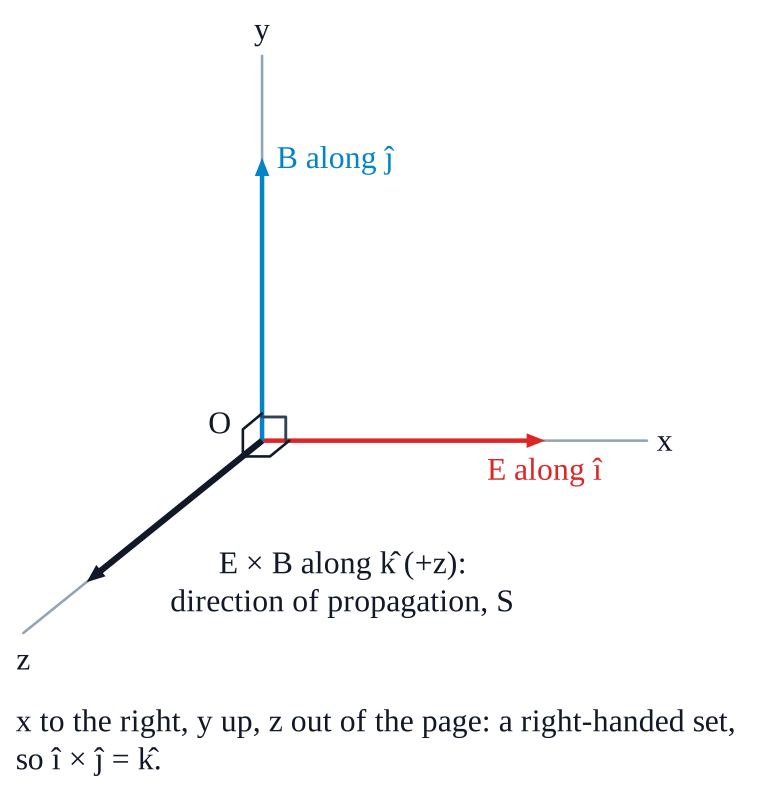
    If E\displaystyle \mathbf{E} and B\displaystyle \mathbf{B} represent electric and magnetic field vectors of the electromagnetic wave, the direction of propagation of electromagnetic wave is along
    (a)
    E\displaystyle \mathbf{E}.
    (b)
    B\displaystyle \mathbf{B}.
    (c)
    B×E\displaystyle \mathbf{B} \times \mathbf{E}.
    (d)
    E×B\displaystyle \mathbf{E} \times \mathbf{B}.
    NCERT’s answer
    (d)
    (d) \(\displaystyle \mathbf{E}\times\mathbf{B}\). Energy flows along the Poynting vector: \[\mathbf{S}=\frac{1}{\mu_0}\,\mathbf{E}\times\mathbf{B} \] NCERT_Solution_Class12_Physics_Exemplar_Ch8_Q5 \[\mathbf{E}\parallel\hat{\mathbf{i}},\ \mathbf{B}\parallel\hat{\mathbf{j}}\ \Rightarrow\ \mathbf{E}\times\mathbf{B}\parallel\hat{\mathbf{i}}\times\hat{\mathbf{j}}=\hat{\mathbf{k}} \] So the wave travels along \(\displaystyle +z\).
  6. Exercise 6

    The ratio of contributions made by the electric field and magnetic field components to the intensity of an EM wave is
    (a)
    c:1\displaystyle c: 1
    (b)
    c2:1\displaystyle c^2: 1
    (c)
    1\displaystyle 1 : 1\displaystyle 1
    (d)
    c:1\displaystyle \sqrt{c}: 1
    NCERT’s answer
    (c)
    (c) $\displaystyle 1$ : 1. The two energy densities are equal: \[u_E=\tfrac12\varepsilon_0E^{2},\qquad u_B=\frac{B^{2}}{2\mu_0} \] \[E=cB,\ \ c^{2}=\frac{1}{\mu_0\varepsilon_0}\ \Rightarrow\ u_E=\tfrac12\varepsilon_0c^{2}B^{2}=\frac{B^{2}}{2\mu_0}=u_B \] \[u_E:u_B=1:1 \]
  7. Exercise 7

    An EM wave radiates outwards from a dipole antenna, with E0\displaystyle E_0 as the amplitude of its electric field vector. The electric field E0\displaystyle E_0 which transports significant energy from the source falls off as
    (a)
    1r3\displaystyle \frac{1}{r^3}
    (b)
    1r2\displaystyle \frac{1}{r^2}
    (c)
    1r\displaystyle \frac{1}{r}
    (d)
    remains constant.
    NCERT’s answer
    (c)
    (c) \(\displaystyle \dfrac{1}{r}\). The radiated power through a sphere of any radius \(\displaystyle r\) is the same: \[P=I\,(4\pi r^{2})=\tfrac12\varepsilon_0 c\,E_0^{2}\,(4\pi r^{2})=\text{constant}\ \Rightarrow\ E_0=\frac{1}{r}\sqrt{\frac{P}{2\pi\varepsilon_0 c}} \] Terms falling as \(\displaystyle 1/r^{2}\) and \(\displaystyle 1/r^{3}\) carry no net energy to large distances.