SolveIt is under development
SolveItClass 12 · Exemplar

NCERT Exemplar · Class 12 Physics Electromagnetic Waves

32 questions

Multiple Choice Questions (Type II) 8–13 (part 2 of 5)

  1. Exercise 8

    An electromognetic wave travels in vacuum along z direction: E=(E1i^+E2j^)cos⁡(kz−ωt)\displaystyle \mathbf{E}=\left(E_1 \hat{\mathbf{i}}+E_2 \hat{\mathbf{j}}\right) \cos (k z-\omega t). Choose the correct options from the following:
    (a)
    The associated magnetic field is given as B=1c(E1i^−E2j^)cos⁡(kz−ωt)\displaystyle \mathbf{B}=\frac{1}{\mathrm{c}}\left(E_1 \hat{\mathbf{i}}-E_2 \hat{\mathbf{j}}\right) \cos (k z-\omega t).
    (b)
    The associated magnetic field is given as B=1c(E1i^−E2j^)cos⁡(kz−ωt)\displaystyle \mathbf{B}=\frac{1}{c}\left(E_1 \hat{\mathbf{i}}-E_2 \hat{\mathbf{j}}\right) \cos (k z-\omega \mathrm{t}).
    (c)
    The given electromagnetic field is circularly polarised.
    (d)
    The given electromagnetic wave is plane polarised.
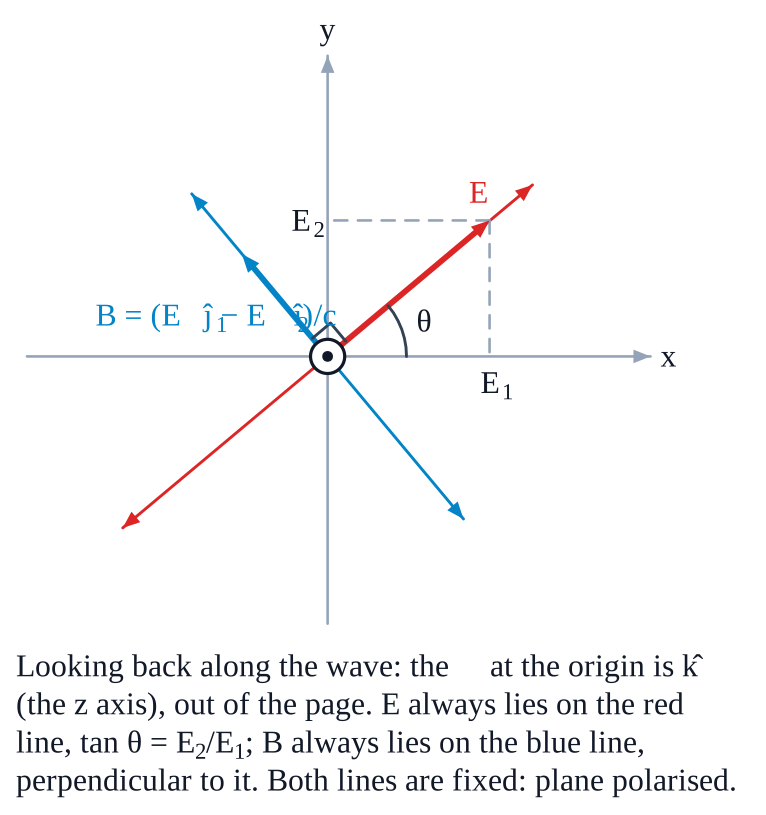
    (d) \(\displaystyle E_x\), \(\displaystyle E_y\) are in phase, so \(\displaystyle \mathbf{E}\) keeps one direction: plane polarised, not circular. (a) and (b) are identical and differ from the \(\displaystyle \mathbf{B}\) below.\[\mathbf{B}=\frac{1}{c}\,\hat{\mathbf{k}}\times\mathbf{E},\qquad \hat{\mathbf{k}}\times\hat{\mathbf{i}}=\hat{\mathbf{j}},\quad \hat{\mathbf{k}}\times\hat{\mathbf{j}}=-\hat{\mathbf{i}} \] \[\mathbf{B}=\frac{1}{c}\left(E_1\hat{\mathbf{j}}-E_2\hat{\mathbf{i}}\right)\cos(kz-\omega t) \] \[\mathbf{E}\cdot\mathbf{B}=\frac{1}{c}\left(-E_1E_2+E_2E_1\right)\cos^{2}(kz-\omega t)=0 \] NCERT_Solution_Class12_Physics_Exemplar_Ch8_Q8 \[\text{(a), (b): } B_x=\frac{E_1}{c}\cos(kz-\omega t),\ \ B_y=-\frac{E_2}{c}\cos(kz-\omega t)\ \neq\ \text{derived }\mathbf{B}\ \text{unless } E_1=-E_2 \] \[\tan\theta=\frac{E_y}{E_x}=\frac{E_2}{E_1}=\text{constant}\ \Rightarrow\ \text{plane polarised} \] \[\text{circular: } E_x=E_0\cos(kz-\omega t),\ E_y=E_0\sin(kz-\omega t)\ \text{(not the case here)} \]
  2. Exercise 9

    An electromagnetic wave travelling along z-axis is given as: E=Eocos⁡(kz−ωt.)\displaystyle \mathbf{E}=\mathbf{E}_{\mathrm{o}} \cos (k z-\omega \mathrm{t}.). Choose the correct options from the following;
    (a)
    The associated magnetic field is given as B=1ck^×E=1ω(k^×E)\displaystyle \mathbf{B}=\frac{1}{c} \hat{\mathbf{k}} \times \mathbf{E}=\frac{1}{\omega}(\hat{\mathbf{k}} \times \mathbf{E}).
    (b)
    The electromagnetic field can be written in terms of the associated magnetic field as E=c(B×k^)\displaystyle \mathbf{E}=c(\mathbf{B} \times \hat{\mathbf{k}}).
    (c)
    k^.E=0,k^.B=0\displaystyle \hat{\mathbf{k}} . \mathbf{E}=0, \hat{\mathbf{k}} . \mathbf{B}=0.
    (d)
    k^×E=0,k^×B=0\displaystyle \hat{\mathbf{k}} \times \mathbf{E}=0, \hat{\mathbf{k}} \times \mathbf{B}=0.
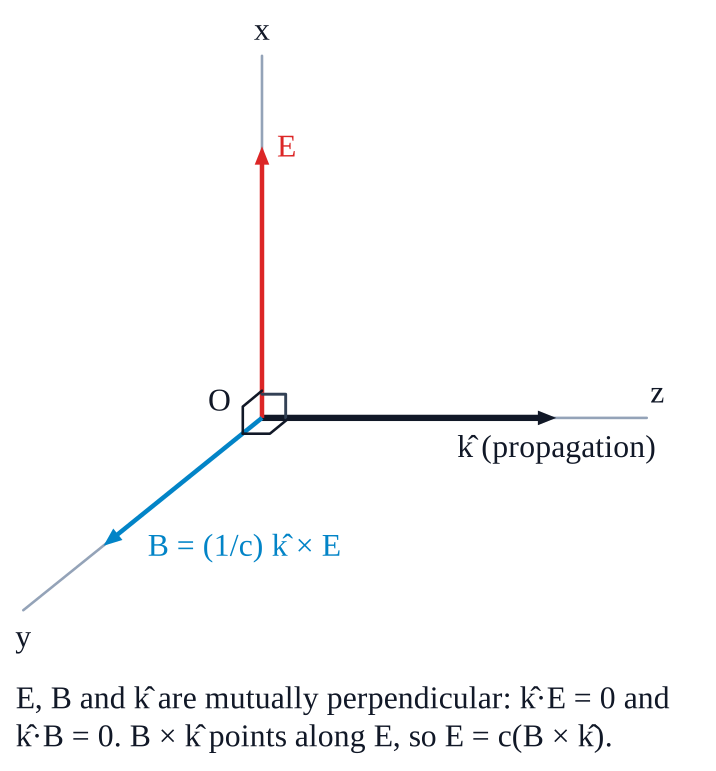
    (b), (c) Both fields are transverse, and \(\displaystyle \mathbf{E}=c(\mathbf{B}\times\hat{\mathbf{k}})\) follows from \(\displaystyle \mathbf{B}\). (a) fails: \(\displaystyle 1/\omega\) is not \(\displaystyle 1/c\). (d) fails: \(\displaystyle \mathbf{E},\mathbf{B}\) are not parallel to \(\displaystyle \hat{\mathbf{k}}\).\[\mathbf{B}=\frac{1}{c}\,\hat{\mathbf{k}}\times\mathbf{E} \] NCERT_Solution_Class12_Physics_Exemplar_Ch8_Q9 \[\mathbf{B}\times\hat{\mathbf{k}}=\frac{1}{c}(\hat{\mathbf{k}}\times\mathbf{E})\times\hat{\mathbf{k}}=\frac{1}{c}\left[\mathbf{E}(\hat{\mathbf{k}}\cdot\hat{\mathbf{k}})-\hat{\mathbf{k}}(\mathbf{E}\cdot\hat{\mathbf{k}})\right]=\frac{\mathbf{E}}{c}\ \Rightarrow\ \mathbf{E}=c\,(\mathbf{B}\times\hat{\mathbf{k}}) \] \[\nabla\cdot\mathbf{E}=0\ \Rightarrow\ \hat{\mathbf{k}}\cdot\mathbf{E}=0,\qquad \hat{\mathbf{k}}\cdot\mathbf{B}=\frac{1}{c}\,\hat{\mathbf{k}}\cdot(\hat{\mathbf{k}}\times\mathbf{E})=0 \] \[\frac{1}{\omega}\neq\frac{1}{c}\ \ (\omega=ck);\qquad \frac{1}{\omega}(\mathbf{k}\times\mathbf{E})=\frac{k}{\omega}(\hat{\mathbf{k}}\times\mathbf{E})=\frac{1}{c}(\hat{\mathbf{k}}\times\mathbf{E})\ \ \text{only for the wave vector } \mathbf{k}=k\hat{\mathbf{k}} \]
  3. Exercise 10

    A plane electromagnetic wave propagating along x\displaystyle x direction can have the following pairs of E\displaystyle \mathbf{E} and B\displaystyle \mathbf{B}
    (a)
    Ex,By\displaystyle E_x, B_y.
    (b)
    Ey,Bz\displaystyle E_y, B_z.
    (c)
    Bx,Ey\displaystyle B_x, E_y.
    (d)
    Ez,By\displaystyle E_z, B_y.
    NCERT’s answer
    (b), (d)
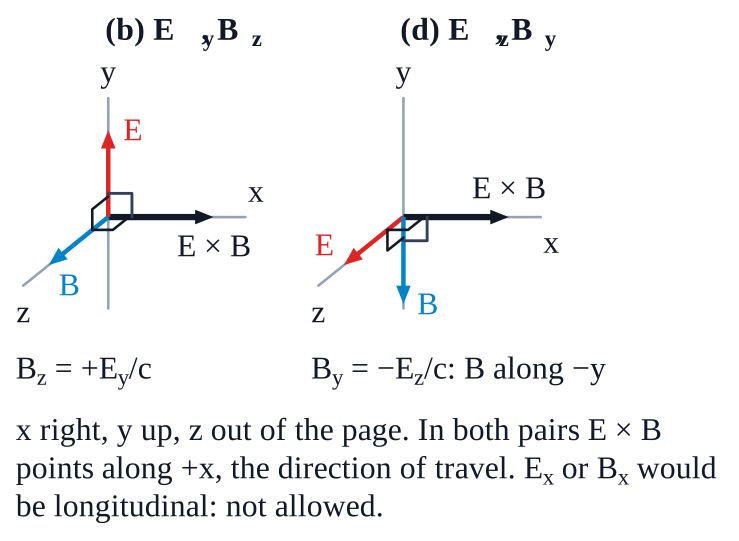
    (b), (d) Both fields are transverse (no \(\displaystyle x\) component) and \(\displaystyle \mathbf{E}\times\mathbf{B}\) points along \(\displaystyle x\). (a), (c) have a field along \(\displaystyle x\).\[E_x=0,\quad B_x=0\ \Rightarrow\ \text{(a), (c) rejected} \] NCERT_Solution_Class12_Physics_Exemplar_Ch8_Q10 \[\mathbf{B}=\frac{1}{c}\,\hat{\mathbf{i}}\times\mathbf{E}\quad(\text{wave along }+x) \] \[\text{(b): } \hat{\mathbf{i}}\times E_y\hat{\mathbf{j}}=E_y\hat{\mathbf{k}}\ \Rightarrow\ B_z=+\frac{E_y}{c} \] \[\text{(d): } \hat{\mathbf{i}}\times E_z\hat{\mathbf{k}}=-E_z\hat{\mathbf{j}}\ \Rightarrow\ B_y=-\frac{E_z}{c} \]
  4. Exercise 11

    A charged particle oscillates about its mean equilibrium position with a frequency of 109 Hz\displaystyle 10^9 \mathrm{~Hz}. The electromagnetic waves produced:
    (a)
    will have frequency of 109 Hz\displaystyle 10^9 \mathrm{~Hz}.
    (b)
    will have frequency of 2×10⁹ Hz\displaystyle 2 \times 10^9 \mathrm{~Hz}.
    (c)
    will have a wavelength of 0.3\displaystyle 0.3 m.
    (d)
    fall in the region of radiowaves.
    NCERT’s answer
    (a), (c), (d)
    (a), (c), (d) The wave has the oscillation frequency of the charge. \(\displaystyle 10^{9}\ \mathrm{Hz}=1000\ \mathrm{MHz}\) is the top of the radio-wave band.\[f_{\text{wave}}=f_{\text{charge}}=10^{9}\ \mathrm{Hz} \] \[\lambda=\frac{c}{f}=\frac{3\times10^{8}\ \mathrm{m\,s^{-1}}}{10^{9}\ \mathrm{Hz}}=0.3\ \mathrm{m} \]
  5. Exercise 12

    The source of electromagnetic waves can be a charge
    (a)
    moving with a constant velocity.
    (b)
    moving in a circular orbit.
    (c)
    at rest.
    (d)
    falling in an electric field.
    NCERT’s answer
    (b), (d)
    (b), (d) Only an accelerated charge radiates. Rest and constant velocity give no acceleration; a circular orbit and a fall in a field do.\[\text{(a), (c): } a=0\ \Rightarrow\ \text{no radiation} \] \[\text{(b): } a=\frac{v^{2}}{r}\neq0\ \Rightarrow\ \text{radiates} \] \[\text{(d): } a=\frac{qE}{m}\neq0\ \Rightarrow\ \text{radiates} \]
  6. Exercise 13

    An EM wave of intensity I\displaystyle I falls on a surface kept in vacuum and exerts radiation pressure p\displaystyle p on it. Which of the following are true?
    (a)
    Radiation pressure is I/c\displaystyle I / c if the wave is totally absorbed.
    (b)
    Radiation pressure is I/c\displaystyle I / c if the wave is totally reflected.
    (c)
    Radiation pressure is 2I/c\displaystyle 2 I / c if the wave is totally reflected.
    (b)
    Radiation pressure is in the range I/c<p<2I/c\displaystyle I / c<p<2 I / c for real surfaces.
    NCERT’s answer
    (a), (c), (d)
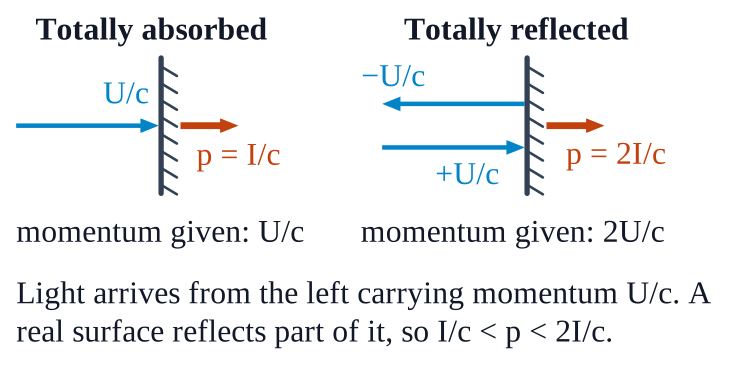
    (a), (c), (d) Energy \(\displaystyle U\) carries momentum \(\displaystyle U/c\): absorbed, it transfers \(\displaystyle U/c\); reversed, \(\displaystyle 2U/c\). A real surface reflects partly.\[p=\frac{F}{A},\qquad F=\frac{\Delta(\text{momentum})}{\Delta t},\qquad I=\frac{U}{A\,\Delta t} \] NCERT_Solution_Class12_Physics_Exemplar_Ch8_Q13 \[\text{absorbed: } \Delta(\text{momentum})=\frac{U}{c}\ \Rightarrow\ p=\frac{U}{c\,A\,\Delta t}=\frac{I}{c} \] \[\text{reflected: } \Delta(\text{momentum})=\frac{U}{c}-\left(-\frac{U}{c}\right)=\frac{2U}{c}\ \Rightarrow\ p=\frac{2I}{c} \] \[\text{real surface: } \frac{I}{c}<p<\frac{2I}{c} \]