SolveIt is under development
SolveItClass 12 · Exemplar

NCERT Exemplar · Class 12 Physics Electromagnetic Waves

32 questions

Short Answer Questions 21–27 (part 4 of 5)

  1. Exercise 21

    Show that the magnetic field B\displaystyle B at a point in between the plates of a parallel-plate capacitor during charging is ε0μr2 dE dt\displaystyle \frac{\varepsilon_0 \mu_r}{2} \frac{\mathrm{~d} E}{\mathrm{~d} t} (symbols having usual meaning).
    NCERT’s answer
    \(\displaystyle B=\frac{\mu_0 2 I_D}{4 \pi r}=\frac{\mu_0 1}{4 \pi r}=\frac{\mu_0}{2 \pi r} \varepsilon_0 \frac{d \phi_E}{d t}\) \[\begin{aligned} & =\frac{\mu_0 \varepsilon_0}{2 \pi r} \frac{d}{d t}\left(E \pi r^2\right) \\ & =\frac{\mu_0 \varepsilon_0 r}{2} \frac{d E}{d t} . \end{aligned} \] NCERT_Solution_Class12_Physics_Exemplar_Ch8_Q21_ncert
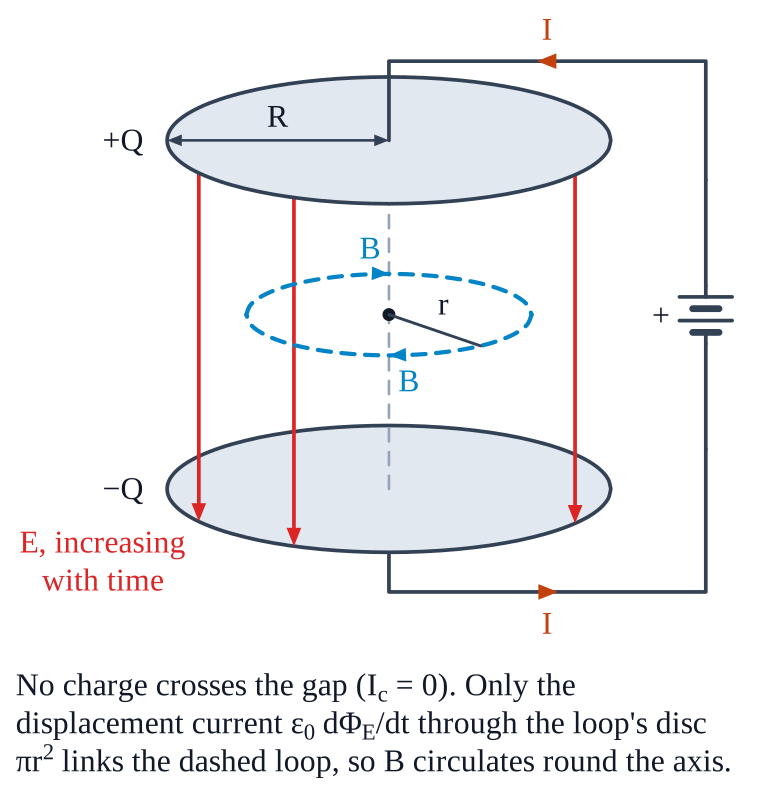
    A circular loop of radius \(\displaystyle r\) (\(\displaystyle r\le R\)) lies between the plates, coaxial with them; by symmetry \(\displaystyle B\) is tangential and equal at every point of it.NCERT_Solution_Class12_Physics_Exemplar_Ch8_Q21No charge crosses the gap, so \(\displaystyle I_c=0\) and only the displacement current links the loop. The flux is through the loop's disc \(\displaystyle \pi r^2\), not the whole plate.\[\oint \mathbf{B}\cdot d\mathbf{l}=\mu_0\left(I_c+\varepsilon_0\frac{d\Phi_E}{dt}\right),\qquad I_c=0 \]\[B\,(2\pi r)=\mu_0\varepsilon_0\frac{d}{dt}\left(E\,\pi r^2\right)=\mu_0\varepsilon_0\,\pi r^2\,\frac{dE}{dt} \]\[B=\frac{\mu_0\varepsilon_0\,r}{2}\,\frac{dE}{dt} \]Answer: \(\displaystyle B=\dfrac{\mu_0\varepsilon_0\, r}{2}\dfrac{dE}{dt}\), with \(\displaystyle r\) the distance from the axis.
  2. Exercise 22

    Electromagnetic waves with wavelength
    (i)
    λ1\displaystyle \lambda_1 is used in satellite communication.
    (ii)
    λ2\displaystyle \lambda_2 is used to kill germs in water purifies.
    (iii)
    λ3\displaystyle \lambda_3 is used to detect leakage of oil in underground pipelines.
    (iv)
    λ4\displaystyle \lambda_4 is used to improve visibility in runways during fog and mist conditions.
    (a)
    Identify and name the part of electromagnetic spectrum to which these radiations belong.
    (b)
    Arrange these wavelengths in ascending order of their magnitude.
    (c)
    Write one more application of each.
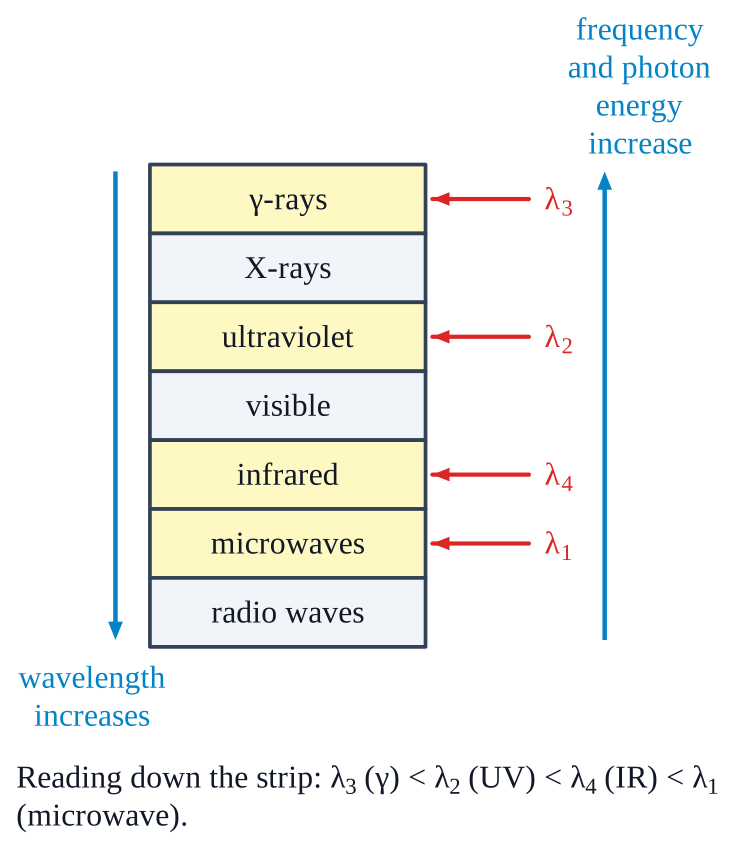
    (a)\[\lambda_1\to\text{microwave},\quad \lambda_2\to\text{ultraviolet},\quad \lambda_3\to\gamma\text{-rays},\quad \lambda_4\to\text{infrared} \]Oil carrying a \(\displaystyle \gamma\)-emitting tracer seeps out at the leak; the count rate above ground peaks there.NCERT_Solution_Class12_Physics_Exemplar_Ch8_Q22(b)\[\gamma:\ <10^{-12}\,\mathrm{m};\quad \text{UV}:\ 10^{-9}\text{–}4\times10^{-7}\,\mathrm{m};\quad \text{IR}:\ 7\times10^{-7}\text{–}10^{-3}\,\mathrm{m};\quad \text{microwave}:\ 10^{-3}\text{–}10^{-1}\,\mathrm{m} \]\[\lambda_3\ (\gamma)<\lambda_2\ (\text{UV})<\lambda_4\ (\text{IR})<\lambda_1\ (\text{microwave}) \](c) Radar (microwave), LASIK eye surgery (UV), cancer radiotherapy (\(\displaystyle \gamma\)), TV remote controls (IR).Answer: (a) microwave, ultraviolet, \(\displaystyle \gamma\)-rays, infrared; (b) \(\displaystyle \lambda_3<\lambda_2<\lambda_4<\lambda_1\); (c) radar, LASIK eye surgery, cancer radiotherapy, TV remote controls.NCERT prints: X-rays for \(\displaystyle \lambda_3\) -- no X-ray source can travel with the oil to a buried leak.
  3. Exercise 23

    Show that average value of radiant flux density 'S' over a single period 'T\displaystyle T is given by S=12cμ0E02\displaystyle \mathrm{S}=\frac{1}{2 \mathrm{c} \mu_0} E_0^2.
    NCERT’s answer
    \(\displaystyle S_{a v}=c^2 \varepsilon_0\left|\mathbf{E}_0 \times \mathbf{B}_0\right| \frac{1}{T} \int_0^T \cos ^2(k x-\omega t) d t\) as \(\displaystyle \mathbf{S}=c^2 \varepsilon_0(\mathbf{E} \times \mathbf{B})\) \[\begin{aligned} & =c^2 \varepsilon_0 E_0 B_0 \frac{1}{\cancel{T}} \times \frac{\cancel{T}}{2} \\ & =c^2 \varepsilon_0 E_0\left(\frac{E_0}{c}\right) \times \frac{1}{2}\left(\text { as } c=\frac{E_0}{B_0}\right) \\ & =\frac{1}{2} \varepsilon_0 E_0^2 c \\ & =\frac{E_0^2}{2 \mu_0 c} \text { as }\left(c=\frac{1}{\sqrt{\mu_0 \varepsilon_0}}\right) \end{aligned} \]
    Plane wave along \(\displaystyle x\), with \(\displaystyle \mathbf{E}\perp\mathbf{B}\):\[E=E_0\sin(kx-\omega t),\qquad B=\frac{E}{c} \]\[S=\frac{|\mathbf{E}\times\mathbf{B}|}{\mu_0}=\frac{EB}{\mu_0}=\frac{E^2}{c\mu_0}=\frac{E_0^2}{c\mu_0}\sin^2(kx-\omega t) \]Average over one period, at fixed \(\displaystyle x\):\[\langle\sin^2\omega t\rangle=\frac1T\int_0^T\frac{1-\cos 2\omega t}{2}\,dt=\frac12 \]\[\bar S=\frac{E_0^2}{c\mu_0}\times\frac12=\frac{1}{2c\mu_0}E_0^2 \]Answer: \(\displaystyle \bar S=\dfrac{E_0^2}{2c\mu_0}\)
  4. Exercise 24

    You are given a 2μ F\displaystyle 2 \mu \mathrm{~F} parallel plate capacitor. How would you establish an instantaneous displacement current of 1\displaystyle 1 mA in the space between its plates?
    NCERT’s answer
    \(\displaystyle i_D=C \frac{d V}{d t}\) \[\begin{aligned} & 1 \times 10^{-3}=2 \times 10^{-6} \frac{d V}{d t} \\ & \frac{d V}{d t}=\frac{1}{2} \times 10^3=5 \times 10 \mathrm{~V} / \mathrm{s} \end{aligned} \] Hence, applying a varying potential difference of \(\displaystyle 5 \times 10^2 \mathrm{~V} / \mathrm{s}\) would produce a displacement current of desired value.
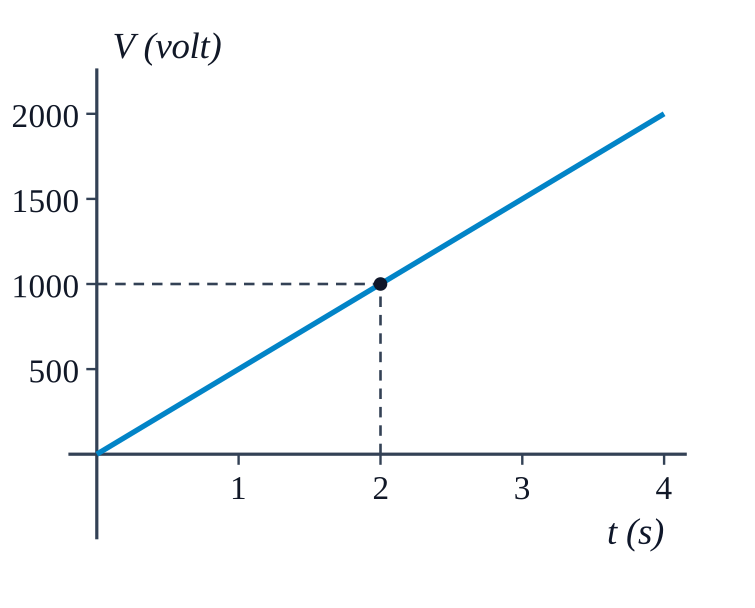
    Connect the capacitor to a source whose voltage is ramped steadily; a constant dc voltage gives \(\displaystyle dV/dt=0\), hence no displacement current.\[I_d=\varepsilon_0\frac{d\Phi_E}{dt}=\varepsilon_0A\frac{dE}{dt}=\frac{\varepsilon_0A}{d}\frac{dV}{dt}=C\,\frac{dV}{dt} \]\[\frac{dV}{dt}=\frac{I_d}{C}=\frac{1\times10^{-3}\ \mathrm{A}}{2\times10^{-6}\ \mathrm{F}}=500\ \mathrm{V\,s^{-1}} \]NCERT_Solution_Class12_Physics_Exemplar_Ch8_Q24Answer: vary the voltage across the plates at \(\displaystyle 500\ \mathrm{V\,s^{-1}}\).
  5. Exercise 25

    Show that the radiation pressure exerted by an EM wave of intensity I\displaystyle I on a surface kept in vacuum is I/c\displaystyle I / c.
    NCERT’s answer
    Pressure \[\begin{aligned} P & =\frac{\text { Force }}{\text { Area }}=\frac{F}{A}=\frac{1}{A} \frac{\Delta p}{\Delta t}\left(F=\frac{\Delta p}{\Delta t}=\text { rate of change of momentum }\right) \\ & =\frac{1}{A} \cdot \frac{U}{\Delta t c}(\Delta p c=\Delta \mathrm{U}=\text { energy imparted by wave in time } \Delta t) \\ & =\frac{I}{c}\left(\text { intensity } I=\frac{U}{A \Delta t}\right. \end{aligned} \]
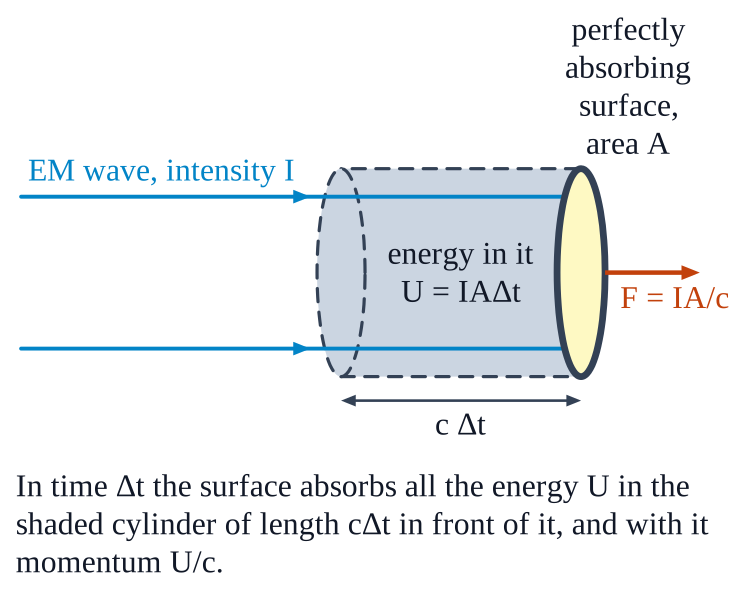
    A plane wave of intensity \(\displaystyle I\) falls normally on a perfectly absorbing surface of area \(\displaystyle A\) for a time \(\displaystyle \Delta t\) (a perfect reflector would give \(\displaystyle 2I/c\)).NCERT_Solution_Class12_Physics_Exemplar_Ch8_Q25\[U=IA\,\Delta t \]\[\Delta p=\frac{U}{c}=\frac{IA\,\Delta t}{c} \]\[F=\frac{\Delta p}{\Delta t}=\frac{IA}{c} \]\[P_{\mathrm{rad}}=\frac{F}{A}=\frac{I}{c} \]Answer: \(\displaystyle P_{\mathrm{rad}}=I/c\)
  6. Exercise 26

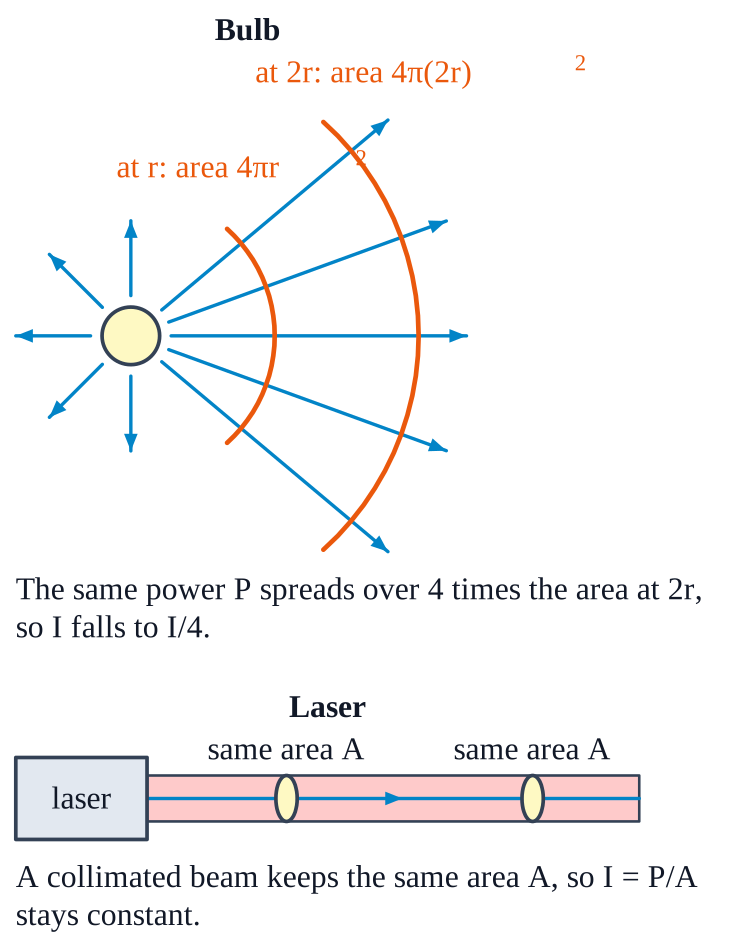
    What happens to the intensity of light from a bulb if the distance from the bulb is doubled? As a laser beam travels across the length of a room, its intensity essentially remains constant. What geomatrical characteristic of LASER beam is responsible for the constant intensity which is missing in the case of light from the bulb?
    NCERT’s answer
    Intensity is reduced to one fourth. Tis is beacause the light beam spreads, as it propogates into a spherical region of area \(\displaystyle 4 \pi r^2\), but LASER does not spread and hence its intensity remains constant.
    Bulb (point source of power \(\displaystyle P\)): light spreads over a sphere.\[I=\frac{P}{4\pi r^2}\ \Rightarrow\ I'=\frac{P}{4\pi(2r)^2}=\frac{I}{4} \]Laser: the beam keeps one cross-section.\[I=\frac{P}{A},\qquad A\approx\text{constant}\ \Rightarrow\ I\approx\text{constant} \]NCERT_Solution_Class12_Physics_Exemplar_Ch8_Q26Answer: The intensity falls to one-fourth. The laser beam is collimated (parallel, negligible divergence); bulb light spreads in all directions.
  7. Exercise 27

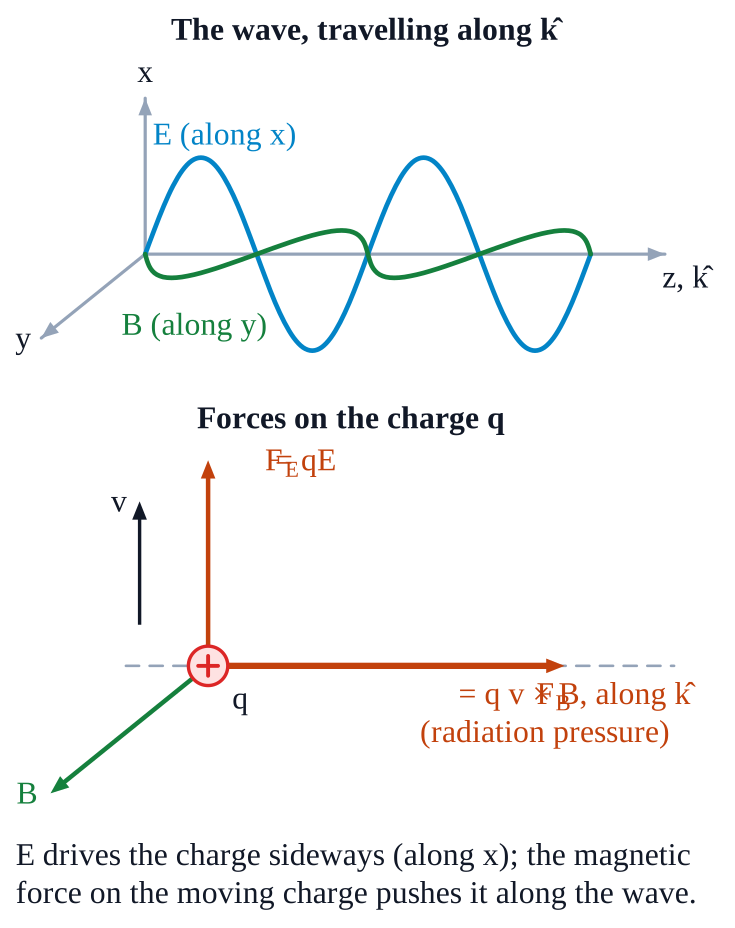
    Even though an electric field E\displaystyle \mathbf{E} exerts a force qE\displaystyle q \mathbf{E} on a charged particle yet the electric field of an EM wave does not contribute to the radiation pressure (but transfers energy). Explain.
    NCERT’s answer
    Electric field of an EM wave is an oscillating field and so is the electric force caused by it on a charged particle. This electric force averaged over an integral number of cycles is zero since its direction changes every half cycle. Hence, electric field is not responsible for radiation pressure.
    For a wave along \(\displaystyle \hat{\mathbf{k}}\), \(\displaystyle \mathbf{E}\perp\mathbf{B}\perp\hat{\mathbf{k}}\).NCERT_Solution_Class12_Physics_Exemplar_Ch8_Q27Electric force: transverse, and it averages to zero over a cycle.\[\mathbf{F}_E=q\mathbf{E}\perp\hat{\mathbf{k}},\qquad \langle\mathbf{F}_E\rangle=q\langle\mathbf{E}\rangle=0 \]The charge oscillates along \(\displaystyle \mathbf{E}\) with velocity \(\displaystyle \mathbf{v}\); the magnetic force on it points along the wave.\[\mathbf{F}_B=q\,\mathbf{v}\times\mathbf{B}\ \parallel\ \hat{\mathbf{k}} \]\[P_E=q\mathbf{E}\cdot\mathbf{v}\neq0,\qquad P_B=q(\mathbf{v}\times\mathbf{B})\cdot\mathbf{v}=0 \]Answer: \(\displaystyle \mathbf{E}\) does the work (energy transfer); the push along the wave, the radiation pressure, is the magnetic force.