SolveIt is under development
SolveItClass 12 · Exemplar

NCERT Exemplar · Class 12 Physics Electric Charges and Fields

31 questions

Very Short Answer Questions 14–19 (part 3 of 5)

  1. Exercise 14

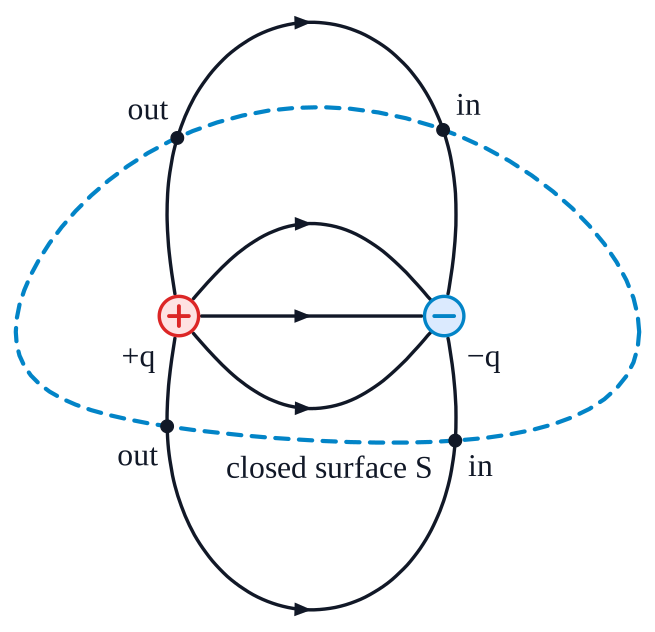
    An arbitrary surface encloses a dipole. What is the electric flux through this surface?
    NCERT’s answer
    Zero.
    Net charge enclosed is zero, so the flux is zero for any shape of surface.NCERT_Solution_Class12_Physics_Exemplar_Ch1_Q14\[\phi=\oint \mathbf{E}\cdot d\mathbf{S}=\frac{q_{enc}}{\varepsilon_0}=\frac{(+q)+(-q)}{\varepsilon_0}=0\ \mathrm{N\,m^2\,C^{-1}} \]Answer: Zero.
  2. Exercise 15

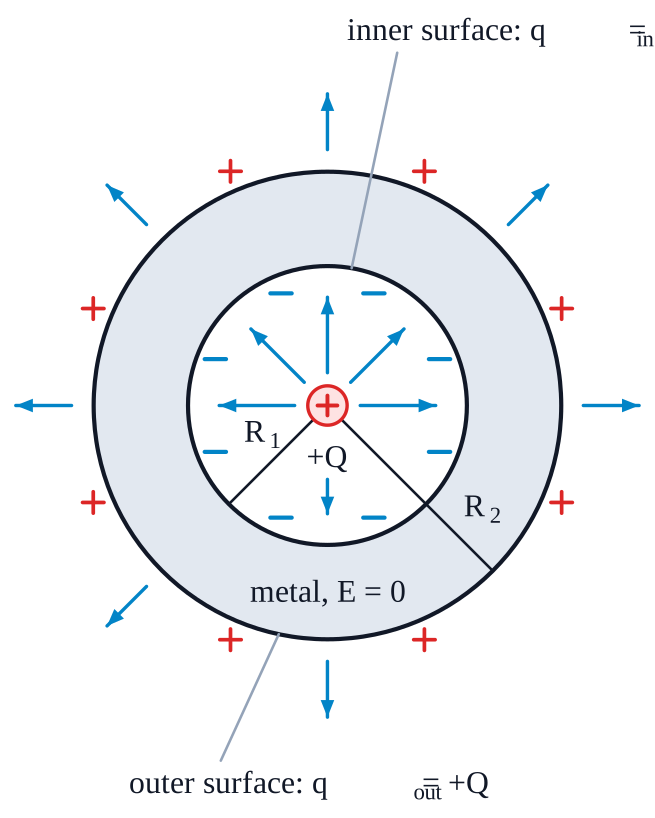
    A metallic spherical shell has an inner radius R1\displaystyle R_1 and outer radius R2\displaystyle R_2. A charge Q\displaystyle Q is placed at the centre of the spherical cavity. What will be surface charge density on (i) the inner surface, and (ii) the outer surface?
    NCERT’s answer
    (i)
    \(\displaystyle \frac{-Q}{4 \pi R_1^2}\)
    (ii)
    \(\displaystyle \frac{Q}{4 \pi R_2^2}\)
    Take a Gaussian sphere inside the metal, where \(\displaystyle \mathbf{E}=0\) (shell uncharged):\[\oint \mathbf{E}\cdot d\mathbf{S}=0=\frac{Q+q_{in}}{\varepsilon_0}\;\Rightarrow\;q_{in}=-Q\ \mathrm{C} \]\[q_{in}+q_{out}=0\;\Rightarrow\;q_{out}=+Q\ \mathrm{C} \]NCERT_Solution_Class12_Physics_Exemplar_Ch1_Q15\[\sigma_{in}=\frac{q_{in}}{4\pi R_1^2}=-\frac{Q}{4\pi R_1^2}\ \mathrm{C\,m^{-2}} \]\[\sigma_{out}=\frac{q_{out}}{4\pi R_2^2}=+\frac{Q}{4\pi R_2^2}\ \mathrm{C\,m^{-2}} \]Answer: (i) \(\displaystyle -\dfrac{Q}{4\pi R_1^2}\); (ii) \(\displaystyle +\dfrac{Q}{4\pi R_2^2}\).
  3. Exercise 16

    The dimensions of an atom are of the order of an Angstrom. Thus there must be large electric fields between the protons and electrons. Why, then is the electrostatic field inside a conductor zero?
    NCERT’s answer
    The electric fields bind the atoms to neutral entity. Fields are caused by excess charges. There can be no excess charge on the inter surface of an isolated conductor.
    Atomic fields stay inside neutral atoms; only excess charge makes a field in the bulk.\[\text{neutral atom}\;\Rightarrow\;\text{strong fields confined within the atom}\;\Rightarrow\;\text{no net field from atoms in the bulk} \]\[\text{excess charge}\to\text{surface only}\;\Rightarrow\;q_{excess}^{\,interior}=0\;\Rightarrow\;\mathbf{E}_{inside}=0\ \mathrm{N\,C^{-1}} \]Answer: Neutral atoms confine their fields; excess charge lies on the surface, so the field inside is zero.
  4. Exercise 17

    If the total charge enclosed by a surface is zero, does it imply that the elecric field everywhere on the surface is zero? Conversely, if the electric field everywhere on a surface is zero, does it imply that net charge inside is zero.
    NCERT’s answer
    No, the field may be normal. However, the converse is true.
    No: the net flux is zero, but \(\displaystyle \mathbf{E}\) can be nonzero at points of the surface, as for a dipole.\[q_{enc}=(+q)+(-q)=0\;\Rightarrow\;\oint \mathbf{E}\cdot d\mathbf{S}=0\ \mathrm{N\,m^2\,C^{-1}},\quad \mathbf{E}\neq 0\ \text{at points of } S \]Yes: zero field gives zero flux.\[\mathbf{E}=0\ \text{everywhere on } S\;\Rightarrow\;q_{enc}=\varepsilon_0\oint \mathbf{E}\cdot d\mathbf{S}=0\ \mathrm{C} \]Answer: No; yes.
  5. Exercise 18

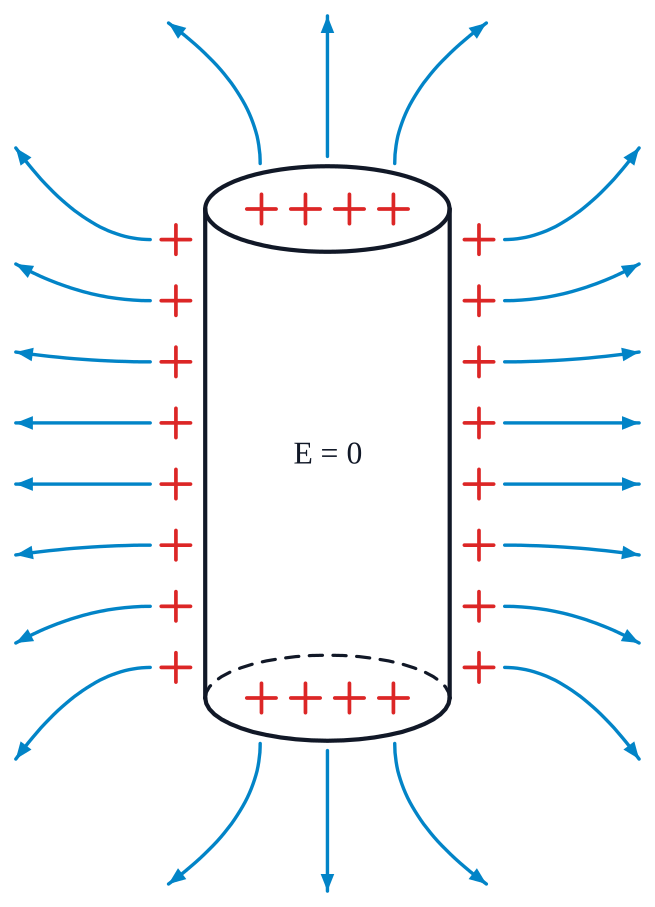
    Sketch the electric field lines for a uniformly charged hollow cylinder shown in Fig 1.8. NCERT_Question_Class12_Physics_Exemplar_Ch1_Q18
    NCERT’s answer
    NCERT_Solution_Class12_Physics_Exemplar_Ch1_Q18_ncert NCERT_Solution_Class12_Physics_Exemplar_Ch1_Q18_ncert_2
    Long cylinder, away from the ends (Gauss's law, radius \(\displaystyle R\), length \(\displaystyle L\), surface charge \(\displaystyle \sigma\)):\[r<R:\quad E(2\pi rL)=\frac{0}{\varepsilon_0}\;\Rightarrow\;E=0\ \ \mathrm{N\,C^{-1}} \]\[r>R:\quad E(2\pi rL)=\frac{\sigma(2\pi RL)}{\varepsilon_0}\;\Rightarrow\;E=\frac{\sigma R}{\varepsilon_0 r}\ \ \mathrm{N\,C^{-1}},\ \text{radially outward} \]NCERT_Solution_Class12_Physics_Exemplar_Ch1_Q18Answer: Lines leave normal to the surface, flare out at the ends, and none lie inside.
  6. Exercise 19

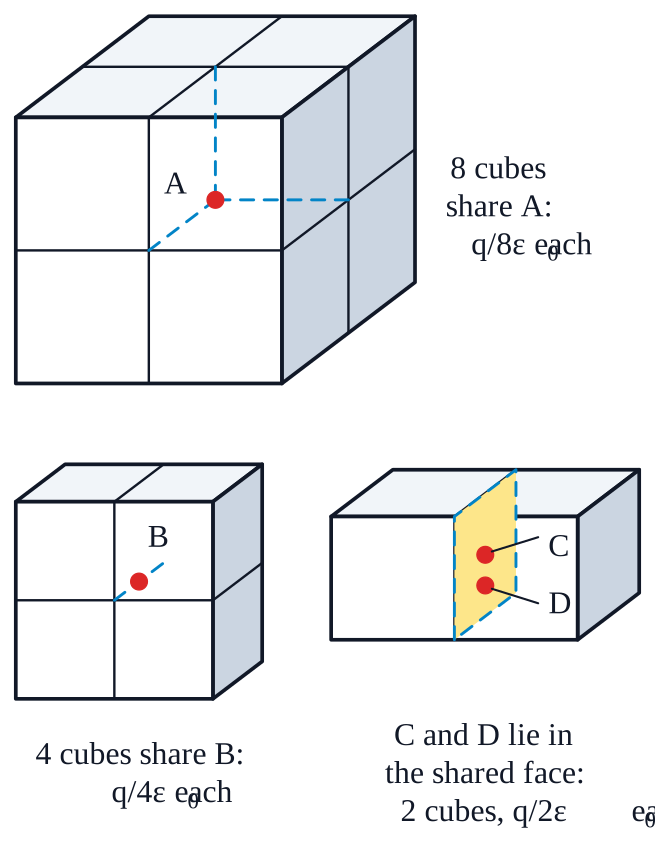
    What will be the total flux through the faces of the cube (Fig. 1.9\displaystyle 1.9) with side of length a\displaystyle a if a charge q\displaystyle q is placed at
    (a)
    A: a corner of the cube.
    (b)
    B: mid-point of an edge of the cube.
    (c)
    C: centre of a face of the cube.
    (d)
    D: mid-point of B and C.
    NCERT_Question_Class12_Physics_Exemplar_Ch1_Q19
    NCERT’s answer
    (i)
    \(\displaystyle \frac{q}{8 \varepsilon_0}\)
    (ii)
    \(\displaystyle \frac{q}{4 \varepsilon_0}\)
    (iii)
    \(\displaystyle \frac{q}{2 \varepsilon_0}\)
    (iv)
    \(\displaystyle \frac{q}{2 \varepsilon_0}\).
    Surround the charge with identical cubes placed symmetrically; the total flux \(\displaystyle q/\varepsilon_0\) divides equally. D lies in a face, as C does.NCERT_Solution_Class12_Physics_Exemplar_Ch1_Q19\[\text{(a) A: 8 cubes share the corner}\;\Rightarrow\;\phi=\frac{1}{8}\frac{q}{\varepsilon_0}=\frac{q}{8\varepsilon_0}\ \mathrm{N\,m^2\,C^{-1}} \]\[\text{(b) B: 4 cubes share the edge}\;\Rightarrow\;\phi=\frac{1}{4}\frac{q}{\varepsilon_0}=\frac{q}{4\varepsilon_0}\ \mathrm{N\,m^2\,C^{-1}} \]\[\text{(c) C: 2 cubes share the face}\;\Rightarrow\;\phi=\frac{1}{2}\frac{q}{\varepsilon_0}=\frac{q}{2\varepsilon_0}\ \mathrm{N\,m^2\,C^{-1}} \]\[\text{(d) D: in the face, mirror cube beyond it}\;\Rightarrow\;\phi=\frac{1}{2}\frac{q}{\varepsilon_0}=\frac{q}{2\varepsilon_0}\ \mathrm{N\,m^2\,C^{-1}} \]Answer: (a) \(\displaystyle \dfrac{q}{8\varepsilon_0}\); (b) \(\displaystyle \dfrac{q}{4\varepsilon_0}\); (c) \(\displaystyle \dfrac{q}{2\varepsilon_0}\); (d) \(\displaystyle \dfrac{q}{2\varepsilon_0}\).