Exercise 20
A paisa coin is made up of Al-Mg alloy and weighs 0.75g. It has a square shape and its diagonal measures mm. It is electrically neutral and contains equal amounts of positive and negative charges.
Treating the paisa coins made up of only Al, find the magnitude of equal number of positive and negative charges. What conclusion do you draw from this magnitude?
NCERT’s answer
$\displaystyle 1$ Molar mass \(\displaystyle M\) of Al has \(\displaystyle N_A=6.023 \times 10^{23}\) atoms.
\(\displaystyle \therefore m=\) mass of Al paisa coin has \(\displaystyle N=N_A \frac{m}{M}\) atoms
Now, \(\displaystyle Z_{\mathrm{Al}}=13, M_{\mathrm{Al}}=26.9815 \mathrm{~g}\)
Hence \(\displaystyle N=6.02 \times 10^{23}\) atoms \(\displaystyle / \mathrm{mol} \times \frac{0.75}{26.9815 \mathrm{~g} / \mathrm{mol}}\)
\[\begin{aligned}
& =1.6733 \times 10^{22} \text { atoms } \\
\therefore q \quad & =+ \text { ve charge in paisa }=N \mathrm{Ze} \\
& =\left(1.67 \times 10^{22}\right)(13)\left(1.60 \times 10^{-19} \mathrm{C}\right) \\
& =3.48 \times 10^4 \mathrm{C} .
\end{aligned}
\]
\(\displaystyle q=34.8 \mathrm{kC}\) of \(\displaystyle \pm \mathrm{ve}\) charge.
This is an enormous amount of charge. Thus we see that ordinary neutral matter contains enormous amount of ± charges.
\[N=\frac{m}{M}\,N_A=\frac{0.75\ \mathrm{g}}{27\ \mathrm{g\,mol^{-1}}}\times6.022\times10^{23}\ \mathrm{mol^{-1}}=1.673\times10^{22}\ \text{atoms} \]
Each Al atom has \(\displaystyle Z=13\) protons and $\displaystyle 13$ electrons:
\[q=N\,Z\,e=1.673\times10^{22}\times13\times1.6\times10^{-19}\ \mathrm{C}=3.48\times10^{4}\ \mathrm{C}=34.8\ \mathrm{kC} \]
The coin holds $\displaystyle 34.8$ kC of each sign, yet its net charge is zero because the two cancel exactly. Ordinary matter is packed with charge, and even a tiny imbalance would give enormous forces.Answer: \(\displaystyle q=3.48\times10^{4}\ \mathrm{C}\) of each sign; matter holds huge charge, balanced exactly.


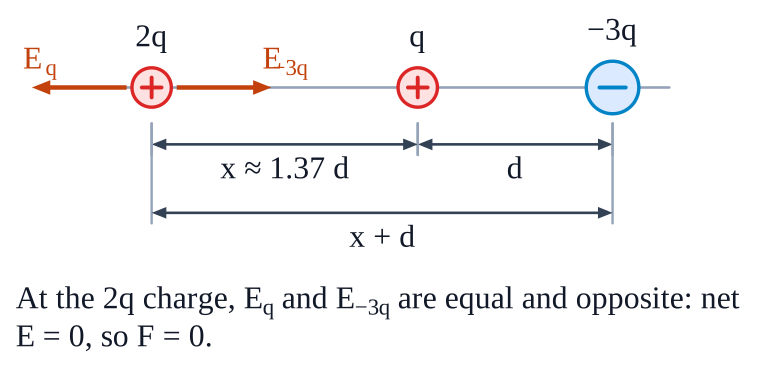 \[\mathbf{F}_{2q}=2q\,\mathbf{E}_{\text{net}}=\mathbf{0} \]Answer: at \(\displaystyle \tfrac{\sqrt3+1}{2}d\approx1.37\,d\) from \(\displaystyle q\), on the line of the charges, on the side away from \(\displaystyle -3q\).