SolveIt is under development
SolveItClass 12 · Exemplar

NCERT Exemplar · Class 12 Physics Electric Charges and Fields

31 questions

Multiple Choice Questions (Type I) 1–7 (part 1 of 5)

  1. Exercise 1

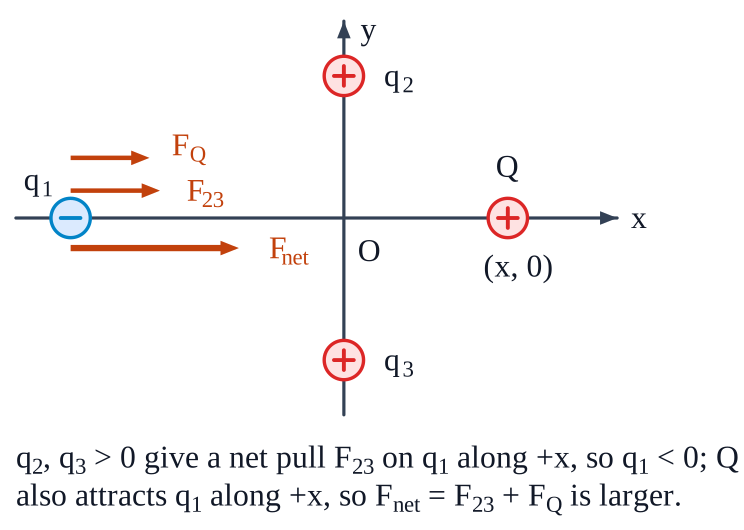
    In Fig.1.1, two positive charges q2\displaystyle q_2 and q3\displaystyle q_3 fixed along the y\displaystyle y axis, exert a net electric force in the +x\displaystyle +x direction on a charge q1\displaystyle \mathrm{q}_1 fixed along the x\displaystyle x axis. If a positive charge Q is added at (x,0)\displaystyle (x, 0), the force on q1\displaystyle q_1
    (a)
    shall increase along the positive x\displaystyle x-axis.
    (b)
    shall decrease along the positive x\displaystyle x-axis.
    (c)
    shall point along the negative x\displaystyle x-axis.
    (d)
    shall increase but the direction changes because of the intersection of Q\displaystyle Q with q2\displaystyle q_2 and q3\displaystyle q_3.
    NCERT_Question_Class12_Physics_Exemplar_Ch1_Q1
    NCERT’s answer
    (a)
    (a) Shall increase along the positive \(\displaystyle x\)-axis.\(\displaystyle Q\) leaves \(\displaystyle \mathbf{F}_{23}\) unchanged and attracts the negative \(\displaystyle q_1\) along \(\displaystyle +x\) as well.NCERT_Solution_Class12_Physics_Exemplar_Ch1_Q1\[q_2,\,q_3>0,\quad \mathbf{F}_{23}\ \text{along}\ +x\ \Rightarrow\ q_1<0 \]\[\mathbf{F}_Q=\frac{1}{4\pi\varepsilon_0}\,\frac{|q_1|\,Q}{r^2}\,\hat{\mathbf{x}}\qquad (r=\text{distance from } q_1 \text{ to } Q) \]\[\mathbf{F}_{\text{net}}=\mathbf{F}_{23}+\mathbf{F}_Q\ \Rightarrow\ F_{\text{net}}\uparrow\ \text{along}\ +x \]
  2. Exercise 2

    A point positive charge is brought near an isolated conducting sphere (Fig. 1.2\displaystyle 1.2). The electric field is best given by
    (a)
    Fig (i)
    (b)
    Fig (ii)
    (c)
    Fig (iii)
    (d)
    Fig (iv)
    NCERT_Question_Class12_Physics_Exemplar_Ch1_Q2
    NCERT’s answer
    (a)
    (a) Fig (i). Lines end normally on the induced negative near face, none enter the conductor, and leave normally from the positive far face.
    \[\mathbf{E}_{\text{inside}}=\mathbf{0},\qquad \mathbf{E}_{\text{surface}}\perp\text{surface} \]
    \[Q_{\text{near}}=-q',\quad Q_{\text{far}}=+q',\quad Q_{\text{near}}+Q_{\text{far}}=0 \]
    (iii)
    : lines not normal; (ii), (iv): arrows reversed.
  3. Exercise 3

    The Electric flux through the surface
    (a)
    in Fig.1.3 (iv) is the largest.
    (b)
    in Fig. 1.3\displaystyle 1.3 (iii) is the least.
    (c)
    in Fig. 1.3\displaystyle 1.3 (ii) is same as Fig. 1.3\displaystyle 1.3 (iii) but is smaller than Fig. 1.3\displaystyle 1.3 (iv)
    (d)
    is the same for all the figures.
    NCERT_Question_Class12_Physics_Exemplar_Ch1_Q3
    NCERT’s answer
    (d)
    (d) Same for all four figures: each surface is closed and encloses the same \(\displaystyle +q\).\[\Phi=\oint_S \mathbf{E}\cdot d\mathbf{s}=\frac{q_{\text{enc}}}{\varepsilon_0}=\frac{q}{\varepsilon_0} \]\[\Phi_{(i)}=\Phi_{(ii)}=\Phi_{(iii)}=\Phi_{(iv)}=\frac{q}{\varepsilon_0} \]Shape of \(\displaystyle S\) and position of \(\displaystyle +q\) inside it do not enter.
  4. Exercise 4

    Five charges q1,q2,q3,q4\displaystyle q_1, q_2, q_3, q_4, and q5\displaystyle q_5 are fixed at their positions as shown in Fig. 1.4. S\displaystyle S is a Gaussian surface. The Gauss's law is given by
    ∮SE.ds=qε0\oint_{\mathrm{S}} \mathbf{E} . d \mathbf{s}=\frac{q}{\varepsilon_0}
    Which of the following statements is correct?
    (a)
    E\displaystyle \mathbf{E} on the LHS of the above equation will have a contribution from q1,q5\displaystyle q_1, q_5 and q3\displaystyle q_3 while q\displaystyle q on the RHS will have a contribution from q2\displaystyle q_2 and q4\displaystyle q_4 only.
    (b)
    E\displaystyle \mathbf{E} on the LHS of the above equation will have a contribution from all charges while q\displaystyle q on the RHS will have a contribution from q2\displaystyle q_2 and q4\displaystyle q_4 only.
    (c)
    E\displaystyle \mathbf{E} on the LHS of the above equation will have a contribution from all charges while q\displaystyle q on the RHS will have a contribution from q1,q3\displaystyle q_1, q_3 and q5\displaystyle q_5 only.
    (d)
    Both E\displaystyle \mathbf{E} on the LHS and q\displaystyle q on the RHS will have contributions from q2\displaystyle q_2 and q4\displaystyle q_4 only.
    NCERT_Question_Class12_Physics_Exemplar_Ch1_Q4
    NCERT’s answer
    (b)
    (b) \(\displaystyle \mathbf{E}\) is the total field of all five charges; \(\displaystyle q\) counts only the charge enclosed by \(\displaystyle S\): \(\displaystyle q_2\) and \(\displaystyle q_4\).\[\mathbf{E}=\mathbf{E}_1+\mathbf{E}_2+\mathbf{E}_3+\mathbf{E}_4+\mathbf{E}_5 \]\[\oint_S(\mathbf{E}_1+\mathbf{E}_3+\mathbf{E}_5)\cdot d\mathbf{s}=0 \quad(\text{charges outside }S) \]\[\oint_S \mathbf{E}\cdot d\mathbf{s}=\frac{q_2+q_4}{\varepsilon_0} \]
  5. Exercise 5

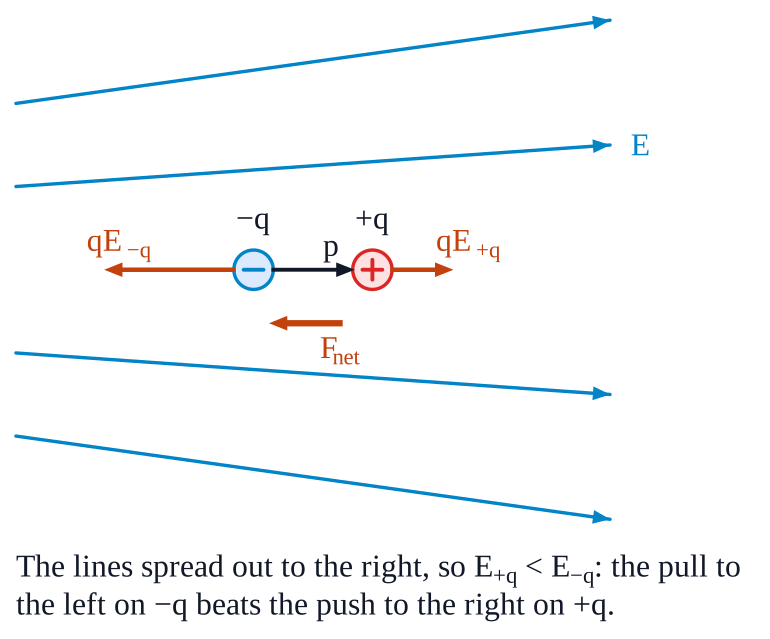
    Figure 1.5\displaystyle 1.5 shows electric field lines in which an electric dipole p\displaystyle \mathbf{p} is placed as shown. Which of the following statements is correct?
    (a)
    The dipole will not experience any force.
    (b)
    The dipole will experience a force towards right.
    (c)
    The dipole will experience a force towards left.
    (d)
    The dipole will experience a force upwards.
    NCERT_Question_Class12_Physics_Exemplar_Ch1_Q5
    NCERT’s answer
    (c)
    (c) The dipole will experience a force towards the left. Lines spread out to the right, so \(\displaystyle E\) is weaker at \(\displaystyle +q\) than at \(\displaystyle -q\).NCERT_Solution_Class12_Physics_Exemplar_Ch1_Q5\[E_{+q}<E_{-q} \]\[F_x=qE_{+q}-qE_{-q}<0 \]\[F_x=p\,\frac{dE_x}{dx}<0\quad(E\ \text{falls towards the right}) \]
  6. Exercise 6

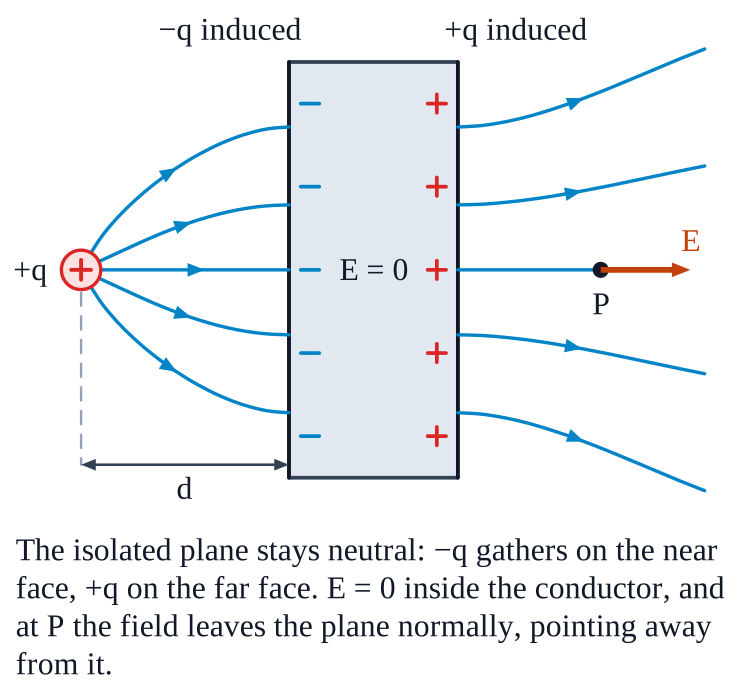
    A point charge +q\displaystyle +q, is placed at a distance d\displaystyle d from an isolated conducting plane. The field at a point P on the other side of the plane is
    (a)
    directed perpendicular to the plane and away from the plane.
    (b)
    directed perpendicular to the plane but towards the plane.
    (c)
    directed radially away from the point charge.
    (d)
    directed radially towards the point charge.
    NCERT’s answer
    (a)
    (a) Perpendicular to the plane and away from it. The isolated plane is neutral, so its far face carries \(\displaystyle +q\); a conductor's field is normal to its surface.NCERT_Solution_Class12_Physics_Exemplar_Ch1_Q6\[Q_{\text{near}}+Q_{\text{far}}=-q+q=0 \]\[\mathbf{E}_{\text{inside}}=\mathbf{0},\qquad \mathbf{E}_{\text{surface}}=\frac{\sigma}{\varepsilon_0}\,\hat{\mathbf{n}},\quad \sigma_{\text{far}}>0 \]
  7. Exercise 7

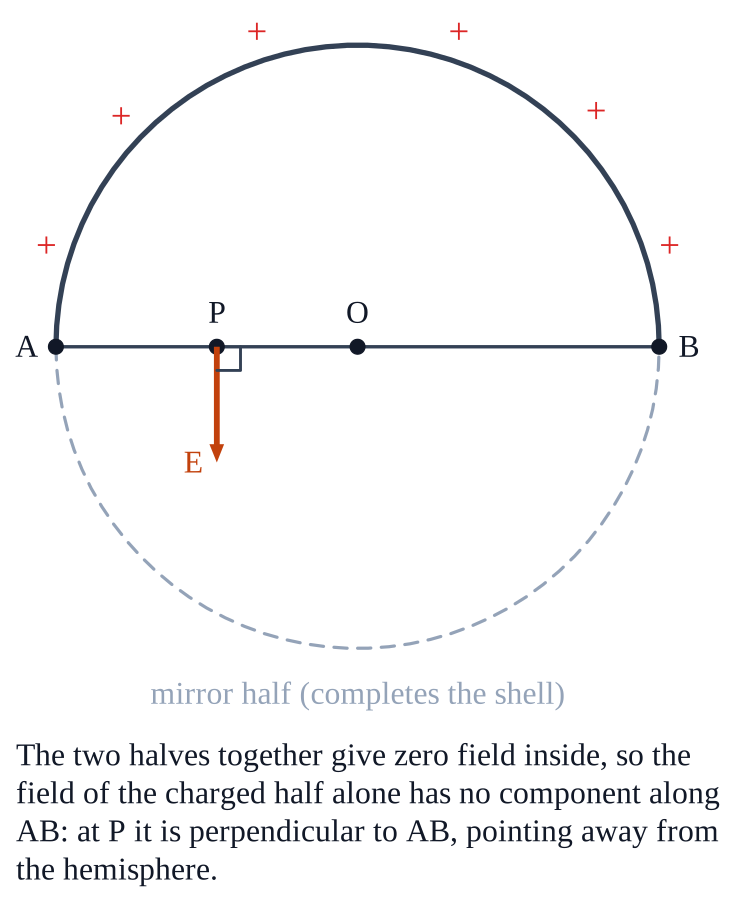
    A hemisphere is uniformly charged positively. The electric field at a point on a diameter away from the centre is directed
    (a)
    perpendicular to the diameter
    (b)
    parallel to the diameter
    (c)
    at an angle tilted towards the diameter
    (d)
    at an angle tilted away from the diameter.
    NCERT’s answer
    (a)
    (a) Perpendicular to the diameter. Take the hemisphere as a charged shell, P inside its rim; the mirror hemisphere completes a shell whose inner field is zero, so the parallel component vanishes.NCERT_Solution_Class12_Physics_Exemplar_Ch1_Q7\[\mathbf{E}_{\text{up}}=(E_\parallel,\,E_\perp),\qquad \mathbf{E}_{\text{low}}=(E_\parallel,\,-E_\perp) \]\[\mathbf{E}_{\text{up}}+\mathbf{E}_{\text{low}}=(2E_\parallel,\,0)=\mathbf{0}\ \Rightarrow\ E_\parallel=0 \]