SolveIt is under development
SolveItClass 12 · Exemplar

NCERT Exemplar · Class 12 Physics Electric Charges and Fields

31 questions

Multiple Choice Questions (Type II) 8–13 (part 2 of 5)

  1. Exercise 8

    If ∮sE.dS=0\displaystyle \oint_{\mathrm{s}} \mathbf{E} . \mathrm{d} \mathbf{S}=0 over a surface, then
    (a)
    the electric field inside the surface and on it is zero.
    (b)
    the electric field inside the surface is necessarily uniform.
    (c)
    the number of flux lines entering the surface must be equal to the number of flux lines leaving it.
    (d)
    all charges must necessarily be outside the surface.
    (c) \[\oint_S \mathbf{E}\cdot d\mathbf{S}=\frac{q_{\mathrm{enc}}}{\varepsilon_0}=0 \;\Rightarrow\; q_{\mathrm{enc}}=0 \] \[\Phi_{\mathrm{out}}-\Phi_{\mathrm{in}}=0 \] \[q_{\mathrm{enc}}=(+q)+(-q)=0,\quad \mathbf{E}\neq 0 \text{ inside} \] Zero net charge does not make \(\displaystyle \mathbf{E}\) zero or uniform, and charges may sit inside.
  2. Exercise 9

    The Electric field at a point is
    (a)
    always continuous.
    (b)
    continuous if there is no charge at that point.
    (c)
    discontinuous only if there is a negative charge at that point.
    (d)
    discontinuous if there is a charge at that point..
    NCERT’s answer
    (b), (d)
    (b), (d) \[E=\frac{q}{4\pi\varepsilon_0 r^2}\;\to\;\infty \quad (r\to 0) \] \[E_{\mathrm{out}}-E_{\mathrm{in}}=\frac{\sigma}{\varepsilon_0}\neq 0 \quad (\text{normal component, across a charged surface}) \] The field is smooth where there is no charge and breaks down at a charge, whatever its sign.
  3. Exercise 10

    If there were only one type of charge in the universe, then
    (a)
    ∮sE.dS≠0\displaystyle \oint_{\mathrm{s}} \mathbf{E} . \mathrm{d} \mathbf{S} \neq 0 on any surface.
    (b)
    ∮sE.dS=0\displaystyle \oint_{\mathrm{s}} \mathbf{E} . \mathrm{d} \mathbf{S}=0 if the charge is outside the surface.
    (c)
    ∮sE.dS\displaystyle \oint_{\mathrm{s}} \mathbf{E} . \mathrm{d} \mathbf{S} could not be defined.
    (d)
    ∮sE.dS=qε0\displaystyle \oint_{\mathrm{s}} \mathbf{E} . \mathrm{d} \mathbf{S}=\frac{q}{\varepsilon_0} if charges of magnitude q\displaystyle q were inside the surface.
    NCERT’s answer
    (b), (d)
    (b), (d) \[\oint_S \mathbf{E}\cdot d\mathbf{S}=\frac{q_{\mathrm{enc}}}{\varepsilon_0} \] \[\text{charge outside: } q_{\mathrm{enc}}=0 \;\Rightarrow\; \oint_S \mathbf{E}\cdot d\mathbf{S}=0 \] \[\text{charge } q \text{ inside: } q_{\mathrm{enc}}=q \;\Rightarrow\; \oint_S \mathbf{E}\cdot d\mathbf{S}=\frac{q}{\varepsilon_0} \] Gauss's law needs only the enclosed charge. (a) fails for a surface enclosing nothing; (c) fails because flux is defined for any field.
  4. Exercise 11

    Consider a region inside which there are various types of charges but the total charge is zero. At points outside the region
    (a)
    the electric field is necessarily zero.
    (b)
    the electric field is due to the dipole moment of the charge distribution only.
    (c)
    the dominant electric field is ∝1r3\displaystyle \propto \frac{1}{r^3}, for large r\displaystyle r, where r\displaystyle r is the distance from a origin in this region.
    (d)
    the work done to move a charged particle along a closed path, away from the region, will be zero.
    NCERT’s answer
    (c), (d)
    (c), (d) \[q_{\mathrm{net}}=0 \;\Rightarrow\; E_{\mathrm{dipole}}=\frac{p\sqrt{1+3\cos^2\theta}}{4\pi\varepsilon_0 r^3}\propto\frac{1}{r^3}\qquad (r\gg \text{size of region}) \] \[\oint \mathbf{E}\cdot d\mathbf{l}=0 \;\Rightarrow\; W=q_0\oint \mathbf{E}\cdot d\mathbf{l}=0 \] The monopole term vanishes, so the dipole term dominates at large \(\displaystyle r\). (b) fails: quadrupole and higher terms also contribute. (a) fails: the dipole field is not zero.
  5. Exercise 12

    Refer to the arrangement of charges in Fig. 1.6\displaystyle 1.6 and a Gaussian surface of radius R\displaystyle R with Q\displaystyle Q at the centre. Then
    (a)
    total flux through the surface of the sphere is −Qε0\displaystyle \frac{-Q}{\varepsilon_0}.
    (b)
    field on the surface of the sphere is −Q4πε0R2\displaystyle \frac{-Q}{4 \pi \varepsilon_0 R^2}.
    (c)
    flux through the surface of sphere due to 5Q\displaystyle 5 Q is zero.
    (d)
    field on the surface of sphere due to −2Q\displaystyle -2 Q is same everywhere.
    NCERT_Question_Class12_Physics_Exemplar_Ch1_Q12
    NCERT’s answer
    (a), (c).
    (a), (c) \[d_{-2Q}=\frac{R}{2}<R \;\Rightarrow\; \text{inside} \]
    \[d_{5Q}=R+R=2R>R \;\Rightarrow\; \text{outside} \]
    \[q_{\mathrm{enc}}=Q+(-2Q)=-Q \;\Rightarrow\; \Phi=\frac{q_{\mathrm{enc}}}{\varepsilon_0}=-\frac{Q}{\varepsilon_0} \]
    \[\Phi_{5Q}=0 \]
    (b)
    fails: \(\displaystyle 5Q\) and \(\displaystyle -2Q\) add their own fields at the surface. (d) fails: \(\displaystyle -2Q\) is off-centre, so its field varies over the surface.
  6. Exercise 13

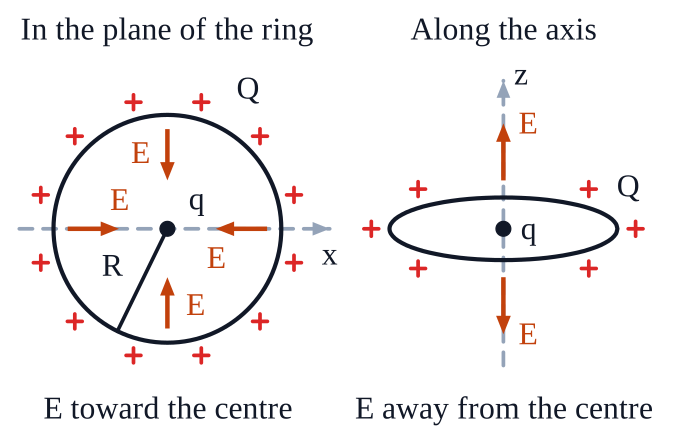
    A positive charge Q is uniformly distributed along a circular ring of radius R\displaystyle R. A small test charge q\displaystyle q is placed at the centre of the ring (Fig. 1.7\displaystyle 1.7). Then
    (a)
    If q>0\displaystyle q>0 and is displaced away from the centre in the plane of the ring, it will be pushed back towards the centre.
    (b)
    If q<0\displaystyle q<0 and is displaced away from the centre in the plane of the ring, it will never return to the centre and will continue moving till it hits the ring.
    (c)
    If q<0\displaystyle q<0, it will perform SHM for small displacement along the axis.
    (d)
    q\displaystyle q at the centre of the ring is in an unstable equilibrium within the plane of the ring for q>0\displaystyle q>0.
    NCERT_Question_Class12_Physics_Exemplar_Ch1_Q13
    NCERT’s answer
    (a), (b), (c) and (d).
    (a), (b), (c), (d) On the axis, \(\displaystyle z\ll R\): \[E_z=\frac{Qz}{4\pi\varepsilon_0(R^2+z^2)^{3/2}}\approx\frac{Qz}{4\pi\varepsilon_0R^3} \] \[q<0:\; F_z=qE_z=-\frac{|q|Q}{4\pi\varepsilon_0R^3}\,z \;\Rightarrow\; \omega=\sqrt{\frac{|q|Q}{4\pi\varepsilon_0 mR^3}},\ \text{SHM}\quad (c) \] \[q>0:\; z>0 \Rightarrow F_z=qE_z>0 \;\Rightarrow\; \text{unstable along } z\quad (d) \] In the plane, the nearer arc repels more: \[E_x\approx-\frac{Qx}{8\pi\varepsilon_0R^3}\quad (x>0:\ \mathbf{E}\ \text{inward}) \] NCERT_Solution_Class12_Physics_Exemplar_Ch1_Q13 \[q>0:\; F_x=qE_x<0 \;\Rightarrow\; \text{pushed back}\quad (a) \] \[q<0:\; F_x=qE_x>0 \;\Rightarrow\; \text{out to the ring}\quad (b) \]