SolveIt is under development
SolveItClass 12 · Exemplar

NCERT Exemplar · Class 12 Physics Electric Charges and Fields

31 questions

Long Answer Questions 26–31 (part 5 of 5)

  1. Exercise 26

    In 1959\displaystyle 1959 Lyttleton and Bondi suggested that the expansion of the Universe could be explained if matter carried a net charge. Suppose that the Universe is made up of hydrogen atoms with a number density N\displaystyle N, which is maintained a constant. Let the charge on the proton be: ep=−(1+y)e\displaystyle e_p=-(1+y) e where e\displaystyle e is the electronic charge.
    (a)
    Find the critical value of y such that expansion may start.
    (b)
    Show that the velocity of expansion is proportional to the distance from the centre.
    NCERT’s answer
    (a)
    Let the Universe have a radius \(\displaystyle R\). Assume that the hydrogen atoms are uniformly distributed. The charge on each hydrogen atom is \(\displaystyle e_H=-(1+y) e+e=-y e=|y e|\)
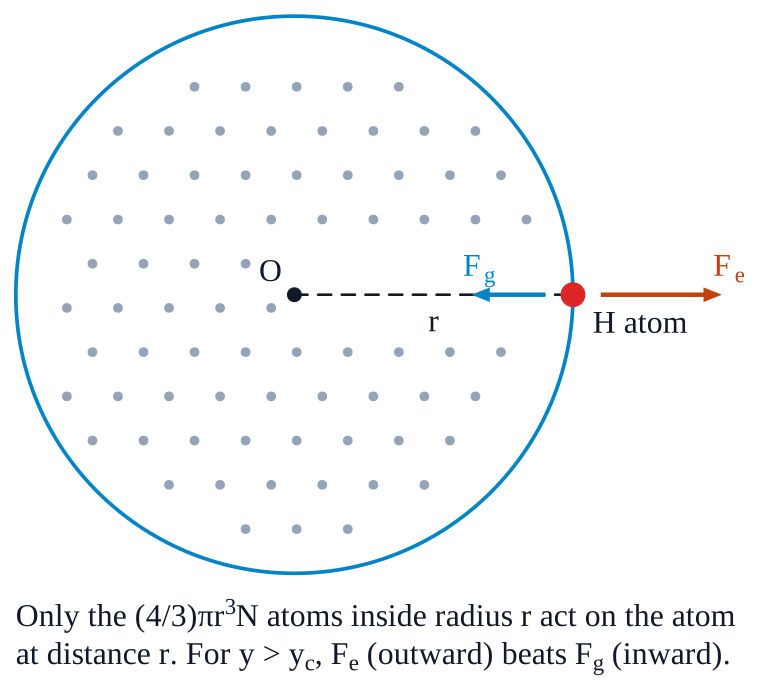
    The mass of each hydrogen atom is \(\displaystyle \sim m_p\) (mass of proton). Expansion starts if the Coulumb repulsion on a hydrogen atom, at \(\displaystyle R\), is larger than the gravitational attraction.
    Let the Electric Field at \(\displaystyle R\) be \(\displaystyle \mathbf{E}\). Then
    \[\begin{aligned} & 4 \pi R^2 E=\frac{4}{3 \varepsilon_{\mathrm{o}}} \pi \mathrm{R}^3 \mathrm{~N}|\mathrm{ye}| \text { (Gauss's law) } \\ & \mathbf{E}(\mathrm{R})=\frac{1}{3} \frac{\mathrm{~N}|\mathrm{ye}|}{\varepsilon_{\mathrm{o}}} \mathrm{R} \hat{\mathbf{r}} \end{aligned} \]
    Let the gravitational field at \(\displaystyle R\) be \(\displaystyle G_{\mathrm{R}}\). Then
    \[\begin{aligned} & -4 \pi R^2 \mathrm{G}_R=4 \pi G \mathrm{~m}_{\mathrm{p}} \frac{4}{3} \pi \mathrm{R}^3 \mathrm{~N} \\ & \mathrm{G}_{\mathrm{R}}=-\frac{4}{3} \pi \mathrm{Gm}_\rho \mathrm{NR} \\ & \mathbf{G}_{\mathrm{R}}(\mathbf{R})=-\frac{4}{3} \pi \mathrm{Gm}_\rho N R \hat{\mathbf{r}} \end{aligned} \]
    Thus the Coulombic force on a hydrogen atom at \(\displaystyle R\) is
    \[\mathrm{ye} \boldsymbol{E}(\mathrm{R})=\frac{1}{3} \frac{\mathrm{Ny}^2 \mathrm{e}^2}{\varepsilon_{\mathrm{o}}} \mathrm{R} \hat{\mathbf{r}} \]
    The gravitional force on this atom is
    \[\mathrm{m}_{\mathrm{p}} \mathbf{G}_{\mathrm{R}}(\mathrm{R})=-\frac{4 \pi}{3} \mathrm{GNm}_{\mathrm{p}}^2 \mathrm{R} \hat{\mathbf{r}} \]
    The net force on the atom is
    \[\mathbf{F}=\left(\frac{1}{3} \frac{\mathrm{Ny}^2 \mathrm{e}^2}{\varepsilon_{\mathrm{o}}} \mathrm{R}-\frac{4 \pi}{3} \mathrm{GNm}_{\mathrm{p}}^2 \mathrm{R}\right) \hat{\mathbf{r}} \]
    The critical value is when
    \[\begin{aligned} & \frac{1}{3} \frac{N y_{\mathrm{C}}^2 \mathrm{e}^2}{\varepsilon_{\mathrm{o}}} R=\frac{4 \pi}{3} G N m_{\mathrm{p}}^2 R \\ & \Rightarrow y_{\mathrm{c}}^2=4 \pi \varepsilon_{\mathrm{o}} \mathrm{G} \frac{\mathrm{~m}_{\mathrm{p}}^2}{\mathrm{e}^2} \\ & \simeq \frac{7 \times 10^{-11} \times 1.8^2 \times 10^6 \times 81 \times 10^{-62}}{9 \times 10^9 \times 1.6^2 \times 10^{-38}} \\ & \sim 63 \times 10^{-38} \\ & \therefore y_{\mathrm{C}} \sim 8 \times 10^{-19} \sim 10^{-18} \end{aligned} \]
    (b)
    Because of the net force, the hydrogen atom experiences an acceleration such that
    \[m_p \frac{d^2 R}{d t^2}=\left(\frac{1}{3} \frac{N y^2 e^2}{e_o} R-\frac{4 p}{3} G N m_p^2 R\right) \]
    Or, \(\displaystyle \frac{d^2 R}{d t^2}=a^2 R\) where \(\displaystyle \alpha^2=\frac{1}{m_p}\left(\frac{1}{3} \frac{N y^2 e^2}{e_o}-\frac{4 p}{3} G N m_p^2\right)\)
    This has a solution \(\displaystyle R=A e^{a t}+B e^{-a t}\)
    As we are seeking an expansion, \(\displaystyle B=0\).
    \[\begin{aligned} & \therefore R=A e^{\alpha t} \\ & \Rightarrow \dot{R}=\alpha A e^{\alpha t}=\alpha R \end{aligned} \]
    Thus, the velocity is proportional to the distance from the centre.
    About the centre, an atom at distance \(\displaystyle r\) feels only the \(\displaystyle \tfrac43\pi r^3N\) atoms inside radius \(\displaystyle r\) (Gauss's law, and its gravitational analogue).NCERT_Solution_Class12_Physics_Exemplar_Ch1_Q26Atom mass \(\displaystyle \approx m_p\); with \(\displaystyle e\) the electron's charge, the net charge per atom is \[q_H=e_p+e=-ye \] \[F_e=\frac{1}{4\pi\varepsilon_0}\,\frac{\left(\tfrac43\pi r^3N\,ye\right)(ye)}{r^2}=\frac{4\pi}{3}Nr\,\frac{y^2e^2}{4\pi\varepsilon_0} \] \[F_g=\frac{G\left(\tfrac43\pi r^3N\,m_p\right)m_p}{r^2}=\frac{4\pi}{3}Nr\,Gm_p^2 \] (a) Expansion starts when \(\displaystyle F_e=F_g\); \(\displaystyle r\) cancels: \[\frac{y^2e^2}{4\pi\varepsilon_0}=Gm_p^2\;\Rightarrow\;y_c=\frac{m_p}{e}\sqrt{4\pi\varepsilon_0G} \] \[y_c=\frac{1.67\times10^{-27}\,\mathrm{kg}}{1.6\times10^{-19}\,\mathrm{C}}\sqrt{\frac{6.67\times10^{-11}}{9\times10^{9}}}\ \mathrm{C\,kg^{-1}}\approx0.9\times10^{-18} \] (b) For \(\displaystyle y>y_c\) the net outward force on the atom at distance \(\displaystyle r\) gives \[m_p\ddot r=\frac{4\pi}{3}Nr\left[\frac{y^2e^2}{4\pi\varepsilon_0}-Gm_p^2\right]\;\Rightarrow\;\ddot r=\kappa^2r,\qquad \kappa^2=\frac{4\pi N}{3m_p}\left[\frac{y^2e^2}{4\pi\varepsilon_0}-Gm_p^2\right] \] \(\displaystyle N\) constant \(\displaystyle \Rightarrow\) \(\displaystyle \kappa\) constant, and the general solution is \[r=Ae^{\kappa t}+Be^{-\kappa t} \] Expansion means the decaying term must go, \(\displaystyle B=0\): \[r=Ae^{\kappa t}\;\Rightarrow\;v=\dot r=\kappa Ae^{\kappa t}=\kappa r \] Answer: \(\displaystyle y_c=\dfrac{m_p}{e}\sqrt{4\pi\varepsilon_0G}\approx10^{-18}\); \(\displaystyle v=\kappa r\), so \(\displaystyle v\propto r\).
  2. Exercise 27

    Consider a sphere of radius R with charge density distributed as
    ρ(r)=kr for r≤R=0 for r>R.\begin{aligned} \rho(r) & =k r \text { for } r \leq R \\ & =0 \quad \text { for } r>R . \end{aligned}
    (a)
    Find the electric field at all points r\displaystyle r.
    (b)
    Suppose the total charge on the sphere is 2e\displaystyle 2 e where e\displaystyle e is the electron charge. Where can two protons be embedded such that the force on each of them is zero. Assume that the introduction of the proton does not alter the negative charge distribution.
    NCERT’s answer
    (a)
    The symmetry of the problem suggests that the electric field is radial. For points \(\displaystyle r<R\), consider a spherical Gaussian surfaces. Then on the surface
    \[\oint \boldsymbol{E}_r \cdot \boldsymbol{d} \mathbf{S}=\frac{1}{\varepsilon_o} \int_V \rho d v \]
    \[\begin{aligned} 4 \pi r^2 E_r & =\frac{1}{\varepsilon_o} 4 \pi k \int_o^r r^{\prime 3} d r^{\prime} \\ & =\frac{1}{\varepsilon_o} \frac{4 \pi k}{4} r^4 \end{aligned} \]
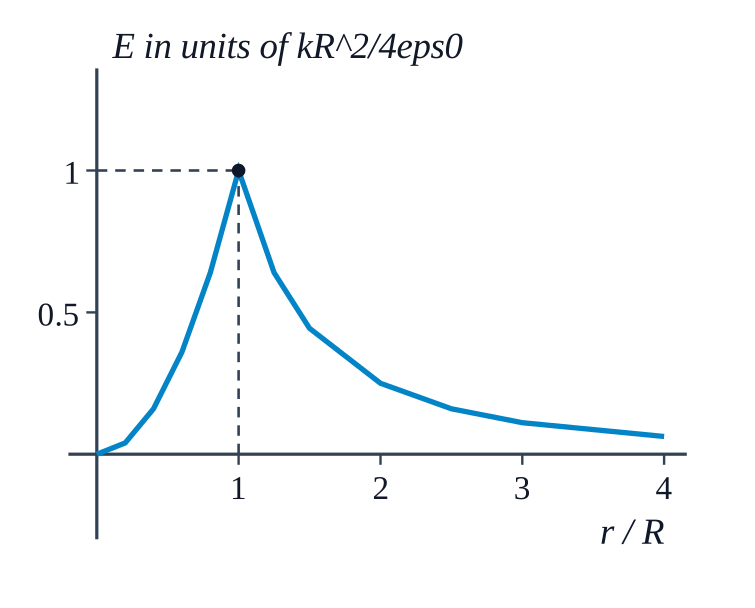
    \[\begin{aligned} & \therefore E_r=\frac{1}{4 \varepsilon_o} k r^2 \\ & \mathbf{E}(r)=\frac{1}{4 \varepsilon_o} k r^2 \hat{\mathbf{r}} \end{aligned} \]
    For points \(\displaystyle r>R\), consider a spherical Gaussian surfaces' of radius \(\displaystyle r\),
    \[\oint \mathbf{E}_r \cdot d \mathbf{S}=\frac{1}{\varepsilon_o} \int_V \rho d v \]
    \[\begin{aligned} 4 \pi r^2 E_r & =\frac{4 \pi k}{\varepsilon_o} \int_o^R r^3 d r \\ & =\frac{4 \pi k}{\varepsilon_o} \frac{R^4}{4} \end{aligned} \]
    \[\therefore E_r=\frac{k}{4 \varepsilon_o} \frac{R^4}{r^2} \]
    \[\mathbf{E}(r)=\left(k / 4 \varepsilon_o\right)\left(R^4 / r^2\right) \hat{\mathbf{r}} \]
    (b)
    The two protons must be on the opposite sides of the centre along a diameter. Suppose the protons are at a distance \(\displaystyle r\) from the centre.
    Now, \(\displaystyle 4 \pi \int_o^R k r^{\prime 3} d r=2 e\)
    \[\begin{aligned} & \therefore \frac{4 \pi k}{4} R^4=2 e \\ & \therefore k=\frac{2 e}{\pi R^4} \end{aligned} \]
    Consider the forces on proton 1. The attractive force due to the charge distribution is
    \[-e \mathbf{E}_r=-\frac{e}{4 \varepsilon_o} k r^2 \hat{\boldsymbol{r}}=-\frac{2 e^2}{4 \pi \varepsilon_o} \frac{r^2}{R^4} \hat{\boldsymbol{r}} \]
    The repulsive force is \(\displaystyle \frac{e^2}{4 \pi \varepsilon_o} \frac{1}{(2 r)^2} \hat{\mathbf{r}}\)
    Net force is \(\displaystyle \left(\frac{e^2}{4 \pi \varepsilon_o 4 r^2}-\frac{2 e^2}{4 \pi \varepsilon_o} \frac{r^2}{R^4}\right) \hat{\mathbf{r}}\)
    This is zero such that
    \[\frac{e^2}{16 \pi \varepsilon_o r^2}=\frac{2 e^2}{4 \pi \varepsilon_o} \frac{r^2}{R^4} \]
    Or, \(\displaystyle r^4=\frac{4 R^4}{32}=\frac{R^4}{8}\)
    \[\Rightarrow r=\frac{R}{(8)^{1 / 4}} \]
    Thus, the protons must be at a distance \(\displaystyle r=\frac{R}{\sqrt[4]{8}}\) from the centre.
    NCERT_Solution_Class12_Physics_Exemplar_Ch1_Q27_ncert
    NCERT_Solution_Class12_Physics_Exemplar_Ch1_Q27_ncert_2
    (a) Gaussian sphere of radius \(\displaystyle r\); charge enclosed: \[q_{enc}=\int_0^{r}kr'\,(4\pi r'^2)\,dr'=\pi kr^4\qquad(r\le R) \] \[E\,(4\pi r^2)=\frac{\pi kr^4}{\varepsilon_0}\;\Rightarrow\;E=\frac{kr^2}{4\varepsilon_0}\qquad(r\le R) \] \[q_{enc}=\pi kR^4\;\Rightarrow\;E=\frac{kR^4}{4\varepsilon_0r^2}\qquad(r>R) \] Radial, outward for \(\displaystyle k>0\).NCERT_Solution_Class12_Physics_Exemplar_Ch1_Q27(b) The sphere must attract protons, so \(\displaystyle \pi kR^4=-2e\) and \(\displaystyle |k|=\dfrac{2e}{\pi R^4}\). Zero force on both needs the protons at opposite ends of a diameter, each a distance \(\displaystyle r\) from the centre. \[F_{sphere}=e|E|=\frac{e}{4\varepsilon_0}\cdot\frac{2e}{\pi R^4}\,r^2=\frac{e^2r^2}{2\pi\varepsilon_0R^4}\quad\text{(inward)} \] \[F_{pp}=\frac{e^2}{4\pi\varepsilon_0(2r)^2}=\frac{e^2}{16\pi\varepsilon_0r^2}\quad\text{(outward)} \] \[\frac{e^2r^2}{2\pi\varepsilon_0R^4}=\frac{e^2}{16\pi\varepsilon_0r^2}\;\Rightarrow\;r^4=\frac{R^4}{8}\;\Rightarrow\;r=2^{-3/4}R\approx0.6R \] Answer: \(\displaystyle E=\dfrac{kr^2}{4\varepsilon_0}\) for \(\displaystyle r\le R\), \(\displaystyle E=\dfrac{kR^4}{4\varepsilon_0r^2}\) for \(\displaystyle r>R\); the protons sit diametrically opposite, each \(\displaystyle 2^{-3/4}R\approx0.6R\) from the centre.
  3. Exercise 28

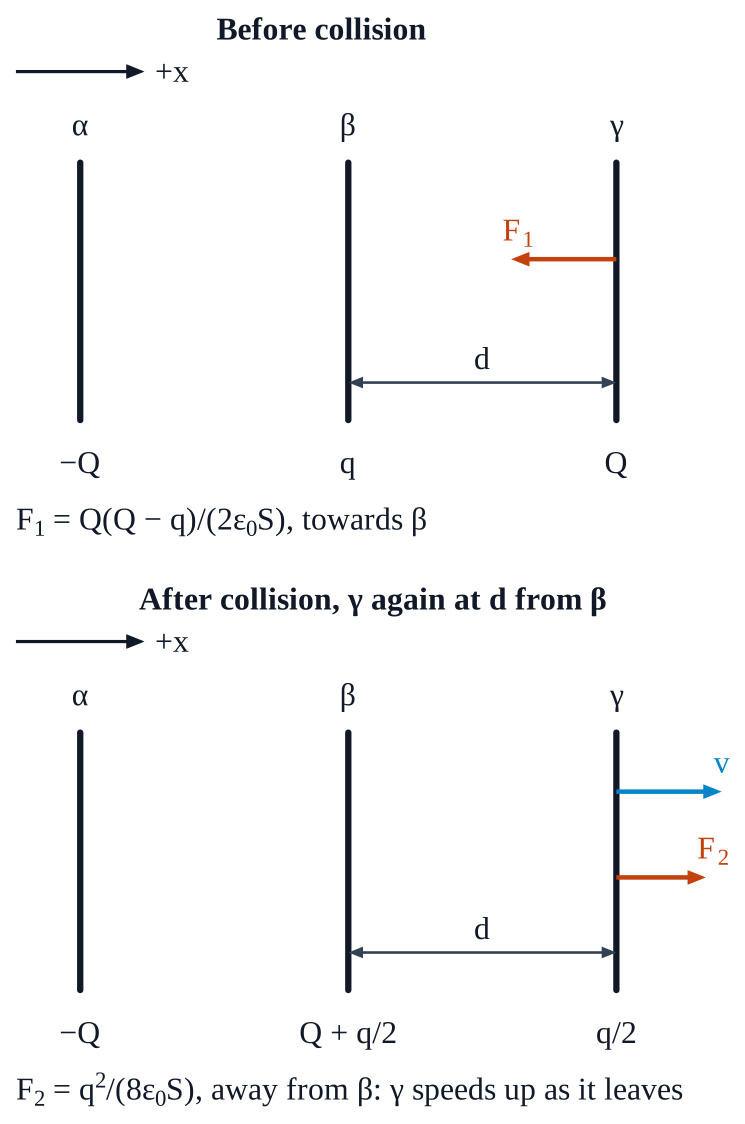
    Two fixed, identical conducting plates (α&β)\displaystyle (\alpha \& \beta), each of surface area S\displaystyle S are charged to −Q\displaystyle -Q and q\displaystyle q, respectively, where Q>q>0\displaystyle Q>q>0. A third identical plate (γ)\displaystyle (\gamma), free to move is located on the other side of the plate with charge q\displaystyle q at a distance d\displaystyle d (Fig 1.13\displaystyle 1.13). The third plate is released and collides with the plate β\displaystyle \beta. Assume the collision is elastic and the time of collision is sufficient to redistribute charge amongst β&γ\displaystyle \beta \& \gamma.
    (a)
    Find the electric field acting on the plate γ\displaystyle \gamma before collision.
    (b)
    Find the charges on β\displaystyle \beta and γ\displaystyle \gamma after the collision.
    (c)
    Find the velocity of the plate γ\displaystyle \gamma after the collision and at a distance d\displaystyle d from the plate β\displaystyle \beta.
    NCERT_Question_Class12_Physics_Exemplar_Ch1_Q28
    NCERT’s answer
    (a)
    The electric field at \(\displaystyle \boldsymbol{\gamma}\) due to plate \(\displaystyle \alpha\) is \(\displaystyle -\frac{Q}{S 2 \varepsilon_o} \hat{\mathbf{x}}\)
    The electric field at \(\displaystyle \gamma\) due to plate \(\displaystyle \beta\) is \(\displaystyle \frac{q}{S 2 \varepsilon_o} \hat{\mathbf{x}}\)
    Hence, the net electric field is
    \[\mathbf{E}_1=\frac{(Q-q)}{2 \varepsilon_o S}(-\hat{\mathbf{x}}) \]
    (b)
    During the collision plates \(\displaystyle \beta \& \gamma\) are together and hence must be at one potential. Suppose the charge on \(\displaystyle \beta\) is \(\displaystyle q_1\) and on \(\displaystyle \gamma\) is \(\displaystyle q_2\). Consider a point O. The electric field here must be zero.
    Electric field at $\displaystyle 0$ due to \(\displaystyle \alpha=-\frac{Q}{2 \varepsilon_o \mathrm{~S}} \hat{\mathbf{x}}\)
    Electric field at $\displaystyle 0$ due to \(\displaystyle \beta=-\frac{q_1}{2 \varepsilon_o S} \hat{\mathbf{x}}\)
    Electric Field at $\displaystyle 0$ due to \(\displaystyle \gamma=-\frac{q_2}{2 \varepsilon_o \mathrm{~S}} \hat{\mathbf{x}}\)
    \[\begin{aligned} & \therefore \frac{-\left(Q+q_2\right)}{2 \varepsilon_o S}+\frac{q_1}{2 \varepsilon_o S}=0 \\ & \Rightarrow q_1-q_2=Q \end{aligned} \]
    Further, \(\displaystyle q_1+q_2=\mathrm{Q}+q\)
    \[\Rightarrow q_1=Q+q / 2 \]
    and \(\displaystyle q_2=q / 2\)
    Thus the charge on \(\displaystyle \beta\) and \(\displaystyle \gamma\) are \(\displaystyle Q+q / 2\) and \(\displaystyle q / 2\), respectively.
    (c)
    Let the velocity be \(\displaystyle v\) at the distance \(\displaystyle d\) after the collision. If \(\displaystyle m\) is the mass of the plate \(\displaystyle \gamma\), then the gain in K.E. over the round trip must be equal to the work done by the electric field.
    After the collision, the electric field at \(\displaystyle \gamma\) is
    \[\mathbf{E}_2=-\frac{Q}{2 \varepsilon_o S} \hat{\mathbf{x}}+\frac{(Q+q / 2)}{2 \varepsilon_o S} \hat{\mathbf{x}}=\frac{q / 2}{2 \varepsilon_o S} \hat{\mathbf{x}} \]
    The work done when the plate \(\displaystyle \gamma\) is released till the collision is \(\displaystyle F_1 d\) where \(\displaystyle F_1\) is the force on plate \(\displaystyle \gamma\).
    The work done after the collision till it reaches \(\displaystyle d\) is \(\displaystyle F_2 d\) where \(\displaystyle F_2\) is the force on plate \(\displaystyle \gamma\).
    \[F_1=E_1 Q=\frac{(Q-q) Q}{2 \varepsilon_o S} \]
    and \(\displaystyle F_2=E_2 q / 2=\frac{(q / 2)^2}{2 \varepsilon_o \mathrm{~S}}\)
    ∴ Total work done is
    \[\begin{aligned} & \frac{1}{2 \varepsilon_o \mathrm{~S}}\left[(Q-q) Q+(q / 2)^2\right] d=\frac{1}{2 \varepsilon_o \mathrm{~S}}(Q-q / 2)^2 d \\ & \Rightarrow(1 / 2) m v^2=\frac{d}{2 \varepsilon_o \mathrm{~S}}(Q-q / 2)^2 \\ & \therefore v=(Q-q / 2)\left(\frac{d}{m \varepsilon_o \mathrm{~S}}\right)^{1 / 2} \end{aligned} \]
    NCERT_Solution_Class12_Physics_Exemplar_Ch1_Q28_ncert
    NCERT_Solution_Class12_Physics_Exemplar_Ch1_Q28_ncert_2
    Charges (from the figure): \(\displaystyle \alpha=-Q,\ \beta=q,\ \gamma=Q\). Large plates act as sheets, each giving \(\displaystyle \dfrac{\text{charge}}{2\varepsilon_0S}\).(a) Field at \(\displaystyle \gamma\) from \(\displaystyle \alpha\) and \(\displaystyle \beta\) (\(\displaystyle +x\) away from \(\displaystyle \beta\)): \[E_\gamma=\frac{q}{2\varepsilon_0S}-\frac{Q}{2\varepsilon_0S}=-\frac{Q-q}{2\varepsilon_0S} \] Magnitude \(\displaystyle \dfrac{Q-q}{2\varepsilon_0S}\), toward \(\displaystyle \beta\). Force on \(\displaystyle \gamma\): \[F_1=QE=\frac{Q(Q-q)}{2\varepsilon_0S} \]NCERT_Solution_Class12_Physics_Exemplar_Ch1_Q28(b) In contact, \(\displaystyle \beta\) and \(\displaystyle \gamma\) are one conductor: charge sits on the outer faces only, so it is not shared equally. The outer face of the whole system holds \(\displaystyle \dfrac{-Q+q+Q}{2}=\dfrac q2\): \[q_\gamma=\frac q2,\qquad q_\beta=(q+Q)-\frac q2=Q+\frac q2 \](c) Before impact \(\displaystyle \tfrac12mu^2=F_1d\). The impact is elastic and \(\displaystyle \beta\) is fixed: the speed stays \(\displaystyle u\), the direction reverses. Field at \(\displaystyle \gamma\) afterwards (away from \(\displaystyle \beta\)): \[E_2=\frac{Q+q/2}{2\varepsilon_0S}-\frac{Q}{2\varepsilon_0S}=\frac{q}{4\varepsilon_0S}\;\Rightarrow\;F_2=\frac q2E_2=\frac{q^2}{8\varepsilon_0S} \] \(\displaystyle F_2\) speeds \(\displaystyle \gamma\) up as it leaves: \[\tfrac12mv^2=F_1d+F_2d=\frac{d}{8\varepsilon_0S}\left(4Q^2-4Qq+q^2\right)=\frac{(2Q-q)^2d}{8\varepsilon_0S} \] \[v=\frac{2Q-q}{2}\sqrt{\frac{d}{\varepsilon_0Sm}} \] Answer: (a) \(\displaystyle \dfrac{Q-q}{2\varepsilon_0S}\) toward \(\displaystyle \beta\); (b) \(\displaystyle q_\beta=Q+\dfrac q2,\ q_\gamma=\dfrac q2\); (c) \(\displaystyle v=\dfrac{2Q-q}{2}\sqrt{\dfrac{d}{\varepsilon_0Sm}}\), directed away from \(\displaystyle \beta\).
  4. Exercise 29

    There is another useful system of units, besides the SI/mks A system, called the cgs (centimeter-gram-second) system. In this system Coloumb's law is given by
    F=Qqr2r^\mathbf{F}=\frac{\mathrm{Qq}}{r^2} \hat{\boldsymbol{r}}
    where the distance r\displaystyle r is measured in cm(=10−2 m),F\displaystyle \mathrm{cm}\left(=10^{-2} \mathrm{~m}\right), F in dynes (=10−5 N)\displaystyle \left(=10^{-5} \mathrm{~N}\right) and the charges in electrostatic units (es units), where
     1es unit of charge =1[3]×10−9C\text { 1es unit of charge }=\frac{1}{[3]} \times 10^{-9} \mathrm{C}
    The number [3\displaystyle 3] actually arises from the speed of light in vaccum which is now taken to be exactly given by c=2.99792458×10⁸\displaystyle c=2.99792458 \times 10^8 m/s. An approximate value of c\displaystyle c then is c=[3]×108 m/s\displaystyle c=[3] \times 10^8 \mathrm{~m} / \mathrm{s}.
    (i)
    Show that the coloumb law in cgs units yields
    1 esu of charge =1( dyne )1/2 cm.1 \text { esu of charge }=1(\text { dyne })^{1 / 2} \mathrm{~cm} .
    Obtain the dimensions of units of charge in terms of mass M\displaystyle M, length L\displaystyle L and time T\displaystyle T. Show that it is given in terms of fractional powers of M\displaystyle M and L\displaystyle L.
    (ii)
    Write 1\displaystyle 1 esu of charge =x\displaystyle =x C, where x\displaystyle x is a dimensionless number. Show that this gives
    14πϵ0=10−9x2 N. m2C2\frac{1}{4 \pi \epsilon_0}=\frac{10^{-9}}{x^2} \frac{\mathrm{~N} . \mathrm{~m}^2}{\mathrm{C}^2}
    With x=1[3]×10−9\displaystyle x=\frac{1}{[3]} \times 10^{-9}, we have
    14πϵ0=[3]2×10⁹Nm2C2 or, 14πϵ0=(2.99792458)2×10⁹Nm2C2 (exactly). \begin{aligned} & \frac{1}{4 \pi \epsilon_0}=[3]^2 \times 10^9 \frac{\mathrm{Nm}^2}{\mathrm{C}^2} \\ & \text { or, } \frac{1}{4 \pi \epsilon_0}=(2.99792458)^2 \times 10^9 \frac{\mathrm{Nm}^2}{\mathrm{C}^2} \text { (exactly). } \end{aligned}
    NCERT’s answer
    (i)
    \(\displaystyle F=\frac{Q_q}{r^2}=1\) dyne \(\displaystyle =\frac{[1 \text { esu of charge }]^2}{[1 \mathrm{~cm}]^2}\)
    Or, $\displaystyle 1$ esu of charge \(\displaystyle =1(\text { dyne })^{1 / 2}(\mathrm{~cm})\)
    Hence, [$\displaystyle 1$ esu of charge] \(\displaystyle =[\mathrm{F}]^{1 / 2} \mathrm{~L}=\left[\mathrm{MLT}^{-2}\right]^{1 / 2} \mathrm{~L}=\mathrm{M}^{1 / 2} \mathrm{~L}^{3 / 2} \mathrm{~T}^{-1}\)
    [$\displaystyle 1$ esu of charge] \(\displaystyle =\mathrm{M}^{1 / 2} \mathrm{~L}^{3 / 2} \mathrm{~T}^{-1}\)
    Thus charge in cgs unit is expressed as fractional powers ($\displaystyle 1$/$\displaystyle 2$) of M and ($\displaystyle 3$/$\displaystyle 2$) of L.
    (ii)
    Consider the coloumb force on two charges, each of magnitude $\displaystyle 1$ esu of charge separated by a distance of $\displaystyle 1$ cm:
    The force is then $\displaystyle 1$ dyne \(\displaystyle =10^{-5} \mathrm{~N}\).
    This situation is equivalent to two charges of magnitude \(\displaystyle x\) C separated by \(\displaystyle 10^{-2} \mathrm{~m}\).
    This gives:
    \[F=\frac{1}{4 \pi \varepsilon_0} \cdot \frac{x^2}{10^{-4}} \]
    which should be $\displaystyle 1$ dyne \(\displaystyle =10^{-5} \mathrm{~N}\). Thus
    \[\frac{1}{4 \pi \varepsilon_0} \cdot \frac{x^2}{10^{-4}}=10^{-5} \Rightarrow \frac{1}{4 \pi \varepsilon_0}=\frac{10^{-9}}{x^2} \frac{\mathrm{Nm}^2}{\mathrm{C}^2} \]
    With \(\displaystyle x=\frac{1}{[3] \times 10^9}\), this yields
    \[\frac{1}{4 \pi \varepsilon_0}=10^{-9} \times[3]^2 \times 10^{18}=[3]^2 \times 10^9 \frac{\mathrm{Nm}^2}{\mathrm{C}^2} \]
    With [$\displaystyle 3$] → $\displaystyle 2.99792458$, we get
    \[\frac{1}{4 \pi \varepsilon_0}=8.98755 \ldots . \times 10^9 \frac{\mathrm{Nm}^2}{\mathrm{C}^2} \text { exactly } \]
    (i) In cgs, \(\displaystyle F=\dfrac{Qq}{r^2}\Rightarrow Qq=Fr^2\). For \(\displaystyle Q=q=1\) esu, \(\displaystyle r\) in cm, \(\displaystyle F\) in dyne: \[(1\ \mathrm{esu})^2=1\ \mathrm{dyne\,cm^2}\;\Rightarrow\;1\ \mathrm{esu}=1\ \mathrm{dyne}^{1/2}\,\mathrm{cm} \] \[[\mathrm{dyne}]=\mathrm{M\,L\,T^{-2}}\;\Rightarrow\;[Q]=\left(\mathrm{M\,L\,T^{-2}}\right)^{1/2}\mathrm{L}=\mathrm{M^{1/2}\,L^{3/2}\,T^{-1}} \] Fractional powers of \(\displaystyle \mathrm{M}\) and \(\displaystyle \mathrm{L}\).(ii) Two charges of $\displaystyle 1$ esu, $\displaystyle 1$ cm apart, exert $\displaystyle 1$ dyne on each other. The same force in SI, with \(\displaystyle 1\ \mathrm{esu}=x\ \mathrm{C}\): \[10^{-5}\ \mathrm{N}=\frac{1}{4\pi\varepsilon_0}\,\frac{x^2\ \mathrm{C^2}}{(10^{-2}\ \mathrm{m})^2} \] \[\frac{1}{4\pi\varepsilon_0}=\frac{10^{-5}\times10^{-4}}{x^2}=\frac{10^{-9}}{x^2}\ \mathrm{N\,m^2\,C^{-2}} \] With \(\displaystyle x=\dfrac{10^{-9}}{[3]}\): \[\frac{1}{4\pi\varepsilon_0}=10^{-9}\,[3]^2\times10^{18}=[3]^2\times10^{9}\ \mathrm{N\,m^2\,C^{-2}} \] With \(\displaystyle [3]=2.99792458\): \[\frac{1}{4\pi\varepsilon_0}=(2.99792458)^2\times10^{9}\approx8.988\times10^{9}\ \mathrm{N\,m^2\,C^{-2}} \] Answer: (i) \(\displaystyle 1\ \mathrm{esu}=1\ \mathrm{dyne}^{1/2}\,\mathrm{cm}\), \(\displaystyle [Q]=\mathrm{M^{1/2}L^{3/2}T^{-1}}\); (ii) \(\displaystyle \dfrac{1}{4\pi\varepsilon_0}=\dfrac{10^{-9}}{x^2}\ \mathrm{N\,m^2\,C^{-2}}=(2.99792458)^2\times10^{9}\ \mathrm{N\,m^2\,C^{-2}}\).
  5. Exercise 30

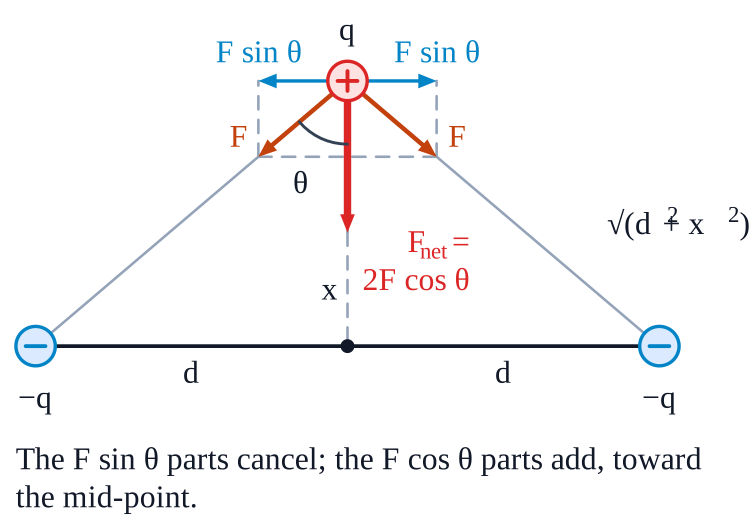
    Two charges −q\displaystyle -q each are fixed separated by distance 2d\displaystyle 2 d. A third charge q\displaystyle q of mass m\displaystyle m placed at the mid-point is displaced slightly by x(x≪d)\displaystyle x(x \ll d) perpendicular to the line joining the two fixed charged as shown in Fig. 1.14. Show that q\displaystyle q will perform simple harmonic oscillation of time period. T=[8π3ε0md3q2]1/2T=\left[\frac{8 \pi^3 \varepsilon_0 m d^3}{q^2}\right]^{1 / 2} NCERT_Question_Class12_Physics_Exemplar_Ch1_Q30
    NCERT’s answer
    Net force \(\displaystyle F\) on \(\displaystyle q\) towards the centre O \[\begin{aligned} F & =2 \frac{q^2}{4 \pi \varepsilon_0 r^2} \cos \theta=-\frac{2 q^2}{4 \pi \varepsilon_0 r^2} \cdot \frac{x}{r} \\ F & =\frac{-2 q^2}{4 \pi \varepsilon_0} \frac{x}{\left(d^2+x^2\right)^{3 / 2}} \\ & \approx \frac{-2 q^2}{4 \pi \varepsilon_0 d^3} x=-k . \text { for } x \ll d . \end{aligned} \] Thus, the force on the third charge \(\displaystyle q\) is proportional to the displacement and is towards the centre of the two other charges. Therefore, the motion of the third charge is harmonic with frequency \[\omega=\sqrt{\frac{2 q^2}{4 \pi \varepsilon_0 d^3 m}}=\sqrt{\frac{k}{m}} \] and hence \(\displaystyle T=\frac{2 \pi}{\omega}\left[\frac{8 \pi^3 \varepsilon_0 m d^3}{q^2}\right]^{1 / 2}\). NCERT_Solution_Class12_Physics_Exemplar_Ch1_Q30_ncert
    Charge \(\displaystyle q\) at height \(\displaystyle x\) is \(\displaystyle \sqrt{d^2+x^2}\) from each \(\displaystyle -q\) and is attracted by each with \[F=\frac{q^2}{4\pi\varepsilon_0\,(d^2+x^2)} \]NCERT_Solution_Class12_Physics_Exemplar_Ch1_Q30Components along the line of the fixed charges cancel; those along \(\displaystyle x\) add, toward the mid-point (\(\displaystyle \cos\theta=x/\sqrt{d^2+x^2}\)): \[F_{net}=2F\cos\theta=\frac{2q^2x}{4\pi\varepsilon_0(d^2+x^2)^{3/2}} \] For \(\displaystyle x\ll d\), \(\displaystyle (d^2+x^2)^{3/2}\approx d^3\): \[F_{net}\approx\frac{q^2}{2\pi\varepsilon_0d^3}\,x\quad\text{(toward the mid-point)} \] \[m\ddot x=-\frac{q^2}{2\pi\varepsilon_0d^3}\,x\;\Rightarrow\;\omega^2=\frac{q^2}{2\pi\varepsilon_0md^3} \] \[T=\frac{2\pi}{\omega}=2\pi\sqrt{\frac{2\pi\varepsilon_0md^3}{q^2}}=\left[\frac{8\pi^3\varepsilon_0md^3}{q^2}\right]^{1/2} \] Answer: the restoring force is \(\displaystyle \propto -x\), so the motion is SHM with \(\displaystyle T=\left[\dfrac{8\pi^3\varepsilon_0md^3}{q^2}\right]^{1/2}\).
  6. Exercise 31

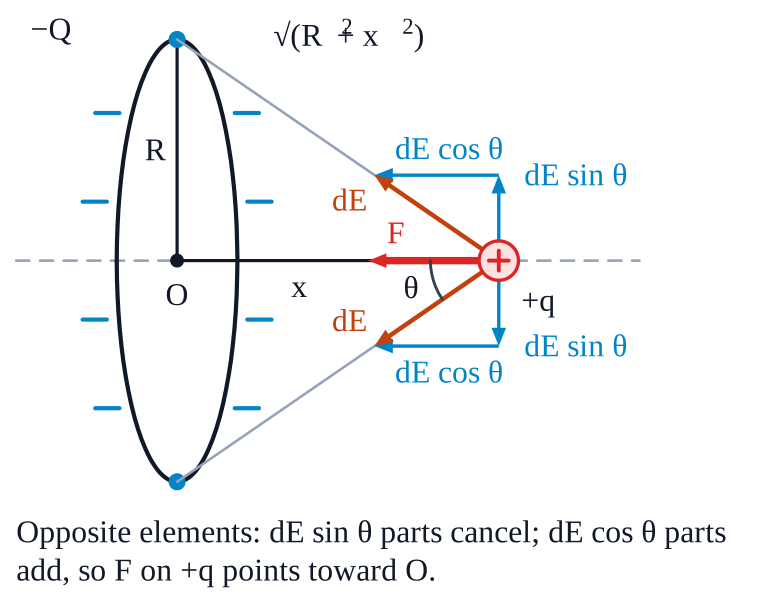
    Total charge −Q\displaystyle -Q is uniformly spread along length of a ring of radius R\displaystyle R. A small test charge +q\displaystyle +q of mass m\displaystyle m is kept at the centre of the ring and is given a gentle push along the axis of the ring.
    (a)
    Show that the particle executes a simple harmonic oscillation.
    (b)
    Obtain its time period.
    Displace \(\displaystyle +q\) by \(\displaystyle x\) along the axis; every element of the ring is \(\displaystyle \sqrt{R^2+x^2}\) away.NCERT_Solution_Class12_Physics_Exemplar_Ch1_Q31Components of \(\displaystyle d\mathbf{E}\) perpendicular to the axis cancel in pairs; axial components add: \[E=\frac{1}{4\pi\varepsilon_0}\,\frac{Q}{R^2+x^2}\cos\theta=\frac{1}{4\pi\varepsilon_0}\,\frac{Qx}{(R^2+x^2)^{3/2}}\quad\text{(toward the centre)} \] (a) For \(\displaystyle x\ll R\), \(\displaystyle (R^2+x^2)^{3/2}\approx R^3\): \[F=-\frac{Qq}{4\pi\varepsilon_0R^3}\,x=-kx \] The force is \(\displaystyle \propto x\) and always toward the centre: SHM.(b) \[m\ddot x=-\frac{Qq}{4\pi\varepsilon_0R^3}\,x\;\Rightarrow\;\omega=\sqrt{\frac{Qq}{4\pi\varepsilon_0mR^3}} \] \[T=\frac{2\pi}{\omega}=2\pi\sqrt{\frac{4\pi\varepsilon_0mR^3}{Qq}}=\sqrt{\frac{16\pi^3\varepsilon_0mR^3}{Qq}} \] Answer: (a) \(\displaystyle F=-kx\) with \(\displaystyle k=\dfrac{Qq}{4\pi\varepsilon_0R^3}\), so SHM; (b) \(\displaystyle T=2\pi\sqrt{\dfrac{4\pi\varepsilon_0mR^3}{Qq}}\).