SolveIt is under development
SolveItClass 12 · Exemplar

NCERT Exemplar · Class 12 Physics Dual Nature of Radiation and Matter

29 questions

Very Short Answer Questions 14–19 (part 3 of 5)

  1. Exercise 14

    A proton and an α\displaystyle \alpha-particle are accelerated, using the same potential difference. How are the deBroglie wavelengths λp\displaystyle \lambda_{\mathrm{p}} and λa\displaystyle \lambda_{\mathrm{a}} related to each other?
    NCERT’s answer
    \(\displaystyle \lambda_p / \lambda_d=p_x / p_p=\frac{\sqrt{2 m_\alpha E_\alpha}}{\sqrt{2 m_p E_p}}=\sqrt{8}: 1\)
    \[qV=\tfrac{1}{2}mv^2 \;\Rightarrow\; p=mv=\sqrt{2mqV} \] \[\lambda=\frac{h}{p}=\frac{h}{\sqrt{2mqV}} \] \[\frac{\lambda_{\mathrm p}}{\lambda_{\mathrm a}}=\sqrt{\frac{m_{\mathrm a}q_{\mathrm a}}{m_{\mathrm p}q_{\mathrm p}}}=\sqrt{\frac{4m_{\mathrm p}\cdot 2e}{m_{\mathrm p}\cdot e}}=\sqrt{8}=2\sqrt{2} \] Answer: \(\displaystyle \lambda_{\mathrm p}:\lambda_{\mathrm a}=2\sqrt{2}:1\)
  2. Exercise 15

    (i)
    In the explanation of photo electric effect, we asssume one photon of frequency ν\displaystyle \nu collides with an electron and transfers its energy. This leads to the equation for the maximum energy Emax\displaystyle E_{max} of the emitted electron as
    Emax⁡=hν−ϕ0E_{\max }=h \nu-\phi_0
    where ϕ0\displaystyle \phi_0 is the work function of the metal. If an electron absorbs 2\displaystyle 2 photons (each of frequency ν\displaystyle \nu) what will be the maximum energy for the emitted electron?
    (ii)
    Why is this fact (two photon absorption) not taken into consideration in our discussion of the stopping potential?
    NCERT’s answer
    (i)
    \(\displaystyle E_{\text {max }}=2 h \nu-\phi\)
    (ii)
    The probability of absorbing $\displaystyle 2$ photons by the same electron is very low. Hence such emissions will be negligible.
    (i) \[E_{\max}=2h\nu-\phi_0 \] (ii) At ordinary intensities an electron almost never meets a second photon before losing energy to the lattice, so the stopping potential obeys \[eV_0=E_{\max}=h\nu-\phi_0 \] Answer: (i) \(\displaystyle 2h\nu-\phi_0\); (ii) two-photon absorption is extremely improbable.
  3. Exercise 16

    There are materials which absorb photons of shorter wavelength and emit photons of longer wavelength. Can there be stable substances which absorb photons of larger wavelength and emit light of shorter wavelength.
    NCERT’s answer
    In the first case energy given out is less than the energy supplied. In the second case, the material has to supply the energy as the emitted photon has more energy. This cannot happen for stable substances.
    \[\lambda_{em}<\lambda_{abs}\;\Rightarrow\;\Delta E=E_{em}-E_{abs}=hc\left(\frac{1}{\lambda_{em}}-\frac{1}{\lambda_{abs}}\right)>0 \] The substance must supply \(\displaystyle \Delta E\) from its own energy; a stable one cannot. Answer: No, a stable substance cannot.
  4. Exercise 17

    Do all the electrons that absorb a photon come out as photoelectrons?
    NCERT’s answer
    No, most electrons get scattered into the metal. Only a few come out of the surface of the metal.
    Escape needs \[h\nu-E_{\text{lost}}\ge\phi_0 \] Electrons deep inside lose energy in collisions, or move away from the surface, so they stay in the metal. Answer: No.
  5. Exercise 18

    There are two sources of light, each emitting with a power of 100\displaystyle 100 W. One emits X-rays of wavelength 1nm and the other visible light at 500\displaystyle 500 nm. Find the ratio of number of photons of X-rays to the photons of visible light of the given wavelength?
    NCERT’s answer
    Total \(\displaystyle E\) is constant Let \(\displaystyle n_1\) and \(\displaystyle n_2\) be the number of photons of X-rays and visible region \[\begin{aligned} & n_1 E_1=n_2 E_2 \\ & n_1 \frac{h c}{\lambda_1}=n_2 \frac{h c}{\lambda_2} \\ & \frac{n_1}{n_2}=\frac{\lambda_1}{\lambda_2} . \\ & \frac{n_1}{n_2}=\frac{1}{500} . \end{aligned} \]
    Photons emitted per second, for the same power \(\displaystyle P=100\ \mathrm{W}\): \[N=\frac{P}{E}=\frac{P\lambda}{hc} \] \[N_{\mathrm x}=\frac{100\times 10^{-9}}{6.63\times10^{-34}\times 3\times10^{8}}\approx 5\times10^{17}\ \mathrm{s^{-1}} \] \[N_{\mathrm v}=\frac{100\times 5\times10^{-7}}{6.63\times10^{-34}\times 3\times10^{8}}\approx 2.5\times10^{20}\ \mathrm{s^{-1}} \] \[\frac{N_{\mathrm x}}{N_{\mathrm v}}=\frac{\lambda_{\mathrm x}}{\lambda_{\mathrm v}}=\frac{1\ \mathrm{nm}}{500\ \mathrm{nm}}=\frac{1}{500} \] Answer: \(\displaystyle N_{\mathrm x}:N_{\mathrm v}=1:500\)
  6. Exercise 19

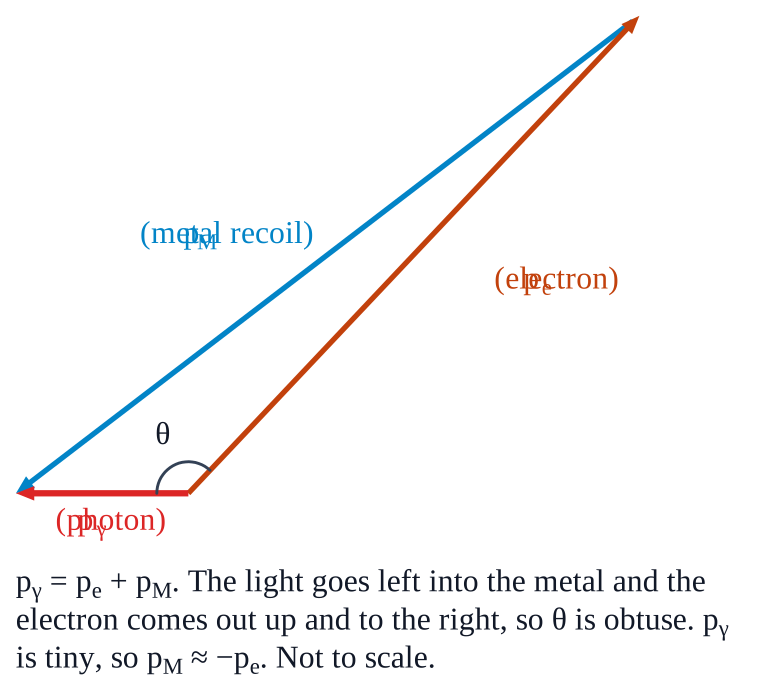
    Consider Fig.11.1 for photoemission.How would you reconcile with momentum-conservation? Note light (photons) have momentum in a different direction than the emitted electrons. NCERT_Question_Class12_Physics_Exemplar_Ch11_Q19
    NCERT’s answer
    The momentum is transferred to the metal. At the microscopic level, atoms absorb the photon and its momentum is transferred mainly to the nucleus and electrons. The excited electron is emitted. Conservation of momentum needs to be accounted for the momentum transferred to the nucleus and electrons.
    NCERT_Solution_Class12_Physics_Exemplar_Ch11_Q19 \[\mathbf{p}_\gamma=\mathbf{p}_e+\mathbf{p}_M \] The metal (lattice) takes the momentum the electron does not. It is so heavy that the energy it gains is negligible: \[E_M=\frac{p_M^2}{2M}\approx 0\quad(M\gg m_e) \] Answer: The metal as a whole recoils and balances the momentum.