SolveIt is under development
SolveItClass 12 · Exemplar

NCERT Exemplar · Class 12 Physics Dual Nature of Radiation and Matter

29 questions

Long Answer Questions 25–29 (part 5 of 5)

  1. Exercise 25

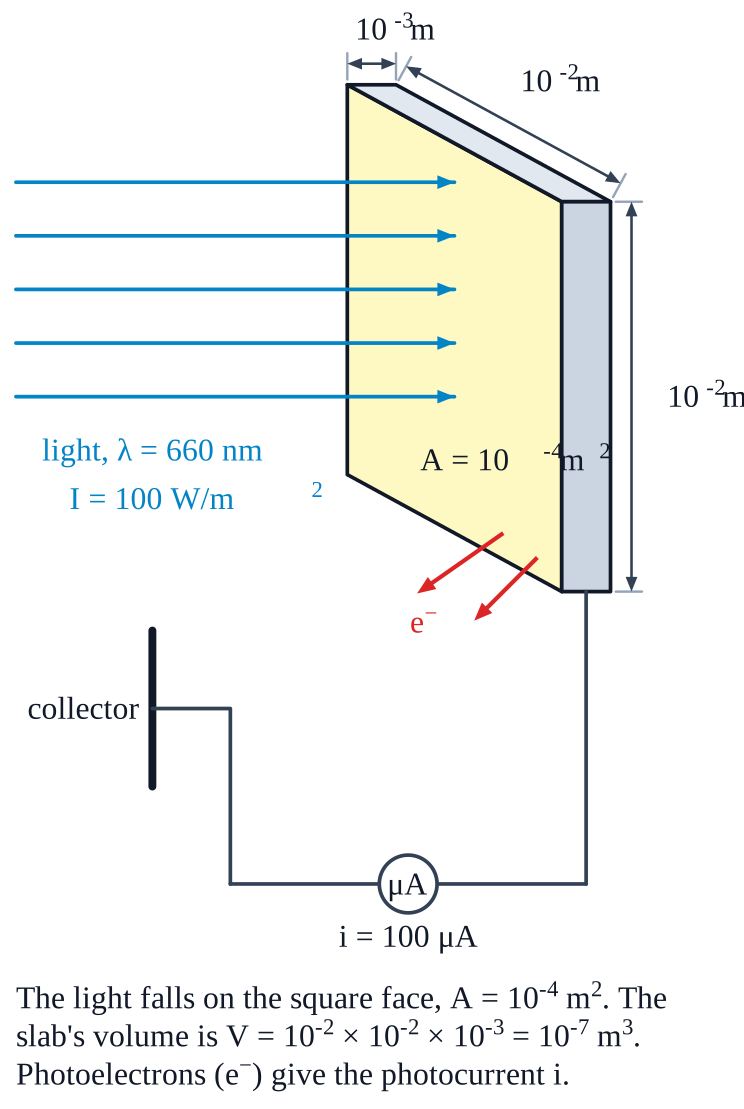
    Consider a thin target (10−2 m\displaystyle 10^{-2} \mathrm{~m} square, 10−3 m\displaystyle 10^{-3} \mathrm{~m} thickness) of sodium, which produces a photocurrent of 100μ A\displaystyle 100 \mu \mathrm{~A} when a light of intensity 100 W/m2(λ=660 nm)\displaystyle 100 \mathrm{~W} / \mathrm{m}^2(\lambda=660 \mathrm{~nm}) falls on it. Find the probability that a photoelectron is produced when a photons strikes a sodium atom. [Take density of Na=0.97 kg/m3\displaystyle \mathrm{Na}=0.97 \mathrm{~kg} / \mathrm{m}^3].
    NCERT_Solution_Class12_Physics_Exemplar_Ch11_Q25\[A=(10^{-2}\,\mathrm{m})^2=10^{-4}\,\mathrm{m^2},\qquad P=IA=100\times10^{-4}=10^{-2}\,\mathrm{W} \]\[E_{ph}=\frac{hc}{\lambda}=\frac{6.63\times10^{-34}\times3\times10^{8}}{660\times10^{-9}}=3.01\times10^{-19}\,\mathrm{J} \]\[n_{ph}=\frac{P}{E_{ph}}=\frac{10^{-2}}{3.01\times10^{-19}}=3.32\times10^{16}\,\mathrm{s^{-1}} \]\[n_e=\frac{i}{e}=\frac{100\times10^{-6}}{1.6\times10^{-19}}=6.25\times10^{14}\,\mathrm{s^{-1}} \]\[\frac{n_e}{n_{ph}}=\frac{6.25\times10^{14}}{3.32\times10^{16}}=1.88\times10^{-2} \]Atoms in the target:\[m=\rho V=0.97\,\mathrm{kg\,m^{-3}}\times10^{-7}\,\mathrm{m^3}=0.97\times10^{-7}\,\mathrm{kg} \]\[N=\frac{m}{M}\,N_A=\frac{0.97\times10^{-7}}{23\times10^{-3}}\times6.02\times10^{23}=2.54\times10^{18} \]The yield per photon is shared over all \(\displaystyle N\) atoms:\[p=\frac{n_e/n_{ph}}{N}=\frac{1.88\times10^{-2}}{2.54\times10^{18}}=7.4\times10^{-21} \](Sodium's true density is \(\displaystyle 970\ \mathrm{kg\,m^{-3}}\); then \(\displaystyle N=2.54\times10^{21}\) and \(\displaystyle p=7.4\times10^{-24}\).)Answer: \(\displaystyle p\approx7.4\times10^{-21}\) per atom, since \(\displaystyle 1.9\times10^{-2}\) of the photons free an electron, shared over \(\displaystyle 2.54\times10^{18}\) atoms.
  2. Exercise 26

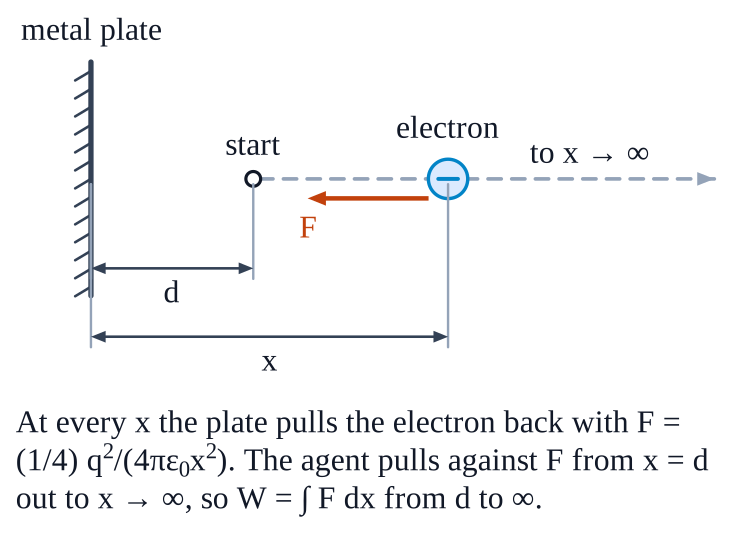
    Consider an electron in front of metallic surface at a distance d\displaystyle d (treated as an infinite plane surface). Assume the force of attraction by the plate is given as 14q24πε0d2\displaystyle \frac{1}{4} \frac{q^2}{4 \pi \varepsilon_0 d^2} Calculate work in taking the charge to an infinite distance from the plate. Taking d=0.1 nm\displaystyle d=0.1 \mathrm{~nm}, find the work done in electron volts. [Such a force law is not valid for d<0.1\displaystyle d<0.1 nm].
    NCERT’s answer
    Work done by an external agency \(\displaystyle =+\frac{1}{4 \pi \varepsilon_0} \cdot \frac{1}{4} \int_d^{\infty} \frac{q^2}{x^2} d x=\frac{1}{4} \cdot \frac{q^2}{4 \pi \varepsilon_0 d}\) With \(\displaystyle d=0.1 \mathrm{~nm}\), energy \(\displaystyle =\frac{\left(1.6 \times 10^{-19}\right) \times 9 \times 10^9}{4\left(10^{-10}\right) \times 1.6 \times 10^{-19}} \mathrm{eV}\) \[=\frac{1.6 \times 9}{4} \mathrm{eV}=3.6 \mathrm{eV} \]
    NCERT_Solution_Class12_Physics_Exemplar_Ch11_Q26The agent pulls against the attraction at every distance \(\displaystyle x\):\[F(x)=\frac14\,\frac{q^2}{4\pi\varepsilon_0\,x^2} \]\[W=\int_d^{\infty}F\,dx=\frac{q^2}{16\pi\varepsilon_0}\int_d^{\infty}\frac{dx}{x^2}=\frac{q^2}{16\pi\varepsilon_0}\left[-\frac1x\right]_d^{\infty}=\frac{q^2}{16\pi\varepsilon_0\,d} \]\[W=\frac14\times\frac{9\times10^{9}\,\mathrm{N\,m^2\,C^{-2}}\times(1.6\times10^{-19}\,\mathrm{C})^2}{10^{-10}\,\mathrm{m}}=5.76\times10^{-19}\,\mathrm{J} \]\[W=\frac{5.76\times10^{-19}\,\mathrm{J}}{1.6\times10^{-19}\,\mathrm{J\,eV^{-1}}}=3.6\,\mathrm{eV} \]Answer: \(\displaystyle W=\dfrac{q^2}{16\pi\varepsilon_0\,d}=3.6\ \mathrm{eV}\)
  3. Exercise 27

    A student performs an experiment on photoelectric effect, using two materials A and B. A plot of Vstop \displaystyle V_{\text {stop }} vs ν\displaystyle \nu is given in Fig. 11.2.
    (i)
    Which material A or B has a higher work function?
    (ii)
    Given the electric charge of an electron =1.6×10⁻¹⁹C\displaystyle =1.6 \times 10^{-19} \mathrm{C}, find the value of h\displaystyle h obtained from the experiment for both A and B.
    Comment on whether it is consistent with Einstein's theory:
    NCERT_Question_Class12_Physics_Exemplar_Ch11_Q27
    Lines meet the frequency axis (\(\displaystyle V_{stop}=0\)) at \(\displaystyle \nu_{0A}=5\times10^{14}\,\mathrm{Hz}\) and \(\displaystyle \nu_{0B}=10\times10^{14}\,\mathrm{Hz}\).(i)\[\phi=h\nu_0,\qquad \nu_{0B}>\nu_{0A}\;\Rightarrow\;\phi_B>\phi_A \](ii)\[eV_{stop}=h\nu-\phi\;\Rightarrow\;\text{slope}=\frac{\Delta V_{stop}}{\Delta\nu}=\frac{h}{e} \]Points read from the graph: A at \(\displaystyle (10\times10^{14}\,\mathrm{Hz},\;2\,\mathrm{V})\), B at \(\displaystyle (15\times10^{14}\,\mathrm{Hz},\;2.5\,\mathrm{V})\).\[h_A=e\,\frac{2.0\,\mathrm{V}}{(10-5)\times10^{14}\,\mathrm{Hz}}=1.6\times10^{-19}\times4\times10^{-15}=6.4\times10^{-34}\,\mathrm{J\,s} \]\[h_B=e\,\frac{2.5\,\mathrm{V}}{(15-10)\times10^{14}\,\mathrm{Hz}}=1.6\times10^{-19}\times5\times10^{-15}=8.0\times10^{-34}\,\mathrm{J\,s} \]\[\phi_A=h_A\nu_{0A}=3.2\times10^{-19}\,\mathrm{J}=2\,\mathrm{eV},\qquad \phi_B=h_B\nu_{0B}=8.0\times10^{-19}\,\mathrm{J}=5\,\mathrm{eV} \]Einstein's equation gives the same slope \(\displaystyle h/e\) for every metal, so the lines must be parallel; here \(\displaystyle h_A\neq h_B\).Answer: (i) B has the higher work function. (ii) \(\displaystyle h_A=6.4\times10^{-34}\,\mathrm{J\,s}\), \(\displaystyle h_B=8.0\times10^{-34}\,\mathrm{J\,s}\); not consistent with Einstein's theory, which needs one \(\displaystyle h\) for both.
  4. Exercise 28

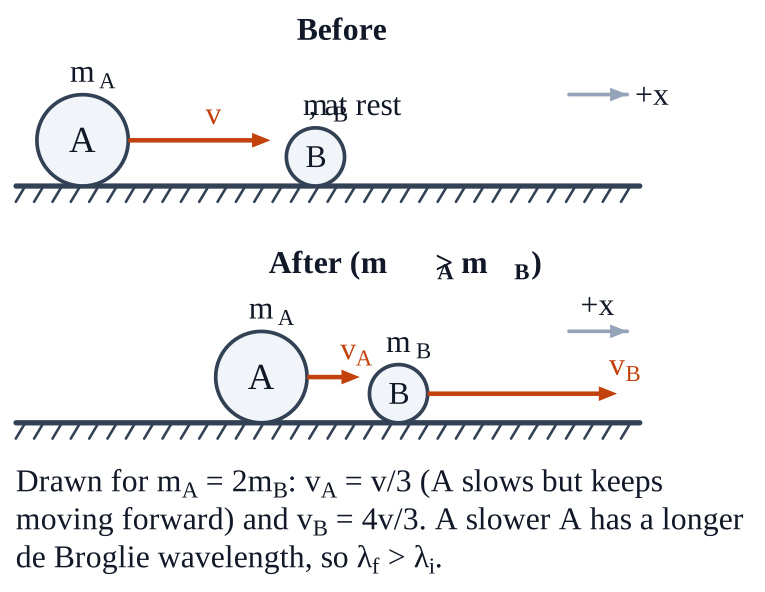
    A particle A with a mass mA\displaystyle m_A is moving with a velocity v\displaystyle v and hits a particle B (mass mB\displaystyle m_B) at rest (one dimensional motion). Find the change in the de Broglic wavelength of the particle A. Treat the collision as elastic.
    NCERT’s answer
    \(\displaystyle m_A v=m_A v_1+m_B v_2\) \[\frac{1}{2} m_A v^2=\frac{1}{2} m_A v_1^2+\frac{1}{2} m_B v_2^2 \] \[\therefore \frac{1}{2} m_A\left(v-v_1\right)\left(v_A+v_1\right)=\frac{1}{2} m_B v_B^2 \] \[\therefore v+v_1=v_2 \] or \(\displaystyle v=v_2-v_1\) \[\therefore v_1=\left(\frac{m_A-m_B}{m_A+m_B}\right) v, \quad \text { and } \quad v_2=\left(\frac{2 m_A}{m_A+m_B}\right) v \] \[\therefore \lambda_{\text {initial }}=\frac{h}{m_A v} \] \[\lambda_{\text {final }}=\frac{h}{m_A v}=\left|\frac{h\left(m_A+m_B\right)}{m_A\left(m_A-m_B\right) v}\right| \] \[\therefore \Delta \lambda=\frac{h}{m_A v}\left[\left|\frac{\left.m_A+m_B\right)}{m_A-m_B}\right|-1\right] \]
    NCERT_Solution_Class12_Physics_Exemplar_Ch11_Q28Elastic collision, A moving along \(\displaystyle +x\):\[m_Av=m_Av_A+m_Bv_B \]\[\tfrac12m_Av^2=\tfrac12m_Av_A^2+\tfrac12m_Bv_B^2 \]\[\Rightarrow\quad v_A=\frac{m_A-m_B}{m_A+m_B}\,v \]\[\lambda_i=\frac{h}{m_Av},\qquad \lambda_f=\frac{h}{m_Av_A}=\frac{h\,(m_A+m_B)}{m_A\,(m_A-m_B)\,v} \]\[\Delta\lambda=\lambda_f-\lambda_i=\frac{h}{m_Av}\left[\frac{m_A+m_B}{m_A-m_B}-1\right]=\frac{2h\,m_B}{m_A\,v\,(m_A-m_B)} \]Caution: if \(\displaystyle m_A<m_B\), A rebounds, so \(\displaystyle \lambda_f\) uses \(\displaystyle |v_A|\):\[\Delta\lambda=\frac{h}{m_Av}\left[\frac{m_A+m_B}{m_B-m_A}-1\right]=\frac{2h}{v\,(m_B-m_A)} \]If \(\displaystyle m_A=m_B\), A stops (\(\displaystyle v_A=0\)) and \(\displaystyle \lambda_f\) is undefined.Answer: \(\displaystyle \Delta\lambda=\dfrac{2h\,m_B}{m_A\,v\,(m_A-m_B)}\) for \(\displaystyle m_A>m_B\) (wavelength increases); \(\displaystyle \Delta\lambda=\dfrac{2h}{v\,(m_B-m_A)}\) for \(\displaystyle m_A<m_B\).
  5. Exercise 29

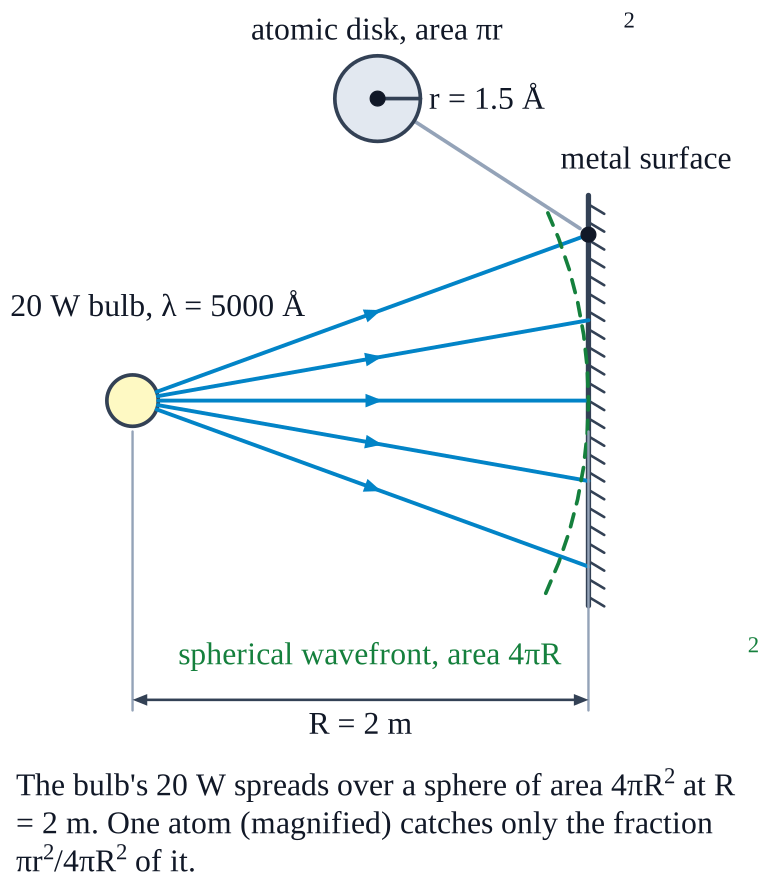
    Consider a 20\displaystyle 20 W bulb emitting light of wavelength 5000A˚\displaystyle 5000 \AA and shining on a metal surface kept at a distance 2m. Assume that the metal surface has work function of 2\displaystyle 2 eV and that each atom on the metal surface can be treated as a circular disk of radius 1.5A˚\displaystyle 1.5 \AA.
    (i)
    Estimate no. of photons emitted by the bulb per second. [Assume no other losses]
    (ii)
    Will there be photoelectric emission?
    (iii)
    How much time would be required by the atomc disk to receive energy equal to work function (2\displaystyle 2 eV)?
    (iv)
    How many photons would atomic disk receive within time duration calculated in (iii) above?
    (v)
    Can you explain how photoelectric effect was observed instantaneously?
    [Hint: Time calculated in part (iii) is from classical consideration and you may further take the target of surface area say 1 cm2\displaystyle 1 \mathrm{~cm}^2 and estimate what would happen?]
    NCERT_Solution_Class12_Physics_Exemplar_Ch11_Q29(i)\[E_{ph}=\frac{hc}{\lambda}=\frac{6.63\times10^{-34}\times3\times10^{8}}{5000\times10^{-10}}=3.98\times10^{-19}\,\mathrm{J}=2.48\,\mathrm{eV} \]\[n=\frac{P}{E_{ph}}=\frac{20\,\mathrm{W}}{3.98\times10^{-19}\,\mathrm{J}}=5.0\times10^{19}\,\mathrm{s^{-1}} \](ii)\[E_{ph}=2.48\,\mathrm{eV}>\phi=2\,\mathrm{eV}\;\Rightarrow\;\text{emission occurs} \](iii) Classical wave picture:\[I=\frac{P}{4\pi R^2}=\frac{20\,\mathrm{W}}{4\pi(2\,\mathrm{m})^2}=0.398\,\mathrm{W\,m^{-2}} \]\[P_{atom}=I\,\pi r^2=0.398\times\pi\,(1.5\times10^{-10}\,\mathrm{m})^2=2.81\times10^{-20}\,\mathrm{W} \]\[t=\frac{\phi}{P_{atom}}=\frac{2\times1.6\times10^{-19}\,\mathrm{J}}{2.81\times10^{-20}\,\mathrm{W}}\approx11\,\mathrm{s} \](iv)\[N=\frac{P_{atom}\,t}{E_{ph}}=\frac{\phi}{E_{ph}}=\frac{2\,\mathrm{eV}}{2.48\,\mathrm{eV}}\approx0.8\approx1\ \text{photon} \](v) On \(\displaystyle 1\,\mathrm{cm^2}\):\[n_1=\frac{I\times10^{-4}\,\mathrm{m^2}}{E_{ph}}=\frac{0.398\times10^{-4}}{3.98\times10^{-19}}=1.0\times10^{14}\,\mathrm{s^{-1}} \]\[\Delta t\sim\frac{1}{n_1}\sim10^{-14}\,\mathrm{s} \]One photon gives all its energy to one electron, so some atom emits within about \(\displaystyle 10^{-14}\) s; the $\displaystyle 11$ s wait never occurs.Answer: (i) \(\displaystyle 5\times10^{19}\ \mathrm{s^{-1}}\); (ii) yes; (iii) \(\displaystyle \approx11\ \mathrm{s}\); (iv) \(\displaystyle \approx1\) photon; (v) about \(\displaystyle 10^{14}\) photons per second reach \(\displaystyle 1\,\mathrm{cm^2}\), so emission starts at once.