SolveIt is under development
SolveItClass 12 · Exemplar

NCERT Exemplar · Class 12 Physics Dual Nature of Radiation and Matter

29 questions

Multiple Choice Questions (Type I) 1–8 (part 1 of 5)

  1. Exercise 1

    A particle is dropped from a height H\displaystyle H. The de Broglie wavelength of the particle as a function of height is proportional to
    (a)
    H\displaystyle H (b) H1/2\displaystyle H^{1 / 2}
    (c)
    H0\displaystyle H^0
    (b)
    H−1/2\displaystyle H^{-1 / 2}
    NCERT’s answer
    (d)
    (d) \(\displaystyle H^{-1/2}\), the last option. The higher the fall, the greater the speed on reaching the ground, so \(\displaystyle \lambda\) falls with \(\displaystyle H\).\[v^2=2gH\;\Rightarrow\;v=\sqrt{2gH} \]\[\lambda=\frac{h}{mv}=\frac{h}{m\sqrt{2gH}} \]\[\lambda\propto H^{-1/2} \]
  2. Exercise 2

    The wavelength of a photon needed to remove a proton from a nucleus which is bound to the nucleus with 1\displaystyle 1 MeV energy is nearly
    (a)
    1.2\displaystyle 2 nm
    (b)
    1.2×10⁻³ nm\displaystyle 1.2 \times 10^{-3} \mathrm{~nm}
    (c)
    1.2×10⁻⁶ nm\displaystyle 1.2 \times 10^{-6} \mathrm{~nm}
    (d)
    1.2×101 nm\displaystyle 1.2 \times 10^1 \mathrm{~nm}
    NCERT’s answer
    (b)
    (b) \(\displaystyle 1.2\times10^{-3}\ \mathrm{nm}\). The photon energy must equal the $\displaystyle 1$ MeV binding energy.\[E=1\ \mathrm{MeV}=10^{6}\ \mathrm{eV} \]\[\lambda=\frac{hc}{E}=\frac{1240\ \mathrm{eV\,nm}}{10^{6}\ \mathrm{eV}} \]\[\lambda=1.24\times10^{-3}\ \mathrm{nm}\approx1.2\times10^{-3}\ \mathrm{nm} \]
  3. Exercise 3

    Consider a beam of electrons (each electron with energy E0\displaystyle E_0) incident on a metal surface kept in an evacuated chamber. Then
    (a)
    no electrons will be emitted as only photons can emit electrons.
    (b)
    electrons can be emitted but all with an energy, E0\displaystyle \mathrm{E}_0.
    (c)
    electrons can be emitted with any energy, with a maximum of E0−ϕ\displaystyle E_0-\phi (ϕ\displaystyle \phi is the work function).
    (d)
    electrons can be emitted with any energy, with a maximum of E0\displaystyle E_0.
    NCERT’s answer
    (d)
    (d) An electron that rebounds elastically leaves with the full \(\displaystyle E_0\); one that gives energy \(\displaystyle \Delta E\) to the metal leaves with less. None can leave with more than \(\displaystyle E_0\).\[E_0=E_{\mathrm{out}}+\Delta E,\qquad \Delta E\ge 0 \]\[\Delta E=0\;\Rightarrow\;E_{\mathrm{out}}=E_0,\qquad \Delta E>0\;\Rightarrow\;E_{\mathrm{out}}<E_0 \]\[0\le E_{\mathrm{out}}\le E_0 \]
  4. Exercise 4

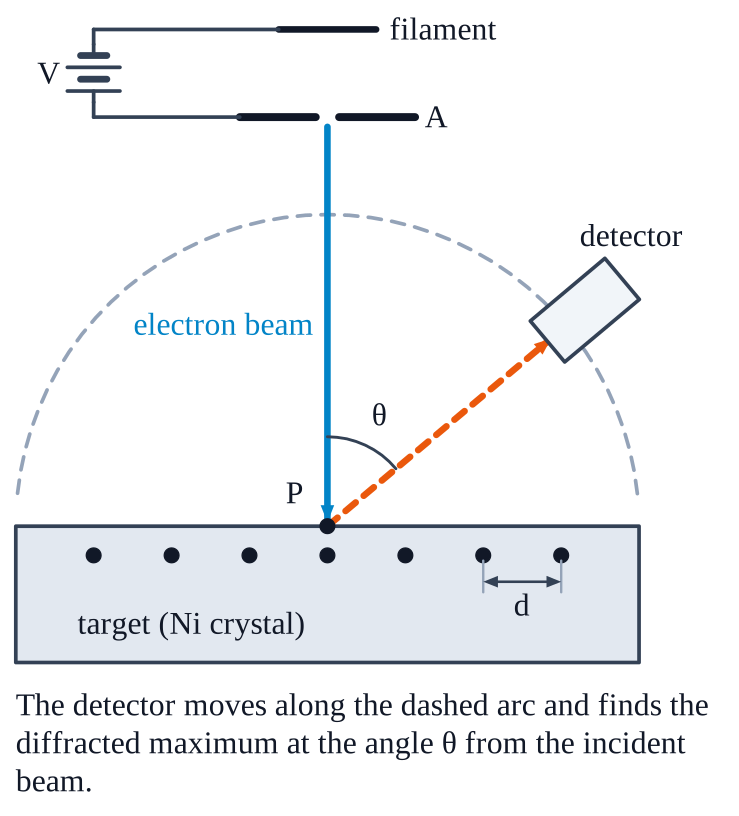
    Consider Fig. 11.7\displaystyle 11.7 in the NCERT text book of physics for Class XII. Suppose the voltage applied to A is increased. The diffracted beam will have the maximum at a value of θ\displaystyle \theta that
    (a)
    will be larger than the earlier value.
    (b)
    will be the same as the earlier value.
    (c)
    will be less than the earlier value.
    (d)
    will depend on the target.
    NCERT’s answer
    (c)
    (c) A larger \(\displaystyle V\) shortens \(\displaystyle \lambda\), so the maximum moves to a smaller \(\displaystyle \theta\). The target fixes only \(\displaystyle d\), not the trend.NCERT_Solution_Class12_Physics_Exemplar_Ch11_Q4\[\lambda=\frac{h}{\sqrt{2meV}} \]\[d\sin\theta=\lambda\quad(\text{first-order maximum}) \]\[V\uparrow\;\Rightarrow\;\lambda\downarrow\;\Rightarrow\;\sin\theta\downarrow\;\Rightarrow\;\theta\downarrow \]
  5. Exercise 5

    A proton, a neutron, an electron and an α\displaystyle \alpha-particle have same energy. Then their de Broglie wavelengths compare as
    (a)
    λp=λn>λe>λα\displaystyle \lambda_{\mathrm{p}}=\lambda_{\mathrm{n}}>\lambda_{\mathrm{e}}>\lambda_\alpha
    (b)
    λα<λp=λn>λe\displaystyle \lambda_\alpha<\lambda_{\mathrm{p}}=\lambda_{\mathrm{n}}>\lambda_{\mathrm{e}}
    (c)
    λe<λp=λn>λα\displaystyle \lambda_{\mathrm{e}}<\lambda_{\mathrm{p}}=\lambda_{\mathrm{n}}>\lambda_\alpha
    (d)
    λe=λp=λn=λα\displaystyle \lambda_{\mathrm{e}}=\lambda_{\mathrm{p}}=\lambda_{\mathrm{n}}=\lambda_\alpha
    NCERT’s answer
    (b)
    (b) \(\displaystyle \lambda_\alpha<\lambda_p=\lambda_n<\lambda_e\) (the last sign in option (b) must read \(\displaystyle <\)). At equal energy the heavier particle has the shorter wavelength.\[\lambda=\frac{h}{p}=\frac{h}{\sqrt{2mK}}\;\Rightarrow\;\lambda\ \text{falls as}\ m\uparrow \]\[m_e\ll m_p\approx m_n<m_\alpha\approx4m_p \]\[\frac{\lambda_e}{\lambda_p}=\sqrt{\frac{m_p}{m_e}}\approx43,\qquad \frac{\lambda_\alpha}{\lambda_p}=\sqrt{\frac{m_p}{m_\alpha}}\approx\frac12 \]\[\lambda_\alpha<\lambda_p\approx\lambda_n<\lambda_e \]
  6. Exercise 6

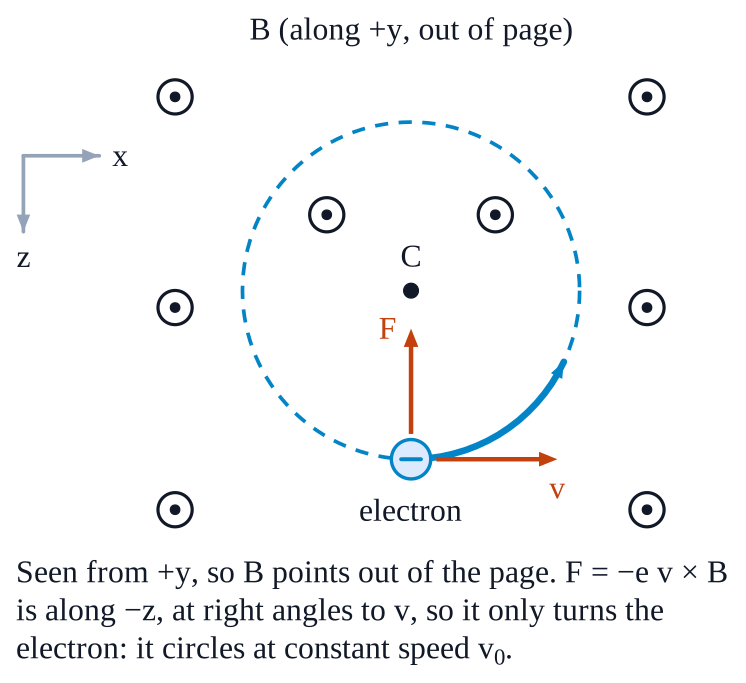
    An electron is moving with an initial velocity v=v0i^\displaystyle \mathbf{v}=v_0 \hat{\mathbf{i}} and is in a magnetic field B=B0j^\displaystyle \mathbf{B}=B_0 \hat{\mathbf{j}}. Then it's de Broglie wavelength
    (a)
    remains constant.
    (b)
    increases with time.
    (c)
    decreases with time.
    (d)
    increases and decreases periodically.
    NCERT’s answer
    (a)
    (a) The magnetic force is perpendicular to \(\displaystyle \mathbf{v}\): it bends the path but does no work, so the speed and \(\displaystyle \lambda\) stay constant.NCERT_Solution_Class12_Physics_Exemplar_Ch11_Q6\[\mathbf{F}=-e\,\mathbf{v}\times\mathbf{B}=-ev_0B_0\,(\hat{\mathbf{i}}\times\hat{\mathbf{j}})=-ev_0B_0\,\hat{\mathbf{k}} \]\[\mathbf{F}\cdot\mathbf{v}=0\;\Rightarrow\;\frac{dK}{dt}=0\;\Rightarrow\;v=v_0 \]\[\lambda=\frac{h}{mv_0}=\text{constant} \]
  7. Exercise 7

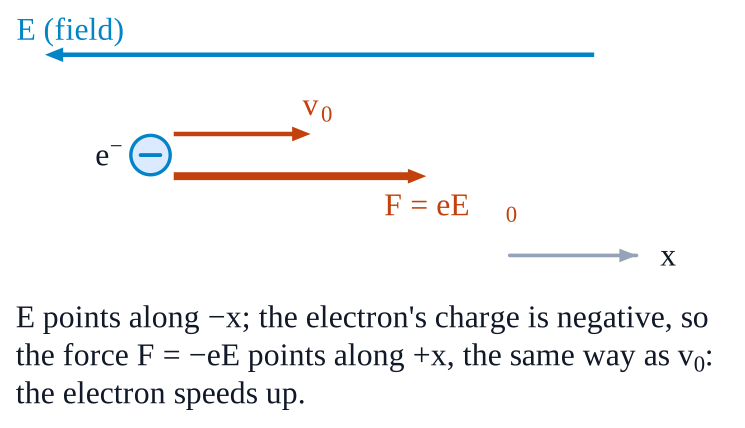
    An electron (mass m\displaystyle m) with an initial velocity v=v0i^(v0>0)\displaystyle \mathbf{v}=v_0 \hat{\mathbf{i}}\left(v_0>0\right) is in an electric field E=−E0i^(E0=\displaystyle \mathbf{E}=-E_0 \hat{\mathbf{i}}\left(E_0=\right. constant >0)\displaystyle \left.>0\right). It's de Broglie wavelength at time t\displaystyle t is given by
    (a)
    λ0(1+eE0mtv0)\displaystyle \frac{\lambda_0}{\left(1+\dfrac{e E_0}{m} \dfrac{t}{v_0}\right)}
    (b)
    λ0(1+eE0tmv0)\displaystyle \lambda_0\left(1+\frac{e E_0 t}{m v_0}\right)
    (c)
    λ0\displaystyle \lambda_0
    (d)
    λ0t\displaystyle \lambda_0 t.
    NCERT’s answer
    (a)
    (a) The force on the electron points along \(\displaystyle +\hat{\mathbf{i}}\), so it speeds up and \(\displaystyle \lambda\) shrinks.NCERT_Solution_Class12_Physics_Exemplar_Ch11_Q7\[\mathbf{F}=-e\mathbf{E}=eE_0\,\hat{\mathbf{i}}\;\Rightarrow\;a=\frac{eE_0}{m} \]\[v=v_0+\frac{eE_0}{m}\,t \]\[\lambda=\frac{h}{mv}=\frac{h}{mv_0\left(1+\dfrac{eE_0}{m}\dfrac{t}{v_0}\right)}=\frac{\lambda_0}{1+\dfrac{eE_0}{m}\dfrac{t}{v_0}} \]
  8. Exercise 8

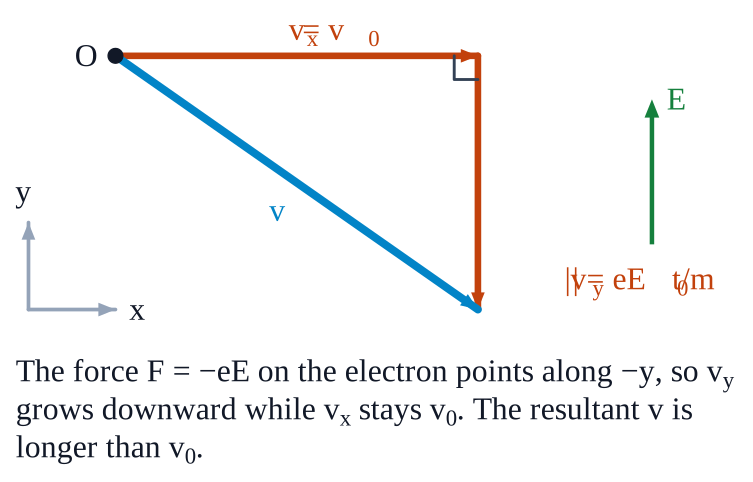
    An electron (mass m\displaystyle m) with an initial velocity v=v0i^\displaystyle \mathbf{v}=v_0 \hat{\mathbf{i}} is in an electric field E=E0j^\displaystyle \mathbf{E}=E_0 \hat{\mathbf{j}}. If λ0=h/mv0\displaystyle \lambda_0=h / m v_0, it's de Breoglie wavelength at time t\displaystyle t is given by
    (a)
    λ0\displaystyle \lambda_0
    (b)
    λ01+e2E02t2m2v02\displaystyle \lambda_0 \sqrt{1+\frac{e^2 E_0^2 t^2}{m^2 v_0^2}}
    (c)
    λ01+e2E02t2m2v02\displaystyle \frac{\lambda_0}{\sqrt{1+\dfrac{e^2 E_0^2 t^2}{m^2 v_0^2}}}
    (d)
    λ0(1+e2E02t2m2v02)\displaystyle \frac{\lambda_0}{\left(1+\dfrac{e^2 E_0^2 t^2}{m^2 v_0^2}\right)}
    NCERT’s answer
    (c)
    (c) \(\displaystyle \lambda_0\Big/\sqrt{1+\dfrac{e^2E_0^2t^2}{m^2v_0^2}}\). The force acts along \(\displaystyle y\) only, so \(\displaystyle v_x\) stays \(\displaystyle v_0\) while \(\displaystyle v_y\) grows and the speed rises.NCERT_Solution_Class12_Physics_Exemplar_Ch11_Q8\[\mathbf{F}=-e\mathbf{E}=-eE_0\,\hat{\mathbf{j}}\;\Rightarrow\;a_y=-\frac{eE_0}{m} \]\[v_x=v_0,\qquad v_y=-\frac{eE_0}{m}\,t \]\[v=\sqrt{v_x^2+v_y^2}=v_0\sqrt{1+\frac{e^2E_0^2t^2}{m^2v_0^2}} \]\[\lambda=\frac{h}{mv}=\frac{h}{mv_0\sqrt{1+\dfrac{e^2E_0^2t^2}{m^2v_0^2}}}=\frac{\lambda_0}{\sqrt{1+\dfrac{e^2E_0^2t^2}{m^2v_0^2}}} \]