SolveIt is under development
SolveItClass 12 · Exemplar

NCERT Exemplar · Class 12 Physics Dual Nature of Radiation and Matter

29 questions

Multiple Choice Questions (Type II) 9–13 (part 2 of 5)

  1. Exercise 9

    Relativistic corrections become neccssary when the expression for the kinetic energy 12mv2\displaystyle \frac{1}{2} m v^2, becomes comparable with mc2\displaystyle m c^2, where m\displaystyle m is the mass of the particle. At what de Broglie wavelength will relativistic corrections become important for an electron?
    (a)
    λ=10 nm\displaystyle \lambda=10 \mathrm{~nm}
    (b)
    λ=10−1 nm\displaystyle \lambda=10^{-1} \mathrm{~nm}
    (c)
    λ=10−4 nm\displaystyle \lambda=10^{-4} \mathrm{~nm}
    (d)
    λ=10−6 nm\displaystyle \lambda=10^{-6} \mathrm{~nm}
    NCERT’s answer
    (c), (d)
    (c), (d)Relativistic once \(\displaystyle KE\approx mc^2\); find the wavelength at that point.\[p=\sqrt{2m\,KE}=\sqrt{2}\,mc \]\[\lambda=\frac{h}{p}=\frac{6.63\times10^{-34}\ \mathrm{J\,s}}{\sqrt{2}\,(9.1\times10^{-31}\ \mathrm{kg})(3\times10^{8}\ \mathrm{m\,s^{-1}})}\approx1.7\times10^{-12}\ \mathrm{m}=1.7\times10^{-3}\ \mathrm{nm} \]\[\lambda\lesssim1.7\times10^{-3}\ \mathrm{nm}\ \Rightarrow\ 10^{-4}\ \mathrm{nm},\ 10^{-6}\ \mathrm{nm} \]
  2. Exercise 10

    Two particles A1 s\displaystyle \mathrm{A}_{1 \mathrm{~s}} and A2\displaystyle \mathrm{A}_2 of masses m1,m2(m1>m2)\displaystyle m_1, m_2\left(m_1>m_2\right) have the same de Broglie wavelength. Then
    (a)
    their momenta are the same.
    (b)
    their energies are the same.
    (c)
    energy of A1\displaystyle \mathrm{A}_1 is less than the energy of A2\displaystyle \mathrm{A}_2.
    (d)
    energy of A1\displaystyle \mathrm{A}_1 is more than the energy of A2\displaystyle \mathrm{A}_2.
    NCERT’s answer
    (a), (c)
    (a), (c)Equal \(\displaystyle \lambda\) fixes the momentum; the heavier particle then has less energy.\[p=\frac{h}{\lambda}\ \Rightarrow\ p_1=p_2 \]\[E=\frac{p^2}{2m},\qquad m_1>m_2\ \Rightarrow\ E_1<E_2 \]
  3. Exercise 11

    The de Broglie wavelength of a photon is twice the de Broglie wavelength of an electron. The speed of the electron is ve=c100\displaystyle v_e=\frac{c}{100}. Then
    (a)
    EeEp=10−4\displaystyle \frac{E_e}{E_p}=10^{-4}
    (b)
    EeEp=10−2\displaystyle \frac{E_e}{E_p}=10^{-2}
    (c)
    pemec=10−2\displaystyle \frac{p_e}{m_e c}=10^{-2}
    (d)
    pemec=10−4\displaystyle \frac{p_e}{m_e c}=10^{-4}.
    NCERT’s answer
    (b), (c)
    (b), (c)Photon momentum from its wavelength; electron is non-relativistic at \(\displaystyle c/100\).\[\lambda_p=2\lambda_e\ \Rightarrow\ p_p=\frac{h}{\lambda_p}=\frac{p_e}{2} \]\[\frac{p_e}{m_e c}=\frac{m_e v_e}{m_e c}=\frac{v_e}{c}=10^{-2} \]\[\frac{E_e}{E_p}=\frac{\tfrac{1}{2}p_e v_e}{p_p\,c}=\frac{\tfrac{1}{2}p_e v_e}{\tfrac{1}{2}p_e\,c}=\frac{v_e}{c}=10^{-2} \]
  4. Exercise 12

    Photons absorbed in matter are converted to heat. A source emitting n\displaystyle n photon/sec of frequency ν\displaystyle \nu is used to convert 1\displaystyle 1 kg of ice at 0\displaystyle 0°C to water at 0\displaystyle 0°C. Then, the time T\displaystyle T taken for the conversion
    (a)
    decreases with increasing n\displaystyle n, with ν\displaystyle \nu fixed.
    (b)
    decreases with n\displaystyle n fixed, ν\displaystyle \nu increasing
    (c)
    remains constant with n and ν\displaystyle \nu changing such that nν=\displaystyle n \nu= constant.
    (d)
    increases when the product nν\displaystyle n \nu increases.
    NCERT’s answer
    (a), (b), (c)
    (a), (b), (c)The heat needed is fixed; the photons supply power \(\displaystyle nh\nu\).\[Q=mL_f=(1\ \mathrm{kg})(3.36\times10^{5}\ \mathrm{J\,kg^{-1}})=3.36\times10^{5}\ \mathrm{J} \]\[Q=(nh\nu)\,T\ \Rightarrow\ T=\frac{mL_f}{nh\nu} \]\[n\uparrow\Rightarrow T\downarrow,\qquad \nu\uparrow\Rightarrow T\downarrow,\qquad n\nu=\text{const}\Rightarrow T=\text{const},\qquad n\nu\uparrow\Rightarrow T\downarrow \]
  5. Exercise 13

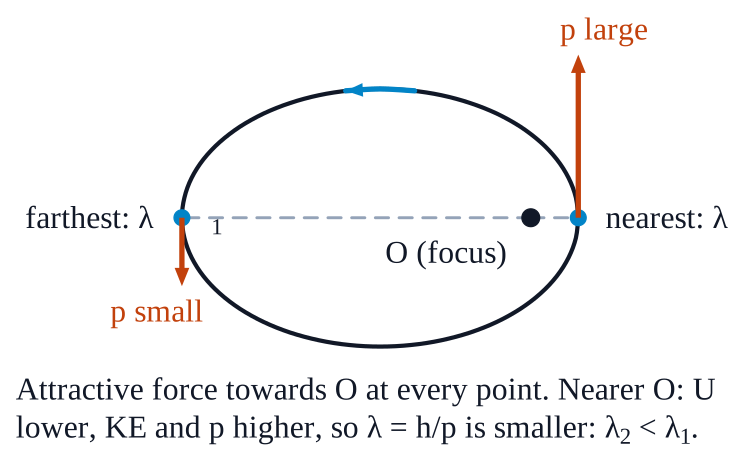
    A particle moves in a closed orbit around the origin, due to a force which is directed towards the origin. The de Broglie wavelength of the particle varies cyclically between two values λ1\displaystyle \lambda_1, λ2\displaystyle \lambda_2 with λ1>λ2\displaystyle \lambda_1>\lambda_2. Which of the following statement are true?
    (a)
    The particle could be moving in a circular orbit with origin as centre
    (b)
    The particle could be moving in an elliptic orbit with origin as its focus.
    (c)
    When the de Broglie wave length is λ1\displaystyle \lambda_1, the particle is nearer the origin than when its value is λ2\displaystyle \lambda_2.
    (d)
    When the de Broglic wavelength is λ2\displaystyle \lambda_2, the particle is nearer the origin than when its value is λ1\displaystyle \lambda_1.
    NCERT’s answer
    (b), (d)
    (b), (d)\(\displaystyle \lambda\) changes, so \(\displaystyle p\) and the speed change; a circular orbit has constant speed, so (a) is out. An inverse-square attraction gives an ellipse with the origin at a focus.\[\frac{p^{2}}{2m}+U(r)=E=\text{const} \]\[r\downarrow\Rightarrow U\downarrow\Rightarrow KE\uparrow\Rightarrow p\uparrow\Rightarrow\lambda\downarrow \]NCERT_Solution_Class12_Physics_Exemplar_Ch11_Q13