SolveIt is under development
SolveItClass 12 · Exemplar

NCERT Exemplar · Class 12 Physics Dual Nature of Radiation and Matter

29 questions

Short Answer Questions 20–24 (part 4 of 5)

  1. Exercise 20

    Consider a metal exposed to light of wavelength 600\displaystyle 600 nm. The maximum energy of the electron doubles when light of wavelength 400\displaystyle 400 snm is used. Find the work function in eV.
    NCERT’s answer
    Maximum energy \(\displaystyle =h \nu-\phi\) \[\begin{aligned} & \left(\frac{1230}{600}-\phi\right)=\frac{1}{2}\left(\frac{1230}{400}-\phi\right) \\ & \phi=\frac{1230}{1200}=1.02 \mathrm{eV} . \end{aligned} \]
    \[E_1=\frac{hc}{\lambda_1}=\frac{1240\ \mathrm{eV\,nm}}{600\ \mathrm{nm}}=2.07\ \mathrm{eV},\qquad E_2=\frac{hc}{\lambda_2}=\frac{1240\ \mathrm{eV\,nm}}{400\ \mathrm{nm}}=3.10\ \mathrm{eV} \] \[K_1=E_1-\phi_0,\qquad K_2=E_2-\phi_0 \] \[K_2=2K_1 \;\Rightarrow\; E_2-\phi_0=2E_1-2\phi_0 \] \[\phi_0=2E_1-E_2=2(2.067)-3.100\ \mathrm{eV}=1.03\ \mathrm{eV} \] Answer: \(\displaystyle \phi_0\approx 1.03\ \mathrm{eV}\)
  2. Exercise 21

    Assuming an electron is confined to a 1nm wide region, find the uncertainty in momentum using Heisenberg Uncertainty principle (Ref Eq 11.12\displaystyle 11.12 of NCERT Textbook). You can assume the uncertainty in position Δx\displaystyle \Delta x as 1\displaystyle 1 nm. Assuming p≃Δp\displaystyle p \simeq \Delta p, find the energy of the electron in electron volts.
    NCERT’s answer
    \(\displaystyle \Delta x \Delta p \simeq \hbar\) \[\Delta p \simeq \frac{\hbar}{\Delta x} \simeq \frac{1.05 \times 10^{-34} \mathrm{Js}}{10^{-9} \mathrm{~m}}=1.05 \times 10^{-25} \] \[\begin{aligned} & E=\frac{p^2}{2 m}=\frac{\left(1.05 \times 10^{-25}\right)^2}{2 \times 9.1 \times 10^{-31}}=\frac{1.05^2}{18.2} \times 10^{-19} \mathrm{~J}=\frac{1.05^2}{18.2 \times 1.6} \mathrm{eV} \\ & =3.8 \times 10^{-2} \mathrm{eV} \end{aligned} \]
    \[\Delta x\,\Delta p\simeq\hbar=\frac{h}{2\pi}=1.05\times10^{-34}\ \mathrm{J\,s} \] \[\Delta p\simeq\frac{\hbar}{\Delta x}=\frac{1.05\times10^{-34}\ \mathrm{J\,s}}{1\times10^{-9}\ \mathrm{m}}=1.05\times10^{-25}\ \mathrm{kg\,m\,s^{-1}} \] \[p\simeq\Delta p\ \Rightarrow\ E=\frac{p^{2}}{2m}=\frac{(1.05\times10^{-25}\ \mathrm{kg\,m\,s^{-1}})^{2}}{2\,(9.11\times10^{-31}\ \mathrm{kg})}=6.05\times10^{-21}\ \mathrm{J} \] \[E=\frac{6.05\times10^{-21}\ \mathrm{J}}{1.6\times10^{-19}\ \mathrm{J\,eV^{-1}}}\approx 3.8\times10^{-2}\ \mathrm{eV} \] Answer: \(\displaystyle \Delta p\approx1.05\times10^{-25}\ \mathrm{kg\,m\,s^{-1}}\); \(\displaystyle E\approx 3.8\times10^{-2}\ \mathrm{eV}\)
  3. Exercise 22

    Two monochromatic beams A and B of equal intensity I\displaystyle I, hit a screen. The number of photons hitting the screen by beam A is twice that by beam B. Then what inference can you make about their frequencies?
    NCERT’s answer
    \(\displaystyle I=n_A n_A=n_B \nu_B\) \[\frac{n_A}{n_B}=2=\frac{\nu_B}{\nu_A} \] The frequency of beam B is twice that of A.
    With \(\displaystyle n\) the photons reaching unit area per second, each carrying \(\displaystyle h\nu\): \[I=n\,h\nu \] \[I_A=I_B\ \Rightarrow\ n_A\,h\nu_A=n_B\,h\nu_B \] \[n_A=2n_B\ \Rightarrow\ 2n_B\,h\nu_A=n_B\,h\nu_B\ \Rightarrow\ \nu_B=2\nu_A \] Beam A has twice the photons, so each A photon carries half the energy.Answer: \(\displaystyle \nu_A=\tfrac12\,\nu_B\), the frequency of A is half that of B.
  4. Exercise 23

    Two particles A and B of de Broglie wavelengths λ1\displaystyle \lambda_1 and λ2\displaystyle \lambda_2 combine to form a particle C. The process conserves momentum. Find the de Broglie wavelength of the particle C. (The motion is one dimensional).
    NCERT’s answer
    \(\displaystyle p_c=\left|p_A\right|+\left|p_B\right|=\frac{h}{\lambda_A}+\frac{h}{\lambda_B}=\frac{h}{\lambda_c}=\frac{h}{\lambda_c}\) if \(\displaystyle p_A, p_B>0\) or \(\displaystyle p_A, p_B<0\) or \(\displaystyle \lambda_c=\frac{\lambda_A \lambda_B}{\lambda_A+\lambda_B}\) If \(\displaystyle p_A>0, \mathrm{p}_{\mathrm{B}}<0\) or \(\displaystyle p_A<0, \mathrm{p}_{\mathrm{B}}>0\) \[\begin{aligned} & p_c=h \frac{\lambda_B-\lambda_A}{\left|\lambda_A \cdot \lambda_B\right|}=\frac{h}{\lambda_c} \\ & \lambda_c=\frac{\lambda_B \cdot \lambda_A}{\left|\lambda_A-\lambda_B\right|} . \end{aligned} \]
    \[p_1=\frac{h}{\lambda_1},\qquad p_2=\frac{h}{\lambda_2} \] Momenta add, not wavelengths. Same direction: \[p_C=p_1+p_2\ \Rightarrow\ \frac{h}{\lambda_C}=\frac{h}{\lambda_1}+\frac{h}{\lambda_2} \] \[\lambda_C=\frac{\lambda_1\lambda_2}{\lambda_1+\lambda_2} \] Opposite directions: \(\displaystyle p_C=p_1-p_2\), so \(\displaystyle \lambda_C=\dfrac{\lambda_1\lambda_2}{|\lambda_2-\lambda_1|}\).Answer: \(\displaystyle \lambda_C=\dfrac{\lambda_1\lambda_2}{\lambda_1+\lambda_2}\) (particles moving the same way)
  5. Exercise 24

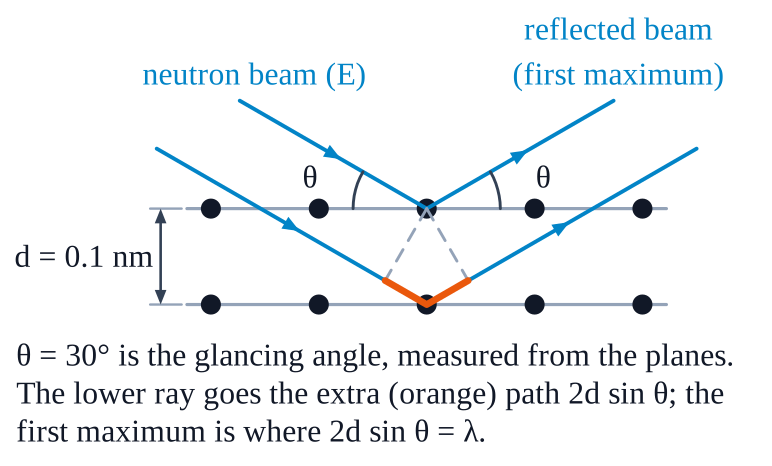
    A neutron beam of energy E\displaystyle E scatters from atoms on a surface with a spacing d=0.1 nm\displaystyle d=0.1 \mathrm{~nm}. The first maximum of intensity in the reflected beam occurs at θ=30∘\displaystyle \theta=30^{\circ}. What is the kinetic energy E\displaystyle E of the beam in eV?
    NCERT_Solution_Class12_Physics_Exemplar_Ch11_Q24 Bragg's condition, with \(\displaystyle \theta\) the glancing angle measured from the planes (not from the normal): \[2d\sin\theta=n\lambda,\qquad n=1 \] \[\lambda=2\,(0.1\ \mathrm{nm})\sin30^\circ=0.1\ \mathrm{nm}=1\times10^{-10}\ \mathrm{m} \] \[E=\frac{p^{2}}{2m_n}=\frac{h^{2}}{2m_n\lambda^{2}}=\frac{(6.63\times10^{-34}\ \mathrm{J\,s})^{2}}{2\,(1.675\times10^{-27}\ \mathrm{kg})(10^{-10}\ \mathrm{m})^{2}}=1.31\times10^{-20}\ \mathrm{J} \] \[E=\frac{1.31\times10^{-20}\ \mathrm{J}}{1.6\times10^{-19}\ \mathrm{J\,eV^{-1}}}\approx 0.082\ \mathrm{eV} \] Answer: \(\displaystyle E\approx 0.082\ \mathrm{eV}\)