SolveIt is under development
SolveItClass 12 · Exemplar

NCERT Exemplar · Class 12 Physics Current Electricity

31 questions

Very Short Answer Questions 12–21 (part 3 of 5)

  1. Exercise 12

    Is the momentum conserved when charge crosses a junction in an electric circuit? Why or why not?
    NCERT’s answer
    When an electron approaches a junction, in addition to the uniform \(\displaystyle \mathbf{E}\) that it normally faces (which keep the drift velocity \(\displaystyle \boldsymbol{v}_d\) fixed), there are accumulation of charges on the surface of wires at the junction. These produce electric field. These fields alter direction of momentum.
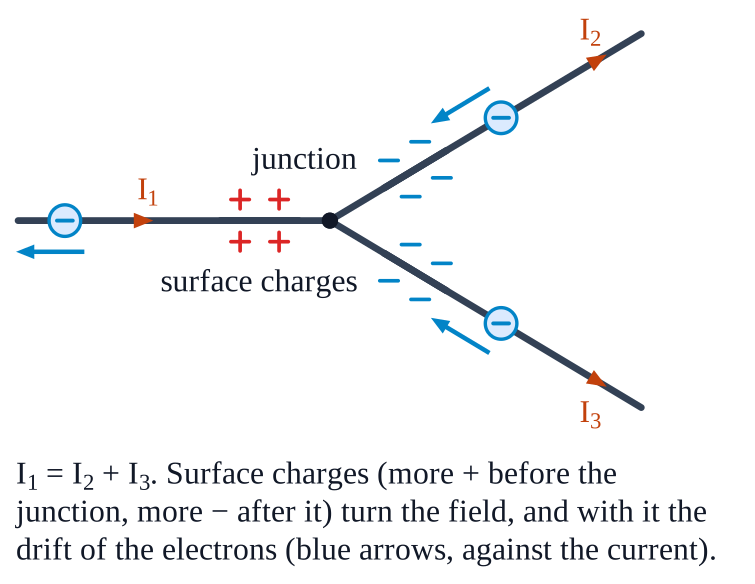
    NCERT_Solution_Class12_Physics_Exemplar_Ch3_Q12 Only charge is conserved at the junction: \[I_1 = I_2 + I_3 \] Surface charges at the junction set up fields that turn the carriers: \[\mathbf{F}_{\text{net}} = \frac{d\mathbf{p}}{dt} \neq 0 \] Answer: No; charge is conserved, momentum is not.
  2. Exercise 13

    The relaxation time τ\displaystyle \tau is nearly independent of applied E\displaystyle E field whereas it changes significantly with temperature T\displaystyle T. First fact is (in part) responsible for Ohm's law whereas the second fact leads to variation of ρ\displaystyle \rho with temperature. Elaborate why?
    NCERT’s answer
    Relaxation time is bound to depend on velocities of electrons and ions. Applied electric field affects the velocities of electrons by speeds at the order of 1mm/s, an insignificant effect. Change in \(\displaystyle T\), on the other hand, affects velocities at the order of \(\displaystyle 10^2 \mathrm{~m} / \mathrm{s}\). This can affect \(\displaystyle \tau\) significantly. [\(\displaystyle \rho=\rho(E, T)\) in which \(\displaystyle E\) dependence is ignorable for ordinary applied voltages.]
    Since \(\displaystyle v_d\) is far below the thermal speed, \(\displaystyle E\) hardly changes \(\displaystyle \tau\): \[\mathbf{v}_d = -\frac{e\tau}{m}\mathbf{E} \] \[\mathbf{J} = -ne\,\mathbf{v}_d = \frac{ne^2\tau}{m}\,\mathbf{E} = \sigma\mathbf{E},\qquad \tau \text{ constant} \Rightarrow \sigma \text{ constant} \Rightarrow J \propto E \] \[\rho = \frac{1}{\sigma} = \frac{m}{ne^2\tau} \] \[T\uparrow \Rightarrow \text{ion vibrations}\uparrow \Rightarrow \tau\downarrow \Rightarrow \rho\uparrow \] Answer: constant \(\displaystyle \tau\) gives Ohm's law; temperature changes \(\displaystyle \tau\), hence \(\displaystyle \rho\).
  3. Exercise 14

    What are the advantages of the null-point method in a Wheatstone bridge? What additional measurements would be required to calculate Runknown\displaystyle R_{\text{unknown}} by any other method?
    NCERT’s answer
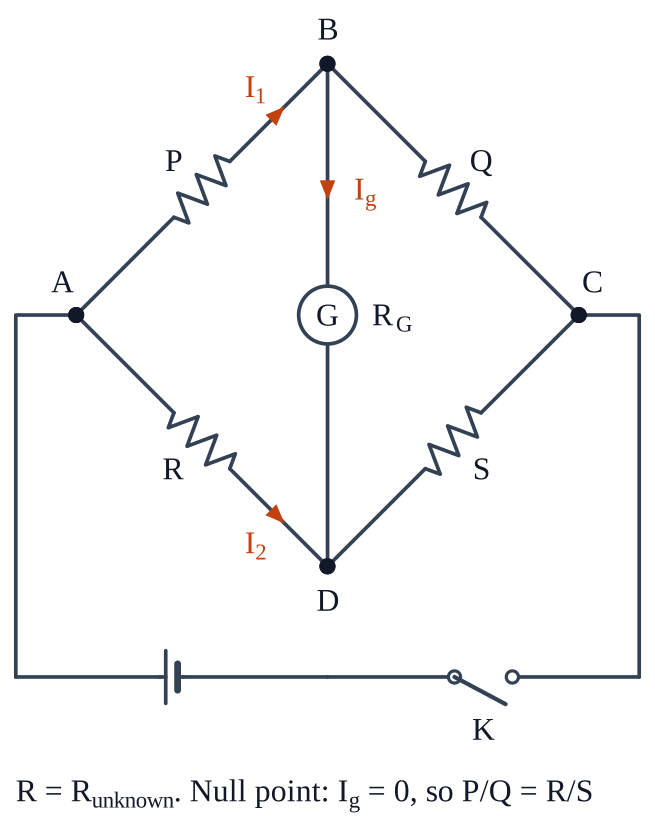
    The advantage of null point method in a Wheatstone bridge is that the resistance of galvanometer does not affect the balance point and there is no need to determine current in resistances and galvanometer and the internal resistance of a galvanometer. \(\displaystyle R_{\text {unknown }}\) can be calculated applying Kirchhoff's rules to the circuit. We would need additional accurate measurement of all the currents in resistances and galvanometer and internal resistance of the galvanometer.
    NCERT_Solution_Class12_Physics_Exemplar_Ch3_Q14 Null point, \(\displaystyle I_g = 0\): \[\frac{P}{Q} = \frac{R}{S} \;\Rightarrow\; R = \frac{P}{Q}\,S \] Independent of \(\displaystyle R_G\), emf and internal resistance. Off balance, loop rule on A-B-D: \[I_1 P + I_g R_G = I_2 R \;\Rightarrow\; R = \frac{I_1 P + I_g R_G}{I_2} \] Answer: the null method needs no current readings; otherwise \(\displaystyle I_1\), \(\displaystyle I_2\), \(\displaystyle I_g\) and \(\displaystyle R_G\) must be measured accurately.
  4. Exercise 15

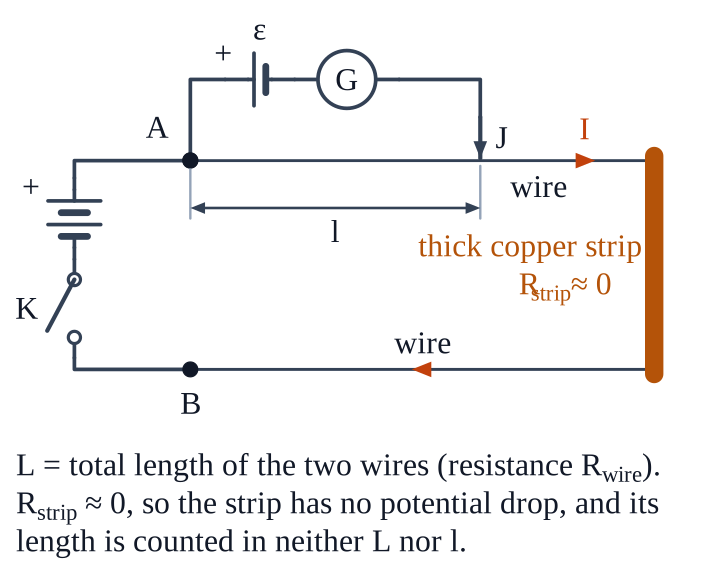
    What is the advantage of using thick metallic strips to join wires in a potentiometer?
    NCERT’s answer
    The metal strips have low resistance and need not be counted in the potentiometer length \(\displaystyle l_1\) of the null point. One measures only their lengths along the straight segments (of lengths $\displaystyle 1$ meter each). This is easily done with the help of centimeter rulings or meter ruler and leads to accurate measurements.
    NCERT_Solution_Class12_Physics_Exemplar_Ch3_Q15 \[R_{\text{strip}} = \rho\,\frac{\ell_s}{A_s},\qquad A_s\uparrow \Rightarrow R_{\text{strip}}\downarrow \] \[R_{\text{strip}} \ll R_{\text{wire}} \;\Rightarrow\; V_{\text{strip}} = I R_{\text{strip}} \approx 0 \] \[k = \frac{V_{AB}}{L} = \frac{I R_{\text{wire}}}{L},\qquad \varepsilon = k\,l \] Answer: negligible strip resistance adds no potential drop, so the gradient stays uniform; strip lengths are not counted in the balance length \(\displaystyle l\).
  5. Exercise 16

    For wiring in the home, one uses Cu wires or Al wires. What considerations are involved in this?
    NCERT’s answer
    Two considerations are required: (i) cost of metal, and (ii) good conductivity of metal. Cost factor inhibits silver. Cu and Al are the next best conductors.
    Cu and Al: low \(\displaystyle \rho\), ductile. Al is cheaper and lighter but needs a larger area: \[\rho_{\mathrm{Cu}} = 1.7\times10^{-8}\ \Omega\,\mathrm{m},\qquad \rho_{\mathrm{Al}} = 2.7\times10^{-8}\ \Omega\,\mathrm{m} \] \[R = \rho\,\frac{l}{A},\qquad P = I^2R \] \[\text{same } l,\ R:\quad \frac{A_{\mathrm{Al}}}{A_{\mathrm{Cu}}} = \frac{\rho_{\mathrm{Al}}}{\rho_{\mathrm{Cu}}} = \frac{2.7}{1.7} \approx 1.6 \] Answer: low resistivity (small \(\displaystyle I^2R\) loss), ductility, cost, weight.
  6. Exercise 17

    Why are alloys used for making standard resistance coils?
    NCERT’s answer
    Alloys have low value of temperature co-efficient (less temperature sensitivity) of resistance and high resistivity.
    Manganin, constantan: high resistivity, tiny \(\displaystyle \alpha\).\[R_T = R_0\,[\,1+\alpha\,(T-T_0)\,],\qquad \alpha\ \text{in}\ \mathrm{K^{-1}} \]\[\alpha_{\text{alloy}} \ll \alpha_{\text{Cu}} \;\Rightarrow\; R_T \approx R_0 \]Answer: Alloys have a very small temperature coefficient of resistance, so the coil's resistance stays almost constant as it heats.
  7. Exercise 18

    Power P\displaystyle P is to be delivered to a device via transmission cables having resistance RC\displaystyle R_C. If V\displaystyle V is the voltage across R\displaystyle R and I\displaystyle I the current through it, find the power wasted and how can it be reduced.
    NCERT’s answer
    Power wasted \(\displaystyle P_C=I^2 R_C\) where \(\displaystyle R_C\) is the resistance of the connecting wires. \[P_{\mathrm{C}}=\frac{P^2}{V^2} R_{\mathrm{C}} \] In order to reduce \(\displaystyle P_C\), power should be transmitted at high voltage.
    The same current \(\displaystyle I\) flows through the cables.\[P = VI \;\Rightarrow\; I = \frac{P}{V} \]\[P_{\text{wasted}} = I^{2}R_C = \frac{P^{2}R_C}{V^{2}} \]\[V\uparrow \;\Rightarrow\; I\downarrow \;\Rightarrow\; P_{\text{wasted}}\downarrow \]Step \(\displaystyle V\) up with a transformer before transmission; thicker cables (smaller \(\displaystyle R_C\)) also help.Answer: Power wasted \(\displaystyle =I^{2}R_C=P^{2}R_C/V^{2}\); reduce it by transmitting at higher \(\displaystyle V\) (smaller \(\displaystyle I\)), or by lowering \(\displaystyle R_C\).
  8. Exercise 19

    AB is a potentiometer wire (Fig 3.4\displaystyle 3.4). If the value of R\displaystyle R is increased, in which direction will the balance point J shift? NCERT_Question_Class12_Physics_Exemplar_Ch3_Q19
    NCERT’s answer
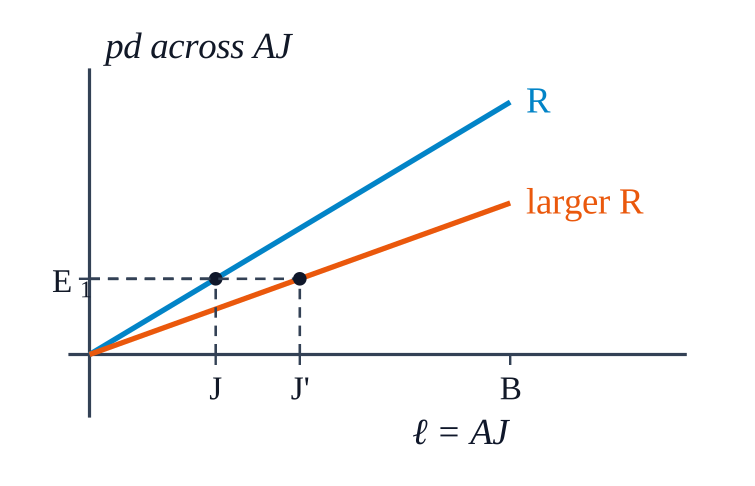
    If \(\displaystyle R\) is increased, the current through the wire will decrease and hence the potential gradient will also decrease, which will result in increase in balance length. So J will shift towards B.
    Wire \(\displaystyle AB\): resistance \(\displaystyle R_{AB}\), length \(\displaystyle L\); internal resistance \(\displaystyle r\) of \(\displaystyle E\); cell \(\displaystyle E_1\) in the galvanometer branch; balance length \(\displaystyle \ell = AJ\).\[I = \frac{E}{R + R_{AB} + r} \]\[k = \frac{I\,R_{AB}}{L} \]\[E_1 = k\,\ell \;\Rightarrow\; \ell = \frac{E_1}{k} \]\[R\uparrow \;\Rightarrow\; I\downarrow \;\Rightarrow\; k\downarrow \;\Rightarrow\; \ell\uparrow \]NCERT_Solution_Class12_Physics_Exemplar_Ch3_Q19Balance exists only while \(\displaystyle E_1 < I R_{AB}\).Answer: J shifts towards B.
  9. Exercise 20

    While doing an experiment with potentiometer (Fig 3.5\displaystyle 3.5) it was found that the deflection is one sided and (i) the deflection decreased while moving from one end A of the wire to the end B; (ii) the deflection increased. while the jockey was moved towards the end B.
    (i)
    Which terminal +or -ve of the cell E1\displaystyle E_1, is connected at X\displaystyle X in case (i) and how is E1\displaystyle E_1 related to E\displaystyle E ?
    (ii)
    Which terminal of the cell E1\displaystyle E_1 is connected at X in case (ii)?
    NCERT_Question_Class12_Physics_Exemplar_Ch3_Q20
    NCERT’s answer
    (i)
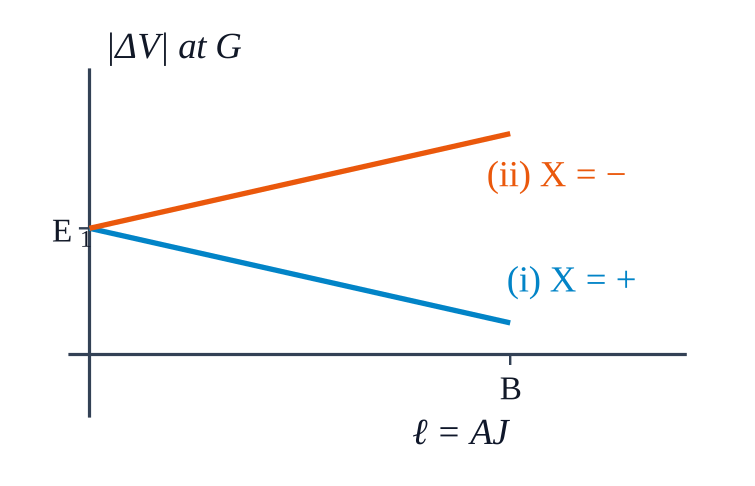
    Positive terminal of \(\displaystyle E_1\) is connected at \(\displaystyle X\) and \(\displaystyle E_1>E\).
    (ii)
    Negative terminal of \(\displaystyle E_1\) is connected at \(\displaystyle X\).
    Jockey at \(\displaystyle J\), \(\displaystyle \ell = AJ\); \(\displaystyle A\) is the positive end of \(\displaystyle E\), so potential falls along \(\displaystyle AB\) at gradient \(\displaystyle k\); \(\displaystyle \Delta V\) is the net pd on \(\displaystyle G\).\[V_J = V_A - k\,\ell \]\[\text{(i)}\;\; X=+:\quad \Delta V = E_1 - k\,\ell \;\downarrow\ \text{as}\ \ell\uparrow,\ \text{never zero} \;\Rightarrow\; E_1 > V_{AB} \approx E \]\[\text{(ii)}\;\; X=-:\quad |\Delta V| = E_1 + k\,\ell \;\uparrow\ \text{as}\ \ell\uparrow \]NCERT_Solution_Class12_Physics_Exemplar_Ch3_Q20Answer: (i) Positive terminal of \(\displaystyle E_1\) at \(\displaystyle X\); \(\displaystyle E_1 > E\). (ii) Negative terminal of \(\displaystyle E_1\) at \(\displaystyle X\).
  10. Exercise 21

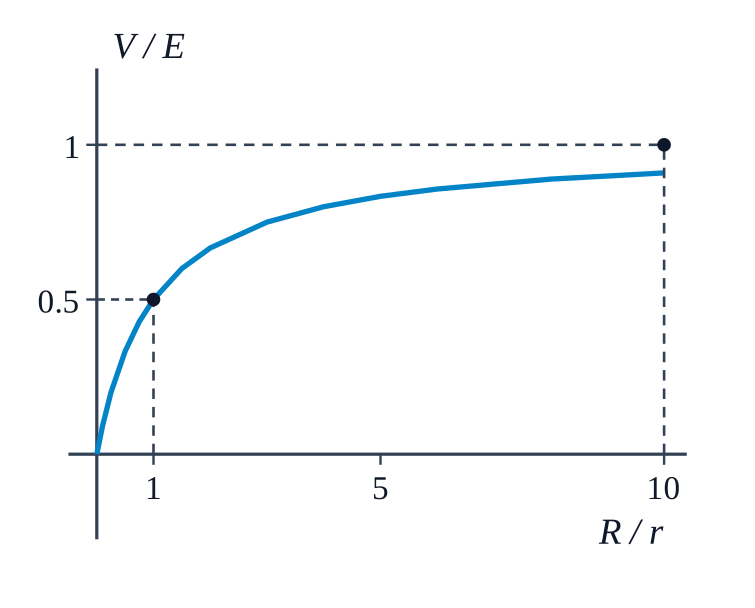
    A cell of emf E\displaystyle E and internal resistance r\displaystyle r is connected across an external resistance R\displaystyle R. Plot a graph showing the variation of P.D. across R, verses R\displaystyle R.
    \[I = \frac{E}{R + r} \]\[V = IR = \frac{E\,R}{R + r} \]\[R=0:\; V=0 \qquad R=r:\; V=\frac{E}{2} \qquad R\to\infty:\; V\to E \]NCERT_Solution_Class12_Physics_Exemplar_Ch3_Q21Answer: \(\displaystyle V\) rises from zero, equals \(\displaystyle E/2\) at \(\displaystyle R=r\), and approaches \(\displaystyle E\) asymptotically.