SolveIt is under development
SolveItClass 12 · Exemplar

NCERT Exemplar · Class 12 Physics Current Electricity

31 questions

Multiple Choice Questions (Type I) 1–6 (part 1 of 5)

  1. Exercise 1

    Consider a current carrying wire (current I\displaystyle I ) in the shape of a circle. Note that as the current progresses along the wire, the direction of j\displaystyle \mathbf{j} (current density) changes in an exact manner, while the current I\displaystyle I remain unaffected. The agent that is essentially responsible for is
    (a)
    source of emf.
    (b)
    electric field produced by charges accumulated on the surface of wire.
    (c)
    the charges just behind a given segment of wire which push them just the right way by repulsion.
    (d)
    the charges ahead.
    NCERT’s answer
    (b)
    (b) Electric field of the charges accumulated on the wire's surface.\[\mathbf{j}=\sigma\mathbf{E}\ \Rightarrow\ \mathbf{j}\parallel\mathbf{E}\ \text{at every point} \]\[\text{bend in wire}\ \Rightarrow\ \text{surface charges turn}\ \mathbf{E}\ \Rightarrow\ \mathbf{j}\ \text{turns},\qquad I=\text{const} \]The emf source only maintains the potential difference.
  2. Exercise 2

    Two batteries of emf ε1\displaystyle \varepsilon_1 and ε2(ε2>ε1)\displaystyle \varepsilon_2\left(\varepsilon_2>\varepsilon_1\right) and internal resistances r1\displaystyle r_1 and r2\displaystyle r_2 respectively are connected in parallel as shown in Fig 3.1.
    (a)
    The equivalent emf εeq\displaystyle \varepsilon_{\mathrm{eq}} of the two cells is between ε1\displaystyle \varepsilon_1 and ε2\displaystyle \varepsilon_2, i.e. ε1<εeq<ε2\displaystyle \varepsilon_1<\varepsilon_{\mathrm{eq}}<\varepsilon_2.
    (b)
    The equivalent emf εeq\displaystyle \varepsilon_{\mathrm{eq}} is smaller than ε1\displaystyle \varepsilon_1.
    (c)
    The εeq\displaystyle \varepsilon_{\mathrm{eq}} is given by εeq=ε1+ε2\displaystyle \varepsilon_{\mathrm{eq}}=\varepsilon_1+\varepsilon_2 always.
    (d)
    εeq\displaystyle \varepsilon_{\mathrm{eq}} is independent of internal resistances r1\displaystyle r_1 and r2\displaystyle r_2.
    NCERT_Question_Class12_Physics_Exemplar_Ch3_Q2
    NCERT’s answer
    (a)
    (a) Both positive plates meet at A, so the emfs oppose and a current circulates. \(\displaystyle \varepsilon_{eq}\) is the open-circuit \(\displaystyle V_{AB}\), and it depends on \(\displaystyle r_1, r_2\).\[I=\frac{\varepsilon_2-\varepsilon_1}{r_1+r_2} \]\[\varepsilon_{eq}=V_{AB}=\varepsilon_2-Ir_2=\frac{\varepsilon_1 r_2+\varepsilon_2 r_1}{r_1+r_2} \]\[\varepsilon_{eq}-\varepsilon_1=\frac{r_1(\varepsilon_2-\varepsilon_1)}{r_1+r_2}>0,\qquad \varepsilon_2-\varepsilon_{eq}=\frac{r_2(\varepsilon_2-\varepsilon_1)}{r_1+r_2}>0 \]\[\Rightarrow\ \varepsilon_1<\varepsilon_{eq}<\varepsilon_2 \]
  3. Exercise 3

    A resistance R\displaystyle R is to be measured using a meter bridge. Student chooses the standard resistance S\displaystyle S to be 100Ω\displaystyle 100 \Omega. He finds the null point at l1=2.9 cm\displaystyle l_1=2.9 \mathrm{~cm}. He is told to attempt to improve the accuracy. Which of the following is a useful way?
    (a)
    He should measure l1\displaystyle l_1 more accurately.
    (b)
    He should change S\displaystyle S to 1000Ω\displaystyle 1000 \Omega and repeat the experiment.
    (c)
    He should change S\displaystyle S to 3Ω\displaystyle 3 \Omega and repeat the experiment.
    (d)
    He should give up hope of a more accurate measurement with a meter bridge.
    NCERT’s answer
    (c)
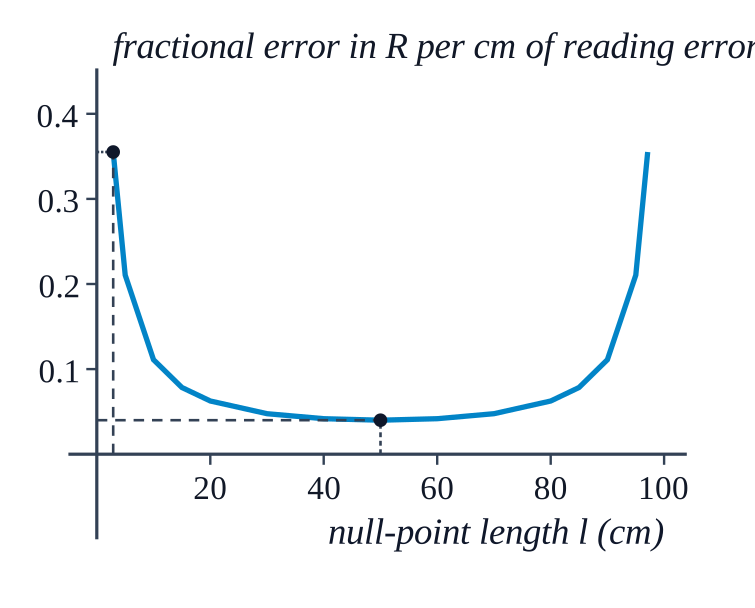
    (c) Choose \(\displaystyle S\) so the null point falls near the $\displaystyle 50$ cm mark, where the reading error matters least. \(\displaystyle S=1000\ \Omega\) would push it to about $\displaystyle 0.3$ cm, which is worse.\[R=S\,\frac{l_1}{100-l_1}=100\ \Omega\times\frac{2.9}{97.1}\approx 3\ \Omega \]\[\frac{\delta R}{R}=\frac{\delta l}{l}+\frac{\delta l}{100-l}=\frac{100\,\delta l}{l\,(100-l)} \]\[l=2.9\ \mathrm{cm}:\ \frac{\delta R}{R}\approx 0.36\ \mathrm{cm^{-1}}\,\delta l,\qquad l=50\ \mathrm{cm}:\ \frac{\delta R}{R}=0.04\ \mathrm{cm^{-1}}\,\delta l \]NCERT_Solution_Class12_Physics_Exemplar_Ch3_Q3\[S=3\ \Omega:\ l=\frac{100\,R}{R+S}\approx 50\ \mathrm{cm} \]\[S=1000\ \Omega:\ l=\frac{100\times 3}{3+1000}\approx 0.3\ \mathrm{cm} \]
  4. Exercise 4

    Two cells of emf's approximately 5V and 10V are to be accurately compared using a potentiometer of length 400cm.
    (a)
    The battery that runs the potentiometer should have voltage of 8V.
    (b)
    The battery of potentiometer can have a voltage of 15\displaystyle 15 V and R\displaystyle R adjusted so that the potential drop across the wire slightly exceeds 10V.
    (c)
    The first portion of 50\displaystyle 50 cm of wire itself should have a potential drop of 10V.
    (d)
    Potentiometer is usually used for comparing resistances and not voltages.
    NCERT’s answer
    (b)
    (b) The potential drop across the whole wire must exceed the larger emf, $\displaystyle 10$ V, or that cell finds no null point. (d) is false: a potentiometer compares emfs.\[\text{(a)}\ V_{\text{wire}}\le 8\ \mathrm{V}<10\ \mathrm{V}\ \Rightarrow\ \text{no null for the 10 V cell} \]\[\text{(b)}\ k\approx\frac{10\ \mathrm{V}}{400\ \mathrm{cm}}=0.025\ \mathrm{V\,cm^{-1}},\qquad l_5=\frac{5\ \mathrm{V}}{k}=200\ \mathrm{cm},\quad l_{10}\approx 400\ \mathrm{cm} \]\[\text{(c)}\ V_{400\,\mathrm{cm}}=\frac{400}{50}\times 10\ \mathrm{V}=80\ \mathrm{V}\ \text{(impractical)} \]
  5. Exercise 5

    A metal rod of length 10\displaystyle 10 cm and a rectangular cross-section of 1 cm×12 cm\displaystyle 1 \mathrm{~cm} \times \frac{1}{2} \mathrm{~cm} is connected to a battery across opposite faces. The resistance will be
    (a)
    maximum when the battery is connected across 1 cm×12 cm\displaystyle 1 \mathrm{~cm} \times \frac{1}{2} \mathrm{~cm} faces.
    (b)
    maximum when the battery is connected across 10 cm×1 cm\displaystyle 10 \mathrm{~cm} \times 1 \mathrm{~cm} faces.
    (c)
    maximum when the battery is connected across 10 cm×12\displaystyle 10 \mathrm{~cm} \times \frac{1}{2} cm faces.
    (d)
    same irrespective of the three faces.
    NCERT’s answer
    (a)
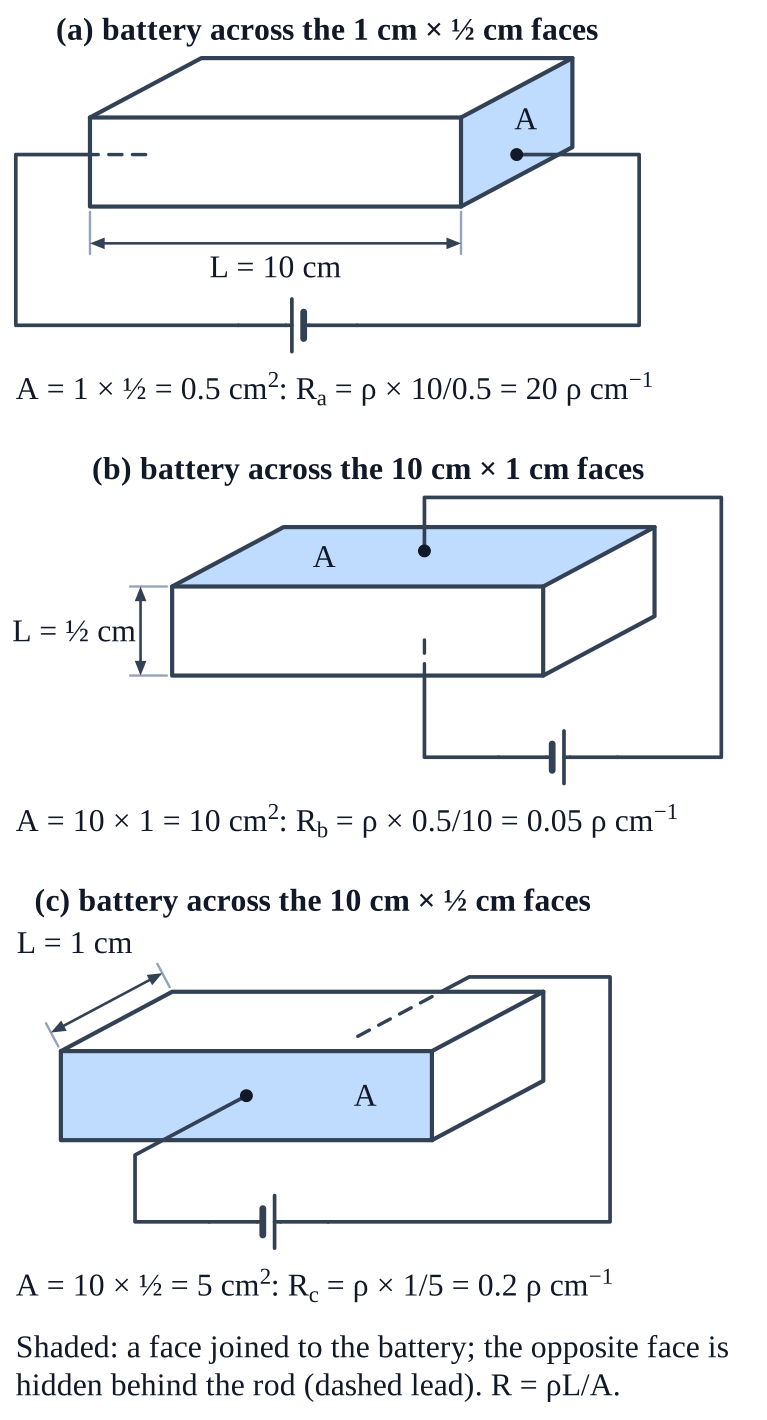
    (a) The current runs between the two connected faces, so \(\displaystyle L\) is their separation and \(\displaystyle A\) is the face area. Resistance is greatest for the longest path through the smallest area.\[R=\rho\,\frac{L}{A} \]\[\text{(a)}\ L=10\ \mathrm{cm},\ A=1\times\tfrac12=0.5\ \mathrm{cm^2}:\quad R_a=\rho\,\frac{10}{0.5}=20\,\rho\ \mathrm{cm^{-1}} \]\[\text{(b)}\ L=\tfrac12\ \mathrm{cm},\ A=10\times1=10\ \mathrm{cm^2}:\quad R_b=\rho\,\frac{0.5}{10}=0.05\,\rho\ \mathrm{cm^{-1}} \]\[\text{(c)}\ L=1\ \mathrm{cm},\ A=10\times\tfrac12=5\ \mathrm{cm^2}:\quad R_c=\rho\,\frac{1}{5}=0.2\,\rho\ \mathrm{cm^{-1}} \]NCERT_Solution_Class12_Physics_Exemplar_Ch3_Q5\[R_a:R_c:R_b=400:4:1 \]
  6. Exercise 6

    Which of the following characteristics of electrons determines the current in a conductor?
    (a)
    Drift velocity alone.
    (b)
    Thermal velocity alone.
    (c)
    Both drift velocity and thermal velocity.
    (d)
    Neither drift nor thermal velocity.
    NCERT’s answer
    (a)
    (a) Drift velocity alone. Thermal motion is random and averages to zero, so it carries no net charge across a section.\[I=neAv_d \]\[\langle\mathbf{v}_{th}\rangle=0\ \Rightarrow\ \text{no net charge transport} \]