SolveIt is under development
SolveItClass 12 · Exemplar

NCERT Exemplar · Class 12 Physics Current Electricity

31 questions

Multiple Choice Questions (Type II) 7–11 (part 2 of 5)

  1. Exercise 7

    Kirchhoff's junction rule is a reflection of
    (a)
    conservation of current density vector.
    (b)
    conservation of charge.
    (c)
    the fact that the momentum with which a charged particle approaches a junction is unchanged (as a vector) as the charged particle leaves the junction.
    (d)
    the fact that there is no accumulation of charges at a junction.
    NCERT’s answer
    (b), (d)
    (b), (d) Charge is conserved and cannot accumulate at a junction, so inflow equals outflow. (a), (c) are not the basis of the rule.\[\frac{dq_{\text{junction}}}{dt}=\sum I_{\text{in}}-\sum I_{\text{out}}=0 \]
  2. Exercise 8

    Consider a simple circuit shown in Fig 3.2. stands for a variable resistance R′.R′\displaystyle R^{\prime} . R^{\prime} can vary from R0\displaystyle R_0 to infinity. r\displaystyle r is internal resistance of the battery (r≪R≪R0)\displaystyle \left(r \ll R \ll R_0\right).
    (a)
    Potential drop across AB is nearly constant as R′\displaystyle R^{\prime} is varied.
    (b)
    Current through R′\displaystyle R^{\prime} is nearly a constant as R′\displaystyle R^{\prime} is varied.
    (c)
    Current I\displaystyle I depends sensitively on R′\displaystyle R^{\prime}.
    (d)
    I≥Vr+R\displaystyle I \geq \frac{V}{r+R} always.
    NCERT_Question_Class12_Physics_Exemplar_Ch3_Q8
    NCERT_Question_Class12_Physics_Exemplar_Ch3_Q8_2
    NCERT’s answer
    (a), (d)
    (a), (d) \(\displaystyle R'\) in parallel can only lower \(\displaystyle R_{AB}\), and \(\displaystyle R'\ge R_0\gg R\) keeps \(\displaystyle R_{AB}\approx R\). (b), (c) fail.\[R_{AB}=\frac{RR'}{R+R'}\le R,\qquad R'\ge R_0\gg R\ \Rightarrow\ R_{AB}\approx R \]\[I=\frac{V}{r+R_{AB}}\ \ge\ \frac{V}{r+R}\qquad\text{(d)} \]\[V_{AB}=IR_{AB}=V\,\frac{R_{AB}}{r+R_{AB}}\approx V\quad(r\ll R)\qquad\text{(a)} \]\[I_{R'}=\frac{V_{AB}}{R'}\approx\frac{V}{R'}:\ \frac{V}{R_0}\to 0\ \text{as}\ R'\to\infty\qquad\text{(b) fails} \]\[I=\frac{V}{r+R_{AB}}\approx\frac{V}{r+R}\ \text{whatever}\ R'\qquad\text{(c) fails} \]
  3. Exercise 9

    Temperature dependence of resistivity ρ(T)\displaystyle \rho(T) of semiconductors, insulators and metals is significantly based on the following factors:
    (a)
    number of charge carriers can change with temperature T\displaystyle T.
    (b)
    time interval between two successive collisions can depend on T\displaystyle T.
    (c)
    length of material can be a function of T\displaystyle T.
    (d)
    mass of carriers is a function of T\displaystyle T.
    NCERT’s answer
    (a), (b)
    (a), (b) Only \(\displaystyle n\) and \(\displaystyle \tau\) in \(\displaystyle \rho\) depend on \(\displaystyle T\); the carrier mass is fixed and length does not appear in \(\displaystyle \rho\).\[\rho=\frac{m}{ne^{2}\tau} \]\[\text{semiconductor, insulator:}\quad T\uparrow\Rightarrow n\uparrow\ (\text{outweighs}\ \tau\downarrow)\Rightarrow\rho\downarrow \]\[\text{metal:}\quad T\uparrow\Rightarrow\tau\downarrow\Rightarrow\rho\uparrow \]
  4. Exercise 10

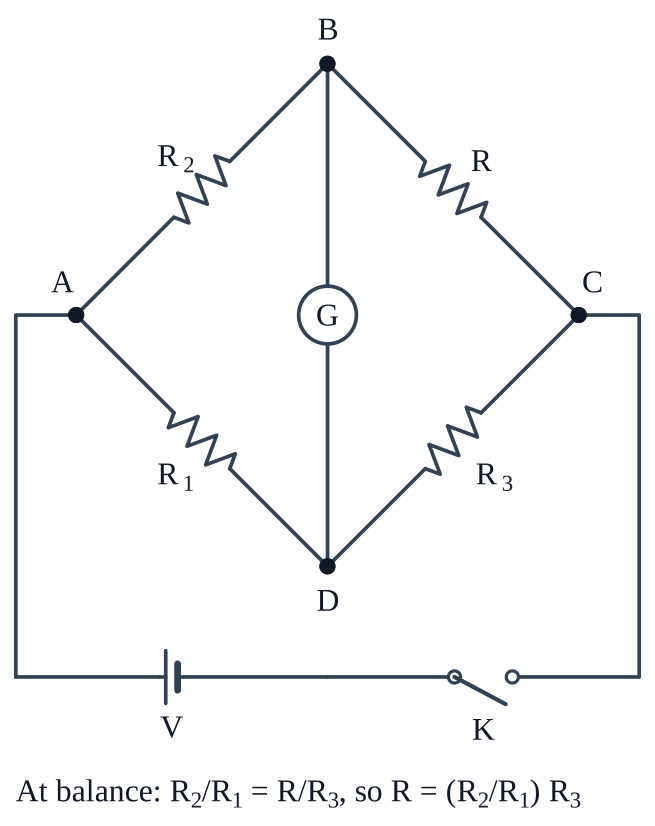
    The measurement of an unknown resistance R\displaystyle R is to be carried out using Wheatstones bridge (see Fig. 3.25\displaystyle 3.25 of NCERT Book). Two students perform an experiment in two ways. The first students takes R2=10Ω\displaystyle R_2=10 \Omega and R1=5Ω\displaystyle R_1=5 \Omega. The other student takes R2=1000Ω\displaystyle R_2=1000 \Omega and R1=500Ω\displaystyle R_1=500 \Omega. In the standard arm, both take R3=5Ω\displaystyle R_3=5 \Omega.
    Both find R=R2R1R3=10Ω\displaystyle R=\frac{R_2}{R_1} R_3=10 \Omega within errors.
    (a)
    The errors of measurement of the two students are the same.
    (b)
    Errors of measurement do depend on the accuracy with which R2\displaystyle R_2 and R1\displaystyle R_1 can be measured.
    (c)
    If the student uses large values of R2\displaystyle R_2 and R1\displaystyle R_1, the currents through the arms will be feeble. This will make determination of null point accurately more difficult.
    (d)
    Wheatstone bridge is a very accurate instrument and has no errors of measurement.
    NCERT’s answer
    (b), (c)
    (b), (c) The error in \(\displaystyle R\) carries the errors of \(\displaystyle R_1, R_2, R_3\). Large \(\displaystyle R_1, R_2\) give feeble currents and a less sharp null. (a), (d) are false.NCERT_Solution_Class12_Physics_Exemplar_Ch3_Q10\[\frac{R_2}{R_1}=\frac{R}{R_3}\ \Rightarrow\ R=\frac{R_2}{R_1}R_3=\frac{10}{5}\times5=\frac{1000}{500}\times5=10\ \Omega \]\[\left(\frac{\Delta R}{R}\right)_{\max}=\frac{\Delta R_1}{R_1}+\frac{\Delta R_2}{R_2}+\frac{\Delta R_3}{R_3}\qquad\text{(b)} \]\[I_{ADC}=\frac{V}{R_1+R_3},\qquad I_{ABC}=\frac{V}{R_2+R}\qquad(\text{cell resistance neglected}) \]\[\text{1st student:}\ \frac{V}{10\ \Omega},\ \frac{V}{20\ \Omega}\qquad \text{2nd student:}\ \frac{V}{505\ \Omega},\ \frac{V}{1010\ \Omega}\ \ (\approx 50\times\text{ smaller})\qquad\text{(c)} \]
  5. Exercise 11

    In a meter bridge the point D is a neutral point (Fig 3.3\displaystyle 3.3).
    (a)
    The meter bridge can have no other neutral point for this set of resistances.
    (b)
    When the jockey contacts a point on meter wire left of D, current flows to B from the wire.
    (c)
    When the jockey contacts a point on the meter wire to the right of D, current flows from B to the wire through galvanometer.
    (d)
    When R\displaystyle R is increased, the neutral point shifts to left.
    NCERT_Question_Class12_Physics_Exemplar_Ch3_Q11
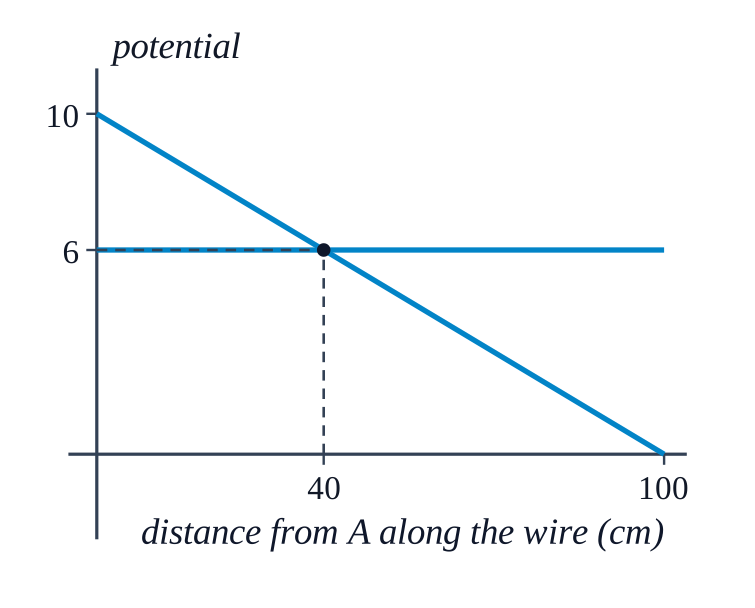
    (a), (b), (c) Wire potential falls uniformly from A (joined to the battery's positive plate) to C, crossing the fixed \(\displaystyle V_B\) once. Increasing \(\displaystyle R\) moves D right, so (d) fails.NCERT_Solution_Class12_Physics_Exemplar_Ch3_Q11\[\text{left of D:}\ V_{\text{wire}}>V_B\ \Rightarrow\ \text{current wire}\to G\to B \]\[\text{right of D:}\ V_{\text{wire}}<V_B\ \Rightarrow\ \text{current } B\to G\to\text{wire} \]\[\frac{R}{S}=\frac{l_1}{100-l_1}:\quad R\uparrow\ \Rightarrow\ l_1\uparrow\ \Rightarrow\ \text{D moves right} \]