SolveIt is under development
SolveItClass 12 · Exemplar

NCERT Exemplar · Class 12 Physics Current Electricity

31 questions

Short Answer Questions 22–28 (part 4 of 5)

  1. Exercise 22

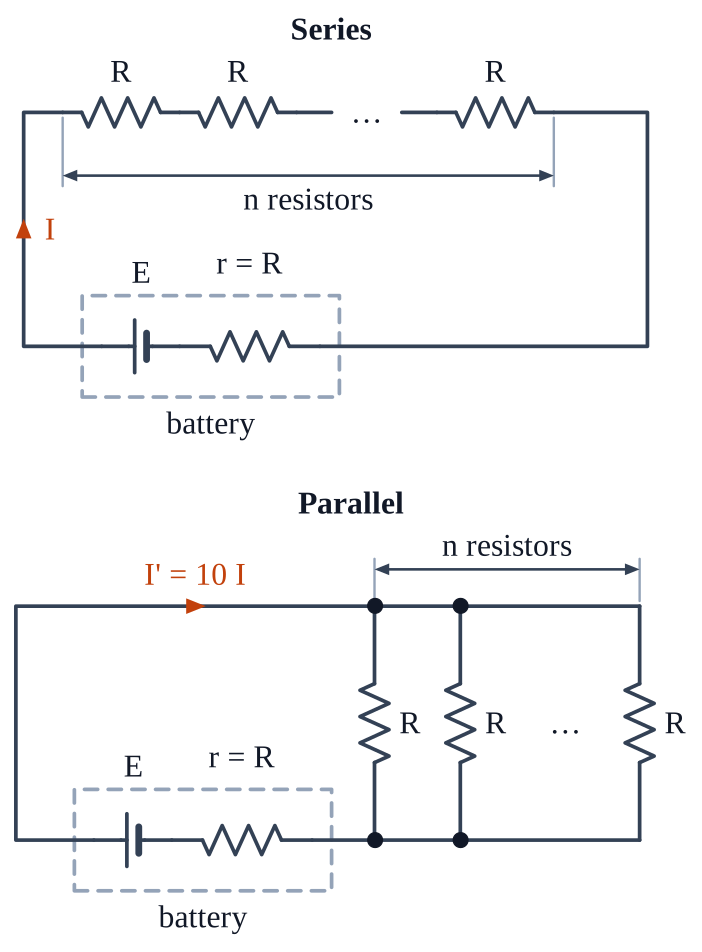
    First a set of n\displaystyle n equal resistors of R\displaystyle R each are connected in series to a battery of emf E\displaystyle E and internal resistance R\displaystyle R. A current I\displaystyle I is observed to flow. Then the n\displaystyle n resistors are connected in parallel to the same battery. It is observed that the current is increased 10\displaystyle 10 times. What is ‘n\displaystyle n’?
    NCERT’s answer
    \(\displaystyle I=\frac{E}{R+n R} ; \frac{E}{R+\dfrac{R}{n}}=10 I\) \[\begin{aligned} & \frac{1+n}{1+\dfrac{1}{n}}=10=\frac{1+n}{n+1} n=n \\ & \therefore n=10 . \end{aligned} \]
    Same battery, so its internal resistance \(\displaystyle R\) is in series with the network both times.NCERT_Solution_Class12_Physics_Exemplar_Ch3_Q22Series:\[I=\frac{E}{nR+R}=\frac{E}{(n+1)R} \]Parallel:\[I'=\frac{E}{\dfrac{R}{n}+R}=\frac{nE}{(n+1)R} \]\[\frac{I'}{I}=n=10 \]Answer: \(\displaystyle n=10\)
  2. Exercise 23

    Let there be n\displaystyle n resistors R1………….Rn\displaystyle R_1 \ldots \ldots \ldots \ldots . R_{\mathrm{n}} with Rmax⁡=max⁡(R1………Rn)\displaystyle R_{\max }=\max \left(R_1 \ldots \ldots \ldots R_{\mathrm{n}}\right) and Rmin =min⁡{R1…..Rn}\displaystyle \mathrm{R}_{\text {min }}=\min \left\{R_1 \ldots . . R_{\mathrm{n}}\right\}. Show that when they are connected in parallel, the resultant resistance RP<Rmin \displaystyle R_{\mathrm{P}}<R_{\text {min }} and when they are connected in series, the resultant resistance RS>Rmax \displaystyle R_{\mathrm{S}}>R_{\text {max }}. Interpret the result physically.
    NCERT’s answer
    \(\displaystyle \frac{1}{R_p}=\frac{1}{R_1}+\ldots \ldots+\frac{1}{R_n}, \quad \frac{R_{\text {min }}}{R_P}=\frac{R_{\text {min }}}{R_1}+\frac{R_{\text {min }}}{R_2}+\ldots \ldots .+\frac{R_{\text {min }}}{R_n}>1\) and \(\displaystyle R_{\mathrm{S}}=R_1+\ldots \ldots+R_{\mathrm{n}} \geq R_{\text {max }}\). In Fig. (b), \(\displaystyle R_{\text {min }}\) provides an equivalent route as in Fig. (a) for current. But in addition there are \(\displaystyle (n-1)\) routes by the remaining \(\displaystyle (n-1)\) resistors. Current in Fig.(b) > current in Fig. (a). Effective Resistance in Fig. (b) \(\displaystyle <R_{\text {min }}\). Second circuit evidently affords a greater resistance. You can use Fig. (c) and (d) and prove \(\displaystyle R_{\mathrm{s}}>R_{\text {max }}\). NCERT_Solution_Class12_Physics_Exemplar_Ch3_Q23_ncert
    For \(\displaystyle n\ge2\) resistors, every \(\displaystyle R_i>0\).Parallel:\[\frac{1}{R_P}=\frac{1}{R_1}+\dots+\frac{1}{R_n}=\frac{1}{R_{\min}}+\sum_{i\ne\min}\frac{1}{R_i}>\frac{1}{R_{\min}} \]\[\Rightarrow\ R_P<R_{\min} \]Series:\[R_S=R_1+\dots+R_n=R_{\max}+\sum_{i\ne\max}R_i>R_{\max} \]Physical meaning: in parallel each extra branch is one more path for the charge, so the set conducts better than its best branch alone; in series the same current crosses every resistor and the voltage drops add, like a longer conductor.Answer: \(\displaystyle R_P<R_{\min}\) and \(\displaystyle R_S>R_{\max}\)
  3. Exercise 24

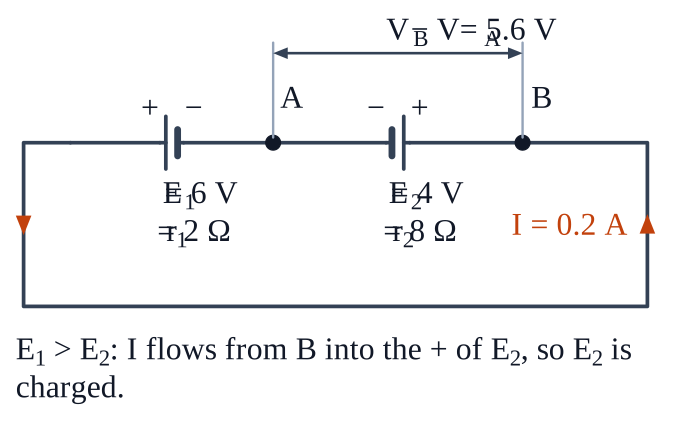
    The circuit in Fig 3.6\displaystyle 3.6 shows two cells connected in opposition to each other. Cell E1\displaystyle E_1 is of emf 6V and internal resistance 2Ω\displaystyle 2 \Omega; the cell E2\displaystyle E_2 is of emf 4V and internal resistance 8Ω\displaystyle 8 \Omega. Find the potential difference between the points A and B. NCERT_Question_Class12_Physics_Exemplar_Ch3_Q24
    NCERT’s answer
    \(\displaystyle I=\frac{6-4}{2+8}=0.2 \mathrm{~A}\) P.D. across \(\displaystyle E_1=6-0.2 \times 2=5.6 \mathrm{~V}\) P.D. across \(\displaystyle E_2=\mathrm{V}_{\mathrm{AB}}=4+0.2 \times 8=5.6 \mathrm{~V}\) Point B is at a higher potential than A NCERT_Solution_Class12_Physics_Exemplar_Ch3_Q24_ncert
    NCERT_Solution_Class12_Physics_Exemplar_Ch3_Q24\(\displaystyle E_1>E_2\), so \(\displaystyle E_1\) drives the current round the loop:\[I=\frac{E_1-E_2}{r_1+r_2}=\frac{6-4}{2+8}=0.2\ \mathrm{A} \]The current enters the \(\displaystyle +\) terminal of \(\displaystyle E_2\), so \(\displaystyle E_2\) is being charged: its terminal p.d. is \(\displaystyle E_2+Ir_2\), not \(\displaystyle E_2-Ir_2\).\[V_B-V_A=E_2+Ir_2=4+0.2\times8=5.6\ \mathrm{V} \]Check through \(\displaystyle E_1\):\[V_B-V_A=E_1-Ir_1=6-0.2\times2=5.6\ \mathrm{V} \]Answer: the p.d. between A and B is \(\displaystyle 5.6\ \mathrm{V}\), B being the higher potential.
  4. Exercise 25

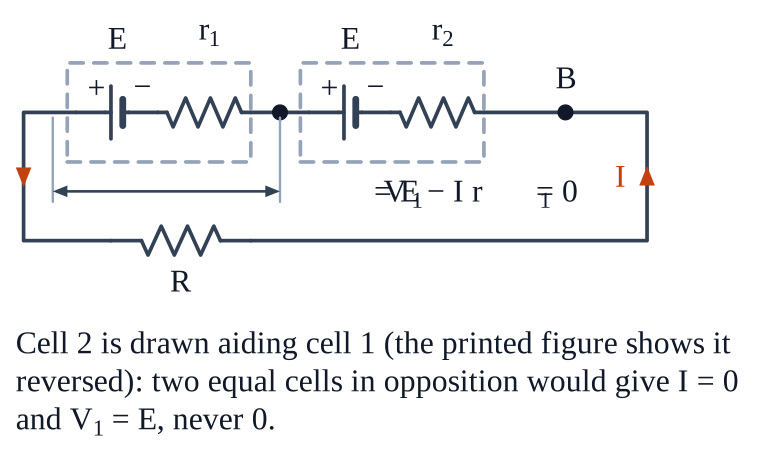
    Two cells of same emf E\displaystyle E but internal resistance r1\displaystyle r_1 and r2\displaystyle r_2 are connected in series to an external resistor R\displaystyle R (Fig 3.7\displaystyle 3.7). What should be the value of R\displaystyle R so that the potential difference across the terminals of the first cell becomes zero. NCERT_Question_Class12_Physics_Exemplar_Ch3_Q25
    NCERT’s answer
    \(\displaystyle I=\frac{\mathrm{E}+\mathrm{E}}{\mathrm{R}+r_1+r_2}\) \[V_1=E-I r_1=E-\frac{2 \mathrm{E}}{r_1+r_2+\mathrm{R}} r_1=0 \] or \(\displaystyle E=\frac{2 E r_1}{r_1+r_2+R}\) \[\begin{aligned} & 1=\frac{2 \mathrm{r}_1}{r_1+r_2+\mathrm{R}} \\ & r_1+r_2+R=2 r_1 \\ & R=r_1-r_2 \end{aligned} \]
    Cells in series, aiding each other.NCERT_Solution_Class12_Physics_Exemplar_Ch3_Q25\[I=\frac{E+E}{r_1+r_2+R}=\frac{2E}{r_1+r_2+R} \]P.d. across the first cell, carrying the full series current:\[V_1=E-Ir_1=0\ \Rightarrow\ I=\frac{E}{r_1} \]\[\frac{2E}{r_1+r_2+R}=\frac{E}{r_1}\ \Rightarrow\ 2r_1=r_1+r_2+R \]\[R=r_1-r_2 \]Answer: \(\displaystyle R=r_1-r_2\), possible only if \(\displaystyle r_1>r_2\).
  5. Exercise 26

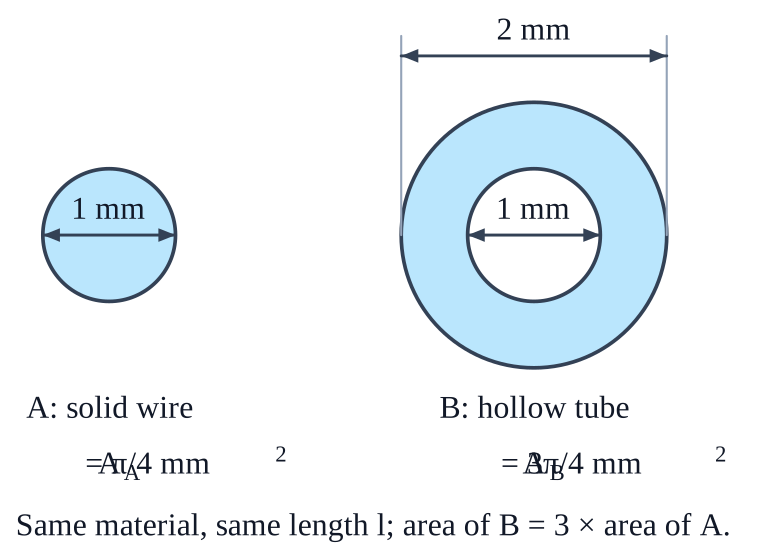
    Two conductors are made of the same material and have the same length. Conductor A is a solid wire of diameter 1mm. Conductor B is a hollow tube of outer diameter 2mm and inner diameter 1mm. Find the ratio of resistance RA\displaystyle R_{\mathrm{A}} to RB\displaystyle R_{\mathrm{B}}.
    NCERT’s answer
    \(\displaystyle R_A=\frac{\rho l}{\pi\left(10^{-3} \times 0.5\right)^2}\) \[\begin{aligned} R_B & =\frac{\rho l}{\pi\left[\left(10^{-3}\right)^2-\left(0.5 \times 10^{-3}\right)^2\right]} \\ \frac{R_A}{R_B} & =\frac{\left(10^{-3}\right)^2-\left(0.5 \times 10^{-3}\right)^2}{\left(.5 \times 10^{-3}\right)^2}=3: 1 \end{aligned} \]
    Same \(\displaystyle \rho\) and \(\displaystyle l\), so the resistances differ only through the cross-section.NCERT_Solution_Class12_Physics_Exemplar_Ch3_Q26\[\frac{R_A}{R_B}=\frac{\rho l/A_A}{\rho l/A_B}=\frac{A_B}{A_A} \]\[A_A=\pi\left(\frac{1}{2}\right)^2=\frac{\pi}{4}\ \mathrm{mm^2} \]\[A_B=\pi\left[\left(\frac{2}{2}\right)^2-\left(\frac{1}{2}\right)^2\right]=\frac{3\pi}{4}\ \mathrm{mm^2} \]\[\frac{R_A}{R_B}=\frac{3\pi/4}{\pi/4}=3 \]Caution: the area of B is the ring (outer disc minus hole), not the full outer disc.Answer: \(\displaystyle R_A:R_B=3:1\)
  6. Exercise 27

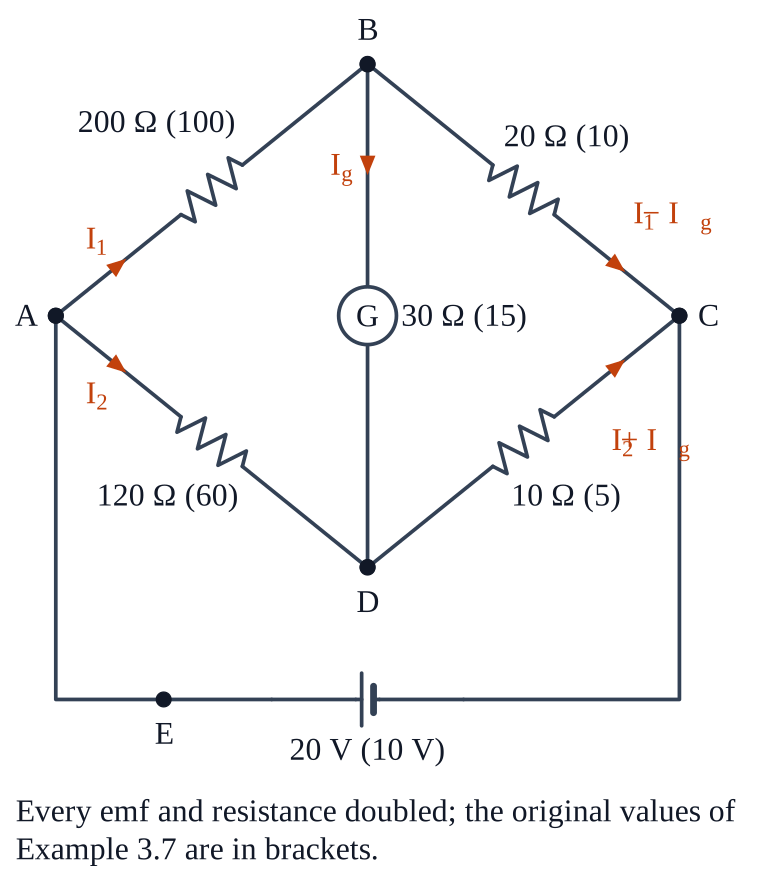
    Suppose there is a circuit consisting of only resistances and batteries and we have to double (or increase it to n\displaystyle n-times) all voltages and all resistances. Show that currents are unaltered. Do this for circuit of Example 3.7\displaystyle 3.7 in the NCERT Text Book for Class XII.
    NCERT’s answer
    We can think of reducing entire network to a simple one for any branch \(\displaystyle R\) as shown in Fig. Then current through \(\displaystyle R\) is \(\displaystyle I=\frac{V_{\text {eff }}}{R_{\text {eff }}+R}\) Dimensionally \(\displaystyle \mathrm{V}_{\text {eff }}=V_{\text {eff }}\left(\mathrm{V}_1, \mathrm{~V}_2, \ldots \ldots \mathrm{~V}_{\mathrm{n}}\right)\) has a dimension of voltage and \(\displaystyle \mathrm{R}_{\text {eff }}=\mathrm{R}_{\text {eff }}\left(R_1, R_2, \ldots \ldots . R_m\right)\) has a dimension of resistance. Therefore if all are increased \(\displaystyle n\)-fold \[V_{e f f}^{\text {new }}=n V_{e f f}, R_{e f f}^{\text {new }}=n \mathrm{R}_{e f f} \] and \(\displaystyle R^{\text {new }}=n R\). Current thus remains the same. NCERT_Solution_Class12_Physics_Exemplar_Ch3_Q27_ncert
    Loop rule: \(\displaystyle \sum\mathcal{E}=\sum IR\). Multiply every emf and resistance by \(\displaystyle n\):\[\sum n\mathcal{E}=\sum I\,(nR)\ \Rightarrow\ \sum\mathcal{E}=\sum IR \]The junction rule has no \(\displaystyle \mathcal{E}\) or \(\displaystyle R\). Same equations, so the same currents.Wheatstone bridge of Example $\displaystyle 3.7$ with \(\displaystyle n=2\):NCERT_Solution_Class12_Physics_Exemplar_Ch3_Q27\[\text{BADB:}\quad 200I_1+30I_g-120I_2=0\ \Rightarrow\ 20I_1+3I_g-12I_2=0 \]\[\text{BCDB:}\quad 20(I_1-I_g)-30I_g-10(I_2+I_g)=0\ \Rightarrow\ 2I_1-6I_g-I_2=0 \]\[\text{ADCEA:}\quad 120I_2+10(I_2+I_g)=20\ \Rightarrow\ 13I_2+I_g=2\ \mathrm{A} \]Each reduces to the very equation of the original circuit, so solve as before:\[(20I_1+3I_g-12I_2)-10(2I_1-6I_g-I_2)=0\ \Rightarrow\ 63I_g-2I_2=0\ \Rightarrow\ I_2=31.5\,I_g \]\[13(31.5\,I_g)+I_g=2\ \Rightarrow\ I_g=\frac{2}{410.5}\ \mathrm{A}=4.87\ \mathrm{mA} \]\[I_1=18.75\,I_g=91.4\ \mathrm{mA},\qquad I_2=153.5\ \mathrm{mA} \]Answer: the currents are unaltered: \(\displaystyle I_g=4.87\ \mathrm{mA}\), the same as with $\displaystyle 10$ V and the original resistances.
  7. Exercise 28

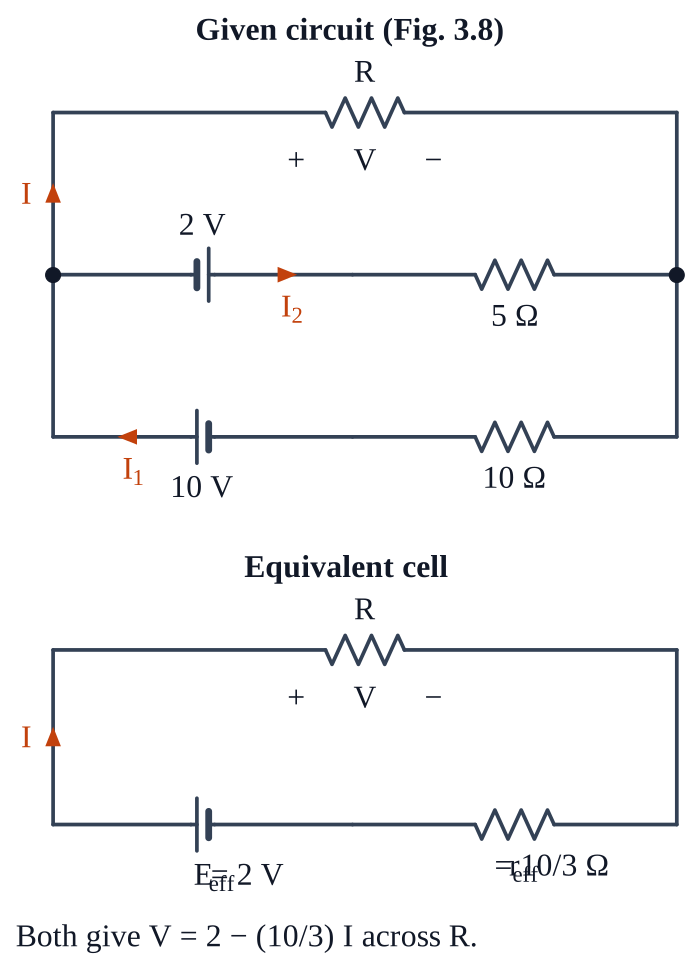
    Two cells of voltage 10V and 2V and internal resistances 10Ω\displaystyle 10 \Omega and 5Ω\displaystyle 5 \Omega respectively, are connected in parallel with the positive end of 10V battery connected to negative pole of 2V battery (Fig 3.8\displaystyle 3.8). Find the effective voltage and effective resistance of the combination. NCERT_Question_Class12_Physics_Exemplar_Ch3_Q28
    NCERT’s answer
    Applying Kirchhoff's junction rule:
    \[I_1=I+I_2 \]
    Kirchhoff's loop rule gives:
    \[\begin{aligned} & 10=I R+10 I_1 \ldots .(\mathrm{i}) \\ & 2=5 \mathrm{I}_2-R I=5\left(I_1-I\right)-R I \\ & 4=10 I_1-10 I-2 R I \ldots . .(\mathrm{ii}) \end{aligned} \]
    (i)
    (ii) \(\displaystyle \Rightarrow 6=3 R I+10 I\) or, \(\displaystyle 2=I\left(R+\frac{10}{3}\right)\)
    \(\displaystyle 2=\left(\mathrm{R}+\mathrm{R}_{\text {eff }}\right) I\) Comparing with \(\displaystyle V_{\text {eff }}=\left(R+R_{\text {eff }}\right) I\)
    and \(\displaystyle V_{\text {eff }}=2 \mathrm{~V}\)
    \[\mathrm{R}_{\mathrm{eff}}=\frac{10}{3} \Omega . \]
    NCERT_Solution_Class12_Physics_Exemplar_Ch3_Q28_ncert
    The $\displaystyle 2$ V cell's \(\displaystyle -\) terminal sits on the same node as the $\displaystyle 10$ V cell's \(\displaystyle +\), so its emf enters with the opposite sign.NCERT_Solution_Class12_Physics_Exemplar_Ch3_Q28With \(\displaystyle R\) connected, let \(\displaystyle V\) be the p.d. across it (left node positive), currents as in the circuit:\[V=10-10I_1,\qquad V=-(2-5I_2),\qquad I=I_1-I_2 \]\[I=\frac{10-V}{10}-\frac{V+2}{5}=\frac{6-3V}{10} \]\[V=2-\frac{10}{3}\,I \]Compare \(\displaystyle V=E_{\mathrm{eff}}-I\,r_{\mathrm{eff}}\):\[E_{\mathrm{eff}}=2\ \mathrm{V},\qquad r_{\mathrm{eff}}=\frac{10}{3}\ \Omega\approx3.3\ \Omega \]Answer: effective voltage \(\displaystyle 2\ \mathrm{V}\) (left node positive), effective resistance \(\displaystyle \frac{10}{3}\ \Omega\approx3.3\ \Omega\).