SolveIt is under development
SolveItClass 12 · Exemplar

NCERT Exemplar · Class 12 Physics Current Electricity

31 questions

Long Answer Questions 29–31 (part 5 of 5)

  1. Exercise 29

    A room has AC run for 5\displaystyle 5 hours a day at a voltage of 220V. The wiring of the room consists of Cu of 1\displaystyle 1 mm radius and a length of 10\displaystyle 10 m. Power consumption per day is 10\displaystyle 10 commercial units. What fraction of it goes in the joule heating in wires? What would happen if the wiring is made of aluminium of the same dimensions? [ρcu=1.7×10Ωm−8,ρAl=2.7×10⁻⁸Ω m]\left[\rho_{\mathrm{cu}}=1.7 \times 10_{\Omega \mathrm{m}}^{-8}, \rho_{\mathrm{Al}}=2.7 \times 10^{-8} \Omega \mathrm{~m}\right]
    NCERT’s answer
    Power consumption = 2units/hour = 2KW = 2000J/s \[I=\frac{P}{V}=\frac{2000}{220} \simeq 9 \mathrm{~A} \] Power loss in wire \(\displaystyle =R I^2 J / \mathrm{s}\) \[\begin{aligned} & =\rho \frac{l}{A} I^2=1.7 \times 10^{-8} \times \frac{10}{\pi \times 10^{-6}} \times 81 \mathrm{~J} / \mathrm{s} \\ & \simeq 4 \mathrm{~J} / \mathrm{s} \\ & =0.2 \% \end{aligned} \] Power loss in Al wire \(\displaystyle =4 \frac{\rho_{A l}}{\rho_{C u}}=1.6 \times 4=6.4 \mathrm{~J} / \mathrm{s}=0.32 \%\)
    Daily energy $\displaystyle 10$ units \(\displaystyle =10\ \mathrm{kWh}\), used over $\displaystyle 5$ h: \[P=\frac{10\ \mathrm{kWh}}{5\ \mathrm{h}}=2\ \mathrm{kW},\qquad I=\frac{P}{V}=\frac{2000\ \mathrm{W}}{220\ \mathrm{V}}=9.09\ \mathrm{A} \] Copper wiring: \[R_{\mathrm{Cu}}=\frac{\rho_{\mathrm{Cu}}\,l}{\pi r^{2}}=\frac{1.7\times10^{-8}\ \Omega\,\mathrm{m}\times10\ \mathrm{m}}{\pi\,(10^{-3}\ \mathrm{m})^{2}}=0.054\ \Omega \] \[P_{\mathrm{Cu}}=I^{2}R_{\mathrm{Cu}}=(9.09\ \mathrm{A})^{2}(0.054\ \Omega)=4.5\ \mathrm{W} \] \[\frac{P_{\mathrm{Cu}}}{P}=\frac{4.5\ \mathrm{W}}{2000\ \mathrm{W}}=2.2\times10^{-3}\ (0.22\,\%) \] Aluminium wiring, same \(\displaystyle I\), \(\displaystyle l\) and \(\displaystyle r\): \[R_{\mathrm{Al}}=\frac{2.7\times10^{-8}\ \Omega\,\mathrm{m}\times10\ \mathrm{m}}{\pi\,(10^{-3}\ \mathrm{m})^{2}}=0.086\ \Omega \] \[P_{\mathrm{Al}}=(9.09\ \mathrm{A})^{2}(0.086\ \Omega)=7.1\ \mathrm{W},\qquad \frac{P_{\mathrm{Al}}}{P}=\frac{7.1\ \mathrm{W}}{2000\ \mathrm{W}}=3.6\times10^{-3}\ (0.36\,\%) \] \[\frac{P_{\mathrm{Al}}}{P_{\mathrm{Cu}}}=\frac{\rho_{\mathrm{Al}}}{\rho_{\mathrm{Cu}}}=\frac{2.7}{1.7}\approx1.6 \] The wires dissipate about $\displaystyle 60$ % more heat, yet the loss stays a very small fraction of the load. Answer: Copper wiring wastes about \(\displaystyle 2.2\times10^{-3}\) ($\displaystyle 0.22$ %) of the power as heat; aluminium wiring wastes about \(\displaystyle 3.6\times10^{-3}\) ($\displaystyle 0.36$ %), i.e. $\displaystyle 1.6$ times as much heat ($\displaystyle 7.1$ W against $\displaystyle 4.5$ W).
  2. Exercise 30

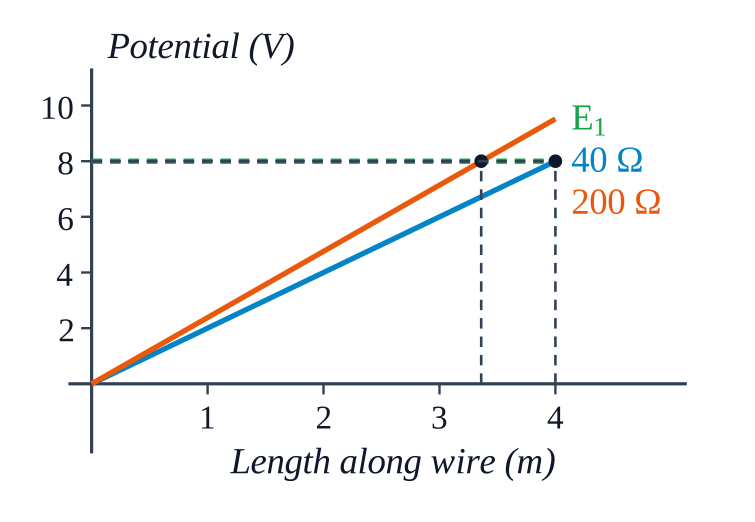
    In an experiment with a potentiometer, VB=10 V\displaystyle V_B=10 \mathrm{~V}. R\displaystyle R is adjusted to be 50Ω\displaystyle 50 \Omega (Fig. 3.9\displaystyle 3.9). A student wanting to measure voltage E1\displaystyle E_1 of a battery (approx. 8V) finds no null point possible. He then diminishes R\displaystyle R to 10Ω\displaystyle 10 \Omega and is able to locate the null point on the last (4th \displaystyle 4^{\text {th }}) segment of the potentiometer. Find the resistance of the potentiometer wire and potential drop per unit length across the wire in the second case. NCERT_Question_Class12_Physics_Exemplar_Ch3_Q30
    Uniform wire, four equal segments of $\displaystyle 1$ m each (\(\displaystyle L=4\ \mathrm{m}\)); \(\displaystyle E_1=8\ \mathrm{V}\). Drop across the wire: \[V_w=IR_p=\frac{V_B\,R_p}{R+R_p} \] No null point at \(\displaystyle R=50\ \Omega\) means \(\displaystyle V_w<E_1\): \[\frac{10\ \mathrm{V}\times R_p}{50\ \Omega+R_p}<8\ \mathrm{V}\ \Rightarrow\ 10R_p<400+8R_p\ \Rightarrow\ R_p<200\ \Omega \] Null point on the 4th segment at \(\displaystyle R=10\ \Omega\) means \(\displaystyle \tfrac34V_w<E_1<V_w\): \[V_w>8\ \mathrm{V}:\quad \frac{10R_p}{10+R_p}>8\ \Rightarrow\ 10R_p>80+8R_p\ \Rightarrow\ R_p>40\ \Omega \] \[\tfrac34V_w<8\ \mathrm{V}:\quad \frac{7.5\,R_p}{10+R_p}<8\ \Rightarrow\ 7.5R_p<80+8R_p\ \text{(true for every } R_p\text{, no limit)} \] \[40\ \Omega<R_p<200\ \Omega \] Caution: the null point is only somewhere on the 4th segment, so \(\displaystyle R_p\) is a range, not one value. Potential drop per unit length, \(\displaystyle \phi=V_w/L\): \[R_p=40\ \Omega:\ V_w=8\ \mathrm{V},\ \phi=\frac{8\ \mathrm{V}}{4\ \mathrm{m}}=2\ \mathrm{V\,m^{-1}} \] \[R_p=200\ \Omega:\ V_w=\frac{10\ \mathrm{V}\times200\ \Omega}{210\ \Omega}=9.52\ \mathrm{V},\ \phi=\frac{9.52\ \mathrm{V}}{4\ \mathrm{m}}=2.38\ \mathrm{V\,m^{-1}} \] NCERT_Solution_Class12_Physics_Exemplar_Ch3_Q30 The null point alone (balance length $\displaystyle 3$ m to $\displaystyle 4$ m) would allow up to \(\displaystyle 8\ \mathrm{V}/3\ \mathrm{m}=2.67\ \mathrm{V\,m^{-1}}\); \(\displaystyle R_p<200\ \Omega\) tightens it. Answer: \(\displaystyle 40\ \Omega<R_p<200\ \Omega\); \(\displaystyle 2\ \mathrm{V\,m^{-1}}<\phi<2.38\ \mathrm{V\,m^{-1}}\).
  3. Exercise 31

    (a)
    Consider circuit in Fig 3.10. How much energy is absorbed by electrons from the initial state of no current (ignore thermal motion) to the state of drift velocity?
    (b)
    Electrons give up energy at the rate of RI2\displaystyle R I^2 per second to the thermal energy. What time scale would one associate with energy in problem (a)? n=\displaystyle n= no of electron/volume =1029/m3\displaystyle =10^{29} / \mathrm{m}^3, length of circuit =10 cm\displaystyle =10 \mathrm{~cm}, cross-section =A=(1 mm)2\displaystyle =\mathrm{A}=(1 \mathrm{~mm})^2
    NCERT_Question_Class12_Physics_Exemplar_Ch3_Q31
    Wire and cell resistances are negligible, so \(\displaystyle R\) is the whole circuit resistance and the electrons start from rest.
    \[I=\frac{V}{R}=\frac{6\ \mathrm{V}}{6\ \Omega}=1\ \mathrm{A} \]
    \[v_d=\frac{I}{nAe}=\frac{1\ \mathrm{A}}{10^{29}\ \mathrm{m^{-3}}\times10^{-6}\ \mathrm{m^{2}}\times1.6\times10^{-19}\ \mathrm{C}}=6.25\times10^{-5}\ \mathrm{m\,s^{-1}} \]
    \[N=nAl=10^{29}\ \mathrm{m^{-3}}\times10^{-6}\ \mathrm{m^{2}}\times0.1\ \mathrm{m}=10^{22} \]
    (a)
    Energy absorbed = kinetic energy of the drifting electrons:
    \[E=N\cdot\tfrac12 m v_d^{2}=10^{22}\times\tfrac12\,(9.1\times10^{-31}\ \mathrm{kg})(6.25\times10^{-5}\ \mathrm{m\,s^{-1}})^{2}=1.78\times10^{-17}\ \mathrm{J} \]
    (b)
    Energy is lost as heat at
    \[P=I^{2}R=(1\ \mathrm{A})^{2}(6\ \Omega)=6\ \mathrm{W} \]
    \[t=\frac{E}{P}=\frac{1.78\times10^{-17}\ \mathrm{J}}{6\ \mathrm{W}}\approx3\times10^{-18}\ \mathrm{s} \]
    This time is extremely short, so the drift state is set up and maintained almost instantly.
    Answer: (a) \(\displaystyle E\approx1.8\times10^{-17}\ \mathrm{J}\); (b) \(\displaystyle t\approx3\times10^{-18}\ \mathrm{s}\).