SolveIt is under development
SolveItClass 12 · Exemplar

NCERT Exemplar · Class 12 Physics Communication Systems

30 questions

This chapter is from the older syllabus and is not in the current NCERT textbook, so you may skip it.

Very Short Answer Questions 15–20 (part 3 of 5)

  1. Exercise 15

    Which of the following would produce analog signals and which would produce digital signals?
    (i)
    A vibrating tuning fork.
    (ii)
    Musical sound due to a vibrating sitar string.
    (iii)
    Light pulse.
    (iv)
    Output of NAND gate.
    NCERT’s answer
    (i)
    analog
    (ii)
    analog
    (iii)
    digital
    (iv)
    digital
    Analog: (i) tuning fork, (ii) sitar string — amplitude varies continuously with time.Digital: (iii) light pulse, (iv) NAND output — only two levels, \(\displaystyle 1\) (ON) and \(\displaystyle 0\) (OFF).Answer: (i) and (ii) are analog; (iii) and (iv) are digital.
  2. Exercise 16

    Would sky waves be suitable for transmission of TV signals of 60\displaystyle 60 MHz frequency?
    NCERT’s answer
    No, signals of frequency greater than $\displaystyle 30$ MHz will not be reflected by the ionosphere, but will penetrate through the ionosphere.
    \[f_{TV}=60\ \mathrm{MHz} \] \[f_{TV} > f_{max}\approx 30\ \mathrm{MHz} \] \(\displaystyle f>f_{max}\Rightarrow\) the wave passes through the ionosphere instead of being reflected, so it does not return to Earth.Answer: No, sky waves are unsuitable for $\displaystyle 60$ MHz TV signals.
  3. Exercise 17

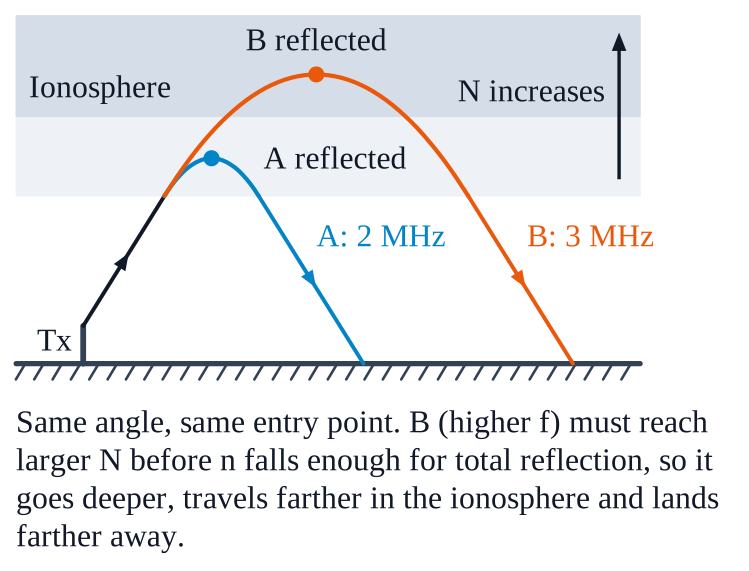
    Two waves A and B of frequencies 2\displaystyle 2 MHz and 3\displaystyle 3 MHz, respectively are beamed in the same direction for communication via sky wave. Which one of these is likely to travel longer distance in the ionosphere before suffering total internal reflection?
    NCERT’s answer
    The refractive index increases with increase in frequency which implies that for higher frequency waves, angle of refraction is less, i.e. bending is less. Hence, the condition of total internal relection is atained after travelling larger distance (by 3MHz wave).
    \[n=\sqrt{1-\frac{81N}{f^{2}}}\qquad (N\ \text{in}\ \mathrm{m^{-3}},\ f\ \text{in}\ \mathrm{Hz}) \] \[f_B=3\ \mathrm{MHz} > f_A=2\ \mathrm{MHz} \] \(\displaystyle f\uparrow\Rightarrow n\uparrow\) at a given \(\displaystyle N\) \(\displaystyle \Rightarrow\) B must go deeper, to larger \(\displaystyle N\), before \(\displaystyle n\) falls enough for total reflection.NCERT_Solution_Class12_Physics_Exemplar_Ch15_Q17Answer: Wave B ($\displaystyle 3$ MHz).
  4. Exercise 18

    The maximum amplitude of an A.M. wave is found to be 15\displaystyle 15 V while its minimum amplitude is found to be 3\displaystyle 3 V. What is the modulation index?
    NCERT’s answer
    \(\displaystyle A_c+A_m=15, A_c-A_m=3\) \[\begin{aligned} & \therefore 2 A_c=18,2 A_m=12 \\ & \therefore m=\frac{A_m}{A_c}=\frac{2}{3} \end{aligned} \]
    \[A_{max}=15\ \mathrm{V},\qquad A_{min}=3\ \mathrm{V} \] \[\mu=\frac{A_{max}-A_{min}}{A_{max}+A_{min}} \] \[\mu=\frac{15\ \mathrm{V}-3\ \mathrm{V}}{15\ \mathrm{V}+3\ \mathrm{V}}=\frac{12}{18}=\frac{2}{3}\approx 0.67 \]Answer: \(\displaystyle \mu=\dfrac{2}{3}\approx 0.67\)
  5. Exercise 19

    Compute the LC\displaystyle L C product of a tuned amplifier circuit required to generate a carrier wave of 1\displaystyle 1 MHz for amplitude modulation.
    NCERT’s answer
    \(\displaystyle \frac{1}{2 \pi \sqrt{L C}}=1 \mathrm{MHz}\) \[\sqrt{\mathrm{LC}}=\frac{1}{2 \pi \times 10^6} \]
    \[f=\frac{1}{2\pi\sqrt{LC}},\qquad f=1\ \mathrm{MHz}=10^{6}\ \mathrm{Hz} \] \[LC=\frac{1}{4\pi^{2}f^{2}} \] \[LC=\frac{1}{4\pi^{2}\,(10^{6}\ \mathrm{Hz})^{2}}=\frac{1}{3.95\times10^{13}\ \mathrm{s^{-2}}} \] \[LC\approx 2.5\times10^{-14}\ \mathrm{s^{2}} \] Put \(\displaystyle f\) in hertz, not megahertz.Answer: \(\displaystyle LC\approx 2.5\times10^{-14}\ \mathrm{s^{2}}\) (henry \(\displaystyle \times\) farad)
  6. Exercise 20

    Why is a AM signal likely to be more noisy than a FM signal upon transmission through a channel?
    NCERT’s answer
    In AM, the carrier waves instantaneous voltage is varied by modulating waves voltage. On transmission, noise signals can also be added and receiver assumes noise a part of the modulating signal. However in FM, the carriers frequency is changed as per modulating waves instantaneous voltage. This can only be done at the mixing/modulating stage and not while signal is transmitting in channel. Hence, noise doesn't effect FM signal.
    Noise alters amplitude.AM: message in amplitude \(\displaystyle \Rightarrow\) noise corrupts it.FM: message in frequency \(\displaystyle \Rightarrow\) limiter clips amplitude noise; message largely unaffected.Answer: AM's message sits in amplitude, which noise alters.