SolveIt is under development
SolveItClass 12 · Exemplar

NCERT Exemplar · Class 12 Physics Communication Systems

30 questions

This chapter is from the older syllabus and is not in the current NCERT textbook, so you may skip it.

Multiple Choice Questions (Type I) 1–9 (part 1 of 5)

  1. Exercise 1

    Three waves A, B and C of frequencies 1600\displaystyle 1600 kHz, 5\displaystyle 5 MHz and 60\displaystyle 60 MHz, respectively are to be transmitted from one place to another. Which of the following is the most appropriate mode of communication:
    (a)
    A is transmitted via space wave while B and C are transmitted via sky wave.
    (b)
    A is transmitted via ground wave, B via sky wave and C via space wave.
    (c)
    B and C are transmitted via ground wave while A is transmitted via sky wave.
    (d)
    B is transmitted via ground wave while A and C are transmitted via space wave.
    NCERT’s answer
    (b)
    (b) A by ground wave, B by sky wave, C by space wave.\[f_A = 1600\ \mathrm{kHz} = 1.6\ \mathrm{MHz}\ (\lesssim 2\ \mathrm{MHz}) \Rightarrow \text{ground wave} \] \[f_B = 5\ \mathrm{MHz}\ (2\text{ to }30\ \mathrm{MHz}) \Rightarrow \text{sky wave, reflected by the ionosphere} \] \[f_C = 60\ \mathrm{MHz}\ (>30\ \mathrm{MHz}) \Rightarrow \text{space wave, line of sight} \]Above about \(\displaystyle 30\ \mathrm{MHz}\) the ionosphere no longer reflects, so C cannot go by sky wave.
  2. Exercise 2

    A 100m long antenna is mounted on a 500m tall building. The complex can become a transmission tower for waves with λ\displaystyle \lambda
    (a)
    400\displaystyle 400 m.
    (b)
    25\displaystyle 25 m.
    (c)
    150\displaystyle 150 m.
    (d)
    2400\displaystyle 2400 m.
    NCERT’s answer
    (a)
    (a) \(\displaystyle \lambda \sim 400\ \mathrm{m}\): the antenna's own length sets the wavelength.\[l = 100\ \mathrm{m} \] \[l \approx \frac{\lambda}{4} \] \[\lambda \approx 4l = 4 \times 100\ \mathrm{m} = 400\ \mathrm{m} \]Use the antenna length only, not the building height; the building just raises the antenna.
  3. Exercise 3

    A 1\displaystyle 1 KW signal is transmitted using a communication channel which provides attenuation at the rate of -2dB per km. If the communication channel has a total length of 5\displaystyle 5 km, the power of the signal received is [gain in dB=10log⁡(P0Pi)\displaystyle \mathrm{dB}=10 \log \left(\frac{P_0}{P_i}\right)]
    (a)
    900\displaystyle 900 W.
    (b)
    100\displaystyle 100 W.
    (c)
    990\displaystyle 990 W.
    (d)
    1010\displaystyle 1010 W.
    NCERT’s answer
    (b)
    (b) \(\displaystyle 100\ \mathrm{W}\).\[\text{total gain} = (-2\ \mathrm{dB\,km^{-1}})(5\ \mathrm{km}) = -10\ \mathrm{dB} \] \[10\log\frac{P_0}{P_i} = -10 \Rightarrow \frac{P_0}{P_i} = 10^{-1} \] \[P_0 = 0.1 \times 1000\ \mathrm{W} = 100\ \mathrm{W} \]Add the decibels over the whole length first, then convert to a power ratio.
  4. Exercise 4

    A speech signal of 3\displaystyle 3 kHz is used to modulate a carrier signal of frequency 1\displaystyle 1 MHz, using amplitude modulation. The frequencies of the side bands will be
    (a)
    1.003\displaystyle 003 MHz and 0.997\displaystyle 0.997 MHz.
    (b)
    3001\displaystyle 3001 kHz and 2997\displaystyle 2997 kHz.
    (c)
    1003\displaystyle 1003 kHz and 1000\displaystyle 1000 kHz.
    (d)
    1\displaystyle 1 MHz and 0.997\displaystyle 0.997 MHz.
    NCERT’s answer
    (a)
    (a) \(\displaystyle 1.003\ \mathrm{MHz}\) and \(\displaystyle 0.997\ \mathrm{MHz}\); the side bands lie at \(\displaystyle f_c \pm f_m\).\[f_c \pm f_m = 1000\ \mathrm{kHz} \pm 3\ \mathrm{kHz} \] \[f_{\text{upper}} = 1003\ \mathrm{kHz} = 1.003\ \mathrm{MHz} \] \[f_{\text{lower}} = 997\ \mathrm{kHz} = 0.997\ \mathrm{MHz} \]The carrier \(\displaystyle 1000\ \mathrm{kHz}\) is not a side band.
  5. Exercise 5

    A message signal of frequency ωm\displaystyle \omega_{\mathrm{m}} is superposed on a carrier wave of frequency ωc\displaystyle \omega_{\mathrm{c}} to get an amplitude modulated wave (AM). The frequency of the AM wave will be
    (a)
    ωm\displaystyle \omega_{\mathrm{m}}.
    (b)
    ωC\displaystyle \omega_{\mathrm{C}}.
    (c)
    ωc+ωm2\displaystyle \frac{\omega_c+\omega_m}{2}.
    (d)
    ωc−ωm2\displaystyle \frac{\omega_c-\omega_m}{2}.
    NCERT’s answer
    (b)
    (b) \(\displaystyle \omega_c\). The carrier frequency is unchanged; only its amplitude varies at \(\displaystyle \omega_m\).\[c_m(t) = A_c\sin\omega_c t + \mu A_c\sin\omega_m t\,\sin\omega_c t \] \[c_m(t) = A_c\sin\omega_c t + \frac{\mu A_c}{2}\cos(\omega_c-\omega_m)t - \frac{\mu A_c}{2}\cos(\omega_c+\omega_m)t \]The side bands are \(\displaystyle \omega_c\pm\omega_m\), not half their sum or difference.
  6. Exercise 6

    I−V\displaystyle I-V characteristics of four devices are shown in Fig. 15.1\displaystyle 15.1
    Identify devices that can be used for modulation:
    (a)
    'i' and 'iii'.
    (b)
    only 'iii'.
    (c)
    'ii' and some regions of 'iv'.
    (d)
    All the devices can be used.
    NCERT_Question_Class12_Physics_Exemplar_Ch15_Q6
    NCERT’s answer
    (c)
    (c) 'ii' and some regions of 'iv'.
    Modulation needs a non-linear \(\displaystyle I\)–\(\displaystyle V\) curve, so that a product term appears:
    \[I = aV + bV^{2},\qquad V = V_c + V_m \]
    \[I = a(V_c+V_m) + b\left(V_c^{2} + V_m^{2} + 2V_cV_m\right) \;\Rightarrow\; \text{term } 2b\,V_cV_m \]
    (i)
    is linear, \(\displaystyle I = V/R\), and (iii) is constant \(\displaystyle I\): neither gives a product term.
  7. Exercise 7

    A male voice after modulation-transmission sounds like that of a female to the receiver. The problem is due to
    (a)
    poor selection of modulation index (selected 0<m<1\displaystyle 0<m<1)
    (b)
    poor bandwidth selection of amplifiers.
    (c)
    poor selection of carrier frequency
    (d)
    loss of energy in transmission.
    NCERT’s answer
    (b)
    (b) Poor bandwidth selection of amplifiers.\(\displaystyle 0<m<1\) is the distortion-free range, and \(\displaystyle f_c\) does not change the recovered \(\displaystyle f_m\). The amplifier passband decides which voice frequencies survive: \[\text{passband misses low (male-voice) frequencies} \;\Rightarrow\; \text{only higher components reproduced} \;\Rightarrow\; \text{pitch heard higher} \]
  8. Exercise 8

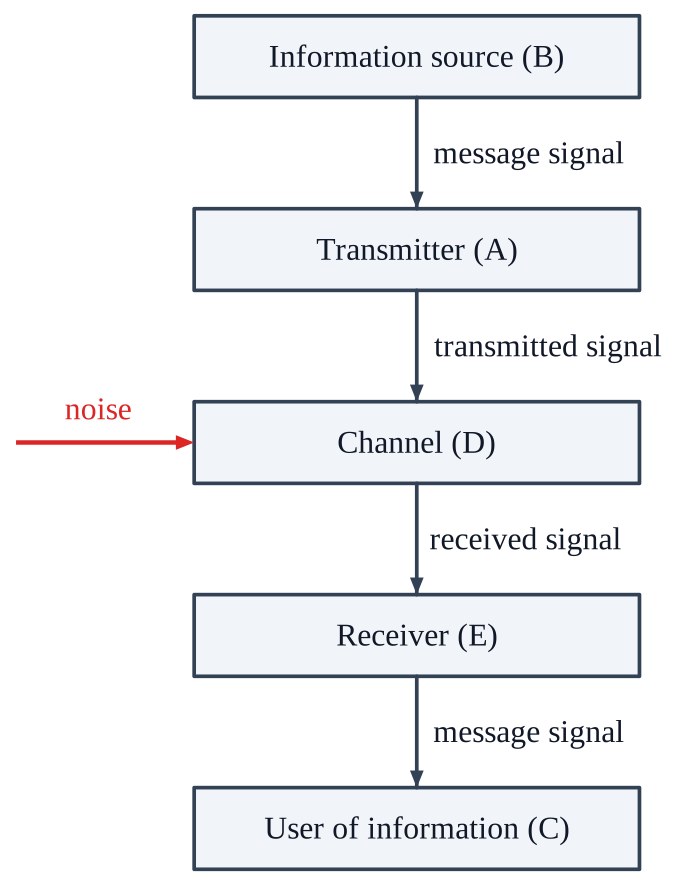
    A basic communication system consists of
    (A)
    transmitter.
    (B)
    information source.
    (C)
    user of information.
    (D)
    channel.
    (E)
    receiver.
    Choose the correct sequence in which these are arranged in a basic communication system:
    (a)
    ABCDE.
    (b)
    BADEC.
    (c)
    BDACE.
    (d)
    BEADC.
    NCERT’s answer
    (b)
    (b) BADEC.Signal path, left to right: \[\text{B (source)} \to \text{A (transmitter)} \to \text{D (channel)} \to \text{E (receiver)} \to \text{C (user)} \] NCERT_Solution_Class12_Physics_Exemplar_Ch15_Q8
  9. Exercise 9

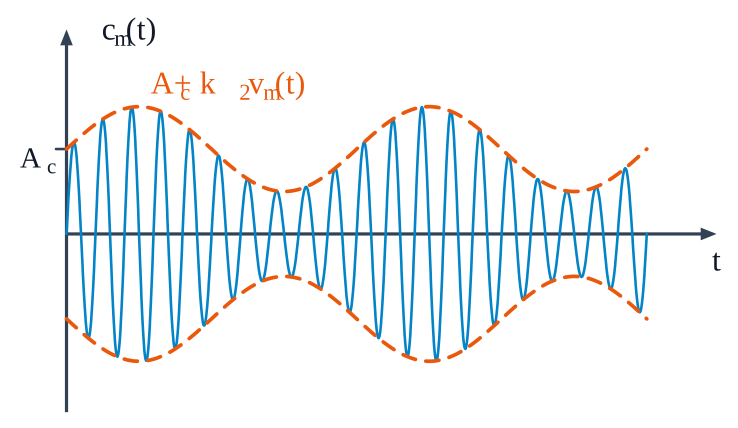
    Identify the mathematical expression for amplitude modulated wave:
    (a)
    Acsin⁡[{ωc+k1vm(t)}t+ϕ]\displaystyle A_c \sin \left[\left\{\omega_c+k_1 v_m(t)\right\} t+\phi\right].
    (b)
    Acsin⁡{ωct+ϕ+k2vm(t)}\displaystyle A_c \sin \left\{\omega_c t+\phi+k_2 v_m(\mathrm{t})\right\}.
    (c)
    {Ac+k2vm(t)}sin⁡(ωct+ϕ)\displaystyle \left\{A_c+k_2 v_m(\mathrm{t})\right\} \sin \left(\omega_c t+\phi\right).
    (d)
    Acvm(t)sin⁡(ωct+ϕ)\displaystyle A_c v_m(\mathrm{t}) \sin \left(\omega_c t+\phi\right).
    NCERT’s answer
    (c)
    (c) \(\displaystyle \{A_c + k_2 v_m(t)\}\sin(\omega_c t+\phi)\)
    In AM only the carrier amplitude follows the message; \(\displaystyle \omega_c\) and \(\displaystyle \phi\) stay fixed.
    \[A(t) = A_c + k_2 v_m(t) \]
    \[c_m(t) = \{A_c + k_2 v_m(t)\}\sin(\omega_c t+\phi) \]
    NCERT_Solution_Class12_Physics_Exemplar_Ch15_Q9
    (a)
    varies the frequency and (b) the phase.