SolveIt is under development
SolveItClass 12 · Exemplar

NCERT Exemplar · Class 12 Physics Communication Systems

30 questions

This chapter is from the older syllabus and is not in the current NCERT textbook, so you may skip it.

Multiple Choice Questions (Type II) 10–14 (part 2 of 5)

  1. Exercise 10

    An audio signal of 15kHz frequency cannot be transmitted over long distances without modulation because
    (a)
    the size of the required antenna would be at least 5\displaystyle 5 km which is not convenient.
    (b)
    the audio signal can not be transmitted through sky waves.
    (c)
    the size of the required antenna would be at least 20\displaystyle 20 km, which is not convenient.
    (d)
    effective power transmitted would be very low, if the size of the antenna is less than 5\displaystyle 5 km.
    NCERT’s answer
    (a), (b), (d)
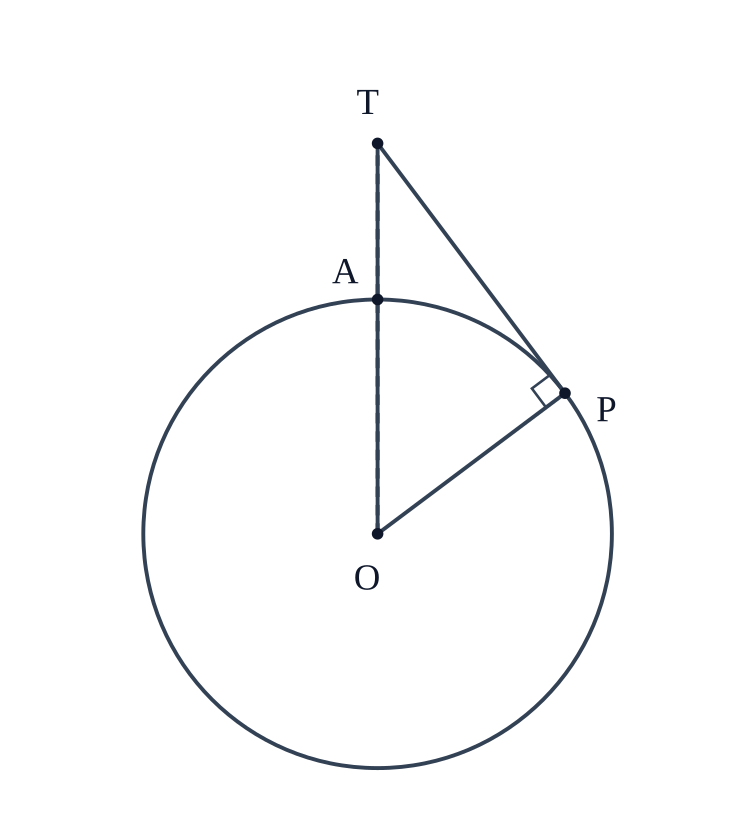
    (a), (b), (d) — a $\displaystyle 15$ kHz signal needs \(\displaystyle l\approx\lambda/4\) (so (c) is wrong), lies below the sky-wave band, and a shorter antenna radiates very little power.\[\lambda=\frac{c}{f}=\frac{3\times10^{8}\ \mathrm{m\,s^{-1}}}{15\times10^{3}\ \mathrm{Hz}}=2\times10^{4}\ \mathrm{m}=20\ \mathrm{km} \]\[l\approx\frac{\lambda}{4}=\frac{20\ \mathrm{km}}{4}=5\ \mathrm{km} \]\[P_{\mathrm{rad}}\propto\left(\frac{l}{\lambda}\right)^{2}:\qquad l<5\ \mathrm{km}\Rightarrow P_{\mathrm{rad}}\downarrow \]\[f=15\ \mathrm{kHz}<3\ \mathrm{MHz}\quad(\text{ionosphere reflects }3\text{–}30\ \mathrm{MHz})\Rightarrow\text{no sky wave} \]
  2. Exercise 11

    Audio sine waves of 3\displaystyle 3 kHz frequency are used to amplitude modulate a carrier signal of 1.5\displaystyle 1.5 MHz. Which of the following statements are true?
    (a)
    The side band frequencies are 1506\displaystyle 1506 kHz and 1494\displaystyle 1494 kHz.
    (b)
    The bandwidth required for amplitude modulation is 6kHz.
    (c)
    The bandwidth required for amplitude modulation is 3\displaystyle 3 MHz.
    (d)
    The side band frequencies are 1503\displaystyle 1503 kHz and 1497\displaystyle 1497 kHz.
    NCERT’s answer
    (b), (d)
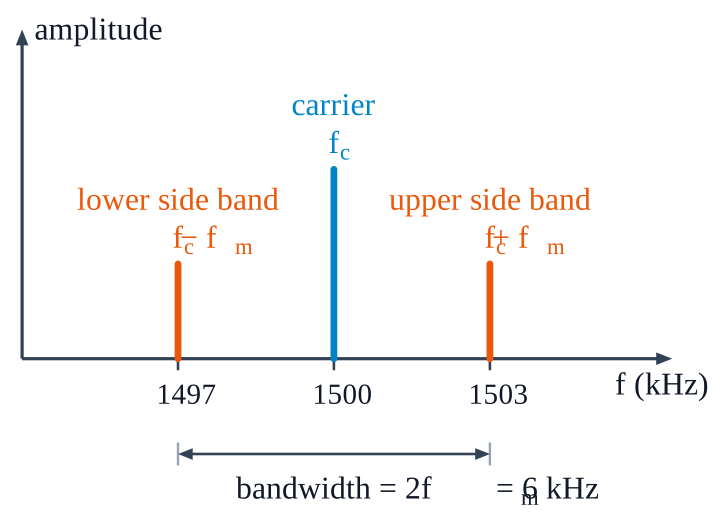
    (b), (d) — the side bands lie at \(\displaystyle f_c\pm f_m\) and the bandwidth is \(\displaystyle 2f_m\).\[f_m=3\ \mathrm{kHz},\qquad f_c=1.5\ \mathrm{MHz}=1500\ \mathrm{kHz} \]\[f_c\pm f_m=(1500\pm3)\ \mathrm{kHz}=1503\ \mathrm{kHz},\ 1497\ \mathrm{kHz} \]\[\text{Bandwidth}=2f_m=2\times3\ \mathrm{kHz}=6\ \mathrm{kHz} \]NCERT_Solution_Class12_Physics_Exemplar_Ch15_Q11
  3. Exercise 12

    A TV trasmission tower has a height of 240\displaystyle 240 m. Signals broadcast from this tower will be received by LOS communication at a distance of (assume the radius of earth to be 6.4×10⁶ m\displaystyle 6.4 \times 10^6 \mathrm{~m})
    (a)
    100\displaystyle 100 km.
    (b)
    24\displaystyle 24 km.
    (c)
    55\displaystyle 55 km.
    (d)
    50\displaystyle 50 km.
    NCERT’s answer
    (b), (c), (d)
    (b), (c), (d) — $\displaystyle 55$ km is the maximum LOS range, so every distance up to it is covered; $\displaystyle 100$ km lies beyond.NCERT_Solution_Class12_Physics_Exemplar_Ch15_Q12\[d^{2}=(R+h)^{2}-R^{2}=2Rh+h^{2}\approx2Rh\qquad(h\ll R) \]\[d=\sqrt{2Rh}=\sqrt{2\times6.4\times10^{6}\ \mathrm{m}\times240\ \mathrm{m}}=\sqrt{3.07\times10^{9}}\ \mathrm{m}\approx5.5\times10^{4}\ \mathrm{m}\approx55\ \mathrm{km} \]\[24\ \mathrm{km},\ 50\ \mathrm{km},\ 55\ \mathrm{km}\le d\ (\text{received});\qquad100\ \mathrm{km}>d\ (\text{not received}) \]
  4. Exercise 13

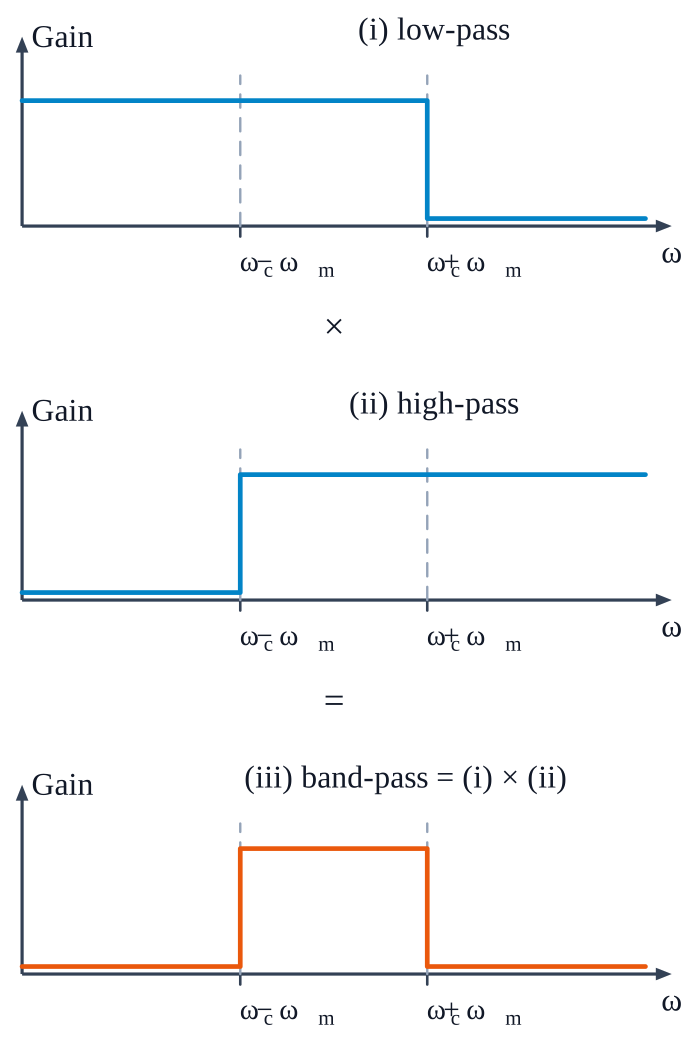
    The frequency response curve (Fig. 15.2\displaystyle 15.2) for the filter circuit used for production of AM wave should be
    (a)(i)
    followed by (ii).
    (b)(ii)
    followed by (i).
    (c)(iii)
    .
    (d)(iv)
    .
    NCERT_Question_Class12_Physics_Exemplar_Ch15_Q13
    NCERT’s answer
    (a), (b), (c)
    (a), (b), (c) — the AM wave occupies \(\displaystyle \omega_c-\omega_m\) to \(\displaystyle \omega_c+\omega_m\), so a band-pass response is needed: (iii), or (i) and (ii) in cascade in either order. (iv) rejects this band.\[\text{AM wave}:\ \omega_c,\ \ \omega_c\pm\omega_m \]\[\text{(i) passes }\omega<\omega_c+\omega_m,\qquad\text{(ii) passes }\omega>\omega_c-\omega_m \]\[G(\omega)=G_{\mathrm{i}}(\omega)\,G_{\mathrm{ii}}(\omega)=G_{\mathrm{ii}}(\omega)\,G_{\mathrm{i}}(\omega)\ \Rightarrow\ \omega_c-\omega_m<\omega<\omega_c+\omega_m\ \equiv\ \text{(iii)} \]NCERT_Solution_Class12_Physics_Exemplar_Ch15_Q13
  5. Exercise 14

    In amplitude modulation, the modulation index m\displaystyle m, is kept less than or equal to 1\displaystyle 1 because
    (a)
    m>1\displaystyle m>1, will result in interference between carrier frequency and message frequency, resulting into distortion.
    (b)
    m>1\displaystyle m>1 will result in overlapping of both side bands resulting into loss of information.
    (c)
    m>1\displaystyle m>1 will result in change in phase between carrier signal and message signal.
    (d)
    m>1\displaystyle m>1 indicates amplitude of message signal greater than amplitude of carrier signal resulting into distortion.
    NCERT’s answer
    (b), (d)
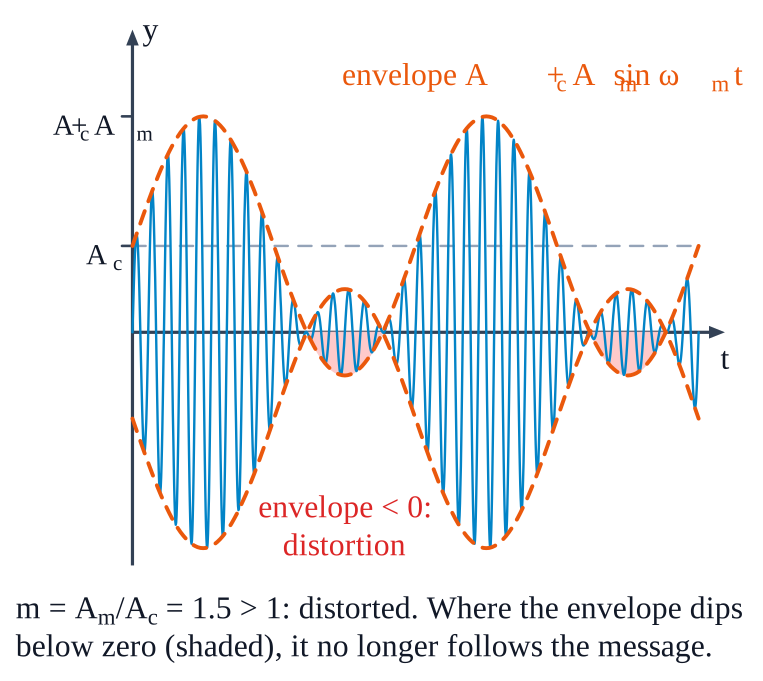
    (b), (d) — for \(\displaystyle m>1\) the message amplitude exceeds the carrier's, the envelope is distorted, and the extra side bands crowd and overlap, so information is lost.\[m=\frac{A_m}{A_c},\qquad y=(A_c+A_m\sin\omega_m t)\sin\omega_c t \]\[m\le1\Rightarrow A_c+A_m\sin\omega_m t\ge0\Rightarrow\text{envelope}=\text{message} \]\[m>1\Rightarrow A_m>A_c\Rightarrow A_c+A_m\sin\omega_m t<0\ \text{for part of each cycle} \]\[\text{envelope}\neq\text{message}\Rightarrow\text{distortion}\Rightarrow\text{extra side frequencies }\omega_c\pm n\omega_m\ (n=2,3,\dots)\Rightarrow\text{side bands overlap} \]NCERT_Solution_Class12_Physics_Exemplar_Ch15_Q14