SolveIt is under development
SolveItClass 12 · Exemplar

NCERT Exemplar · Class 12 Physics Communication Systems

30 questions

This chapter is from the older syllabus and is not in the current NCERT textbook, so you may skip it.

Short Answer Questions 21–25 (part 4 of 5)

  1. Exercise 21

    Figure 15.3\displaystyle 15.3 shows a communication system. What is the output power when input signal is of 1.01mW? (gain in dB=10log⁡10\displaystyle \mathrm{dB}=10 \log _{10} (Po/Pi)\displaystyle \left(P_o / P_i\right). NCERT_Question_Class12_Physics_Exemplar_Ch15_Q21
    NCERT’s answer
    Loss suffered in transmission path \[=-2 \mathrm{~dB} \mathrm{~km}^{-1} \times 5 \mathrm{~km}=-10 \mathrm{~dB} \] \[\begin{aligned} \text { Total amplifier gain } & =10 \mathrm{~dB}+20 \mathrm{~dB} \\ & =30 \mathrm{~dB} \end{aligned} \] \[\begin{aligned} \text { Overall gain of signal } & =30 \mathrm{~dB}-10 \mathrm{~dB} \\ & =20 \mathrm{~dB} \end{aligned} \] \[\begin{aligned} 10 \log \left(\frac{P_o}{P_i}\right) \quad=12 \text { or } \mathrm{P}_{\mathrm{o}} & =\mathrm{P}_i \times 10^2 \\ \quad & =1.01 \mathrm{~mW} \times 100=101 \mathrm{~mW} . \end{aligned} \]
    Gains and losses in dB add; the cable is a loss, so it enters with a minus sign.\[G = 10\ \mathrm{dB} - (2\ \mathrm{dB\,km^{-1}})(5.0\ \mathrm{km}) + 20\ \mathrm{dB} = 20\ \mathrm{dB} \]\[10\log_{10}\!\left(\frac{P_o}{P_i}\right) = 20\ \mathrm{dB} \;\Rightarrow\; \frac{P_o}{P_i} = 10^{2} = 100 \]\[P_o = 100 \times 1.01\ \mathrm{mW} = 101\ \mathrm{mW} \]Answer: \(\displaystyle P_o = 101\ \mathrm{mW}\)
  2. Exercise 22

    A TV transmission tower antenna is at a height of 20\displaystyle 20 m. How much service area can it cover if the receiving antenna is (i) at ground level, (ii) at a height of 25\displaystyle 25 m? Calculate the percentage increase in area covered in case (ii) relative to case (i).
    NCERT’s answer
    (i)
    Range \(\displaystyle =\sqrt{2 \times 6.4 \times 10^6 \times 20}=16 \mathrm{~km}\)
    Area covered \(\displaystyle =803.84 \mathrm{~km}^2\)
    (ii)
    Range \(\displaystyle =\sqrt{2 \times 6.4 \times 10^6 \times 20}+\sqrt{2 \times 6.4 \times 10^6 \times 25}\)
    \[=(16+17.9) \mathrm{km}=33.9 \mathrm{~km} \]
    Area covered \(\displaystyle =3608.52 \mathrm{~km}^2\)
    ∴ Percentage increase in area
    \[\begin{aligned} & =\frac{(3608.52-803.84)}{803.84} \times 100 \\ & =348.9 \% \end{aligned} \]
    With \(\displaystyle R = 6.4\times10^{6}\ \mathrm{m}\), the range is \(\displaystyle d=\sqrt{2Rh_T}\) for a ground-level receiver, and \(\displaystyle d=\sqrt{2Rh_T}+\sqrt{2Rh_R}\) for a raised one. Area covered \(\displaystyle =\pi d^{2}\).
    NCERT_Solution_Class12_Physics_Exemplar_Ch15_Q22
    (i)
    Receiver at ground level:
    \[d_1=\sqrt{2(6.4\times10^{6}\ \mathrm{m})(20\ \mathrm{m})}=1.6\times10^{4}\ \mathrm{m}=16\ \mathrm{km} \]
    \[A_1=\pi d_1^{2}=3.14\times(16\ \mathrm{km})^{2}\approx 804\ \mathrm{km^{2}} \]
    (ii)
    Receiver at \(\displaystyle h_R = 25\ \mathrm{m}\):
    \[d_2=16\ \mathrm{km}+\sqrt{2(6.4\times10^{6}\ \mathrm{m})(25\ \mathrm{m})}=16\ \mathrm{km}+17.9\ \mathrm{km}=33.9\ \mathrm{km} \]
    \[A_2=\pi d_2^{2}=3.14\times(33.9\ \mathrm{km})^{2}\approx 3.61\times10^{3}\ \mathrm{km^{2}} \]
    \[\frac{A_2-A_1}{A_1}\times100=\frac{3610-804}{804}\times100\approx 349\% \]
    Add the two ranges before squaring, not the two areas.
    Answer: (i) \(\displaystyle \approx 804\ \mathrm{km^{2}}\); (ii) \(\displaystyle \approx 3.6\times10^{3}\ \mathrm{km^{2}}\); increase \(\displaystyle \approx 349\%\)
  3. Exercise 23

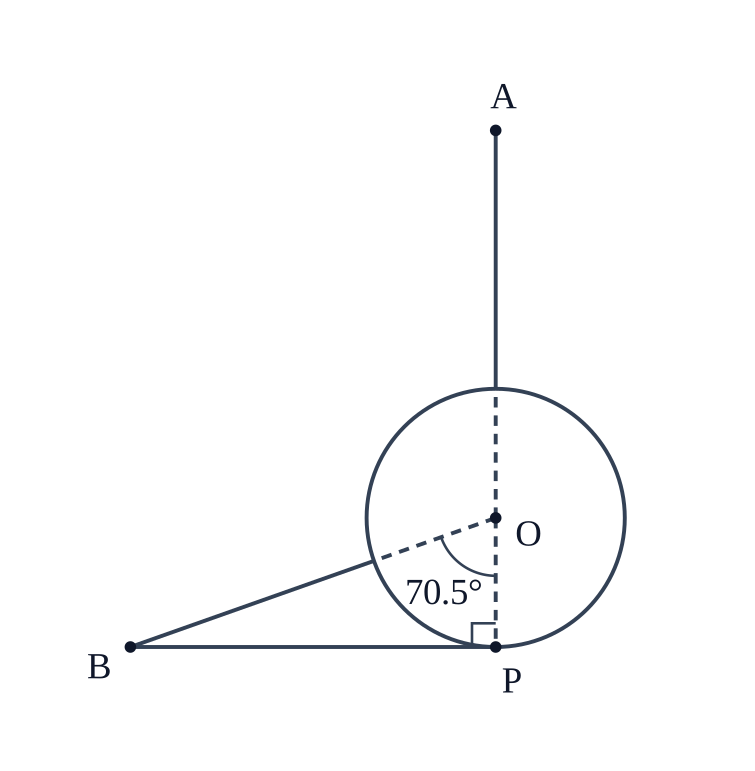
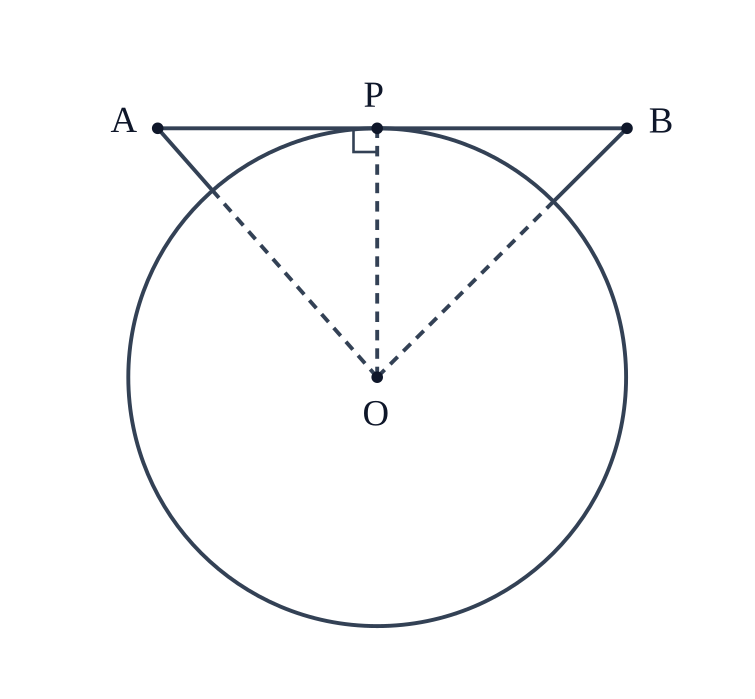
    If the whole earth is to be connected by LOS communication using space waves (no restriction of antenna size or tower height), what is the minimum number of antennas required? Calculate the tower height of these antennas in terms of earths radius?
    Each tower sees a cap of half-angle \(\displaystyle \theta<90^\circ\). Any three towers leave some point \(\displaystyle 90^\circ\) or more away, so three fail; four at the corners of a regular tetrahedron work.NCERT_Solution_Class12_Physics_Exemplar_Ch15_Q23B's line of sight touches the earth at P:\[\cos\theta=\frac{R}{R+h} \]Tetrahedron corners:\[\cos\angle AOB=-\tfrac13 \;\Rightarrow\; \angle AOB=109.5^\circ \]P, opposite A, is the worst-placed point:\[\theta=180^\circ-109.5^\circ=70.5^\circ \;\Rightarrow\; \cos\theta=\tfrac13 \]\[\frac{R}{R+h}=\frac13 \;\Rightarrow\; R+h=3R \;\Rightarrow\; h=2R\approx 2(6.4\times10^{6}\ \mathrm{m})=1.3\times10^{7}\ \mathrm{m} \]Use \(\displaystyle 70.5^\circ\), not the angle between towers. Six towers at \(\displaystyle h=R\) (octahedron) work too, but are not minimal.Answer: $\displaystyle 4$ antennas, each tower \(\displaystyle h=2R\) high
  4. Exercise 24

    The maximum frequency for reflection of sky waves from a certain layer of the ionosphere is found to be fmax =9(Nmax )1/2\displaystyle f_{\text {max }}=9\left(N_{\text {max }}\right)^{1 / 2}, where Nmax \displaystyle N_{\text {max }} is the maximum electron density at that layer of the ionosphere. On a certain day it is observed that signals of frequencies higher than 5MHz are not received by reflection from the F1\displaystyle \mathrm{F}_1 layer of the ionosphere while signals of frequencies higher than 8MHz are not received by reflection from the F2\displaystyle \mathrm{F}_2 layer of the inonosphere. Estimate the maximum electron densities of the F1\displaystyle \mathrm{F}_1 and F2\displaystyle \mathrm{F}_2 layers on that day.
    NCERT’s answer
    For \(\displaystyle F_1\) layer \[5 \times 10^6=9\left(N_{\max }\right)^{1 / 2} \text { or } N_{\max }=\left(\frac{5}{9} \times 10^6\right)^2=3.086 \times 10^{11} \mathrm{~m}^{-3} \] For \(\displaystyle \mathrm{F}_2\) layer \[\begin{aligned} & 8 \times 10^6=9\left(N_{\max }\right)^{1 / 2} \text { or } \\ & N_{\max }=\left(\frac{8}{9} \times 10^6\right)=7.9 \times 10^{11} \mathrm{~m}^{-3}=7.9 \times 10^{11} \mathrm{~m}^{-3} . \end{aligned} \]
    Signals above \(\displaystyle f_{max}\) pass through the layer, so the cut-off frequency of each layer is its \(\displaystyle f_{max}\).\[f_{max}=9\sqrt{N_{max}} \;\Rightarrow\; N_{max}=\left(\frac{f_{max}}{9}\right)^{2} \]\(\displaystyle \mathrm{F_1}\): \(\displaystyle f_{max}=5\ \mathrm{MHz}=5\times10^{6}\ \mathrm{Hz}\)\[N_1=\left(\frac{5\times10^{6}}{9}\right)^{2}\approx 3.1\times10^{11}\ \mathrm{m^{-3}} \]\(\displaystyle \mathrm{F_2}\): \(\displaystyle f_{max}=8\ \mathrm{MHz}=8\times10^{6}\ \mathrm{Hz}\)\[N_2=\left(\frac{8\times10^{6}}{9}\right)^{2}\approx 7.9\times10^{11}\ \mathrm{m^{-3}} \]Convert MHz to Hz before substituting; the formula takes \(\displaystyle f\) in Hz and gives \(\displaystyle N\) in \(\displaystyle \mathrm{m^{-3}}\).Answer: \(\displaystyle N_1\approx 3.1\times10^{11}\ \mathrm{m^{-3}}\), \(\displaystyle N_2\approx 7.9\times10^{11}\ \mathrm{m^{-3}}\)
  5. Exercise 25

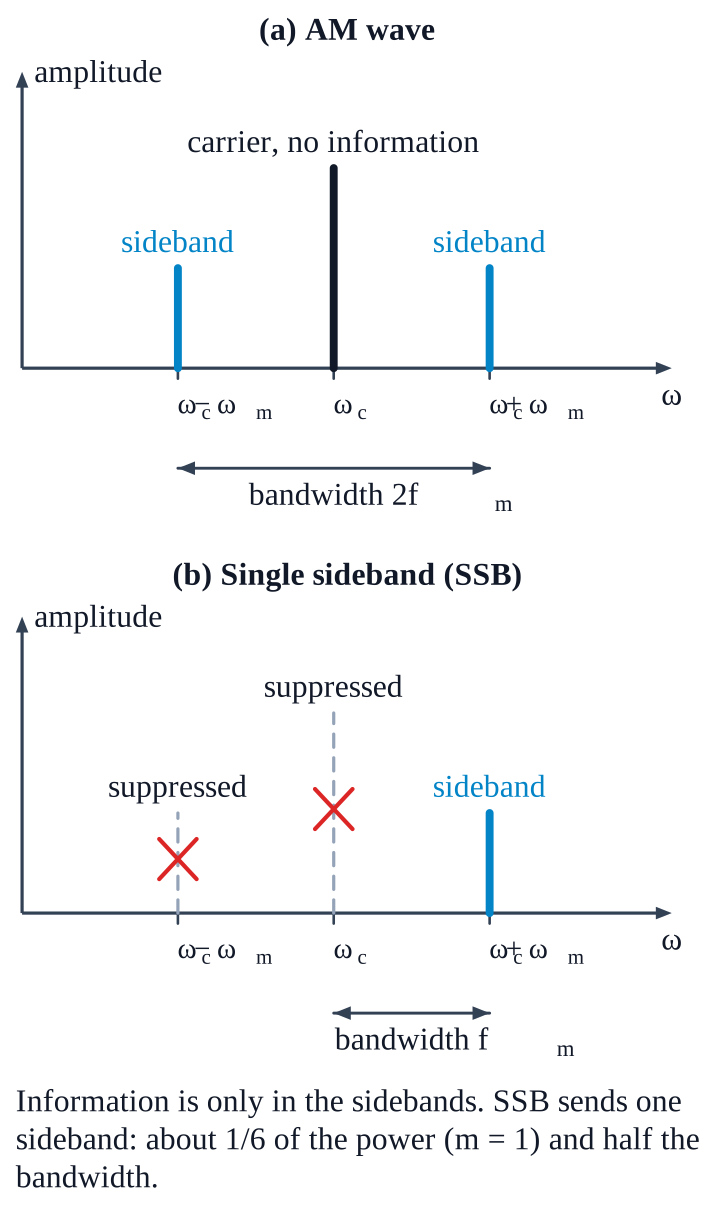
    On radiating (sending out) an AM modulated signal, the total radiated power is due to energy carried by ωc,ωc−ωm&ωc+ωm\displaystyle \omega_{\mathrm{c}}, \omega_{\mathrm{c}}-\omega_{\mathrm{m}} \& \omega_{\mathrm{c}}+\omega_{\mathrm{m}}. Suggest ways to minimise cost of radiation without compromising on information.
    NCERT’s answer
    Of \(\displaystyle \omega_{\mathrm{c}}-\omega_{\mathrm{m}}, \omega_{\mathrm{c}}\) and \(\displaystyle \omega_{\mathrm{m}}+\omega_{\mathrm{m}}\), only \(\displaystyle \omega_{\mathrm{c}}+\omega_{\mathrm{m}}\) or \(\displaystyle \omega_{\mathrm{c}}-\omega_{\mathrm{m}}\) contains information. Hence cost can be reduced by transmitting \(\displaystyle \omega_{\mathrm{c}}+\omega_{\mathrm{m}}, \omega_{\mathrm{c}}-\omega_{\mathrm{m}}\), both \(\displaystyle \omega_{\mathrm{c}}+\omega_{\mathrm{m}}\) & \(\displaystyle \omega_{\mathrm{c}}-\omega_{\mathrm{m}}\)
    The information is in the sidebands \(\displaystyle \omega_c\pm\omega_m\); the carrier carries none, and the two sidebands are mirror copies of each other.\[P_t=P_c+\underbrace{\tfrac{m^{2}}{4}P_c}_{\omega_c-\omega_m}+\underbrace{\tfrac{m^{2}}{4}P_c}_{\omega_c+\omega_m}=P_c\left(1+\tfrac{m^{2}}{2}\right) \]\[m=1:\quad P_c=\tfrac{2}{3}P_t,\qquad \text{each sideband}=\tfrac{1}{6}P_t \]NCERT_Solution_Class12_Physics_Exemplar_Ch15_Q25Suppress the carrier and one sideband, and radiate a single sideband:\[P_{SSB}=\tfrac{m^{2}}{4}P_c=\tfrac{1}{6}P_t,\qquad B:\ 2f_m\to f_m \]The receiver must supply a carrier of frequency \(\displaystyle \omega_c\) to recover the signal.Answer: Radiate only one sideband with the carrier suppressed (SSB): same information, about \(\displaystyle \tfrac{1}{6}\) of the power (\(\displaystyle m=1\)) and half the bandwidth