SolveIt is under development
SolveItClass 12 · Exemplar

NCERT Exemplar · Class 12 Physics Communication Systems

30 questions

This chapter is from the older syllabus and is not in the current NCERT textbook, so you may skip it.

Long Answer Questions 26–30 (part 5 of 5)

  1. Exercise 26

    (i)
    The intensity of a light pulse travelling along a communication channel decreases exponentially with distance x\displaystyle x according to the relation I=Ioe−αx\displaystyle I=I_{\mathrm{o}} \mathrm{e}^{-\alpha \mathrm{x}}, where Io\displaystyle I_{\mathrm{o}} is the intensity at x=0\displaystyle x=0 and α\displaystyle \alpha is the attenuation constant.
    Show that the intensity reduces by 75\displaystyle 75 per cent after a distance of (ln⁡4α)\displaystyle \left(\frac{\ln 4}{\alpha}\right)
    (ii)
    Attenuation of a signal can be expressed in decibel (dB) according to the relation dB=10log⁡10(IIo)\displaystyle \mathrm{dB}=10 \log _{10}\left(\frac{I}{I_o}\right). What is the attenuation in dB/km for an optical fibre in which the intensity falls by 50\displaystyle 50 per cent over a distance of 50\displaystyle 50 km?
    NCERT’s answer
    (i)
    \(\displaystyle \frac{I}{I_o}=\frac{1}{4}\), so \(\displaystyle \ln \left(\frac{1}{4}\right)=-\alpha x\)
    or \(\displaystyle \ln 4=a x\) or \(\displaystyle x=\left(\frac{\ln 4}{\alpha}\right)\)
    (ii)
    \(\displaystyle 10 \log _{10} \frac{I}{I_o}=-\alpha x\) where \(\displaystyle \alpha\) is the attunation in dB/km.
    Here \(\displaystyle \frac{I}{I_o}=\frac{1}{2}\)
    or \(\displaystyle 10 \log \left(\frac{1}{2}\right)=-50 \alpha\) or \(\displaystyle \log 2=5 \alpha\)
    or \(\displaystyle \alpha=\frac{\log 2}{5}=\frac{0.3010}{5}=0.0602 d \mathrm{~B} / \mathrm{km}\)
    (i) \[x=\frac{\ln 4}{\alpha}\;\Rightarrow\; I=I_0\,e^{-\alpha x}=I_0\,e^{-\ln 4}=\frac{I_0}{4} \] \[\text{fall}=\frac{I_0-I_0/4}{I_0}\times100\,\%=75\,\% \] (ii) \[\frac{I}{I_0}=1-0.50=0.50 \] \[\mathrm{dB}=10\log_{10}(0.50)=-3.01\ \mathrm{dB}\quad\text{over }50\ \mathrm{km} \] \[\text{attenuation}=\frac{3.01\ \mathrm{dB}}{50\ \mathrm{km}}\approx 0.06\ \mathrm{dB\,km^{-1}} \] Answer: $\displaystyle 75$ % lost at \(\displaystyle x=\ln 4/\alpha\); attenuation \(\displaystyle \approx 0.06\ \mathrm{dB\,km^{-1}}\) (the minus sign only marks a loss).
  2. Exercise 27

    A 50\displaystyle 50 MHz sky wave takes 4.04\displaystyle 4.04 ms to reach a receiver via re-transmission from a satellite 600\displaystyle 600 km above earth's surface. Assuming re-transmission time by satellite negligible, find the distance between source and receiver. If communication between the two was to be done by Line of Sight (LOS) method, what should size and placement of receiving and transmitting antenna be?
    NCERT’s answer
    \(\displaystyle \frac{2 x}{\text { time }}=\) velocity \[\begin{aligned} & 2 x=3 \times 10^8 \mathrm{~m} / \mathrm{s} \times 4.04 \times 10^{-3} \mathrm{~s} \\ & x=\frac{12.12 \times 10^5}{2} \mathrm{~m}=6.06 \times 10^5 \mathrm{~m}=606 \mathrm{~km} \end{aligned} \] \(\displaystyle d^2=x^2-h_s^2=(606)^2-(600)^2=7236 ; d=85.06 \mathrm{~km}\) Distance between source and receiver \(\displaystyle =2 \mathrm{~d} \cong 170 \mathrm{~km}\) \[\begin{aligned} & d_m=2 \sqrt{2 R h_T}, 2 d=d_{\mathrm{m}}, \quad 4 d^2=8 R h_{\mathrm{T}} \\ & \frac{d^2}{2 R}=h_T=\frac{7236}{2 \times 6400} \approx 0.565 \mathrm{~km}=565 \mathrm{~m} . \end{aligned} \] NCERT_Solution_Class12_Physics_Exemplar_Ch15_Q27_ncert
    The wave goes up to the satellite and comes down: the path is two slant lengths. \[2s=ct=(3\times10^{8}\ \mathrm{m\,s^{-1}})(4.04\times10^{-3}\ \mathrm{s})=1212\ \mathrm{km}\;\Rightarrow\; s=606\ \mathrm{km} \] NCERT_Solution_Class12_Physics_Exemplar_Ch15_Q27 Caution: the right triangle needs \(\displaystyle s=606\ \mathrm{km}\), not the height alone. \[x=\sqrt{s^{2}-h^{2}}=\sqrt{606^{2}-600^{2}}\ \mathrm{km}=\sqrt{7236}\ \mathrm{km}\approx85\ \mathrm{km} \] \[D=2x\approx170\ \mathrm{km} \] LOS antennas \[\lambda=\frac{c}{\nu}=\frac{3\times10^{8}}{50\times10^{6}}=6\ \mathrm{m}\;\Rightarrow\;\ell\gtrsim\frac{\lambda}{4}=1.5\ \mathrm{m} \] \[D=\sqrt{2Rh_T}+\sqrt{2Rh_R}\ \overset{h_T=h_R=h}{=}\ 2\sqrt{2Rh}\;\Rightarrow\;h=\frac{D^{2}}{8R} \] \[h=\frac{(170\ \mathrm{km})^{2}}{8\times6400\ \mathrm{km}}\approx0.56\ \mathrm{km} \] Answer: \(\displaystyle D\approx170\ \mathrm{km}\); LOS needs antennas \(\displaystyle \gtrsim1.5\ \mathrm{m}\) long, each on a tower about $\displaystyle 560$ m high.
  3. Exercise 28

    An amplitude modulated wave is as shown in Fig. 15.4. Calculate (i) the percentage modulation, (ii) peak carrier voltage and, (iii) peak value of information voltage. NCERT_Question_Class12_Physics_Exemplar_Ch15_Q28
    NCERT’s answer
    From the figure
    \[V_{\max }=\frac{100}{2}=50 \mathrm{~V}, V_{\min }=\frac{20}{2}=10 \mathrm{~V} . \]
    (i)
    Percentage modulation
    \[\mu(\%)=\frac{V_{\max }-V_{\min }}{V_{\max }+V_{\min }} \times 100=\left(\frac{50-10}{50+10}\right) \times 100=\frac{40}{60} \times 100=66.67 \% \]
    (ii)
    Peak carrier voltage \(\displaystyle =V_c=\frac{V_{\text {max }}+V_{\text {min }}}{2}=\frac{50+10}{2}=30 \mathrm{~V}\)
    (iii)
    Peak information voltage \(\displaystyle =V_{\mathrm{m}}=\mu V_{\mathrm{c}}=\frac{2}{3} \times 30=20 \mathrm{~V}\).
    From the envelope: largest peak-to-peak \(\displaystyle =100\ \mathrm V\), smallest peak-to-peak \(\displaystyle =20\ \mathrm V\). \[A_c+A_m=\frac{100\ \mathrm V}{2}=50\ \mathrm V \] \[A_c-A_m=\frac{20\ \mathrm V}{2}=10\ \mathrm V \] \[A_c=30\ \mathrm V,\qquad A_m=20\ \mathrm V \] \[\mu=\frac{A_m}{A_c}=\frac{20\ \mathrm V}{30\ \mathrm V}=0.67\;\Rightarrow\;66.7\,\% \] Answer: (i) $\displaystyle 66.7$ % (ii) \(\displaystyle A_c=30\ \mathrm V\) (iii) \(\displaystyle A_m=20\ \mathrm V\)
  4. Exercise 29

    (i)
    Draw the plot of amplitude versus 'ω\displaystyle \omega' for an amplitude modulated wave whose carrier wave (ωc)\displaystyle \left(\omega_{\mathrm{c}}\right) is carrying two modulating signals, ω1\displaystyle \omega_1 and ω2(ω2>ω1)\displaystyle \omega_2\left(\omega_2>\omega_1\right). [Hint: Follow derivation from Eq 15.6\displaystyle 15.6 of NCERT Textbook of XII]
    (ii)
    Is the plot symmetrical about ωc\displaystyle \omega_{\mathrm{c}}? Comment especially about plot in region ω<ωc\displaystyle \omega<\omega_{\mathrm{c}}.
    (iii)
    Extrapolate and predict the problems one can expect if more waves are to be modulated.
    (iv)
    Suggest solutions to the above problem. In the process can one understand another advantage of modulation in terms of bandwidth?
    NCERT’s answer
    (a)
    \(\displaystyle v(t)=\mathrm{A}\left(\mathrm{A}_{m_1} \sin \omega_{m_1} t+A_{m_2} \sin \omega_{m_2} t+A_c \sin \omega_c t\right)\)
    \[\begin{aligned} & +B\left(A_{m_1} \sin \omega_{m_1} t+A_{m_2} \sin \omega_{m_2} t+A_c \sin \omega_c t\right)^2 \\ = & A\left(A_{m_1} \sin \omega_{m_1} t+A_{m_2} \sin \omega_{m_2} t+A_c \sin \omega_c t\right) \\ + & B\left(\left(A_{m_1} \sin \omega_{m_1} t+A_{m_2} t\right)^2+A_c^2 \sin ^2 \omega_c t\right. \\ + & 2 A_c\left(A_{m_1} \sin \omega_{m 1} t+A_{m_2} \sin \omega_c t\right) \\ = & A\left(A_1 \sin \omega_{m_1} t+A_{m_2} \sin \omega_{m_2} t+A_c \sin \omega_c t\right) \\ + & B\left[A_{m_1}^2 \sin ^2 \omega_{m_1} t+A_{m_2}^2 \sin ^2 \omega_{m_2} t+2 A_{m_1} A_{m_2} \sin \omega_{m_1} t \sin \omega_{m_2} t\right. \\ + & A_c^2 \sin ^2 \omega_c t+2 A_c\left(A_{m_1} \sin \omega_{m_1} t \sin \omega_c t+A_{m_2} \sin \omega_{m_2}+\sin \omega_c t\right] \\ & =A\left(A_{m_1} \sin \omega_{m_1} t+A_{m_2} \sin \omega_{m_2} t+A_c \sin \omega_c t\right) \\ & +B\left[A_{m 1}^2 \sin ^2 \omega_{m_1} t+A_{m_2}^2 \sin ^2 \omega_{m_2} t+A_c^2 \sin ^2 \omega_c t\right. \\ & +\frac{\cancel{2} A_{m_1} A_{m_2}}{\cancel{2}}\left[\cos \left(\omega_{m_2}-\omega_{m_1}\right) t-\cos \left(\omega_{m_1}+\omega_{m_2}\right) t\right] \\ & +\frac{\cancel{2} A_c A_{m_2}}{\cancel{2}}\left[\cos \left(\omega_c-\omega_{m_1}\right) t-\cos \left(\omega_c+\omega_{m_1}\right) t\right] \\ + & \frac{\cancel{2} A_c A_{m_1}}{\cancel{2}}\left[\cos \left(\omega_c-\omega_{m_2}\right) t-\cos \left(\omega_c+\omega_{m_2}\right) t\right] \end{aligned} \]
    ∴ Frequencies present are
    \[\begin{gathered} \omega_{m_1}, \omega_{m_2}, \omega_c \\ \left(\omega_{m_2}-\omega_{m_1}\right),\left(\omega_{m_1}+\omega_{m_2}\right) \\ \left(\omega_c-\omega_{m_1}\right),\left(\omega_c+\omega_{m_1}\right) \\ \left(\omega_c-\omega_{m_2}\right),\left(\omega_c+\omega_{m_2}\right) \end{gathered} \]
    (i)
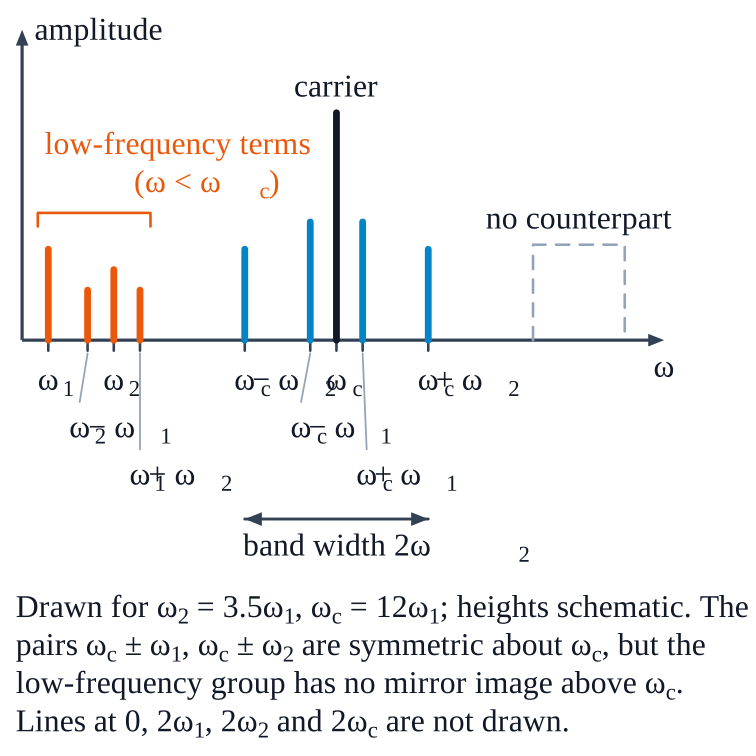
    Plot of amplitude versus \(\displaystyle \omega\) is shown in the Figure.
    (ii)
    As can be seen frequency spectrum is not symmetrical about \(\displaystyle \omega_{\mathrm{c}}\). Crowding of spectrum is present for \(\displaystyle \omega<\omega_{\mathrm{c}}\).
    (iii)
    Adding more modulating signals lead to more crowding in \(\displaystyle \omega<\omega_{\mathrm{c}}\) and more chances of mixing of signals.
    (iv)
    Increase band-width and \(\displaystyle \omega_{\mathrm{c}}\) to accommodate more signals. This shows that large carrier frequency enables to carry more information (more \(\displaystyle \omega_{\mathrm{m}}\) ) and which will in turn increase band-width.
    NCERT_Solution_Class12_Physics_Exemplar_Ch15_Q29_ncert
    (i) Add both signals to the carrier and pass them through a square-law device, \(\displaystyle y=Bx+Cx^{2}\): \[x=A_1\sin\omega_1t+A_2\sin\omega_2t+A_c\sin\omega_ct \] Using \(\displaystyle \sin^{2}P=\tfrac12(1-\cos2P)\) and \(\displaystyle 2\sin P\sin Q=\cos(P-Q)-\cos(P+Q)\): \[y=B\,(A_1\sin\omega_1t+A_2\sin\omega_2t+A_c\sin\omega_ct)+\tfrac{C}{2}(A_1^{2}+A_2^{2}+A_c^{2})-\tfrac{C}{2}(A_1^{2}\cos2\omega_1t+A_2^{2}\cos2\omega_2t+A_c^{2}\cos2\omega_ct) \] \[+\,CA_1A_2\,[\cos(\omega_2-\omega_1)t-\cos(\omega_2+\omega_1)t] \] \[+\,CA_cA_1\,[\cos(\omega_c-\omega_1)t-\cos(\omega_c+\omega_1)t]+CA_cA_2\,[\cos(\omega_c-\omega_2)t-\cos(\omega_c+\omega_2)t] \] \[\underbrace{0,\ \omega_1,\ \omega_2,\ \omega_2-\omega_1,\ \omega_1+\omega_2,\ 2\omega_1,\ 2\omega_2}_{\text{low group}}\ ;\qquad \underbrace{\omega_c,\ \omega_c\pm\omega_1,\ \omega_c\pm\omega_2}_{\text{carrier group}},\ 2\omega_c \] NCERT_Solution_Class12_Physics_Exemplar_Ch15_Q29 (ii) No. The pairs \(\displaystyle \omega_c\pm\omega_1\) and \(\displaystyle \omega_c\pm\omega_2\) are symmetric about \(\displaystyle \omega_c\), but \(\displaystyle \omega_1,\ \omega_2,\ \omega_2\pm\omega_1,\ 2\omega_1,\ 2\omega_2\) have no counterpart above \(\displaystyle \omega_c\): \[\omega<\omega_c:\ 0,\ \omega_1,\ \omega_2,\ \omega_2\pm\omega_1,\ 2\omega_1,\ 2\omega_2,\ \omega_c-\omega_2,\ \omega_c-\omega_1\quad(9\ \text{lines}) \] \[\omega>\omega_c:\ \omega_c+\omega_1,\ \omega_c+\omega_2,\ 2\omega_c\quad(3\ \text{lines}) \] The region \(\displaystyle \omega<\omega_c\) is crowded. (iii) More signals \(\displaystyle \Rightarrow\) more cross-terms: \[n\ \text{signals}\ \Rightarrow\ 2\binom{n}{2}=n(n-1)\ \text{sum and difference lines below}\ \omega_c \;\Rightarrow\; \text{overlap, distortion} \] (iv) Keep the low group clear of the carrier group, then filter around \(\displaystyle \omega_c\): \[2\omega_2<\omega_c-\omega_2\;\Rightarrow\;\omega_c>3\omega_2 \] \[\Delta\omega=(\omega_c+\omega_2)-(\omega_c-\omega_2)=2\omega_2 \] With \(\displaystyle \omega_c\gg\omega_2\), one channel (one carrier's band, carrying both \(\displaystyle \omega_1\) and \(\displaystyle \omega_2\)) occupies only \(\displaystyle 2\omega_2\ll\omega_c\), so further channels get their own carriers at least \(\displaystyle 2\omega_2\) apart. This room for many channels at high frequency is the bandwidth advantage. Answer: Not symmetric about \(\displaystyle \omega_c\): the low group crowds \(\displaystyle \omega<\omega_c\); more signals add overlapping lines; use \(\displaystyle \omega_c>3\omega_2\) (in practice \(\displaystyle \omega_c\gg\omega_2\)), filter, and space carriers at least \(\displaystyle 2\omega_2\) apart.
  5. Exercise 30

    An audio signal is modulated by a carrier wave of 20MHz such that the bandwidth required for modulation is 3kHz. Could this wave be demodulated by a diode detector which has the values of R\displaystyle R and C\displaystyle C as
    (i)
    R=1kΩ,C=0.01μ F\displaystyle R=1 \mathrm{k} \Omega, C=0.01 \mu \mathrm{~F}.
    (ii)
    R=10kΩ,C=0.01μ F\displaystyle R=10 \mathrm{k} \Omega, C=0.01 \mu \mathrm{~F}.
    (iii)
    R=10kΩ,C=0.1μ F\displaystyle R=10 \mathrm{k} \Omega, C=0.1 \mu \mathrm{~F}.
    NCERT’s answer
    \(\displaystyle f_{\mathrm{m}}=1.5 \mathrm{kHz}, \frac{1}{f_m}=0.7 \times 10^{-3} \mathrm{~s}\)
    \[f_{\mathrm{c}}=20 \mathrm{MHz}, \frac{1}{f_c}=0.5 \times 10^{-7} \mathrm{~s} \]
    (i)
    \(\displaystyle R C=10^3 \times 10^{-8}=10^{-5} \mathrm{~s}\)
    So, \(\displaystyle \frac{1}{f_c} \ll R C<\frac{1}{f_m}\) is satisfied
    So it can be demodulated.
    (ii)
    \(\displaystyle R C=10^4 \times 10^{-8}=10^{-4} \mathrm{~s}\).
    Here too \(\displaystyle \frac{1}{f_c} \ll R C<\frac{1}{f_m}\).
    So this too can be demodulated
    (iii)
    \(\displaystyle R C=104 \times 10^{-12}=10^{-8} \mathrm{~s}\).
    Here \(\displaystyle \frac{1}{f_c}>R C\), so this cannot be demodulated.
    \[\mathrm{BW}=2f_m=3\ \mathrm{kHz}\;\Rightarrow\;f_m=1.5\ \mathrm{kHz} \] Caution: \(\displaystyle f_m\) is half the band width. \[\frac1{f_c}=\frac{1}{20\times10^{6}\ \mathrm{Hz}}=0.05\ \mu\mathrm s,\qquad \frac1{f_m}=\frac{1}{1.5\times10^{3}\ \mathrm{Hz}}\approx667\ \mu\mathrm s \] \[\text{need}\quad \frac1{f_c}\ll RC\ll\frac1{f_m}:\qquad 0.05\ \mu\mathrm s\ll RC\ll667\ \mu\mathrm s \] (i) \[RC=(10^{3}\ \Omega)(10^{-8}\ \mathrm F)=10\ \mu\mathrm s \] Inside the range: yes. (ii) \[RC=(10^{4}\ \Omega)(10^{-8}\ \mathrm F)=100\ \mu\mathrm s \] Inside the range: yes, with less margin than (i). (iii) \[RC=(10^{4}\ \Omega)(10^{-7}\ \mathrm F)=1000\ \mu\mathrm s>667\ \mu\mathrm s \] Capacitor discharges too slowly to follow the envelope: no. Answer: (i) and (ii) can demodulate; (iii) cannot.