SolveIt is under development
SolveItNCERT · CBSE · NEET

NCERT Exemplar · Class 12 Mathematics Vector Algebra

45 questions · 45 still being checked

EXERCISE 10.3 31–40 (part 4 of 5)

  1. Choose the correct answer from the given four options in each of the Exercises from $\displaystyle 19$ to $\displaystyle 33$ (M.C.Q)

    Exercise 31

    If a⃗,b⃗,c⃗\displaystyle \vec{a}, \vec{b}, \vec{c} are three vectors such that a⃗+b⃗+c⃗=0→\displaystyle \vec{a}+\vec{b}+\vec{c}=\overrightarrow{0} and ∣a⃗∣=2,∣b⃗∣=3,∣c⃗∣=5\displaystyle |\vec{a}|=2,|\vec{b}|=3,|\vec{c}|=5, then value of a⃗⋅b⃗+b⃗⋅c⃗+c⃗⋅a⃗\displaystyle \vec{a} \cdot \vec{b}+\vec{b} \cdot \vec{c}+\vec{c} \cdot \vec{a} is
    (A)
    0\displaystyle 0 (B) 1\displaystyle 1 (C) -19\displaystyle 19
    (D)
    38\displaystyle 38

    Matches the book, not yet reviewed

    This working reaches the answer NCERT prints. It has not yet been read through by hand.

    NCERT’s answer
    C
    (C) \(\displaystyle -19\)\[|\vec a+\vec b+\vec c|^2=0 \]\[|\vec a|^2+|\vec b|^2+|\vec c|^2+2(\vec a\cdot\vec b+\vec b\cdot\vec c+\vec c\cdot\vec a)=0 \]\[4+9+25+2(\vec a\cdot\vec b+\vec b\cdot\vec c+\vec c\cdot\vec a)=0 \]\[\vec a\cdot\vec b+\vec b\cdot\vec c+\vec c\cdot\vec a=-19 \]
  2. Exercise 32

    If ∣a⃗∣=4\displaystyle |\vec{a}|=4 and −3≤λ≤2\displaystyle -3 \leq \lambda \leq 2, then the range of ∣λa⃗∣\displaystyle |\lambda \vec{a}| is
    (A)
    [0\displaystyle 0, 8\displaystyle 8]
    (B)
    [-12,8\displaystyle 12{,}8]
    (C)
    [0\displaystyle 0, 12\displaystyle 12]
    (D)
    [8\displaystyle 8, 12\displaystyle 12]

    Matches the book, not yet reviewed

    This working reaches the answer NCERT prints. It has not yet been read through by hand.

    NCERT’s answer
    C
    (C) \(\displaystyle [0,12]\)\[|\lambda\vec{a}|=|\lambda|\,|\vec{a}|=4|\lambda| \]\[-3\le\lambda\le 2 \quad\Rightarrow\quad 0\le|\lambda|\le 3 \]\[0\le 4|\lambda|\le 12 \]
  3. Exercise 33

    The number of vectors of unit length perpendicular to the vectors a⃗=2i^+j^+2k^\displaystyle \vec{a}=2 \hat{i}+\hat{j}+2 \hat{k} and b⃗=j^+k^\displaystyle \vec{b}=\hat{j}+\hat{k} is
    (A)
    one
    (B)
    two
    (C)
    three
    (D)
    infinite

    Matches the book, not yet reviewed

    This working reaches the answer NCERT prints. It has not yet been read through by hand.

    NCERT’s answer
    B
    (B) two\[\vec a\times\vec b=\begin{vmatrix}\hat i&\hat j&\hat k\\2&1&2\\0&1&1\end{vmatrix}=-\hat i-2\hat j+2\hat k \]\[|\vec a\times\vec b|=\sqrt{1+4+4}=3 \]\[\hat n=\pm\frac{\vec a\times\vec b}{|\vec a\times\vec b|}=\pm\frac13\left(-\hat i-2\hat j+2\hat k\right) \]Only \(\displaystyle \hat n\) and \(\displaystyle -\hat n\) are unit vectors perpendicular to both.
  4. Fill in the blanks in each of the Exercises from $\displaystyle 34$ to 40.

    Exercise 34

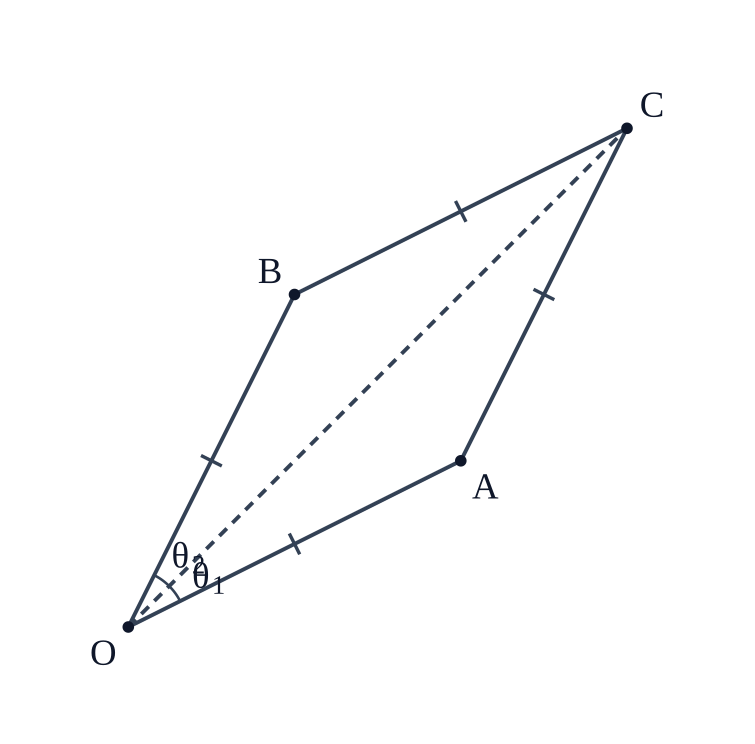
    The vector a⃗+b⃗\displaystyle \vec{a}+\vec{b} bisects the angle between the non-collinear vectors a⃗\displaystyle \vec{a} and b⃗\displaystyle \vec{b} if ____

    Check this one against your book

    NCERT’s printed answer for this exercise does not match its own question. This working follows the question as printed.

    \(\displaystyle |\vec a|=|\vec b|\)NCERT_Solution_Class12_Maths_Exemplar_Ch10_Ex10-3_Q34\[\vec{OA}=\vec a,\quad \vec{OB}=\vec b,\quad \vec{OC}=\vec a+\vec b \]\[\cos\theta_1=\frac{\vec a\cdot(\vec a+\vec b)}{|\vec a||\vec a+\vec b|}=\frac{|\vec a|^2+\vec a\cdot\vec b}{|\vec a||\vec a+\vec b|} \]\[\cos\theta_2=\frac{\vec b\cdot(\vec a+\vec b)}{|\vec b||\vec a+\vec b|}=\frac{|\vec b|^2+\vec a\cdot\vec b}{|\vec b||\vec a+\vec b|} \]Bisector means \(\displaystyle \theta_1=\theta_2\):\[|\vec b|\left(|\vec a|^2+\vec a\cdot\vec b\right)=|\vec a|\left(|\vec b|^2+\vec a\cdot\vec b\right) \]\[\left(|\vec a|-|\vec b|\right)\left(|\vec a||\vec b|-\vec a\cdot\vec b\right)=0 \]\[\vec a\cdot\vec b\ne|\vec a||\vec b| \quad \text{(non-collinear)} \;\Rightarrow\; |\vec a|=|\vec b| \]
  5. Exercise 35

    If r⃗.a⃗=0,r⃗.b⃗=0\displaystyle \vec{r} . \vec{a}=0, \vec{r} . \vec{b}=0, and r⃗.c⃗=0\displaystyle \vec{r} . \vec{c}=0 for some non-zero vector r⃗\displaystyle \vec{r}, then the value of a⃗⋅(b⃗×c⃗)\displaystyle \vec{a} \cdot(\vec{b} \times \vec{c}) is ____

    Matches the book, not yet reviewed

    This working reaches the answer NCERT prints. It has not yet been read through by hand.

    NCERT’s answer
    $\displaystyle 0$
    \(\displaystyle 0\)If \(\displaystyle \vec a\cdot(\vec b\times\vec c)\ne0\), then \(\displaystyle \vec a,\vec b,\vec c\) are not coplanar and span space:\[\vec r=x\vec a+y\vec b+z\vec c \]\[\vec r\cdot\vec r=x(\vec r\cdot\vec a)+y(\vec r\cdot\vec b)+z(\vec r\cdot\vec c)=0 \]\[\Rightarrow\ \vec r=\vec 0 \quad \text{(contradicts } \vec r\ne\vec 0\text{)} \]So \(\displaystyle \vec a,\vec b,\vec c\) are coplanar:\[\vec a\cdot(\vec b\times\vec c)=0 \]
  6. Exercise 36

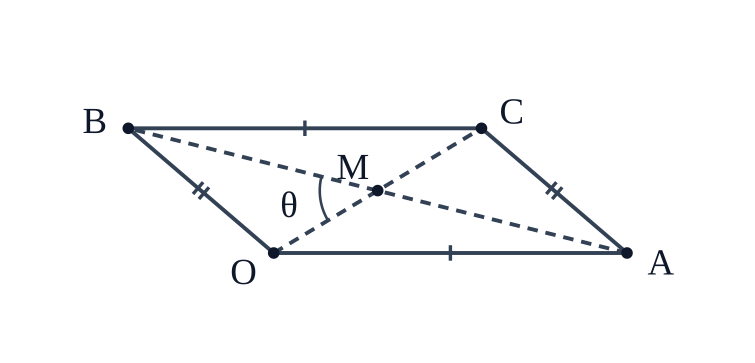
    The vectors a⃗=3i−2j+2k^\displaystyle \vec{a}=3 i-2 j+2 \hat{k} and b⃗=−i^−2k^\displaystyle \vec{b}=-\hat{i}-\widehat{2 k} are the adjacent sides of a parallelogram. The acute angle between its diagonals is ____.

    Matches the book, not yet reviewed

    This working reaches the answer NCERT prints. It has not yet been read through by hand.

    NCERT’s answer
    \(\displaystyle \frac{\pi}{4}\)
    \(\displaystyle \dfrac{\pi}{4}\)NCERT_Solution_Class12_Maths_Exemplar_Ch10_Ex10-3_Q36\[\vec a=3\hat i-2\hat j+2\hat k,\qquad \vec b=-\hat i-2\hat k \]\[\vec{OC}=\vec a+\vec b=2\hat i-2\hat j \]\[\vec{BA}=\vec a-\vec b=4\hat i-2\hat j+4\hat k \]\[\cos\theta=\frac{(\vec a+\vec b)\cdot(\vec a-\vec b)}{|\vec a+\vec b|\,|\vec a-\vec b|}=\frac{8+4+0}{2\sqrt2\cdot 6} \]\[\cos\theta=\frac1{\sqrt2}\;\Rightarrow\;\theta=\frac{\pi}{4} \]
  7. Exercise 37

    The values of k\displaystyle k for which ∣ka⃗∣<∣a⃗∣\displaystyle |k \vec{a}|<|\vec{a}| and ka⃗+12a⃗\displaystyle k \vec{a}+\frac{1}{2} \vec{a} is parallel to a⃗\displaystyle \vec{a} holds true are ____.

    Matches the book, not yet reviewed

    This working reaches the answer NCERT prints. It has not yet been read through by hand.

    NCERT’s answer
    \(\displaystyle k \in ]-1,1[ k \neq -\frac{1}{2}\)
    \(\displaystyle -1<k<1,\ k\ne-\tfrac12\)\[|k\vec a|<|\vec a|\;\Rightarrow\;|k|\,|\vec a|<|\vec a|\;\Rightarrow\;|k|<1 \]\[k\vec a+\tfrac12\vec a=\left(k+\tfrac12\right)\vec a \]This is parallel to \(\displaystyle \vec a\) except when \(\displaystyle k=-\tfrac12\), where it is the zero vector.
  8. Exercise 38

    The value of the expression ∣a⃗×b⃗∣2+(a⃗⋅b⃗)2\displaystyle |\vec{a} \times \vec{b}|^2+(\vec{a} \cdot \vec{b})^2 is ____.

    Matches the book, not yet reviewed

    This working reaches the answer NCERT prints. It has not yet been read through by hand.

    NCERT’s answer
    \(\displaystyle |\vec{a}|^2|\vec{b}|^2\)
    \(\displaystyle |\vec a|^2|\vec b|^2\)\[|\vec a\times\vec b|=|\vec a||\vec b|\sin\theta,\qquad \vec a\cdot\vec b=|\vec a||\vec b|\cos\theta \]\[|\vec a\times\vec b|^2+(\vec a\cdot\vec b)^2=|\vec a|^2|\vec b|^2\left(\sin^2\theta+\cos^2\theta\right) \]\[=|\vec a|^2|\vec b|^2 \]
  9. Exercise 39

    If ∣a⃗×b⃗∣2+∣a⃗⋅b⃗∣2=144\displaystyle |\vec{a} \times \vec{b}|^2+|\vec{a} \cdot \vec{b}|^2=144 and ∣a⃗∣=4\displaystyle |\vec{a}|=4, then ∣b⃗∣\displaystyle |\vec{b}| is equal to ____.

    Matches the book, not yet reviewed

    This working reaches the answer NCERT prints. It has not yet been read through by hand.

    NCERT’s answer
    $\displaystyle 3$
    \(\displaystyle 3\)\[|\vec a\times\vec b|^2+|\vec a\cdot\vec b|^2=|\vec a|^2|\vec b|^2\left(\sin^2\theta+\cos^2\theta\right)=|\vec a|^2|\vec b|^2 \]\[144=4^2\,|\vec b|^2 \]\[|\vec b|^2=9\;\Rightarrow\;|\vec b|=3 \]
  10. Exercise 40

    If a⃗\displaystyle \vec{a} is any non-zero vector, then (a⃗.i^)i^+(a⃗.j^)j^+(a⃗.k^)k^\displaystyle (\vec{a} . \hat{i}) \hat{i}+(\vec{a} . \hat{j}) \hat{j}+(\vec{a} . \hat{k}) \hat{k} equals ____.

    Matches the book, not yet reviewed

    This working reaches the answer NCERT prints. It has not yet been read through by hand.

    NCERT’s answer
    \(\displaystyle \vec{a}\)
    \(\displaystyle \vec a\)\[\vec a=a_1\hat i+a_2\hat j+a_3\hat k \]\[\vec a\cdot\hat i=a_1,\qquad \vec a\cdot\hat j=a_2,\qquad \vec a\cdot\hat k=a_3 \]\[(\vec a\cdot\hat i)\hat i+(\vec a\cdot\hat j)\hat j+(\vec a\cdot\hat k)\hat k=a_1\hat i+a_2\hat j+a_3\hat k=\vec a \]