SolveIt is under development
SolveItNCERT · CBSE · NEET

NCERT Exemplar · Class 12 Mathematics Vector Algebra

45 questions · 45 still being checked

EXERCISE 10.3 11–20 (part 2 of 5)

  1. Exercise 11

    Find the sine of the angle between the vectors a⃗=3i^+j^+2k^\displaystyle \vec{a}=3 \hat{i}+\hat{j}+2 \hat{k} and b⃗=2i^−2j^+4k^\displaystyle \vec{b}=2 \hat{i}-2 \hat{j}+4 \hat{k}.

    Matches the book, not yet reviewed

    This working reaches the answer NCERT prints. It has not yet been read through by hand.

    NCERT’s answer
    \(\displaystyle \frac{2}{\sqrt{7}}\)
    \[\vec a\times\vec b=\begin{vmatrix}\hat i&\hat j&\hat k\\3&1&2\\2&-2&4\end{vmatrix}=8\hat i-8\hat j-8\hat k \]\[|\vec a\times\vec b|=\sqrt{64+64+64}=8\sqrt3 \]\[|\vec a|=\sqrt{9+1+4}=\sqrt{14},\qquad |\vec b|=\sqrt{4+4+16}=\sqrt{24} \]\[\sin\theta=\frac{|\vec a\times\vec b|}{|\vec a|\,|\vec b|}=\frac{8\sqrt3}{\sqrt{14}\,\sqrt{24}}=\frac{8\sqrt3}{4\sqrt{21}}=\frac{2}{\sqrt7} \]Answer: \(\displaystyle \sin\theta=\dfrac{2}{\sqrt7}\)
  2. Exercise 12

    If A,B,C,D\displaystyle \mathrm{A}, \mathrm{B}, \mathrm{C}, \mathrm{D} are the points with position vectors i^+j^−k^,2i^−j^+3k^\displaystyle \hat{i}+\hat{j}-\hat{k}, 2 \hat{i}-\hat{j}+3 \hat{k}, 2i^−3k^,3i^−2j^+k^\displaystyle 2 \hat{i}-3 \hat{k}, 3 \hat{i}-2 \hat{j}+\hat{k}, respectively, find the projection of AB→\displaystyle \overrightarrow{\mathrm{AB}} along CD→\displaystyle \overrightarrow{\mathrm{CD}}.

    Matches the book, not yet reviewed

    This working reaches the answer NCERT prints. It has not yet been read through by hand.

    NCERT’s answer
    \(\displaystyle \sqrt{21}\)
    \[\overrightarrow{AB}=(2-1)\hat i+(-1-1)\hat j+(3+1)\hat k=\hat i-2\hat j+4\hat k \]\[\overrightarrow{CD}=(3-2)\hat i+(-2-0)\hat j+(1+3)\hat k=\hat i-2\hat j+4\hat k \]\[\text{projection of }\overrightarrow{AB}\text{ along }\overrightarrow{CD}=\frac{\overrightarrow{AB}\cdot\overrightarrow{CD}}{|\overrightarrow{CD}|} \]\[=\frac{1+4+16}{\sqrt{1+4+16}}=\frac{21}{\sqrt{21}}=\sqrt{21} \]Answer: \(\displaystyle \sqrt{21}\) units
  3. Exercise 13

    Using vectors, find the area of the triangle ABC with vertices A(1,2,3)\displaystyle \mathrm{A}(1,2,3), B(2\displaystyle 2, -1\displaystyle 1, 4\displaystyle 4) and C(4\displaystyle 4, 5\displaystyle 5, - 1\displaystyle 1).

    Matches the book, not yet reviewed

    This working reaches the answer NCERT prints. It has not yet been read through by hand.

    NCERT’s answer
    \(\displaystyle \frac{\sqrt{274}}{2}\)
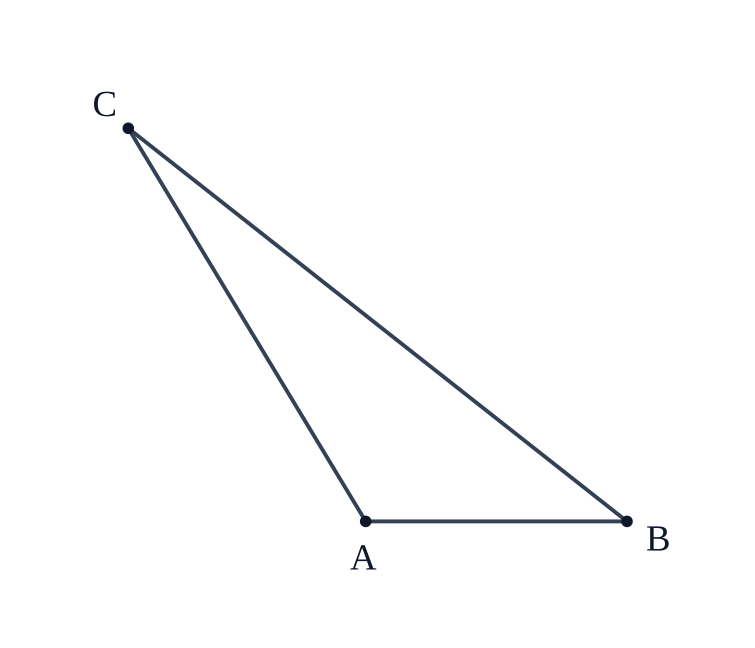
    \[\overrightarrow{AB}=(2-1)\hat i+(-1-2)\hat j+(4-3)\hat k=\hat i-3\hat j+\hat k \]\[\overrightarrow{AC}=(4-1)\hat i+(5-2)\hat j+(-1-3)\hat k=3\hat i+3\hat j-4\hat k \]NCERT_Solution_Class12_Maths_Exemplar_Ch10_Ex10-3_Q13\[\overrightarrow{AB}\times\overrightarrow{AC}=\begin{vmatrix}\hat i&\hat j&\hat k\\1&-3&1\\3&3&-4\end{vmatrix}=9\hat i+7\hat j+12\hat k \]\[|\overrightarrow{AB}\times\overrightarrow{AC}|=\sqrt{81+49+144}=\sqrt{274} \]\[\text{Area}=\tfrac12\,|\overrightarrow{AB}\times\overrightarrow{AC}|=\tfrac12\sqrt{274} \]Answer: \(\displaystyle \tfrac12\sqrt{274}\) square units
  4. Exercise 14

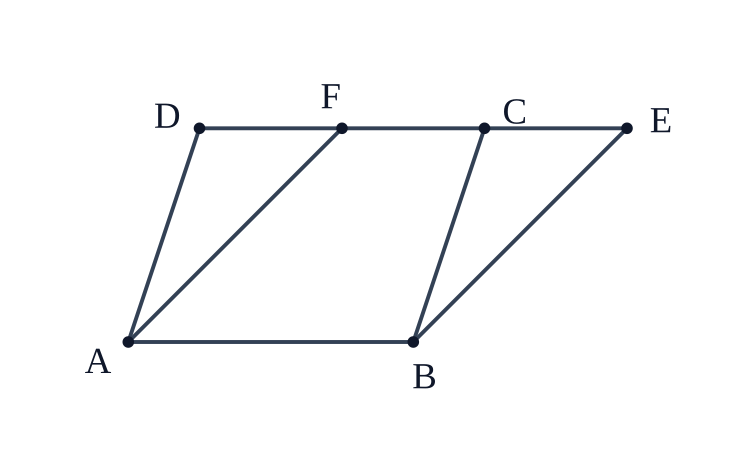
    Using vectors, prove that the parallelogram on the same base and between the same parallels are equal in area.

    Not cross-checked

    NCERT prints no numerical answer for this exercise, so this working has not been cross-checked against the book.

    Let \(\displaystyle ABCD\) and \(\displaystyle ABEF\) stand on the base \(\displaystyle AB\), with \(\displaystyle D, F, C, E\) on a line parallel to \(\displaystyle AB\).NCERT_Solution_Class12_Maths_Exemplar_Ch10_Ex10-3_Q14\[\overrightarrow{AB}=\vec a,\qquad \overrightarrow{AD}=\vec b \]\[\text{Area}(ABCD)=|\vec a\times\vec b| \]\(\displaystyle F\) lies on the line through \(\displaystyle D\) parallel to \(\displaystyle \vec a\):\[\overrightarrow{AF}=\overrightarrow{AD}+\overrightarrow{DF}=\vec b+\lambda\vec a \]\[\text{Area}(ABEF)=|\vec a\times\overrightarrow{AF}|=|\vec a\times(\vec b+\lambda\vec a)| \]\[=|\vec a\times\vec b+\lambda(\vec a\times\vec a)|=|\vec a\times\vec b| \qquad (\vec a\times\vec a=\vec 0) \]Answer: \(\displaystyle \text{Area}(ABEF)=\text{Area}(ABCD)=|\vec a\times\vec b|\)
  5. Exercise 15

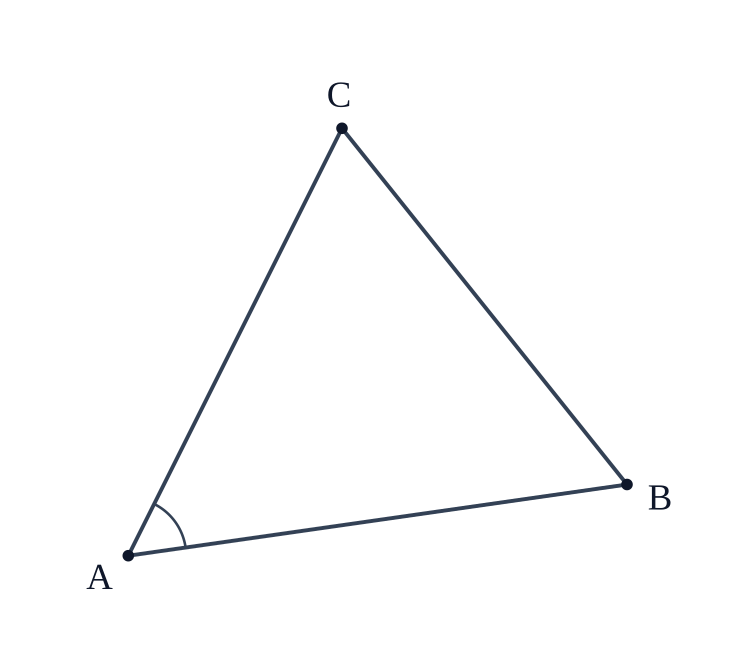
    Prove that in any triangle ABC,cos⁡A=b2+c2−a22bc\displaystyle \mathrm{ABC}, \cos \mathrm{A}=\frac{b^2+c^2-a^2}{2 b c}, where a,b,c\displaystyle a, b, c are the magnitudes of the sides opposite to the vertices A,B,C\displaystyle \mathrm{A}, \mathrm{B}, \mathrm{C}, respectively.

    Not cross-checked

    NCERT prints no numerical answer for this exercise, so this working has not been cross-checked against the book.

    In \(\displaystyle \triangle ABC\), \(\displaystyle |\overrightarrow{BC}|=a\), \(\displaystyle |\overrightarrow{AC}|=b\), \(\displaystyle |\overrightarrow{AB}|=c\), and the angle between \(\displaystyle \overrightarrow{AB}\) and \(\displaystyle \overrightarrow{AC}\) is \(\displaystyle A\).NCERT_Solution_Class12_Maths_Exemplar_Ch10_Ex10-3_Q15\[\overrightarrow{BC}=\overrightarrow{AC}-\overrightarrow{AB} \]\[a^2=\overrightarrow{BC}\cdot\overrightarrow{BC}=(\overrightarrow{AC}-\overrightarrow{AB})\cdot(\overrightarrow{AC}-\overrightarrow{AB}) \]\[a^2=|\overrightarrow{AC}|^2+|\overrightarrow{AB}|^2-2\,\overrightarrow{AB}\cdot\overrightarrow{AC} \]\[\overrightarrow{AB}\cdot\overrightarrow{AC}=bc\cos A \]\[a^2=b^2+c^2-2bc\cos A \]\[\cos A=\frac{b^2+c^2-a^2}{2bc} \]Answer: \(\displaystyle \cos A=\dfrac{b^2+c^2-a^2}{2bc}\)
  6. Exercise 16

    If a⃗,b⃗,c⃗\displaystyle \vec{a}, \vec{b}, \vec{c} determine the vertices of a triangle, show that 12[b⃗×c⃗+c⃗×a⃗+a⃗×b⃗]\displaystyle \frac{1}{2}[\vec{b} \times \vec{c}+\vec{c} \times \vec{a}+\vec{a} \times \vec{b}] gives the vector area of the triangle. Hence deduce the condition that the three points a⃗,b⃗,c⃗\displaystyle \vec{a}, \vec{b}, \vec{c} are collinear. Also find the unit vector normal to the plane of the triangle.

    Matches the book, not yet reviewed

    This working reaches the answer NCERT prints. It has not yet been read through by hand.

    NCERT’s answer
    \(\displaystyle \hat{n}=\frac{\vec{a} \times \vec{b}+\vec{b} \times \vec{c}+\vec{c} \times \vec{a}}{|\vec{a} \times \vec{b}+\vec{b} \times \vec{c}+\vec{c} \times \vec{a}|}\)
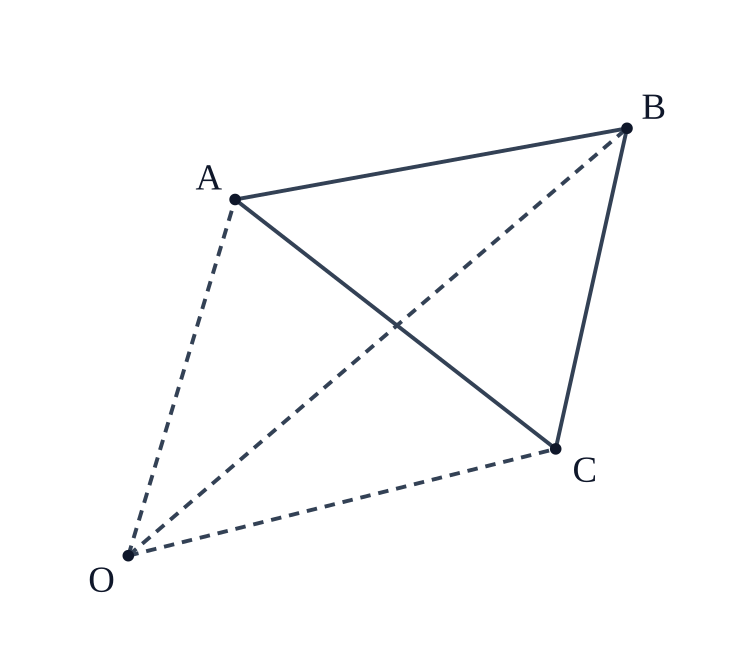
    Let \(\displaystyle A, B, C\) have position vectors \(\displaystyle \vec a, \vec b, \vec c\).NCERT_Solution_Class12_Maths_Exemplar_Ch10_Ex10-3_Q16\[\overrightarrow{AB}=\vec b-\vec a,\qquad \overrightarrow{AC}=\vec c-\vec a \]\[\text{Vector area}=\tfrac12\,\overrightarrow{AB}\times\overrightarrow{AC}=\tfrac12(\vec b-\vec a)\times(\vec c-\vec a) \]\[=\tfrac12\left[\vec b\times\vec c-\vec b\times\vec a-\vec a\times\vec c+\vec a\times\vec a\right] \]\[=\tfrac12\left[\vec b\times\vec c+\vec c\times\vec a+\vec a\times\vec b\right] \]Collinear points enclose zero area:\[\vec a\times\vec b+\vec b\times\vec c+\vec c\times\vec a=\vec 0 \]The vector area is perpendicular to the plane of the triangle:\[\hat n=\frac{\vec a\times\vec b+\vec b\times\vec c+\vec c\times\vec a}{\left|\vec a\times\vec b+\vec b\times\vec c+\vec c\times\vec a\right|} \]Answer: The vector area is \(\displaystyle \tfrac12[\vec b\times\vec c+\vec c\times\vec a+\vec a\times\vec b]\); the points are collinear when \(\displaystyle \vec a\times\vec b+\vec b\times\vec c+\vec c\times\vec a=\vec 0\); the unit normal is \(\displaystyle \hat n\) above.
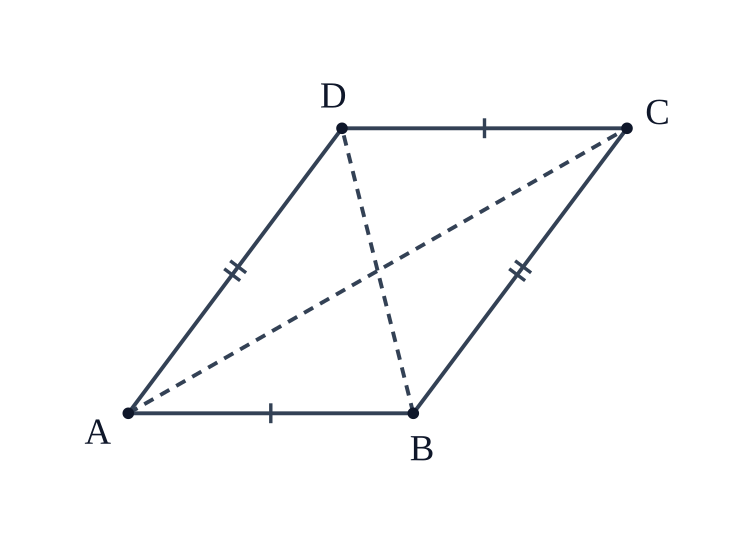
  7. Exercise 17

    Show that area of the parallelogram whose diagonals are given by a⃗\displaystyle \vec{a} and b⃗\displaystyle \vec{b} is ∣a⃗×b⃗∣2\displaystyle \frac{|\vec{a} \times \vec{b}|}{2}. Also find the area of the parallelogram whose diagonals are 2i^−j^+k^\displaystyle 2 \hat{i}-\hat{j}+\hat{k} and i^+3j^−k^\displaystyle \hat{i}+3 \hat{j}-\hat{k}.

    Matches the book, not yet reviewed

    This working reaches the answer NCERT prints. It has not yet been read through by hand.

    NCERT’s answer
    \(\displaystyle \frac{\sqrt{62}}{2}\)
    Take adjacent sides \(\displaystyle \vec{AB}=\vec p\), \(\displaystyle \vec{AD}=\vec q\), with diagonals \(\displaystyle \vec{AC}=\vec a\), \(\displaystyle \vec{BD}=\vec b\).NCERT_Solution_Class12_Maths_Exemplar_Ch10_Ex10-3_Q17\[\vec a = \vec p + \vec q \qquad \vec b = \vec q - \vec p \]\[\vec a\times\vec b = (\vec p+\vec q)\times(\vec q-\vec p) \]\[= \vec p\times\vec q - \vec p\times\vec p + \vec q\times\vec q - \vec q\times\vec p \]\[= \vec p\times\vec q + \vec p\times\vec q = 2\,(\vec p\times\vec q) \]\[\text{Area} = |\vec p\times\vec q| = \frac{|\vec a\times\vec b|}{2} \]For \(\displaystyle \vec a = 2\hat i-\hat j+\hat k\), \(\displaystyle \vec b = \hat i+3\hat j-\hat k\):\[\vec a\times\vec b = \begin{vmatrix} \hat i & \hat j & \hat k \\ 2 & -1 & 1 \\ 1 & 3 & -1 \end{vmatrix} = -2\hat i+3\hat j+7\hat k \]\[|\vec a\times\vec b| = \sqrt{4+9+49} = \sqrt{62} \]\[\text{Area} = \frac{\sqrt{62}}{2} \]Answer: \(\displaystyle \dfrac{\sqrt{62}}{2}\) square units.
  8. Exercise 18

    If a⃗=i^+j^+k^\displaystyle \vec{a}=\hat{i}+\hat{j}+\hat{k} and b⃗=j^−k^\displaystyle \vec{b}=\hat{j}-\hat{k}, find a vector c⃗\displaystyle \vec{c} such that a⃗×c⃗=b⃗\displaystyle \vec{a} \times \vec{c}=\vec{b} and a⃗.c⃗=3\displaystyle \vec{a} . \vec{c}=3.

    Matches the book, not yet reviewed

    This working reaches the answer NCERT prints. It has not yet been read through by hand.

    NCERT’s answer
    \(\displaystyle \frac{1}{3}(5 \vec{i}+2 \vec{j}+2 \vec{k})\)
    Let \(\displaystyle \vec c = x\hat i+y\hat j+z\hat k\).\[\vec a\times\vec c = \begin{vmatrix} \hat i & \hat j & \hat k \\ 1 & 1 & 1 \\ x & y & z \end{vmatrix} = (z-y)\hat i+(x-z)\hat j+(y-x)\hat k \]Equate with \(\displaystyle \vec b = 0\,\hat i+\hat j-\hat k\):\[z-y=0, \qquad x-z=1, \qquad y-x=-1 \]\[y=z, \qquad x=z+1 \]\[\vec a\cdot\vec c = x+y+z = 3 \]\[(z+1)+z+z=3 \Rightarrow z=\frac23 \]\[x=\frac53, \qquad y=\frac23 \]Answer: \(\displaystyle \vec c = \dfrac53\hat i+\dfrac23\hat j+\dfrac23\hat k\)
  9. Choose the correct answer from the given four options in each of the Exercises from $\displaystyle 19$ to $\displaystyle 33$ (M.C.Q)

    Exercise 19

    The vector in the direction of the vector i^−2j^+2k^\displaystyle \hat{i}-2 \hat{j}+2 \hat{k} that has magnitude 9\displaystyle 9 is
    (A)
    i^−2j^+2k^\displaystyle \hat{i}-2 \hat{j}+2 \hat{k}
    (B)
    i^−2j^+2k^3\displaystyle \frac{\hat{i}-2 \hat{j}+2 \hat{k}}{3}
    (C)
    3(i^−2j^+2k^)\displaystyle 3(\hat{i}-2 \hat{j}+2 \hat{k})
    (D)
    9(i^−2j^+2k^)\displaystyle 9(\hat{i}-2 \hat{j}+2 \hat{k})

    Matches the book, not yet reviewed

    This working reaches the answer NCERT prints. It has not yet been read through by hand.

    NCERT’s answer
    C
    (C) \(\displaystyle 3(\hat i-2\hat j+2\hat k)\)\[|\hat i-2\hat j+2\hat k| = \sqrt{1+4+4} = 3 \]\[\vec r = 9\cdot\frac{\hat i-2\hat j+2\hat k}{3} = 3(\hat i-2\hat j+2\hat k) \]
  10. Exercise 20

    The position vector of the point which divides the join of points 2a⃗−3b⃗\displaystyle 2 \vec{a}-3 \vec{b} and a⃗+b⃗\displaystyle \vec{a}+\vec{b} in the ratio 3\displaystyle 3 : 1\displaystyle 1 is
    (A)
    3a⃗−2b⃗2\displaystyle \frac{3 \vec{a}-2 \vec{b}}{2}
    (B)
    7a⃗−8b⃗4\displaystyle \frac{7 \vec{a}-8 \vec{b}}{4}
    (C)
    3a⃗4\displaystyle \frac{3 \vec{a}}{4}
    (D)
    5a⃗4\displaystyle \frac{5 \vec{a}}{4}

    Matches the book, not yet reviewed

    This working reaches the answer NCERT prints. It has not yet been read through by hand.

    NCERT’s answer
    D
    (D) \(\displaystyle \dfrac{5\vec a}{4}\)Section formula, internal division \(\displaystyle 3:1\):\[\vec r = \frac{3(\vec a+\vec b)+1\,(2\vec a-3\vec b)}{3+1} \]\[= \frac{5\vec a}{4} \]