SolveIt is under development
SolveItNCERT · CBSE · NEET

NCERT Exemplar · Class 12 Mathematics Vector Algebra

45 questions · 45 still being checked

EXERCISE 10.3 1–10 (part 1 of 5)

  1. Exercise 1

    Find the unit vector in the direction of sum of vectors a⃗=2i^−j^+k^\displaystyle \vec{a}=2 \hat{i}-\hat{j}+\hat{k} and b⃗=2j^+k^\displaystyle \vec{b}=2 \hat{j}+\hat{k}.

    Matches the book, not yet reviewed

    This working reaches the answer NCERT prints. It has not yet been read through by hand.

    NCERT’s answer
    \(\displaystyle \frac{1}{3}(2 \hat{i}+\hat{j}+2 \hat{k})\)
    \[\vec a+\vec b = (2\hat i-\hat j+\hat k)+(2\hat j+\hat k) = 2\hat i+\hat j+2\hat k \] \[|\vec a+\vec b| = \sqrt{2^2+1^2+2^2} = 3 \] \[\hat n = \frac{\vec a+\vec b}{|\vec a+\vec b|} = \frac{2\hat i+\hat j+2\hat k}{3} \] Answer: \(\displaystyle \dfrac{2}{3}\hat i+\dfrac{1}{3}\hat j+\dfrac{2}{3}\hat k\)
  2. Exercise 2

    If a⃗=i^+j^+2k^\displaystyle \vec{a}=\hat{i}+\hat{j}+2 \hat{k} and b⃗=2i^+j^−2k^\displaystyle \vec{b}=2 \hat{i}+\hat{j}-2 \hat{k}, find the unit vector in the direction of
    (i)
    6b⃗\displaystyle 6 \vec{b}
    (ii)
    2a⃗−b⃗\displaystyle 2 \vec{a}-\vec{b}

    Matches the book, not yet reviewed

    This working reaches the answer NCERT prints. It has not yet been read through by hand.

    NCERT’s answer
    (i)
    \(\displaystyle \frac{1}{3}(2 \hat{i}+\hat{j}-2 \hat{k})\)
    (ii)
    \(\displaystyle \frac{1}{\sqrt{37}}(\hat{j}+6 \hat{k})\)
    (i) \[6\vec b = 12\hat i+6\hat j-12\hat k \] \[|6\vec b| = \sqrt{144+36+144} = 18 \] \[\hat n = \frac{12\hat i+6\hat j-12\hat k}{18} = \frac{2\hat i+\hat j-2\hat k}{3} \] (ii) \[2\vec a-\vec b = (2\hat i+2\hat j+4\hat k)-(2\hat i+\hat j-2\hat k) = \hat j+6\hat k \] \[|2\vec a-\vec b| = \sqrt{1+36} = \sqrt{37} \] \[\hat n = \frac{\hat j+6\hat k}{\sqrt{37}} \] Answer: (i) \(\displaystyle \dfrac{2\hat i+\hat j-2\hat k}{3}\); (ii) \(\displaystyle \dfrac{\hat j+6\hat k}{\sqrt{37}}\)
  3. Exercise 3

    Find a unit vector in the direction of PQ→\displaystyle \overrightarrow{\mathrm{PQ}}, where P and Q have co-ordinates (5\displaystyle 5, 0\displaystyle 0, 8\displaystyle 8) and (3\displaystyle 3, 3\displaystyle 3, 2\displaystyle 2), respectively.

    Matches the book, not yet reviewed

    This working reaches the answer NCERT prints. It has not yet been read through by hand.

    NCERT’s answer
    \(\displaystyle \frac{1}{7}(-2 \hat{i}+3 \hat{j}-6 \hat{k})\)
    \[\overrightarrow{PQ} = (3-5)\hat i+(3-0)\hat j+(2-8)\hat k = -2\hat i+3\hat j-6\hat k \] \[|\overrightarrow{PQ}| = \sqrt{4+9+36} = 7 \] \[\hat n = \frac{\overrightarrow{PQ}}{|\overrightarrow{PQ}|} = \frac{-2\hat i+3\hat j-6\hat k}{7} \] Answer: \(\displaystyle -\dfrac{2}{7}\hat i+\dfrac{3}{7}\hat j-\dfrac{6}{7}\hat k\)
  4. Exercise 4

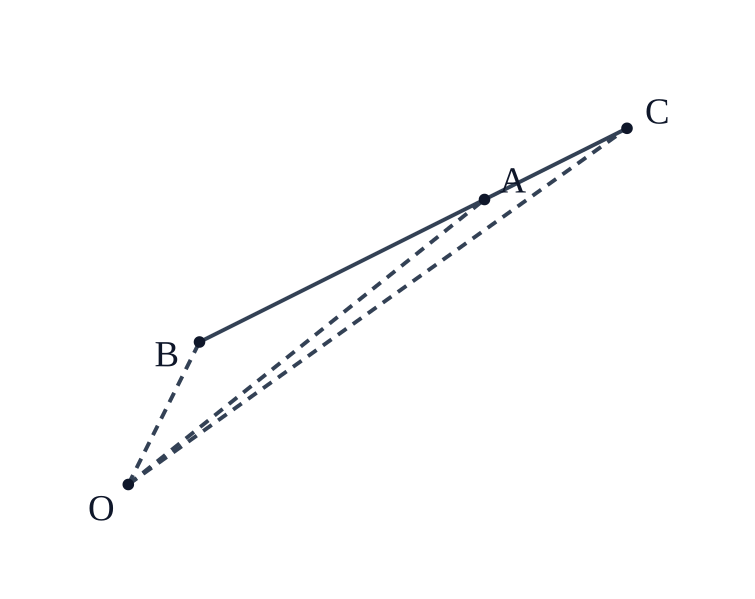
    If a⃗\displaystyle \vec{a} and b⃗\displaystyle \vec{b} are the position vectors of A and B, respectively, find the position vector of a point C in BA produced such that BC=1.5BA\displaystyle \mathrm{BC}=1.5 \mathrm{BA}.

    Check this one against your book

    NCERT’s printed answer for this exercise does not match its own question. This working follows the question as printed.

    C lies beyond A on BA produced, so \(\displaystyle \overrightarrow{BC}\) has the direction of \(\displaystyle \overrightarrow{BA}\). NCERT_Solution_Class12_Maths_Exemplar_Ch10_Ex10-3_Q4 \[\overrightarrow{BC} = 1.5\,\overrightarrow{BA} \] \[\vec c-\vec b = 1.5(\vec a-\vec b) \] \[\vec c = 1.5\vec a-0.5\vec b = \frac{3\vec a-\vec b}{2} \] Answer: \(\displaystyle \vec c=\dfrac{3\vec a-\vec b}{2}\)
  5. Exercise 5

    Using vectors, find the value of k\displaystyle k such that the points (k,−10,3),(1,−1,3)\displaystyle (k,-10,3),(1,-1,3) and (3\displaystyle 3, 5\displaystyle 5, 3\displaystyle 3) are collinear.

    Matches the book, not yet reviewed

    This working reaches the answer NCERT prints. It has not yet been read through by hand.

    NCERT’s answer
    \(\displaystyle k=-2\)
    Let \(\displaystyle A(k,-10,3)\), \(\displaystyle B(1,-1,3)\), \(\displaystyle C(3,5,3)\). \[\overrightarrow{AB} = (1-k)\hat i+9\hat j,\qquad \overrightarrow{BC} = 2\hat i+6\hat j \] Collinear \(\displaystyle \Rightarrow \overrightarrow{AB}=\lambda\,\overrightarrow{BC}\) \[\frac{1-k}{2} = \frac{9}{6} \] \[1-k = 3 \] \[k = -2 \] Answer: \(\displaystyle k=-2\)
  6. Exercise 6

    A vector r⃗\displaystyle \vec{r} is inclined at equal angles to the three axes. If the magnitude of r⃗\displaystyle \vec{r} is 23\displaystyle 2 \sqrt{3} units, find r⃗\displaystyle \vec{r}.

    Matches the book, not yet reviewed

    This working reaches the answer NCERT prints. It has not yet been read through by hand.

    NCERT’s answer
    \(\displaystyle \pm 2(\hat{i}+\hat{j}+\hat{k})\)
    Equal angles with the axes give equal direction cosines. \[l=m=n \] \[l^2+m^2+n^2 = 1 \Rightarrow 3l^2 = 1 \Rightarrow l = \pm\frac{1}{\sqrt3} \] \[\vec r = |\vec r|\,(l\hat i+m\hat j+n\hat k) = 2\sqrt3\left(\pm\frac{1}{\sqrt3}\right)(\hat i+\hat j+\hat k) \] Answer: \(\displaystyle \vec r=\pm 2(\hat i+\hat j+\hat k)\)
  7. Exercise 7

    A vector r⃗\displaystyle \vec{r} has magnitude 14\displaystyle 14 and direction ratios 2\displaystyle 2, 3\displaystyle 3, - 6. Find the direction cosines and components of r⃗\displaystyle \vec{r}, given that r⃗\displaystyle \vec{r} makes an acute angle with x\displaystyle x-axis.

    Matches the book, not yet reviewed

    This working reaches the answer NCERT prints. It has not yet been read through by hand.

    NCERT’s answer
    \(\displaystyle \frac{2}{7}, \frac{3}{7}, \frac{-6}{7} ; 4 \hat{i}, 6 \hat{j},-12 \hat{k}\)
    \[\sqrt{2^2+3^2+(-6)^2} = 7 \] \[(l,m,n) = \pm\left(\frac{2}{7},\,\frac{3}{7},\,-\frac{6}{7}\right) \] Acute angle with the \(\displaystyle x\)-axis means \(\displaystyle l>0\), so \[l=\frac{2}{7},\quad m=\frac{3}{7},\quad n=-\frac{6}{7} \] \[\vec r = 14\,(l\hat i+m\hat j+n\hat k) = 4\hat i+6\hat j-12\hat k \] Answer: direction cosines \(\displaystyle \dfrac27,\dfrac37,-\dfrac67\); components \(\displaystyle 4,\,6,\,-12\), i.e. \(\displaystyle \vec r=4\hat i+6\hat j-12\hat k\)
  8. Exercise 8

    Find a vector of magnitude 6\displaystyle 6, which is perpendicular to both the vectors 2i^−j^+2k^\displaystyle 2 \hat{i}-\hat{j}+2 \hat{k} and 4i^−j^+3k^\displaystyle 4 \hat{i}-\hat{j}+3 \hat{k}.

    Matches the book, not yet reviewed

    This working reaches the answer NCERT prints. It has not yet been read through by hand.

    NCERT’s answer
    \(\displaystyle -2 \hat{i}+4 \hat{j}+4 \hat{k}\)
    A vector perpendicular to both is their cross product. \[\vec a\times\vec b = \begin{vmatrix}\hat i&\hat j&\hat k\\ 2&-1&2\\ 4&-1&3\end{vmatrix} \] \[= \hat i(-3+2)-\hat j(6-8)+\hat k(-2+4) = -\hat i+2\hat j+2\hat k \] \[|\vec a\times\vec b| = \sqrt{1+4+4} = 3 \] \[\vec r = \pm 6\cdot\frac{-\hat i+2\hat j+2\hat k}{3} = \pm(-2\hat i+4\hat j+4\hat k) \] Answer: \(\displaystyle \vec r=\pm(-2\hat i+4\hat j+4\hat k)\)
  9. Exercise 9

    Find the angle between the vectors 2i^−j^+k^\displaystyle 2 \hat{i}-\hat{j}+\hat{k} and 3i^+4j^−k^\displaystyle 3 \hat{i}+4 \hat{j}-\hat{k}.

    Matches the book, not yet reviewed

    This working reaches the answer NCERT prints. It has not yet been read through by hand.

    NCERT’s answer
    \(\displaystyle \cos ^{-1}\left(\frac{1}{\sqrt{156}}\right)\)
    Let \(\displaystyle \vec a=2\hat i-\hat j+\hat k\), \(\displaystyle \vec b=3\hat i+4\hat j-\hat k\).\[\vec a\cdot\vec b = (2)(3)+(-1)(4)+(1)(-1) = 1 \]\[|\vec a|=\sqrt{4+1+1}=\sqrt6, \qquad |\vec b|=\sqrt{9+16+1}=\sqrt{26} \]\[\cos\theta=\frac{\vec a\cdot\vec b}{|\vec a|\,|\vec b|}=\frac{1}{\sqrt6\,\sqrt{26}}=\frac{1}{2\sqrt{39}} \]\[\theta=\cos^{-1}\!\left(\frac{1}{2\sqrt{39}}\right) \]Answer: \(\displaystyle \theta=\cos^{-1}\dfrac{1}{2\sqrt{39}}\)
  10. Exercise 10

    If a⃗+b⃗+c⃗=0\displaystyle \vec{a}+\vec{b}+\vec{c}=0, show that a⃗×b⃗=b⃗×c⃗=c⃗×a⃗\displaystyle \vec{a} \times \vec{b}=\vec{b} \times \vec{c}=\vec{c} \times \vec{a}. Interpret the result geometrically?

    Matches the book, not yet reviewed

    This working reaches the answer NCERT prints. It has not yet been read through by hand.

    NCERT’s answer
    Area of the parallelograms formed by taking any two sides represented by \(\displaystyle \bar{a}, \bar{b}\) and \(\displaystyle \bar{c}\) as adjacent are equal
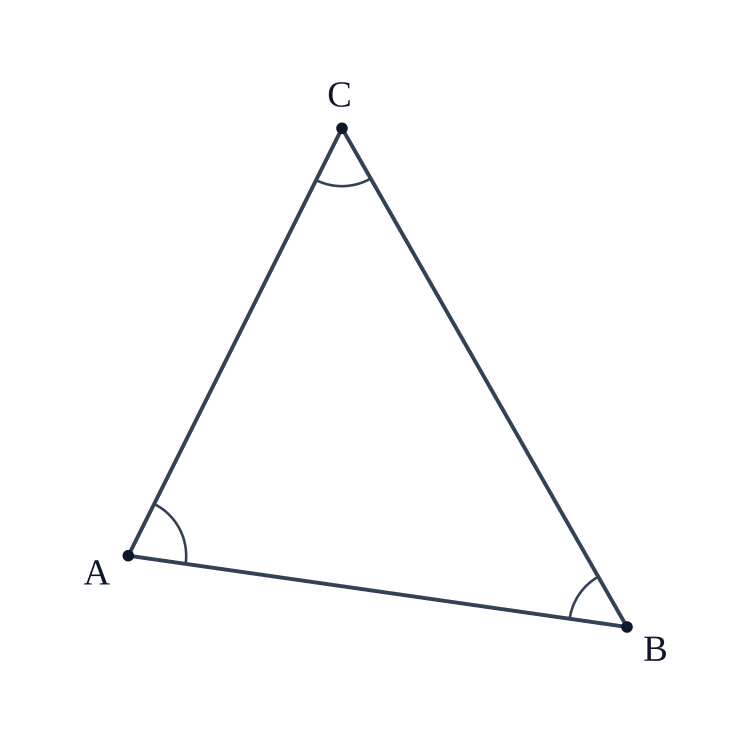
    Put \(\displaystyle \vec c=-(\vec a+\vec b)\).\[\vec b\times\vec c=-\vec b\times(\vec a+\vec b)=-\vec b\times\vec a-\vec b\times\vec b=\vec a\times\vec b \]\[\vec c\times\vec a=-(\vec a+\vec b)\times\vec a=-\vec a\times\vec a-\vec b\times\vec a=\vec a\times\vec b \]\[\vec a\times\vec b=\vec b\times\vec c=\vec c\times\vec a \]Geometrically, three vectors with zero sum are the sides of a triangle taken in order.NCERT_Solution_Class12_Maths_Exemplar_Ch10_Ex10-3_Q10\[\vec a=\overrightarrow{BC},\quad \vec b=\overrightarrow{CA},\quad \vec c=\overrightarrow{AB} \]Each cross product equals twice the vector area of the triangle; taking magnitudes:\[ab\sin C=bc\sin A=ca\sin B \]\[\frac{\sin A}{a}=\frac{\sin B}{b}=\frac{\sin C}{c} \]Answer: \(\displaystyle \vec a\times\vec b=\vec b\times\vec c=\vec c\times\vec a\), each twice the vector area of the triangle; in magnitude this is the sine rule.