SolveIt is under development
SolveItNCERT · CBSE · NEET

NCERT Exemplar · Class 12 Mathematics Vector Algebra

45 questions · 45 still being checked

EXERCISE 10.3 41–45 (part 5 of 5)

  1. State True or False in each of the following Exercises.

    Exercise 41

    If ∣a⃗∣=∣b⃗∣\displaystyle |\vec{a}|=|\vec{b}|, then necessarily it implies a⃗=±b⃗\displaystyle \vec{a}= \pm \vec{b}.

    Check this one against your book

    NCERT’s printed answer for this exercise does not match its own question. This working follows the question as printed.

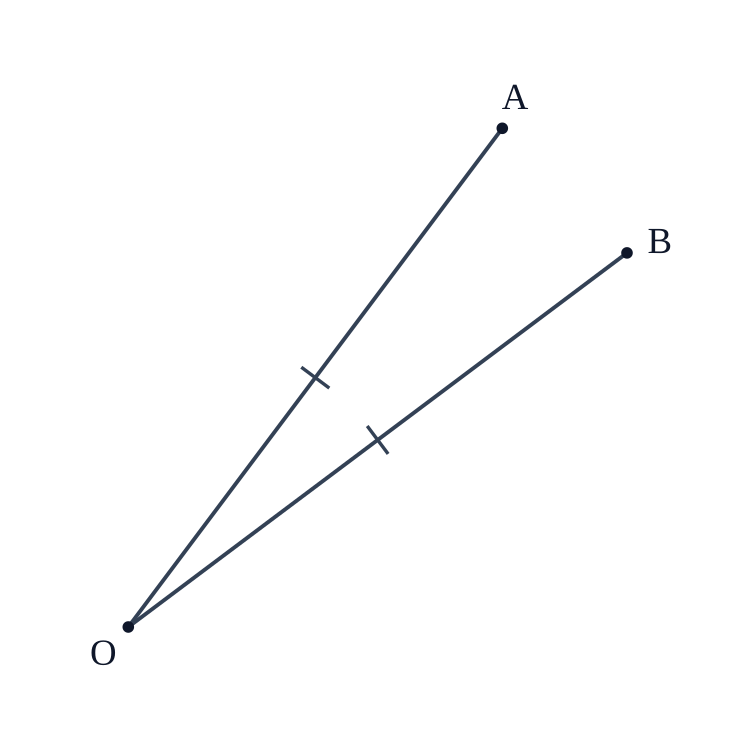
    False. Equal lengths say nothing about direction; one counterexample is enough.\[\vec{a} = 3\hat{i} + 4\hat{j}, \qquad \vec{b} = 4\hat{i} + 3\hat{j} \]\[|\vec{a}| = \sqrt{3^2 + 4^2} = 5 = \sqrt{4^2 + 3^2} = |\vec{b}| \]NCERT_Solution_Class12_Maths_Exemplar_Ch10_Ex10-3_Q41\[\vec{a} \neq \vec{b} \quad \text{and} \quad \vec{a} \neq -\vec{b} = -4\hat{i} - 3\hat{j} \]
  2. Exercise 42

    Position vector of a point P is a vector whose initial point is origin.

    Matches the book, not yet reviewed

    This working reaches the answer NCERT prints. It has not yet been read through by hand.

    NCERT’s answer
    True
    True. The position vector of \(\displaystyle P\) is, by definition, the vector from the origin \(\displaystyle O\) to \(\displaystyle P\).\[\text{position vector of } P = \overrightarrow{OP} \]\[P(x, y, z) \;\Rightarrow\; \overrightarrow{OP} = x\hat{i} + y\hat{j} + z\hat{k} \]Initial point \(\displaystyle O\), terminal point \(\displaystyle P\).
  3. Exercise 43

    If ∣a⃗+b⃗∣=∣a⃗−b⃗∣\displaystyle |\vec{a}+\vec{b}|=|\vec{a}-\vec{b}|, then the vectors a⃗\displaystyle \vec{a} and b⃗\displaystyle \vec{b} are orthogonal.

    Matches the book, not yet reviewed

    This working reaches the answer NCERT prints. It has not yet been read through by hand.

    NCERT’s answer
    True
    True. Square both sides; the dot product is forced to vanish.\[|\vec{a}+\vec{b}|^2 = |\vec{a}-\vec{b}|^2 \]\[|\vec{a}|^2 + 2\,\vec{a}\cdot\vec{b} + |\vec{b}|^2 = |\vec{a}|^2 - 2\,\vec{a}\cdot\vec{b} + |\vec{b}|^2 \]\[4\,\vec{a}\cdot\vec{b} = 0 \]\[\vec{a}\cdot\vec{b} = 0 \;\Rightarrow\; \vec{a} \perp \vec{b} \]
  4. Exercise 44

    The formula (a⃗+b⃗)2=a⃗2+b⃗2+2a⃗×b⃗\displaystyle (\vec{a}+\vec{b})^2=\vec{a}^2+\vec{b}^2+2 \vec{a} \times \vec{b} is valid for non-zero vectors a⃗\displaystyle \vec{a} and b⃗\displaystyle \vec{b}.

    Matches the book, not yet reviewed

    This working reaches the answer NCERT prints. It has not yet been read through by hand.

    NCERT’s answer
    False
    False. \(\displaystyle \vec{a}\times\vec{b}\) is a vector, while \(\displaystyle \vec{a}^2\) and \(\displaystyle \vec{b}^2\) are scalars, so the sum is meaningless. The valid identity uses the dot product.\[(\vec{a}+\vec{b})^2 = (\vec{a}+\vec{b})\cdot(\vec{a}+\vec{b}) \]\[(\vec{a}+\vec{b})^2 = \vec{a}^2 + \vec{b}^2 + 2\,\vec{a}\cdot\vec{b} \]
  5. Exercise 45

    If a⃗\displaystyle \vec{a} and b⃗\displaystyle \vec{b} are adjacent sides of a rhombus, then a⃗⋅b⃗=0\displaystyle \vec{a} \cdot \vec{b}=0.

    Matches the book, not yet reviewed

    This working reaches the answer NCERT prints. It has not yet been read through by hand.

    NCERT’s answer
    False
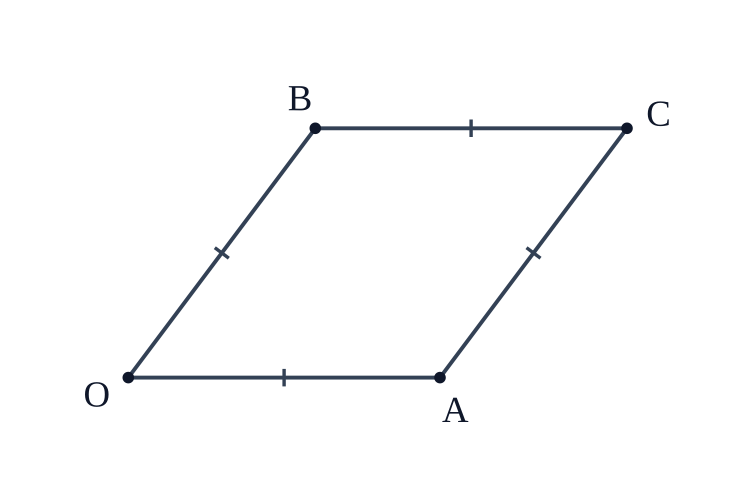
    False. Adjacent sides of a rhombus are equal in length, but they are perpendicular only when the rhombus is a square.NCERT_Solution_Class12_Maths_Exemplar_Ch10_Ex10-3_Q45\[\vec{a} = 5\hat{i}, \quad \vec{b} = 3\hat{i} + 4\hat{j}, \quad |\vec{a}| = |\vec{b}| = 5 \]\[\vec{a}\cdot\vec{b} = 15 \neq 0 \]