SolveIt is under development
SolveItNCERT · CBSE · NEET

NCERT Exemplar · Class 12 Mathematics Vector Algebra

45 questions · 45 still being checked

EXERCISE 10.3 21–30 (part 3 of 5)

  1. Choose the correct answer from the given four options in each of the Exercises from $\displaystyle 19$ to $\displaystyle 33$ (M.C.Q)

    Exercise 21

    The vector having initial and terminal points as (2,5,0)\displaystyle (2,5,0) and (−3,7,4)\displaystyle (-3,7,4), respectively is
    (A)
    −i^+12j^+4k^\displaystyle -\hat{i}+12 \hat{j}+4 \hat{k}
    (B)
    5i^+2j^−4k^\displaystyle 5 \hat{i}+2 \hat{j}-4 \hat{k}
    (C)
    −5i^+2j^+4k^\displaystyle -5 \hat{i}+2 \hat{j}+4 \hat{k}
    (D)
    i^+j^+k^\displaystyle \hat{i}+\hat{j}+\hat{k}

    Matches the book, not yet reviewed

    This working reaches the answer NCERT prints. It has not yet been read through by hand.

    NCERT’s answer
    C
    (C) \(\displaystyle -5\hat i+2\hat j+4\hat k\)Terminal point minus initial point:\[(-3-2)\hat i+(7-5)\hat j+(4-0)\hat k = -5\hat i+2\hat j+4\hat k \]
  2. Exercise 22

    The angle between two vectors a⃗\displaystyle \vec{a} and b⃗\displaystyle \vec{b} with magnitudes 3\displaystyle \sqrt{3} and 4\displaystyle 4, respectively, and a⃗.b⃗=23\displaystyle \vec{a} . \vec{b}=2 \sqrt{3} is
    (A)
    π6\displaystyle \frac{\pi}{6}
    (B)
    π3\displaystyle \frac{\pi}{3}
    (C)
    π2\displaystyle \frac{\pi}{2}
    (D)
    5π2\displaystyle \frac{5 \pi}{2}

    Matches the book, not yet reviewed

    This working reaches the answer NCERT prints. It has not yet been read through by hand.

    NCERT’s answer
    B
    (B) \(\displaystyle \dfrac{\pi}{3}\)\[\cos\theta = \frac{\vec a\cdot\vec b}{|\vec a||\vec b|} = \frac{2\sqrt3}{\sqrt3\cdot 4} = \frac12 \]\[\theta = \frac{\pi}{3} \]
  3. Exercise 23

    Find the value of λ\displaystyle \lambda such that the vectors a⃗=2i^+λj^+k^\displaystyle \vec{a}=2 \hat{i}+\lambda \hat{j}+\hat{k} and b⃗=i^+2j^+3k^\displaystyle \vec{b}=\hat{i}+2 \hat{j}+3 \hat{k} are orthogonal
    (A)
    0\displaystyle 0 (B) 1\displaystyle 1 (C) 32\displaystyle \frac{3}{2}
    (D)
    −52\displaystyle -\frac{5}{2}

    Matches the book, not yet reviewed

    This working reaches the answer NCERT prints. It has not yet been read through by hand.

    NCERT’s answer
    D
    (D) \(\displaystyle -\dfrac52\)Orthogonal vectors have zero dot product:\[\vec a\cdot\vec b = 2(1)+\lambda(2)+1(3) = 0 \]\[2\lambda+5=0 \Rightarrow \lambda=-\frac52 \]
  4. Exercise 24

    The value of λ\displaystyle \lambda for which the vectors 3i^−6j^+k^\displaystyle 3 \hat{i}-6 \hat{j}+\hat{k} and 2i^−4j^+λk^\displaystyle 2 \hat{i}-4 \hat{j}+\lambda \hat{k} are parallel is
    (A)
    23\displaystyle \frac{2}{3}
    (B)
    32\displaystyle \frac{3}{2}
    (C)
    52\displaystyle \frac{5}{2}
    (D)
    25\displaystyle \frac{2}{5}

    Matches the book, not yet reviewed

    This working reaches the answer NCERT prints. It has not yet been read through by hand.

    NCERT’s answer
    A
    (A) \(\displaystyle \dfrac23\)Parallel vectors have proportional components:\[\frac{3}{2} = \frac{-6}{-4} = \frac{1}{\lambda} \]\[\lambda = \frac23 \]
  5. Exercise 25

    The vectors from origin to the points A and B are a⃗=2i^−3j^+2k^\displaystyle \vec{a}=2 \hat{i}-3 \hat{j}+2 \hat{k} and b⃗=2i^+3j^+k^\displaystyle \vec{b}=2 \hat{i}+3 \hat{j}+\hat{k}, respectively, then the area of triangle OAB is
    (A)
    340\displaystyle 340
    (B)
    25\displaystyle \sqrt{25}
    (C)
    229\displaystyle \sqrt{229}
    (D)
    12229\displaystyle \frac{1}{2} \sqrt{229}

    Matches the book, not yet reviewed

    This working reaches the answer NCERT prints. It has not yet been read through by hand.

    NCERT’s answer
    D
    (D) \(\displaystyle \tfrac{1}{2}\sqrt{229}\)\[\vec{a}\times\vec{b}=\begin{vmatrix}\hat{i}&\hat{j}&\hat{k}\\ 2&-3&2\\ 2&3&1\end{vmatrix}=-9\hat{i}+2\hat{j}+12\hat{k} \]\[|\vec{a}\times\vec{b}|=\sqrt{81+4+144}=\sqrt{229} \]\[\text{Area of } \triangle OAB=\tfrac{1}{2}|\vec{a}\times\vec{b}|=\tfrac{1}{2}\sqrt{229} \]
  6. Exercise 26

    For any vector a⃗\displaystyle \vec{a}, the value of (a⃗×i^)2+(a⃗×j^)2+(a⃗×k^)2\displaystyle (\vec{a} \times \hat{i})^2+(\vec{a} \times \hat{j})^2+(\vec{a} \times \hat{k})^2 is equal to
    (A)
    a⃗2\displaystyle \vec{a}^2
    (B)
    3a⃗2\displaystyle 3 \vec{a}^2
    (C)
    4a⃗2\displaystyle 4 \vec{a}^2
    (D)
    2a⃗2\displaystyle 2 \vec{a}^2

    Matches the book, not yet reviewed

    This working reaches the answer NCERT prints. It has not yet been read through by hand.

    NCERT’s answer
    D
    (D) \(\displaystyle 2\vec{a}^2\)For a unit vector \(\displaystyle \hat{u}\):\[(\vec{a}\times\hat{u})^2=|\vec{a}|^2|\hat{u}|^2-(\vec{a}\cdot\hat{u})^2=|\vec{a}|^2-(\vec{a}\cdot\hat{u})^2 \]\[\text{Sum}=3|\vec{a}|^2-\left[(\vec{a}\cdot\hat{i})^2+(\vec{a}\cdot\hat{j})^2+(\vec{a}\cdot\hat{k})^2\right] \]\[(\vec{a}\cdot\hat{i})^2+(\vec{a}\cdot\hat{j})^2+(\vec{a}\cdot\hat{k})^2=a_1^2+a_2^2+a_3^2=|\vec{a}|^2 \]\[\text{Sum}=3|\vec{a}|^2-|\vec{a}|^2=2\vec{a}^2 \]
  7. Exercise 27

    If ∣a⃗∣=10,∣b⃗∣=2\displaystyle |\vec{a}|=10,|\vec{b}|=2 and a⃗⋅b⃗=12\displaystyle \vec{a} \cdot \vec{b}=12, then value of ∣a⃗×b⃗∣\displaystyle |\vec{a} \times \vec{b}| is
    (A)
    5\displaystyle 5 (B) 10\displaystyle 10
    (C)
    14\displaystyle 14
    (D)
    16\displaystyle 16

    Matches the book, not yet reviewed

    This working reaches the answer NCERT prints. It has not yet been read through by hand.

    NCERT’s answer
    D
    (D) \(\displaystyle 16\)\[|\vec{a}\times\vec{b}|^2+(\vec{a}\cdot\vec{b})^2=|\vec{a}|^2|\vec{b}|^2 \]\[|\vec{a}\times\vec{b}|^2=10^2\cdot 2^2-12^2=400-144=256 \]\[|\vec{a}\times\vec{b}|=16 \]
  8. Exercise 28

    The vectors λi^+j^+2k^,i^+λj^−k^\displaystyle \lambda \hat{i}+\hat{j}+2 \hat{k}, \hat{i}+\lambda \hat{j}-\hat{k} and 2i^−j^+λk^\displaystyle 2 \hat{i}-\hat{j}+\lambda \hat{k} are coplanar if
    (A)
    λ=−2\displaystyle \lambda=-2
    (B)
    λ=0\displaystyle \lambda=0
    (C)
    λ=1\displaystyle \lambda=1
    (D)
    λ=−1\displaystyle \lambda=-1

    Matches the book, not yet reviewed

    This working reaches the answer NCERT prints. It has not yet been read through by hand.

    NCERT’s answer
    A
    (A) \(\displaystyle \lambda=-2\)Coplanar means the scalar triple product is zero.\[\begin{vmatrix}\lambda&1&2\\ 1&\lambda&-1\\ 2&-1&\lambda\end{vmatrix}=\lambda(\lambda^2-1)-(\lambda+2)+2(-1-2\lambda)=0 \]\[\lambda^3-6\lambda-4=0 \]\[(\lambda+2)(\lambda^2-2\lambda-2)=0 \]The quadratic gives \(\displaystyle \lambda=1\pm\sqrt{3}\), not among the options, so \(\displaystyle \lambda=-2\).
  9. Exercise 29

    If a⃗,b⃗,c⃗\displaystyle \vec{a}, \vec{b}, \vec{c} are unit vectors such that a⃗+b⃗+c⃗=0→\displaystyle \vec{a}+\vec{b}+\vec{c}=\overrightarrow{0}, then the value of a⃗⋅b⃗+b⃗⋅c⃗+c⃗⋅a⃗\displaystyle \vec{a} \cdot \vec{b}+\vec{b} \cdot \vec{c}+\vec{c} \cdot \vec{a} is
    (A)
    1\displaystyle 1 (B) 3\displaystyle 3 (C) −32\displaystyle -\frac{3}{2}
    (D)
    None of these

    Matches the book, not yet reviewed

    This working reaches the answer NCERT prints. It has not yet been read through by hand.

    NCERT’s answer
    C
    (C) \(\displaystyle -\tfrac32\)\[|\vec a+\vec b+\vec c|^2=0 \]\[|\vec a|^2+|\vec b|^2+|\vec c|^2+2(\vec a\cdot\vec b+\vec b\cdot\vec c+\vec c\cdot\vec a)=0 \]\[1+1+1+2(\vec a\cdot\vec b+\vec b\cdot\vec c+\vec c\cdot\vec a)=0 \]\[\vec a\cdot\vec b+\vec b\cdot\vec c+\vec c\cdot\vec a=-\tfrac32 \]
  10. Exercise 30

    Projection vector of a⃗\displaystyle \vec{a} on b⃗\displaystyle \vec{b} is
    (A)
    (a⃗⋅b⃗∣b⃗∣2)b⃗\displaystyle \left(\frac{\vec{a} \cdot \vec{b}}{|\vec{b}|^2}\right) \vec{b}
    (B)
    a⃗⋅b⃗∣b⃗∣\displaystyle \frac{\vec{a} \cdot \vec{b}}{|\vec{b}|}
    (C)
    a⃗⋅b⃗∣a⃗∣\displaystyle \frac{\vec{a} \cdot \vec{b}}{|\vec{a}|}
    (D)
    (a⃗⋅b⃗∣a⃗∣2)b^\displaystyle \left(\frac{\vec{a} \cdot \vec{b}}{|\vec{a}|^2}\right) \hat{b}

    Matches the book, not yet reviewed

    This working reaches the answer NCERT prints. It has not yet been read through by hand.

    NCERT’s answer
    A
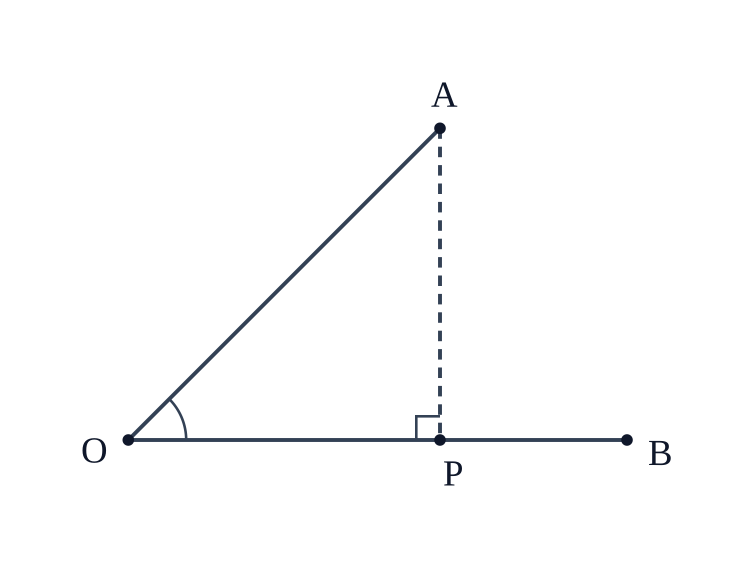
    (A) \(\displaystyle \left(\dfrac{\vec a\cdot\vec b}{|\vec b|^{2}}\right)\vec b\)NCERT_Solution_Class12_Maths_Exemplar_Ch10_Ex10-3_Q30With \(\displaystyle \theta\) the angle between \(\displaystyle \vec a\) and \(\displaystyle \vec b\), the projection vector is \(\displaystyle OP\) along the unit vector of \(\displaystyle \vec b\):\[OP=|\vec a|\cos\theta=\frac{\vec a\cdot\vec b}{|\vec b|} \]\[\hat b=\frac{\vec b}{|\vec b|} \]\[\overrightarrow{OP}=\frac{\vec a\cdot\vec b}{|\vec b|}\cdot\frac{\vec b}{|\vec b|}=\frac{\vec a\cdot\vec b}{|\vec b|^{2}}\,\vec b \]